
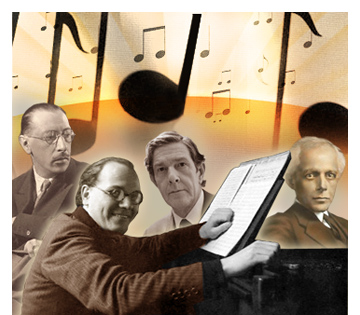

Alex Ross is my favorite rock critic. He writes about music in vivid language humming with intelligence. He tells great stories about musicians’ lives and illuminates their work with the light of his own experiences. His critical insights flow out of a deep respect for artists, and his judgments depend on the emotional and intellectual success of their designs. Ross reminds me of the early days of Rolling Stone and Creem, when journalists stretched themselves and their vocabularies to express the music from the inside. Before the centrifugal force of the mass media flung music into a thousand silos and opinions, good rock writers managed to unite artist and reader in the heart of a shared culture. Everybody felt they were singing the same exciting song.
All right, so much for the clever opening. Ross, as you may or may not know, is the classical music critic of the New Yorker. But in the past decade, employing the spry rhythms of pop journalism, and displaying an unabashed affinity for Pavement and Radiohead, Ross has managed to spring classical music from its encrusted shell and make it feel contemporary. That’s a mighty admirable feat and now it reaches something close to magnificence in his first book, “The Rest Is Noise.”
As you’ve no doubt heard, classical music is supposed to be dead. It’s buried somewhere beneath an avalanche of pop CDs, TVs, Broadway ticket stubs, computers and Danielle Steel paperbacks. For good measure, that ash heap of history also contains the syllabuses from old music education classes and foreclosure notices for symphony halls that are now 24-Hour Fitness gyms. Supposedly the populace is too dumb to appreciate Beethoven’s monumental Ninth Symphony and too drugged by Celine Dion singing some song from “Titanic” to care.
If Beethoven and Mozart are supposed to be barely noticeable in the sports arena of pop culture, 20th century composers from Alban Berg to John Adams have been assigned seats so far up in the nosebleed section that they are mere specks in the crowd. From 1900 to 2000, Ross writes, classical music “experienced what can only be described as a fall from a great height. At the beginning of the century, composers were cynosures on the world stage, their premieres mobbed by curiosity seekers.” When Mahler walked the streets of Vienna in the 1900s, passersby would stop and whisper to themselves, “Der Mahler!” “A hundred years on,” Ross writes, “no one whispers, ‘Der Adams!,’ as the composer of El Nino walks the streets of Berkeley.”
Actually, that’s not true. I’ve walked the streets of Berkeley with Adams and people did recognize and greet him by name. Of course, I’m not about to say that 20th century classical is alive and well based on my experience as a journalist, interviewing Adams one day. But I am about to say that 20th century classical music is definitely not dead and is more relevant to us today than our teeming culture has dared acknowledge in a long time. All we’ve needed is a brilliant reminder. And that’s exactly what Ross delivers. His book peels away the old critical myths and theories shrouding 20th century music and swings open the door to understanding its manifold pleasures.
“The Rest Is Noise” is a long and thrilling ride on the social and intellectual currents that shaped the century’s vanguard composers, from Stravinsky to Steve Reich. As Ross writes: “Composers weren’t simply engaging in artificial games; they were asking mighty questions about what art meant and how it related to society.” In that way, “The Rest Is Noise” is reminiscent of Roger Shattuck’s “The Banquet Years,” the literary critic’s anatomy of the avant-garde in Paris at the end of the century. For all I know, Shattuck’s book still inspires college bohemians to wear black and mimic psychotic playwright Alfred Jarry, as it no doubt did the members of the sensational postpunk band Pere Ubu, who stole the name of Jarry’s hilariously obscene, mass-murdering antihero for their own.
With his own bohemian verve, Ross re-creates the cultural scandals that greeted the century’s tradition-busting works, from Strauss’ salacious opera “Salome” to John Cage’s “4’33,” in which pianist David Tudor sat on a stage in Woodstock, N.Y., opened the piano lid and played nothing. For all artistic purposes, the century dawned with the 1913 debut at the Theatre des Champs-Elysees of “The Rite of Spring,” a new work by a young Stravinsky for the Ballet Russes. Pounding rhythms and dissonant harmonies filled the hall as choreographer Nijinsky’s dancers shivered and stomped. “Howls of discontent went up from the boxes, where the wealthiest onlookers sat,” Ross writes. “Immediately, the aesthetes in the balconies and the standing room howled back.”
Unlike most retellings of the legendary performance, attended by Paris luminaries Jean Cocteau and Gertrude Stein, Ross’ doesn’t stop at the ruckus. He adds a welcome coda. “In a matter of days, confusion turned into pleasure, boos into bravos. Even at the first performance, Stravinsky, Nijinsky, and the dancers had to bow four or five times for the benefit of the applauding faction.”
Ross doesn’t offer the anecdote solely for amusement but to introduce a key theme that will shape composers over the course of the century and his book. “The Rite of Spring” prophesied “a new type of popular art,” he writes. “For much of the 19th century, music had been a theater of the mind; now composers would create a music of the body. Melodies would follow the patterns of speech; rhythms match the energy of dance; musical forms would be more concise and clear; sonorities would have the hardness of life as it is really lived.” Music emerged from the palaces and into the streets. As Hungarian composer Béla Bartók, who wove gypsy dance tunes into his riveting string quartets, said, “We must drink our fill not from your silver goblets but from cool mountain springs.”
The masterly Bartók’s remark cuts to the paradoxical heart of 20th century music. As composers like he and Stravinsky drafted the people’s music into their own, the further out of favor their music seemed to fall. Concert halls in the first half of the century were doing a fine business with the lords and ladies, even the artists and bartenders, by presenting a sweet diet of Brahms symphonies and Puccini operas. But as the music incorporated foreign sounds and abandoned lush melodies and harmonies, concertgoers began to rebel. They felt composers had turned their backs on them. And for the most part they were right. But as Ross shows, history was the real culprit. And Arnold Schoenberg.
In the first part of the century, Schoenberg, a headstrong Austrian, was not a big fan of aristocrats prancing off to concerts by Haydn and Beethoven, humming melodies along the way. “If it is art, it is not for all,” he wrote, “and if it is for all, it is not art.” His anti-bourgeois fever infused his early symphonic works like “Verklarte Nacht,” and later his development of 12-tone technique in pieces like “Variations for Orchestra,” so named because compositions must honor every note of a chromatic scale and not devolve into such antiquated things as triads and alternating keys and all those methods favored by the powder-wigged Mozart and Brahms.
“Schoenberg applied the concept of degeneration to music,” Ross writes. “He introduced a theme that would reappear often as the century went on — the idea that some musical languages were healthy while others were degenerate, that a true composer required a pure place in a polluted world, that only by assuming a militant asceticism could they withstand the almost sexual allure of dubious chords.”
Militant asceticism during and after World War II deepened into artistic violence. During their reigns of terror, Stalin and Hitler exhibited “a corrosive love of music,” especially for the grand Wagner. As living composers’ history was being consumed by evil, their only moral choice was to create a new musical language. The relics of Romantic convention had to be obliterated.
“I believe that music should be collective hysteria and spells, violently of the present time,” wrote French composer and conductor Pierre Boulez not long after the war. With works like “Polyphonie X,” he certainly walked the talk, influencing a host of avant-gardists on both sides of the Atlantic, notably Cage, who said: “I am going toward violence rather than tenderness, hell rather than heaven, ugly rather than beautiful, impure rather than pure — because by doing these things they become transformed, and we become transformed.”
Yet during the war, Ross shows, in one dismaying incident after another, that Richard Strauss, Schoenberg and Anton Webern were swept up in Hitler’s rage and made vile public avowals of anti-Semitism themselves. Ross also ventures across the continent and recounts the tortured dance that Shostakovich had with Stalin, one minute finding his music in the graces of the Soviet dictator, the next finding it condemned and censored. He takes us inside the raging conflicts and fleeting triumphs in Shostakovich’s works and concludes with a compassionate portrait of the august Russian composer’s unknowable heart.
Ranging across the battlefield of the times, Ross retains a humane bead on the World War II composers. “Black-and-white categories make no sense in the shadowland of dictatorship,” he writes. “These composers were neither saints nor devils; they were flawed actors on a tilted stage.” More ideological critics or historians may be tempted to leave Schoenberg and the World War II composers in a room of their most reactionary and dissonant sounds. But Ross pauses to see the other side.
“Schoenberg’s early atonal music is not all sound and fury,” he offers. “Periodically it discloses worlds that open up like hidden valleys between mountains; a hush descends, the sun glimmers in fog, shapes hover.”
In one of my favorite anecdotes in the book, Ross relates a story from Schoenberg’s son, Ronald, about the end of the composer’s life. In the 1940s, the Schoenbergs lived in upscale Brentwood, Calif., near Shirley Temple. Ronald admits his father, the scourge of the bourgeois, the enfant terrible of the 20th century, felt discouraged that Hollywood tourist buses never pointed out his house. “But another time,” Ronald says, “we stopped at a juice bar out on Highway 1, and the radio was playing ‘Verklarte Nacht,’ and I never saw him so happy.”
As Ross’ narrative wends its way from 1950 to 2000, limning the brash and uncompromising, experimental and grimly absurd sounds of Karlheinz Stockhausen and Milton Babbitt, we see the music retreating further from a mass audience. At the same time, Ross, betraying his own tastes in 20th century music, stops to consider British composer Benjamin Britten, whose music enchanted a wide audience. Referring to Britten’s opera “Peter Grimes,” Ross writes, “The music is poised perfectly between the familiar and the strange, the pictorial and the psychological.” Ross also touches down on the weird and magisterial French composer Olivier Messiaen, and writes nimbly about what he calls the composer’s greatest achievement, “From the Canyons to the Stars,” a series of haunting pieces based on the composer’s 1972 trip to Bryce Canyon and Zion Park: “The majesty of the Utah canyons reawakened in the composer a songfulness that had long been missing from his music.”
As an aside, I should say that although the chapter on Britten, and a similarly long one on Sibelius, are compelling in themselves, they underscore one flaw in “The Rest Is Noise,” which is that Ross periodically interrupts his narrative with, well, New Yorker articles. In the case of Britten, you are forced to ask, hey, what happened to our discussion of Elliot Carter and his break from Aaron Copland’s populism?
In that discussion, the avant-garde musicians in the ’60s looked up from their treated pianos and saw pop culture marching toward them like a giant infantry line. They felt besieged. Roger Sessions declared that American composers like him had to “abandon resolutely chimerical hopes of success in a world dominated overwhelmingly by ‘stars,’ by mechanized popular music, and by the box-office standard, and set themselves to discovering what they truly have to say, and to saying it in the manner of the adult artist delivering his message to those who have ears to hear it. All else is childlessness and futility.”
The unvarnished elitism of Sessions’ statement, and the intensely dissonant music it generated, pretty much constitutes the benighted image that continues to hang over modern classical music, especially in populist America. “The Rest Is Noise” is not going to change that, but it does usher modern classical music into a heartening light. Looking ahead, Ross makes a stand for the music’s persistence in today’s shopping mall of cultural niche markets. Referencing Adams and polyglot Argentine composer Osvaldo Golijov, he points to how classical music has fused with global sounds, pop music, theater and film — artistic forms that rule the pop marketplace. He mentions Hungarian composer György Ligeti, who wrote piercing and haunting concertos before he died in 2006, and will always be remembered for his atmospheric pieces that Stanley Kubrick wove into “2001: A Space Odyssey,” notably at the movie’s end when Keir Dullea floats off into a cosmic light show. Ross turns the table and shows how rock continues to shape its identity with classical music. He notes the orchestral arrangements that underpin tunes by Sufjan Stevens and the Stockhausen and Messiaen sounds that color Björk’s songs.
These are modest claims and Ross realizes classical music will never regain the popularity it had in 1900s Europe or even 1950s America, when Leonard Bernstein regaled a radio audience every week with the splendors of Mahler or Copland. But I am glad to be more than modest and say “The Rest Is Noise” is the biggest cultural boost classical music could hope to receive. With perpetual grace and excitement, Ross reanimates music buried in history and super-obscure record stores, and allows us to feel just how contemporary it can be. Let your heart curdle with thoughts of the unrelenting nightmare in Iraq, and the men responsible for it. Then play the splintering choral work “Le Soleil des eaux,” by Boulez, based on poems by René Char — “River with an indestructible heart in this mad prison-world, keep us violent” — and you may never again say you don’t understand atonal music.
“For now, the art is like the ‘sunken cathedral’ that Debussy depicts in his Preludes for Piano — a city that chants beneath the waves,” Ross concludes. After reading “The Rest Is Noise,” and having literally listened my way through it, I can feel that city chanting now. Stravinsky’s beats are pounding in my head; Ligeti’s spare piano lines are sailing through my heart. On my iPod the other day, I was listening to Bartók’s String Quartet No. 2 on a crowded streetcar. As the violins rushed off in every direction, and the cello drove them madly on, I suddenly had the most profoundly clear and terrifying vision that nothing in the world made sense. Experiencing sheer chaos in the burning tunnel of Bartók’s music, I felt utterly alive.
