
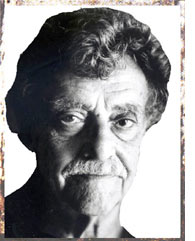

Listen: This is really it. After entertaining and provoking us with his novels for 50 years, Kurt Vonnegut says he is retiring from the literature business. His last book, “Bagombo Snuff Box,” is a short-story collection that harks back to the dawn of his literary career in the 1950s, a Golden Age of magazine fiction long since vanished, when he left his job as a General Electric PR flack and began publishing stories. In his introduction, he calls these new-old (and previously unavailable) pieces — simple melodramas about materialism, pretense, love and heaven — “Buddhist catnaps,” observing that the short-story form, “because of its physiological and psychological effects on a human being, is more closely related to Buddhist styles of meditation than it is to any other form of narrative entertainment.”
In “A Present for Big Saint Nick,” children expose a gangster’s egotism and their parents’ hypocrisy. In the title story, a 9-year-old sniffs out an adult’s pretensions. A couple of the stories rise to culminating jokes in the vein of Vonnegut’s classic tall tale, “Tom Edison’s Shaggy Dog,” from his only previous collection, 1968’s “Welcome to the Monkey House.”
I recently met Vonnegut on a blustery day in Manhattan to talk about these stories. We also discussed the loneliness of the writer’s life, television, politics and life at the end of the 20th century. Vonnegut, who remembers the Depression and served in World War II, turns 78 next month. He smoked unfiltered Pall Malls throughout the interview. When he laughs, which he does frequently, he squeezes his face up horizontally in the wide-open grin of the Cheshire Cat. He is always ready to pounce with a joke, and the loudest laugh, like the last, is always his.
Is this really it? The last Vonnegut book?
I have one more I’m shopping around, but publishers have found the subject rather dated, and so I guess this probably is my last book. What I’ve been shopping around is the story of my love affair with O.J. Simpson. [Laughs.]
Tough sell.
Yes, most people have forgotten who he is. And it was so long ago. It was in Buffalo, and I went to the dressing room after the game. I asked him to autograph my football, but I didn’t realize that was code.
For?
Well … the beginning of a love affair. But I felt used. Anyway, nobody’s interested, so please, let’s go on.
OK, OK. Your introduction to the new collection gives a quick career rundown. Did it make you nostalgic to be writing it for your last published book?
I wanted to repair every story, because the premise of each story was pretty good, and I wanted to do more with it now. But no — it is archaeology, and the artifact is from the past. I was nostalgic just for the sake of future generations. It was very easy to get started as a writer during the golden age of magazines, before TV. The Saturday Evening Post published five stories every week; Collier’s published five stories every week; Cosmopolitan, which is a sex manual now, published five stories a month; and the country was short-
As early as 1973, you said you were “tired of thinking,” that “it didn’t seem to help very much.” Is there a little of that attitude in your retirement?
Well, yes. I guess it was either Camus or Sartre who said that because of technology, we no longer make history. History happens to us — the new weaponry, the new communications and all that. I don’t much want to play anymore. I enjoyed the game as a young man, but I don’t enjoy it now. Early on, I would think of writing plays, for instance. But Broadway has so changed, there’s no longer an opportunity.
You once said you were going to give up writing novels entirely and devote yourself strictly to plays.
I did write a couple. What’s good about plays is you get extended families, and you can smoke backstage. [Laughs.]
No co-workers as a novelist, I guess.
No, it’s a very lonely business. I knew Jack Kerouac at the very end, I knew Truman Capote at the very end, and they were all alone.
Kerouac especially.
Yeah.
I didn’t realize you’d crossed paths with him.
It was accidentally. He’d moved to Cape Cod for a short time, and I was living there. So somebody brought him around.
Did he know your work?
That I don’t know. I’m quite sure Capote didn’t. We were neighbors out at Sagaponack, on Long Island. He’d lost all his friends, the ladies at restaurants where he ate, because he’d started writing about them. So he would come over to my house every afternoon — I have a swimming pool — and say he was there to treat his bursitis. But he also knew where the vodka and the orange juice were, and that was part of the treatment. I have no indication that he had read anything by me, and Kerouac probably hadn’t, either.
Kerouac seemed very bitter and demoralized at the end of his life.
He was furious because he had been screwed out of a fortune, which was “Route 66.” It was a huge television hit, and it was an obvious rip-off of “On the Road.”
Getting into the short stories, a few of them deal with the war. Robert Scholes called Dresden “the completion of your education in pacifism.” Would you have become a writer without your World War II experience?
I was going to be a journalist. But after the war I studied anthropology, just in order to become educated. I thought it was worth knowing the science of man. I still intended to become a journalist, but there were no jobs, because the reporters who had gone to war were coming back and were entitled to their jobs, and the women who had replaced them were damned if they’d leave, and they shouldn’t have left. These women were absolutely first-rate reporters.
No room for fresh blood. And so on to General Electric, and on to your career as a novelist. You’ve been a lot of things along the way — Saab dealer, volunteer fireman. How did those experiences inform you as a writer?
Well, they were real, you know? I’m glad I was a foot soldier, I’m glad I was a PFC in combat. And I was glad to really be a teacher. So there’s a lot of stuff I don’t have to imagine. I don’t have to imagine being a car dealer — I was one.
That sounds like a particularly funny experience.
I think it’s the business story of that decade. I was the third Saab dealer in the United States — you could have a dealership just by asking for one. Had to put up my own money for five cars. Terrible car then, may I say. My story as a Saab dealer is the business story of
the decade because in two years I lost only $35,000. [Laughs.]
A lot of these early stories deal with themes that would be carried through your novels — technology, materialism and notions of “progress.” They made me wonder if you think we’re sort of re-living the 1950s in our rush toward technology or in our blind belief in progress.
At the time I wrote the stories, we weren’t swamped by technology. Now we are. Jesus, it’s all around us. There wasn’t even television then. What television does is rent us friends and relatives who are quite satisfactory. The child watching TV loves these people, you know — they’re in color, and they’re talking to the child. Why wouldn’t a child relate to these people? And you know, if you can’t sleep at 3 o’clock in the morning, you can turn on a switch, and there are your friends and relatives, and they obviously like you. And they’re charming. Who wouldn’t want Peter Jennings for a relative? This is quite something, to rent artificial friends and relatives right inside the house.
What do you think that’s doing to people?
Well, they are very commonly more satisfactory friends and relatives than what most people really have. And so, sure, it’s analgesic, it’s comforting. So many people have awful friends and relatives. [Laughs.]
What about a return — or maybe it’s never left us — to the sort of consumerism we associate with the ’50s?
I’ve called the ’50s the Golden Age of White People. They were the ones doing the consuming. People of color and women were making very few purchases on their own.
Children are featured prominently in these stories, it struck me — I’ve never seen so many children in your past literature. They’re always there exposing the adults, exposing lies and hypocrisy. Does this have anything to do with the fact that you were raising a family at the time?
I had a lot of kids — three of my own, and I adopted three nephews.
Your sister’s children.
Yeah. But I think that one of the things parents have to do is to teach children hypocrisy, because that’s how you survive — by being nice to people who are contemptible. So the kid coming into the world sees hypocrisy and wants to point it out. You’re nice to this awful person? What you’re doing is a crime, isn’t it, Dad?
“A Present for Big Saint Nick” is like that.
Yeah. I mean, come on, wise up, we have to eat. And so the kids learn hypocrisy as one of the early lessons.
You were accused at one time of encouraging pessimism and cynicism in youth.
I was speaking at the Library of Congress — and this is like being invited to Buckingham Palace by the royal family — and I was thinking that my jokes, as now, were going pretty well. [Laughs.] And a guy stood up dressed like a middle European. And he had obviously had an awful time under Communism, and somehow he got over here. And he said, “What right have you got as a leader of young people to speak so ill of the most wonderful nation in the world?” And this just muzzled me entirely. I was so abashed I left the stage.
And you didn’t speak again for a while.
No. But it is a shitty country! [Laughs.]
Speaking of which, you’ve always concerned yourself with politics and politicians. What do you think of the current crop?
They’re television candidates. The permanent government now is the anchorpeople. They don’t get elected, and year after year they’re responding emotionally to this or that. I mean, CNN now decides where we send our troops next.
Do you think this is because of the intermediation of television, or because people are so tired of the politicians?
I think we don’t care much anymore. Most of us, as when we were children, have very sound ethical instincts and realize that it’s all a lot of baloney. And so we’re completely fatalistic about our government’s being for sale.
You once wrote that there were two political parties in America — the Winners and the Losers. And that was in 1972. I doubt you’d say anything is different today.
No. Obviously if Hillary Clinton is a candidate for United States senator, it’s because she’s so famous, simply as an abused wife.
But would you take her over Giuliani?
Oh, hell, no. Giuliani — I don’t like him, but he is surely more entitled to represent New York than she is. All the people involved in the O.J. Simpson case — the case involving my former lover [laughs] — became famous, Johnnie Cochran and all of them. Just to get on TV is what you want to do; that’s the only kind of fame you can have now. There’s no way you can become famous without TV now.
Kilgore Trout, the hero of “Breakfast of Champions,” is frequently referred to as your alter ego. Do you think that’s accurate?
Sure. But he is a Christ figure, too. He’s not being crucified, but in order to cleanse us of our sins, he is living a life not worth living.
Why did you invent him?
I don’t know. As I’ve said my entire career, it’s like skiing — you don’t have time to think. Of course, you can have a calculated literary career, but my books are too personal.
What do you think of the film version of “Breakfast of Champions,” the latest Hollywood attempt to put your vision on the big screen?
Well, I’m completely in print now; everything I’ve published is available. Often a movie becomes the only representative of a book that has gone out of print. But I am completely in print. I wrote the book, Alan Rudolph wrote the movie and they’re two separate works of art. And that’s it — let them both stand on their own two feet. I had nothing to do with the movie.
Have you seen it?
Yes, I’ve seen it.
Thumbs up or thumbs down?
I answered your question. I said, “Yes, I’ve seen it.” [Laughs.]
Fair enough. It always struck me that “The Sirens of Titan,” your second novel, represented a real leap forward for you.
Oh, yes.
You really seemed to discover your voice and your style there. What happened?
It was partly economic. I was at a cocktail party here in New York, living on Cape Cod with a lot of kids, and an editor said, “Hey, isn’t it time you wrote another novel?” And I said, “Yeah, as a matter of fact.” And I spoke the whole book. I just went off like a burglar alarm. So then I went home and wrote it. People hate to hear of an artist having economic problems or doing anything for money. Like a priest.
Did writing for the slicks help you refine your style?
I knew how to be a good date on a blind date, how to entertain strangers. I developed sociability skills writing for the slicks, because they wouldn’t publish it if it wasn’t sociable.
So in terms of entertaining strangers, I guess you had a pretty good idea that “The Sirens of Titan” was going to work once it came out of you at the cocktail party.
I knew it was a good story, but you can’t count on anything selling. It was just another paperback novel that came out that year. But it felt good. The act of creation feels good.
A lot of your work deals in one way or another with the end of the world. Do you ever get the feeling we’re just about there?
I wrote a piece about that, which nobody read, because nobody reads Playboy. But I talked about the fact that antibiotics aren’t working, and we had an incurable disease show up, AIDS, and I came to the conclusion that the planet’s immune system was trying to get rid of us. [Laughs.]
Only you could put it that way.
Well, what do you think of the weather?
What do you think of the weather — it fits right in, doesn’t it?
The planet’s immune system is doing everything it can. Gave a pretty good whack to Taiwan … You know, after two world wars and the Holocaust and then the Balkans, I think the planet should get rid of us. We’re really awful animals. I mean, that dumb Barbra Streisand song, “People who need people are the luckiest people in the world” — she’s talking about cannibals. [Laughs.] Lots to eat. [Laughs harder.]
Is there anything about life at the end of the millennium that has instilled a sense of happy wonderment in you?
Oh, sure — civil rights, extraordinary. And after 5 million years, women are finally treated with respect. When F. Scott Fitzgerald and Ernest Hemingway were born, at the tail end of the last century, they were much closer to the utter atrocity of human slavery than we are to the Holocaust today.
So there is such a thing as progress. If you could write an epitaph for the 20th century, what would it be?
I have written it. “The good Earth — we could have saved it, but we were too damn cheap and lazy.”
