
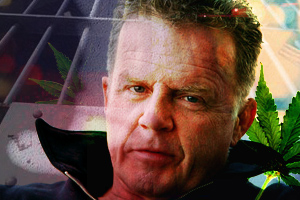

In 1982 Richard Stratton was convicted of operating a Continuing Criminal Enterprise under the kingpin statute of New York State. For over 10 years he had been running an international drug smuggling operation, bringing tons of marijuana and hashish into the United States and arranging for its distribution. How does one become an international drug smuggler? For Stratton it was a fluke, a chance encounter south of the border in 1964. But what kept Stratton coming back for more was the challenge, the adrenaline rush, and the belief that one day he could take his experiences and put them all into a book.
After his conviction, Stratton got his chance. His eight-year stint in prison afforded him plenty of time to write “Smack Goddess,” a novel based on the life of notorious drug dealer Frin Mullin, which was published upon his release in 1990. Since then, Stratton has worked as a consultant for the TV show “Oz,” co-written and produced the award-winning feature film “Slam,” and the Emmy Award-winning “Thug Life in D.C.,” and created the Showtime series “Street Time.” His first job after prison was working for Barbara Kopple, the Academy Award-winning documentary filmmaker, who hired him to write a treatment for a film about Mike Tyson. Kopple kept him on as a field producer once the project got underway. “I remember running around from phone booth to phone booth,” Stratton says, “setting up interviews, coordinating camera crews, organizing transportation logistics, and thinking, I can do this; this isn’t so different from running a smuggling operation.”
Late last year, a selection of Stratton’s best nonfiction work, which originally appeared in such magazines as GQ, Esquire and Details, was collected in an anthology called “Altered States of America.” The subjects covered range from in-depth profiles of Norman Mailer and Hunter S. Thompson to exposis of the CIA’s covert LSD experiments, and the FBI’s complicity in a series of New York Mafia hits in the 1980s.
Salon caught up with Stratton, now 60, at his studio apartment in Chelsea, where he stays when he has business in New York. The apartment is windowless except for a skylight, high over Stratton’s desk. The bookshelves are lined with tomes about cannabis and crime. On the walls hang various movie posters from projects Stratton has worked on. Stratton himself, wearing black nylon jogging pants and a black tee, sits at his desk in a wooden swivel chair, sipping Earl Grey. He has the elegant, brushed-back hair of a TV preacher and the solid build of a wrestler.
The first and most obvious question is, how does an upper-middle-class white kid from Wellesley, Mass., become an international drug smuggler?
Well, that’s a good question. I had flirted around with pot when I was in high school. But when I got to Arizona — I went to ASU on a wrestling scholarship — I started going down to Mexico with my roommate, and that’s when I made my first buy. It was $100 a kilo. I had 300 bucks on me so I bought three kilos, hid them in the car, and then brought it back to Boston and sold it to the cousin of this friend of mine. I made $2,000, which was a lot of money in those days, especially for a 19-year-old kid. I never really thought of it as “smuggling.” After that I dropped out of school, became a hippie, and went on the backpack hippie tour of the world for two or three years. I started doing these little scams where we’d build these false-bottom suitcases and we’d hide hash in there, and then friends would carry it back to the States.
What was your parents’ reaction to this activity?
My parents never really knew what I was up to. Well, my father had some suspicion because I had all this money. But I had been such a rebellious kid. I had been in reform school and arrested so many times that they really didn’t want to know. My mother was very different; she was supportive no matter what I did. She was one of these overweening mothers that you could’ve gone to and said, Your son just killed three people down the street and ate them, and she’d go, Well, they must have been really bad people, otherwise he would never have done something like that.
So how did an irredeemable delinquent like yourself end up a writer?
I went to a prep school in western Massachusetts, because they had a great wrestling coach. My English teacher there was a guy named Dudley Cloud, who had been an editor at the Atlantic Monthly. And he took an interest in me, based on essays I’d written. He said, You really have a knack for this. You should pursue it. So when I came back from Europe I enrolled in a summer writing program at Harvard. After that I applied to the Fine Arts Work Center in Provincetown, and got a writing fellowship. That’s when I met Norman Mailer. He was living two houses down, across the street. There was a woman who worked for him, his cook, who lived in the apartment below mine. She said, Oh you gotta meet Norman, you guys will love each other. And one day he called and invited me over to watch a football game. We stayed up the whole night, drinking and talking. At that point he was offering to help me any way he could. I was 22.
And did he help you?
I interviewed him for Rolling Stone. Then they hired me to write a piece about Rochdale College, in Toronto, which was one of these experimental colleges that sprang up in the early ’70s. But it had turned into one of the centers of soft drug distribution in North America, largely because of Robert Rowbotham, who was like the hippie godfather. When I went up there and started interviewing people they all said, Oh you have to talk to Rosie. He’s the flower. That was his other nickname. He was probably in his early 20s and already had maybe $5 million or $6 million in cash stashed away. The guy was a master organized crime figure in the marijuana underworld. People would come up from all over North America and buy hash from this guy, and then smuggle it back into the United States.
So I hung out at his farm for three or four days, and we started talking about some of the smuggles I’d done. He was not an importer, he was a dealer. He was connected to these Lebanese people who would bring tons of Lebanese hash into Canada. And then Rosie would sell it to people from all over North America. So I wrote the piece, but in the meantime he fronted me like 100 or 150 kilos. We smuggled it back into the United States and I sold it to friends of mine who I had been doing business with prior to that. So then with Rosie’s money and connections I went back to Europe and started sending loads of hash back to the United States.
Why did he let you get close to him if he knew you were a reporter?
I don’t know. It was just one of those things. He’s still probably one of the closest people in my life. The guy did like 17 years in prison in Canada, just because he refused to give up the people he was associated with, and he was very political about it. He really saw himself as some kind of Johnny Marijuana Seed. He had the best reputation of anybody I’ve ever met in the business. You could leave $3 million or $4 million worth of hash with him and come back in three weeks and Rosie would have all your money. An unbelievably meticulous businessman, and nonviolent, too. No guns, no hard drugs. He was very strict about that.
Is that a code you adopted for yourself? Or was that just a part of the hippie gestalt?
It was part of the hippie gestalt, but I think no one quite articulated it as fully as Rosie did. There’s a political aspect to it. It’s not just about greed. Jesse James and his brother, they were confederate soldiers, and what happened to them made them become outlaws. The outlaws of the hippie generation were reacting to laws, which we thought were totally ridiculous. The outlaw marijuana growers still see themselves as political, as doing something innately American, by challenging laws that they feel are wrong. The problem is that in the United States it all becomes co-opted by big business. Which happened to the marijuana industry too: Huge amounts of low-grade Mexican pot started coming into the country. Rosie wouldn’t touch the stuff. There was a morality to it. These guys wouldn’t deal in cocaine. When cocaine came along, it corrupted everything. People started getting strung out, the Colombians got involved, the weapons. It all turned ugly.
So how exactly did the partnership between you and Rowbotham work?
Well, Rosie would say, What we really need is Thai sticks. So I’d go to Thailand and get them. He was the dealer, I was the smuggler.
This may be a naive question, but what are Thai sticks?
Thai sticks were these pieces of bamboo about 9 inches long. They would take the buds and tie them to the stick with a piece of hemp. In those days when you got a big load of pot there would be a lot of seeds and shake. But not with Thai sticks, cannabis indica. In those days everything was sativa. Sativa is usually from Colombia, Mexico, that part of the world. You never saw indica. There’s three basic strains: sativa, indica and ruberalis. Ruberalis you get mostly in places like Lebanon. So indica was virtually unknown in this country. There were these sticks called Buddha sticks, which were supposedly the best. The buds are really fat and juicy and stinky.
So you would travel to these places.
If there’s anything that I miss about those years it’s the adventure of going way up into the mountains and meeting these people, the farmers. There were always these shady middlemen you had to go through, but I would always insist that I wanted to go to the fields and buy it still on the plant. You could never trust these guys, the middlemen. They’d show you a bale of really good pot and say, Yeah, it’s all gonna be just like that. And then you go to all this trouble to smuggle it back to the States and maybe a third of it would be like that and the rest would have something else thrown in. So quality control was hugely important. You had to go there and oversee every step of the operation. My thing was to go there and stay with these people. For me it was material to write about.
What smuggle are you most proud of?
The one that comes to mind is this huge one we did from the Middle East, where we almost got caught. In fact there was tremendous pressure being put on me by my guys in New York to give it up, to just walk away, because they thought it was hot. This was during the war between Iran and Iraq, when you couldn’t get chopped dates in this country. Iraq was basically closed down. So I would go to Iraq and buy these dates. Millions of pounds.
[The phone rings. Stratton talks for a few minutes with his business manager about money that he’s owed by a Hollywood studio for a draft of a script he completed.]
It’s harder to get paid by these people in Hollywood than it is to get paid by dope dealers, I’ll tell you that right now.
So start at the beginning. Before you go to Iraq.
We had set up our own trucking company in New Jersey. And we had a bonded warehouse over there. The trucking company was owned by the father of one of the guys that I was involved with in New York. He was one of the biggest dealers of soft drugs in the world at that point. He knew that I had been smuggling hash out of Lebanon for years, so he came to me and said, Look, Bordeau Foods is having a hard time getting dates. They need as much as they can get, for cake mix and all this other stuff. Can you do that?
The thing is, before you even go you have to have a lot of stuff in order. You have to have a letter of credit from Bordeau Foods, for one thing, so you don’t look like a dope dealer. So I had to read up, so I’d know a little bit about what I was talking about. Then I met the Bordeau people here in New York and went out to dinner with them, so they’d think I was a legitimate importer/exporter. I had business cards made up and the whole deal. One of the things about dates you have to know about are the acceptable levels of infestation, because there’s always a certain level of bugs in these things, and if there’s too many they won’t pass muster with the USDA. So I went to Iraq, and I bought these dates, but then because of the war I could say, Well, we can’t ship them out of Iraq, we’ll have to send them to Lebanon and then ship them from there back to the United States.
Who does one talk to in Iraq about buying a million pounds of dates?
Bordeau had some leads, but when you get there you just start asking around. You go to these whole food distributors and say, I want to buy dates. It’s not that hard. The big problem is, again, quality control. You check the infestation rate and they look pretty good, but then the rest of them … Well, that’s part of the story. So I bought all these dates, I have them shipped overland by truck to Beirut. There, my contacts take the dates, put them in cartons, and then put these sealed metal boxes of hash inside the cartons and pack the dates all around them. That’s what they were supposed to do.
How much hash?
Fifteen tons. Probably the biggest single smuggle of hashish. We used to do much bigger loads of pot. They’d come up in these mother ships from Colombia. But the Lebanese, see this is the thing, they never follow instructions. I get back to Beirut, and we’re right down at the docks with the containers. I start opening up a couple of the boxes, and I see a metal box with hash sitting right inside these cartons. I said, Man, what the fuck are you guys doing? See, over there everybody is paid off all the way down the line. So they assume that it’s the same way back here, like we’re gonna pay customs off. But we weren’t paying customs. We were gonna get it through customs without them knowing. Because to pay customs off over here is not so easy for a load that big.
It took them weeks but they did it right. Out of the seven containers, there might have been four that had hash. So I get back to the States before the shipment gets there, and I go to my people in New Jersey that have the trucking company and I say, When they [inspectors] come in pick up these containers first, the ones that have the hash. Because typically what happens is they’ll look at the first couple, but they’re not going to bother with all seven, because it’s a big, well-known company.
The one problem was it was coming out of Beirut, which is flagged as a drug source country. So when the containers get here, my friends come to me and say, We’ve got a problem. Customs called the trucking company and said that they want to accompany the containers from the dock to the warehouse, open them at the warehouse, and visually inspect the cartons. So what are we gonna do? They were ready to walk away. I go, Look, if you walk away they’re going to know that something is in there. That’s going to expose the trucking company, it’s gonna expose everybody. So I said, What you do is you pick up the ones that just have the dates. You go on a Friday afternoon, late in the day, so that you can only get two or three. Bring them back and just let them look at those, and hopefully that will satisfy them.
So this gets communicated to my friend whose father owns the trucking company, who then communicates it to the truck drivers, who don’t even know that there’s hash in there. The communications get fucked up along the way and they pick up a couple of the containers that have hash in them, and the customs people accompany them back to the warehouse. You know how these cartons have those plastic straps that go around them? What I had done was put red straps, as opposed to green or yellow or blue, on the cartons with the hash, so I would know at a glance. So I get to the warehouse that night, right after the customs guys. They brought dogs with them too. They bring the boxes out and they put them on these big tables and they start opening them up and looking at them. And they opened up some of the ones with the red straps on them, too. If those guys hadn’t repackaged them in Beirut we all would’ve been busted.
So you were standing there when they opened them?
No, I wasn’t standing there. I was at the Chelsea Hotel, sweating. But the brother of my friend whose father owned the trucking company was there. He saw them unloading the red ones and he knew.
But there were still two other containers that hadn’t even been opened, and both had hash in them, sitting in the fenced area of the warehouse, waiting for the customs guys to come back on Monday morning to inspect them. They put these special seals on them, and if you break the seal they know that you’ve been in there. So one of the guys we were working with was a welder. He came over and he cut the actual hinges of the doors off the back of the containers. We had to get a tow truck with a big hook on it to lift the door off the back.
How big are these containers?
Well, you’ve seen them. You see millions of them over in Jersey. They’re huge. They’re not as big as this apartment but they’re —
Like a railroad car?
Yeah. So we cut the doors off with a welder, and took out all the boxes with the hash. It took us all weekend, working 24 hours a day, 16 guys. But now we’re worried that they’re going to look in the boxes on Monday and wonder why there’s 40 cartons missing. But we figured, fuck it, at least we’ll have the hash. So we put the doors back on, reweld them, and then had to go out and buy paint to match the paint on the containers. But we still had two containers at the docks. Then, after all that, at like 9:30, Monday morning, the customs guy calls and says, We’re satisfied, just come get the rest of them. We’ll send someone ever there to break the seal. So in the end we got everything. Except the dates.
The dates?
The USDA rejected the dates. The infestation rate was too high.
How much more money would you have made if you were smuggling heroin?
Ten times maybe. But there’s a lot of other problems. For one thing, I wouldn’t know where to sell it. That wasn’t my field. I probably could’ve found those people if I needed to. But then there’s organized crime. You’re dealing with people who are really not good people at all. Not that everybody in the soft drug business was a good person. But it’s just a whole different world. You’re dealing with people who will kill you for whatever reason. And the other thing is, you know, the drug gets cut, and people shoot up and die. In those days that was considered bad karma. Even cocaine was considered bad karma. In other words, if you dealt with bad shit, bad shit was gonna happen to you, and invariably it did.
What about air smuggles? How does that work?
Well, you need a catch. The catch is usually with the people who work in air freight. For a certain amount of money, they’ll take your shipment and it won’t even go through customs. They’ll take it off the plane, put it in your truck, and you get it out of there. That’s a catch. They’ll get rid of the bill of lading so customs doesn’t even know the load came in. There’s a lot of baggage handlers who do that. And customs people. I’m sure right now if you went out to Kennedy, there’s stuff going on. We had one in Logan, we had one in Kennedy, and we had one at LAX for a while.
How do you set them up?
Usually somebody comes to me, knowing that I have the overseas connections, and they’ll say, I know these guys at the airport and they want to make some money. They’ve done it before. They know how to do it. Are you interested? Usually we’d send a trial, 35 or 45 kilos, and make sure it went through.
How much do you pay these guys?
That’s negotiable. There’s always a problem, though, once they start making money. I was paying these guys at Logan $30,000 every time we brought a load in. Which was reasonable. There were three of them and they each got 10 grand, for one weekend of work. So I’m paying them 30 grand I’m giving my Lebanese connection a third, and the next thing I know it starts to come in, every three weeks. But then these guys started talking to the Mafia, and next thing I know I’m being called in to have a sit-down with the Mafia guys. And they’re like, What are you doing? They were looking to kill me at one point. Because I refused to knuckle under. I said I can’t do that. I had this Lebanese guy that I was working with at the time in Boston, who knew organized crime people really well. So I went to him and explained the situation, that if I knuckle under I’m not going to make any money. So he calls Raymond Patriarca, the boss of the whole New England family at the time. And word came back from Patriarca that I had to do whatever the Mafia guys said. And I was like, fuck that, you know? I had a load at the airport at the time and I got it out of there. I just took it. And two days later they called me up and said, What the fuck are you doing? We’re going to put a contract out on you. It was hairy. That was the first time I started carrying a gun.
Did you even know how to shoot it?
I’d done some target shooting. But it leads to another story. I was going through Logan on my way back to New York with like $250,000 in cash in a suitcase. So I put my briefcase on the conveyor belt that goes through the X-ray machine. And just as it started to go in I thought, Oh shit. I left the gun in there. Now Massachusetts had this really strict gun law. If you got caught with a gun it’s a mandatory year in jail. So I see the thing go through the metal detector, and I go to grab the briefcase. So of course they see the gun and call the state cops and they arrest me on the spot. They put me in a holding cell in Logan airport. My suitcase with the money had already gone, I had checked it. It’s gone to New York. So I called this friend of mine, a lawyer, and explained the situation. And at the time I was carrying this false I.D., from Texas. So he comes in, we go to court that very afternoon, and he gets up in front of the judge and says, This man’s from Texas. In Texas they carry guns, and so on. And ultimately the judge fined me, and they kept the gun and they let me go. So, I get on a plane. I fly to New York. I get to LaGuardia, and here is my suitcase, six or seven hours later, still going around on the baggage claim.
He’s from Texas. They carry guns in Texas. They bought that.
And that’s how I stopped carrying a gun.
What do you do with all the money?
It comes to you over a period of time. You never get it all at once. You have to wait till these guys sell it, and a big load could take six months to sell. People are going to get busted. The DEA and the local narcotics cops know a big load of hash came in. So they start watching individuals that they know are involved. Then they start arresting. And we hear about it, we lost a thousand pounds here or we lost 500 pounds there. So this shit happens. But what I did with it was spend it. I bought a ranch in Texas. I bought boats, I bought airplanes. I reinvested a lot of it into the business. But I was so addicted to the adrenaline rush that I just kept going and going and going. I would have five or six different things going on at any given moment. And maybe two or three of them would make it. I managed to save some of the money. I bought my parents a house. I bought land in Maine. I bought property in the Bahamas. I was big on real estate. I started doing all kinds of crazy things. I started a magazine. We put money in High Times magazine.
You helped start High Times?
Tom Forcade was the founder. But I was part of the original brain trust.
So you didn’t have any of those overseas bank accounts?
I did. I had money in the Bahamas, I had money in the Cayman Islands. I had money all over Europe for a while there.
And did any of that survive the prison years?
Some of it.
Enough?
One person that I trusted dearly had saved some money and had set some properties aside. I had a house in Hawaii that they never found. But the government found a lot of it. The IRS began what they call a net worth study. They spent years tracking all my assets, going around to every place that I did business. They don’t care how long it takes. And then when the DEA finally arrested me they seized everything. They got the ranch in Texas; they got the property in Maine. They got vehicles. They got airplanes. They got bank accounts.
And that’s just gone.
Yeah. It’s gone.
So what happened when they finally caught you? What was your defense?
In the Maine case, my defense was that I was doing it to write about it. At that time there were all these unusual defenses going on. Vietnam vets had the post-traumatic stress syndrome defense. They came back from Vietnam such action junkies that the only thing they could find that would fill that need was smuggling pot. The other group on trial up there was the Ethiopian Zion Coptic Church, a bunch of white Rastas from Florida. Their defense was they were bringing it back as sacrament for the church. And this all in front of this same federal judge up in Maine, who was a very good judge actually. Judge Edward T. Ginoux. And that was my defense. I was a writer and I was just doing this to gather material.
You imported tons of illegal drugs into the United States in order to gain material to be a writer.
Yeah.
These days most people settle for an MFA.
There was actually a lot of publicity about it at the time because people found the defense amusing.
And then later they charged you again, in New York.
They said, Well, we’re going to bring more charges, unless you’re willing to cooperate with the government. Because in the Maine case they didn’t have the big hashish trip that we did. They didn’t really have that much. So they brought the New York case and that’s when they charged me with Continuing Criminal Enterprise, and charged me under the kingpin statute. That’s when I started really getting into the law, because I was like, Wait a minute — how can they try me twice? So my defense there was, Yes, I did it, but I’ve already been tried and convicted, and this whole case has been concocted just to get me to rat out my friends, Norman Mailer particularly.
What was prison like? You’ve described it elsewhere as like living in the men’s room at Penn Station.
The interesting part of it is the inner trip. How it tests your character.
Did you finally find the time to do some writing when you were in there?
Yeah, I wrote “Smack Goddess.” I wrote a whole bunch of short stories. But they don’t make it easy for you. I would write longhand on legal pads and then go to the law library and say that I was writing briefs. A lot of time I was actually doing legal work but in between I would be typing up a short story, or whatever else I was working on. You’re not allowed to run a business from prison. So you can’t get paid for being published. But in my case I never did get paid for anything until after I got out.
You mentioned somewhere in your book that you have a few regrets but ratting isn’t one of them. But what regrets do you have?
What I regret more than anything are the days and weeks and months and years that I spent sitting in hotels, waiting for people, partying, living this high life that was really pretty empty when you get right down to it. I wasn’t writing, I wasn’t doing anything creative, I was living for this adrenaline rush. I used to go through these periods where I would put everything aside and just try to focus on my writing. But when a deal comes along, it’s too good to pass up.
And I regret the people that as a result of my activity got sucked in, the people who ended up in prison or dead. It’s a dark, ugly world and the criminality of it seeps out, and infects everybody. So I regret that. And I also regret that I didn’t take 10 million and put it aside somewhere where they could never find it, so that I could make movies with it now. Laundering it is a huge problem.
So do you feel that the dictum you inherited from writers like Hemingway, that you should have wild experiences so that you can write about them, has served you well?
Overall I’d say it has served me well. I certainly have a wealth of material that I can tap into. But it comes at a price. Hemingway paid for it. He had to keep tempting death, and ended up killing himself as a result. I think what I was able to do with the prison experience saved me. Because it forced me to examine my character and say, Wait a minute, what are you doing with your life? I use it as a touchstone now. To try to keep me grounded. I think of my apartment as my high-tech prison cell. If they told me you’re going to have to spend the rest of your life in prison but you’ll be able to design your own cell I would design something like this. So when I saw this place I was like, Oh yeah, this is my ADX, my maximum-security prison cell. Fortunately, though, I can still go out and buy the paper.
