

Last year, celebrity economist and United Nations special advisor Jeffrey D. Sachs published his opus, “The End of Poverty: Economic Possibilities for Our Time,” to much fanfare. Bono even (or not surprisingly) wrote the introduction. In the book, Sachs unveiled his crusading vision of how increased aid to poor countries could lift their most desperate citizens out of what he called a “poverty trap.” He advocated for a flood of funds from the West to transform beleaguered nations into functional societies. Yet, unlike so many tracts, Sachs’ book wasn’t merely a proposal, but a blueprint of grand actions currently in effect; Sachs is the director of the United Nations Millennium Project, an effort to eradicate poverty by 2015. According to Sachs, it will take very little money to accomplish this. The world’s poor simply need the will of the world’s rich.
Sachs’ appealing book was received with adulation, but critical reviews of it made a splash too. Essays in the New York Times and the Washington Post, for instance, commended the professor for passionately shoving poverty to the fore, yet angrily denounced his central plan. “Sachs’s missionary zeal is infectious, but the flaws in ‘The End of Poverty’ should sound important notes of caution,” said one. “The danger is that when the utopian dreams fail (as they will again), the rich-country public will get even more disillusioned about foreign aid,” warned another.
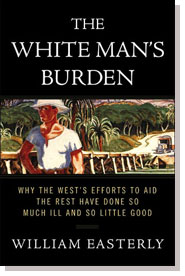
That last quote (from the Washington Post Book World) was written by the New York University economist William Easterly, once called the “Charles Murray” of the aid debate by then Times columnist, now Times editor, Bill Keller. Easterly’s new book, “The White Man’s Burden: Why the West’s Efforts to Aid the Rest Have Done So Much Ill and So Little Good,” suggests that the world’s official aid agencies — the World Bank, the International Monetary Fund, the U.N. — and national agencies such as USAID, have been recycling the same unworkable aid plans for the last 50 years. (Non-governmental organizations are not necessarily included in his argument.) In fact, Easterly claims that Jeffrey Sachs’ strategy resembles failed utopian aid policies that date back to the Eisenhower and Kennedy administrations. Easterly, on the other hand, believes in small, preferably homegrown, “piecemeal” efforts that focus on one specific problem at a time, perhaps focus on one specific problem in one tiny village.
At times, Easterly sounds a lot like the typical intervention critic, casually denouncing rich white Westerners who, as he sees it, meddle in thorny affairs of which they have no genuine understanding. But Easterly once meddled himself: He worked as a World Bank official for 16 years. “I didn’t know anything,” he told Salon by phone about his 26-year-old self. “I knew what you learn in an economics Ph.D. program. Over time I learned as I went along. A lot of aid jobs are writing reports. As if Africa could be made rich by reports. But I was a slow learner. I stayed in the World Bank for 16 years before I got disillusioned enough to want to try and reform the business I’d been in for so long.”
What does “poverty trap” mean and why don’t you believe in it?
The idea of the poverty trap is that if poor people start off poor, they will have difficulty saving enough to finance the investment they need to get out of poverty. It was appealing as a theory, it sounds like plausible common sense. Like other plausible common sense-sounding theories it turned out not to be true. Poor people save more than you would think and saving is not the only way to escape from poverty. Plenty of countries have started off poor and have had quite decent growth. If we take the poverty trap literally then really it should still be true for everyone — life would have been a place that was nasty, brutish and short. That’s a line I stole from someone else.
But this theory is the guiding principle for aid, isn’t it?
This was the original rationale for aid back in the 1950s and it still is. One thing that strikes me — having been trained in this field and having read all the old and new writings — is just the amazing parallels between what was written in the 1950s (which should have solved the problem by 1965). My good friend Jeff Sachs’ book really capitulates ideas that could have been written by Walt Rostow, an advisor to Kennedy and Eisenhower. He was writing the same stuff about the big push and the poverty trap. Unfortunately, experience since then has pretty amply demonstrated that that approach hasn’t worked. Somehow we don’t learn from failure. We’re trying the same thing over again, which is very discouraging. If occasionally a note of outrage leaks out in the book, it’s because I got so frustrated with the way failed ideas get recycled.
Why do you think they do?
These ideas offer simple answers and promise big things — the end of poverty, for example — in a fairly easy way that doesn’t require huge sacrifices from rich countries: Just increase aid a little bit more, and that would lift the world’s desperately poor out of poverty. I wish that were true myself. But simple is always appealing to politicians: Here is the thing that I can do that will alleviate this tragic problem of world poverty. So politicians like Blair and Bush can give the impression that something’s being done. The public isn’t terribly informed about what’s actually happening in remote villages in Africa. There’s no check on whether problems are being solved or not. Africans don’t vote in our elections — there’s no pushback when plans don’t work out or get results. Nobody is holding the aid donors accountable.
So the people who receive the aid should be holding them accountable?
In aid, 95 percent is implementation. Five percent is raising enough money from rich-country donors. [Bob] Geldof and Bono are talking about solving the 5 percent. The 95 percent has a long chain of poorly motivated and sometimes corrupt actors in between money and poor people. Donor bureaucracies like the World Bank or IMF are even less accountable than Blair and Bush because they don’t have to face election. They’re operating in a place that’s hidden from view. I don’t want to be too cynical. I think there are a lot of well-meaning professionals at these places. I am more cynical about the management, who I think just like to make a big splash in the media. The donor bureaucracies only have incentives to move the money. If it isn’t spent, that will be a scandal, but what happens far away is never known.
Of course, there are tons of problems on the receiving end. These are fragile states with often-poisonous political situations, conflicts, corruption, patronage politics. Health workers, for example, are appointed for political reasons and don’t have much incentive to get medicine to children. Drugs disappear on black markets.
Bob Geldof seemed concerned about accountability when he sponsored his aid concerts this year. What happened when he raised all that money for Ethiopia in the ’80s?
The problem was that the money passed through an authoritarian Marxist government whose main preoccupation was fighting a war against rebels who eventually ended up winning. There are plenty of allegations that both sides used food aid as a political weapon in war. That’s the kind of messy reality on the ground that makes it so hard for good intentions — even a caring person like Geldof — to actually have the money accomplish something good.
“Accountability” seems like a buzzword today, in general.
A lot of people are talking about accountability because that has been a criticism that has been voiced strongly in the last years. And that’s the main criticism that I would make of the whole exercise. But as I learned from being on the inside of a bureaucracy, they’re very skillful at deflecting criticism. When the World Bank is told they don’t have accountability they immediately write five reports about how they will.
But you know it’s become a meaningless buzzword at this point. We have to rescue the original idea. What does it mean? It means you are individually responsible for whether you did something. Someone gives you a reward or penalty — that way of thinking is completely alien to the whole aid bureaucracy, I can tell you.
So how would the people receiving aid hold aid groups accountable?
You’d have to be creative to think of ways to give people who receive aid a voice. The technical solution is to do evaluations before and after.
I thought NGOs already did this.
NGOs do it a little bit, but NGOS are not necessarily the knights in shining armor that will ride to the rescue of aid problems. They have their own problems — they respond to big problems that will be very visible to rich-country publics so rich people will give donations. Like the tsunami. All the NGOs will flock in, even though, as tragic as that event was, the amount of money that went to it was more than could be effectively spent to help the victims. It would be better spent on long-run development, nutrition or school programs.
I think you need to explain what you mean by too much money. The perception is that these poor, and now devastated, communities need everything they can get.
There’s never too much money in the sense of need. But the problem comes back to 95 percent implementation. You have to have the aid workers or locals who are motivated and accountable make sure money does good things, and they can only handle so much money. Huge amounts overwhelm the system.
So, Jeffrey Sachs is obviously prominent. And so are you. How could two economists come up with such opposite conclusions on a problem that’s been going on for years? Is it political motivation? Ego?
Frankly, I don’t think Jeff Sachs is doing good economics. Call economists at top schools and ask their opinion and I think you would get a similar one. He wants to solve problems in administrative and bureaucratic ways whereas economists want to ask: What are the incentives for people to get things done? Who has the incentive to make things work on the ground? And Jeff doesn’t address that at all in his book. It’s all about the technological, scientific or administrative situation you would need to improve soil fertility. But there’s nothing about who will be the one implementing the solution to soil fertility.
Well, who should be?
I’ll tell you right away my answers are never as convincing as the problems. Because there has been so little incentive to learn from past failures, we’ve been recycling and we have a lot less knowledge than we would have if we’d treated the last 40 years as a trial-and-error experiment with lots of methods on the ground.
The answers differ from one country to another. There’s been far too little learning. To learn you have to admit mistakes. In aid, it’s politically poisonous to ever admit you made a mistake because then the fear is they’ll cut aid.
In defense of aid agencies, they really had a bad political environment in which to operate — they’re never allowed to make mistakes and thus they never learn.
Can you give an example of something that worked then?
I like the example I gave in the first chapter of the book. There’s a nonprofit NGO called Population Services International, which is trying to control malaria in Africa. It’s a huge problem. The prevailing administrative top-down apparatus is to just hand out free bed nets through mass campaigns. That has not worked because when you flood the market with free bed nets and you don’t educate people on their great benefits, they end up not used or they’re diverted — since they’re free — to other uses, like wedding veils or fishing nets.
So PSI tackled this problem in Malawi. They don’t like the model of just flying in the 22-year-old white kid from America to tell the local people how to solve their problems. They employ a lot of local staff. Their local staff came up with a reasonable solution that worked better: They targeted a high-risk group, which is pregnant women and children under 5, and they had the nets sold at a highly subsidized price to mothers through antenatal clinics and gave the nurses a commission. When you give nurses a commission and offer counseling — and these are local Malawian nurses, not rich arrogant foreigners telling them what to do — the number of children sleeping under them went way up. This model is now being copied by other countries.
The free bed net campaigns in some countries have statistics like: 70 percent of bed nets not used. And there are even scarier ones. In a refugee camp in Uganda, a survey found six months later that one-third of the nets were still in the package, one-third were out of the package but not used, and one-third were being used. When Jeff Sachs ignores that kind of problem — that’s why I have to disagree.
But obviously the reaction must be, how could you make poor people pay for things?
There’s a visceral reaction to making people pay for things. That’s another way I think Sachs is being demagogic — he insists they have to be free whereas the PSI camp is charging mothers 50 cents per net. That isn’t trivial, but once the benefits are clear, then 50 cents is very worthwhile for someone who wants to save their child from malaria. The advantage of charging something for someone is that it places some value on it. That doesn’t play well in demagogic politics that surround debates about poverty, but it’s pragmatic. When people pay for things they feel like they have a right to hold you accountable.
Are the products always fairly priced, though?
They make sure it’s within their ability to pay. Then once the villagers pay then they get very angry if someone dies anyway. This is a totally homegrown aid program.
It’s common to rail against white foreigners implementing aid. But is there evidence that poor people respond better to programs run by locals? Or is it simply that locals know more about what’s going on — which I guess would suggest that the white aid people just need to be well-informed?
It’s more the second than the first — the local people just know so much more about local conditions. Especially when there’s some social entrepreneur working on one specific problem rather than the U.N. trying to achieve Millennium Challenge goals.
What are those goals exactly?
According to Sachs, they recommend 449 separate interventions to achieve improvements in the 54 indicators of poverty and suffering and to try and achieve this by 2015. That’s just an impossible, unworkable plan.
Wouldn’t the 449 interventions be 449 small plans, rather than one Big Plan?
When Sachs and I talked, he kept insisting that what he’s doing is not a “plan,” and then I quoted large sections of books he writes that talk about planning and strategies back to him. I think he may not like the word because it’s become pejorative — it sounds like a top-down plan to me. It was designed by 250 world experts meeting on task forces and writing reports — that’s an expert-driven approach. Very top down.
What are we to do about countries with corrupt governments?
The aid business has been stuck on this problem. You get people who say, “Well, the government is not really so bad, let’s give them money anyway.” Which is what I read the U.N. and Sachs as saying. And then you get people like the U.S. government and the IMF and World Bank saying, “Let’s supply tough love and we’ll only give aid if they reform.”
Both of these approaches have been tried and neither has worked. First of all, all the governments are not good governments so the first camp is way out of their depth. Second, although it might sound good in principle — these structural adjustment loans — all the empirical evidence is that aid is not successful in changing behavior. An awful lot of people agree that that’s been a failure. It was applied widely in Africa, the Soviet Union (called “shock therapy”), Latin America, the Middle East and somewhat less in Asia.
Part of the secret of the success in Asia is that they’re in a stronger position to resist being told what to do. They’re big, old civilizations that have strong senses of nationalism and self-determination and they have a big weight on the international scene.
But is there a way to bypass corrupt governments?
I think so. Try and get help to individuals and make products and services available that don’t depend on governments. There’s been this country obsession in the foreign aid business that somehow the objective is to fix countries.
Well, so they can help themselves eventually.
I don’t think countries are what matter so much; I think aid should just try and help individuals. That would free up enormous amount of money and reserves (now being wasted on trying to reform governments) into programs just focused on poor people. On getting drugs and textbooks to the poor. Doing things like the Gates Foundation: trying to create a malaria vaccine.
Is that organization effective?
The Gates Foundation is definitely more creative than official aid agencies, but they have to be diplomatic also. Gates is caught halfway in between the conventional wisdom and trying to think of new approaches that work better.
Your book is pointedly called “The White Man’s Burden.” It’s often said that aid is an extension of colonialism. But isn’t it to a certain extent an effort to rectify the damage done by colonialism?
I don’t think aid is a nefarious conspiracy to keep control in countries that used to be colonies. But it is part of the kind of colonial mind-set that has persisted. Kipling’s “white man’s burden” saw colonials as these benign white people bringing civilization to these people. It was put in much more p.c. language and became “foreign aid,” but still with rich, white people in charge thinking they knew the answers. There certainly isn’t the overt racism as before, but there is paternalism.
What’s happening now in countries like the Congo and Sierra Leone and Sudan and all these failed states — there’s this new rhetoric which I find worrisome that we should do something like shared sovereignty or trusteeships. That sounds a lot like colonialism to me. I’m not saying we’ll re-colonize — that certainly won’t happen — but they are failed states where very intrusive political and military intervention is taking place, which is somehow seen as the same package as foreign aid. That’s very neocolonial. I get invitations now and then to attend workshops with soldiers and aid workers who learned how to work side by side to reform society. Those e-mails scare the daylights out of me. That’s the last thing that should happen.
Not to overkill something that has been overkilled, but in Iraq we’re showing signs of these bad tendencies: military and aid are part of same package.
But are you saying we should never intervene militarily, even during genocide? You mentioned Sudan.
One should never say never. It’s very hard to watch “Hotel Rwanda” and say the West should never intervene. I’m sure if we’re on the ground in Darfur it would be very hard to say the West should keep hands off. But again, that’s the contrast between the grandiose plans to fix whole countries vs. the piecemeal apparatus that tries to help individuals and solve specific problems. Even with military intervention I think this same divide could apply. Yes, try and figure out a way to rescue civilians in Darfur from rape and murder and burning villages, but certainly do not attempt to invade Sudan and achieve regime change that is aimed at turning Sudan into an oasis of peace and prosperity. Just have more specific doable things that you can be held accountable for.
