

Early in July, Michael Chertoff, the secretary of the Department of Homeland Security, told the Chicago Tribune that though he had no specific information pointing to a new threat, his “gut feeling” suggested that the U.S. faced a heightened risk of a terrorist attack during the next couple of months. Summertime is an “appealing” time of year to the enemy, Chertoff said; it was natural to assume, then, that the season would once again bring “increased vulnerability.”
Chertoff’s intestinal sixth sense was met, to put it mildly, with some skepticism. The Bush administration has not proved to be above pulling the trick of conveniently timed terror warnings; now, facing congressional rebuke on matters from Iraq to everything else, the White House obviously was once again aiming to distract us.
But what rankled folks wasn’t that administration officials were once again milking the terror-threat cow — it was how lamely they were doing it. Chertoff’s gut! The comment smacked of self-parody, a takeoff on Stephen Colbert’s line that we are a nation divided “between those who think with their head and those who know with their heart.” MSNBC anchor Keith Olbermann called Chertoff “a hunch-driven clown,” and advised that he turn his duties over to someone who “represents the brain and not the gut, certainly to somebody who does not, as you do now, represent that other part of the anatomy — the one through which the body disposes of what the stomach doesn’t want.”
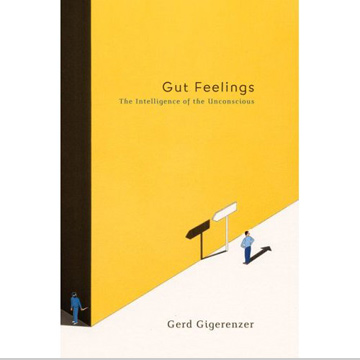
The controversy hit at a propitious moment for Gerd Gigerenzer, a German behavioral scientist who has made human intuition his life’s work. Gigerenzer’s new book, “Gut Feelings: The Intelligence of the Unconscious” — a more deeply scientific (if less tickling) look at a subject first popularized by Malcolm Gladwell in “Blink” — seeks to undo the cultural dismissal of the gut.
Not just Chertoff’s but everyone’s: Intuition, Gigerenzer writes, “is more than impulse and caprice; it has its own rationale.” A “gut feeling” is not a supernatural force — it’s not ESP. Rather it is the product of your brain quickly, often unconsciously, using a rule of thumb (what academics call a “heuristic”) to arrive at a decision using little evidence.
Imagine that you’re playing baseball and a fly ball comes headed your way. How do you know where it’s going to land? As Gigerenzer points out, people do not — as scientists have long assumed — calculate the ball’s trajectory, estimating its velocity, angle, spin, the air’s resistance and wind speed. Indeed, in experiments, baseball players have proved very bad at guessing where a fly ball will hit the ground. Instead, everyone who has ever caught a ball has (unconsciously) used a rule of thumb to do so. The rule is known as the “gaze heuristic,” and it governs your speed as you chase the ball: You fix your eyes on the ball, start running, and adjust your speed so that the angle between you and the ball remains constant. In other words, instead of computing the ball’s trajectory, all you have to do is keep your eye on it — “the heuristic leads the player to the landing point,” Gigerenzer writes.
Gigerenzer says that these heuristics arise out of our “evolved capacities.” We’ve evolved to be able to track objects through the air, for instance. Consequently, our gut feelings — whether they’re useful in catching a ball, or in predicting a terrorist attack — aren’t to be taken lightly. Intuition is not a deviation from the right way to make decisions; it’s how we make decisions all the time.
I spoke to Gigerenzer on the phone; he lives in Berlin.
Let me start by asking you about Michael Chertoff’s gut. Should we care if a public official says he has a gut feeling about something? Should we place much stock in that?
It depends on whether your public official is an expert. There are many American politicians who say that they rely on their gut feelings — including your president, who said, “I’m a gut player.” On the other hand, we know that some people are real experts, and we can trust their gut feelings to a good degree, particularly if you are an expert in a situation where you have feedback and you can learn from it. But it’s less clear if one can learn from terrorist attacks. There are not so many of them, at least on American soil.
So because there’s no practice in this field a gut feeling is probably shaky?
It might be much shakier, right. But this also shows that much of intelligence work is based on guesswork and gut feelings. I have given a lecture recently to a group of international security services from many countries, and it’s very clear that although they work with the most expensive computers and try to feed in all the information they have, these computers often do not do much better than a good expert’s gut. Intelligence typically has lots of evidence, but how reliable is it? How do you weigh it? If you sit on a mountain of evidence, at the end you have to make a decision based on your gut.
Well, but that still doesn’t resolve the question — when a politician says he goes on his gut feeling, we really have no way of knowing whether he’s an expert. So what do we do?
That’s right. I would look at his record. Let him make some more predictions with his gut and we can find out how good he is. If he has a good record, then I think it’s reasonable to trust his gut feeling.
On this topic, you write about drug couriers and the police officers who go after them.
Right, here you have a real expert who is able to pick a drug courier out of hundreds and hundreds of people floating through Los Angeles Airport. And when I asked him how he does it, he said, “I don’t know — I can’t tell you because I really have no idea.” The background is that he learned this skill while working over years with a very experienced colleague who told him, “Look at this person over there, he looks suspicious.” Just by learning and watching he got this skill.
The problem, though, as you point out, is that those gut feelings aren’t admissible in court. Juries don’t trust them, and judges don’t want police officers to say, “Well, I picked him out for a search because I had a gut feeling.”
In the case of the American courts, the situation is something like this: If a policeman finds illegal weapons or illegal drugs, the policeman has to explain in court why he stopped the person in the first place. And the policemen that I talked to said they originally said, “Yes, we had a hunch there was something wrong with this person, and that’s why we picked him out.” When they said this in court, then usually the whole case was dismissed. The court expects reasons, and these experts cannot give reasons.
Of course, one wants to have protections of minorities and others, but in the end it’s the wrong psychology that the court has.
But it’s hard to say what the courts should do. Would you advocate that a court accept police officers’ gut feelings? It’s the same problem that we have with politicians — we need to be able to judge this person’s expertise before we can decide.
You’re right, there is a conflict. I would suggest that in general the courts look at the accuracy and the experience of the policeman instead of whether the procedure was the right one.
The same thing applies to doctors. It would also be worthwhile to study how accurate a doctor’s gut feelings are instead of dismissing them. And many American doctors feel that they have to hide their gut feelings from patients because otherwise they might be sued. Part of our research is about collecting evidence about the quality of gut feelings and showing when it works and what doesn’t work.
One of the strongest bits of evidence pointing to the power of gut feelings is your study of high school dropout rates — how a heuristic can be used to predict dropout rates.
This is just one study of about two dozen we have done and published in scientific journals. The exciting thing is that for decades people have argued that humans’ intuitions follow just a few reasons and therefore they are irrational. So that was the received wisdom.
I’ve shown for the first time that intuitive judgment can actually be better than highly complex strategies. This was a big surprise, and the high school dropout study was one example of it.
The idea is that to make a prediction, you look at one very good cue, like in this case [the high school’s] attendance rate. If two schools differ on the attendance rate — one is high and one is low — then you pick the high one, and you ignore all the other data. If they are equal on this you go to the second measurement, which was writing score. If they differ on that, then that’s how you choose.
The real interesting result is that this simple strategy is, in the case of predicting which school will have a higher dropout rate, actually not just faster but also more accurate than a highly complex effort to take in all 18 measurements and try to weigh them optimally.
So you have all the data on all the schools in Chicago, and you want to predict which school will have the lowest dropout rate. You’re saying it makes more sense to ignore some of that data, and look at just a few measurements to make your prediction.
That’s the real fantastic part of this — ignoring information can pay.
But why does that work? That seems completely crazy.
Well, that’s the counterintuitive part about intuition. Why does it work? First I’ll explain to you when it would not work. If the high school dropout rate were perfectly predictable from all the data and everything about it was understood, then the complex method of taking everything relevant and weighing it optimally, that would do better. On the other extreme it could be totally unpredictable, like a roulette game.
Most important problems are in between. So that means in order to make good decisions one needs to ignore part of the information and try to concentrate on the few cues that really are powerful predictors. Most of the things we know don’t matter for the future. And the art is to concentrate on a few important things, then to have the courage to ignore the rest.
But isn’t the hard part knowing how to rank them — knowing which ones are the important ones to look at?
This reflects the kind of experience you need — that’s the expertise you need for doing predicting.
Now, in regard to Michael Chertoff, you’ve also studied 9/11, right?
[That’s] a good example of where intuitions or gut feelings can go wrong, even cost your life. We know that after 9/11 many Americans stopped flying. What did they do instead? Did they stay home or did they drive? I analyzed the data and published a study showing that for 12 months after 9/11, miles driven was up 5 percent more than usual. And that cost the lives of about 1,500 Americans. They lost their lives while driving in an attempt to avoid the fear of flying.
These people were motivated by a kind of emotional gut feeling of fear that is well known. The fear is not of losing your life — it’s the consideration of where many people can die at one time. So that doesn’t apply to driving. More than 40,000 people lose their lives in the U.S. on the road every year, but not many care much about it. But if it’s a large number — about 3,000 at one time — that’s really what causes fear.
The reason may be evolutionary. In the times when humans were in small bands wandering around, the loss of many lives at one point would have threatened the survival of the entire group. That kind of gut feeling is still around — people are afraid of catastrophes, killer bees from west Africa and other kinds of things. Here’s where an education of the public can help to avoid these fears the next time something happens.
Is it possible to work against your intuition — to train yourself to ignore your intuition in cases where you know it’s wrong?
Yes. For instance, assume the next terror attack happened somewhere in the world, and you live there. After you feel your emotions, you say to yourself, “Well, I’m not going with my gut feeling this time because I know flying is still safer than driving.”
But it seems easier to say that before it happens than to do it when it does happen. That’s the point of your book — that intuitions control us.
There are some more easy ways to train your intuition. For instance, if you go shopping. Many people I know are “maximizers” — they try to find the best pair of trousers, say, in the department store. Others are more intuitive and do “satisficing” — they look for something good enough based on their gut and then stop. If your readers are maximizers they could try to do this, buy a good enough pair of trousers which fits and has the right color, not even searching for the best thing.
Speaking of how intuition plays a role in marketing and commerce, you talk a lot about something called the “recognition heuristic.“
Let me explain that. Imagine you are in a $1 million game show and there’s the final question, “Which city has more inhabitants, Detroit or Milwaukee?” When I was a professor at the University of Chicago, we tested our students on questions like this one, and on this particular question they were undecided — they didn’t know the result. Forty percent thought it was Milwaukee and 60 percent thought it was Detroit.
Then we tested German students in a comparable class. These German students knew very little about Detroit and many of them hadn’t even heard of Milwaukee. But almost all of the Germans got it right.
How could it be that a group that knows less can do better than a group that knows more? Well, those who know less have to rely on intuition. What they use is what we call the recognition heuristic, and it means “go with what you know.” The Germans had never heard of Milwaukee, so it must be Detroit. [That’s the right answer.] The Americans couldn’t use the simple heuristic — they knew too much. They had to use knowledge about the cities. They knew some things — but what does it help you to know that one is an industrial city that’s the birth of the American automobile industry and the other one is another industrial city with lots of breweries?
So here’s an example of a heuristic that exploits our ability to instantly recognize that we know something. This simple strategy exploits that fact and can do better than quite a good amount of factual knowledge.
You also point out that that companies have harnessed this power of recognition.
Advertisers know about it. Some companies give you no information about the product and only bet on name recognition. A good example is Benetton. The man behind the Benetton campaign, Oliverio Toscani, proudly announced years ago that Benetton made it into the top six of the world’s most recognized brand names, and because of this saw its income go up by an order of magnitude.
That’s an example of how the intuition of ordinary people is being exploited by advertisements — and it also shows the conditions where intuitions are successful. In a world where a manufacturer puts his money and effort into improving the quality of the product, which then causes word-of-mouth and media reports about his company, that’s a situation where you can rely on the recognition heuristic. The moment when manufacturers make a shortcut and put their money not into improving quality but their advertisements, then your intuition is being misled.
You point out that recognition even affects your physical senses — peanut butter, for instance, tastes better if it comes out of a jar labeled with a brand you like.
These are very striking experiments which show that much of what we consume is a name. It’s not the taste — like the studies of beer drinkers which show that even people who regularly drank beer, people who believe that their favorite brand is much superior to the competition, the moment you take the label away, they’re lost. They cannot tell their favorite brand from the other ones. What they love about the beer is the label and not the taste.
Your book follows Malcolm Gladwell’s book on this similar topic — both of you try to convince the public that gut feelings and intuitions are something that we should pay attention to. Are gut feelings getting more respect these days?
My aim is certainly to put intuition on the same level as conscious thinking. The argument is, you need both and it’s not a good idea to dismiss either one. Malcolm Gladwell popularized the issue, and he’s done a very good job. But our research was of course first; he draws on this research.
And with respect to the social sciences, they’re very reluctant to accept the idea that less is more. You’ve got to go a long way to show an economist the data — we have mathematical proofs for our work, and it’s just like someone proved to him that there is no God. It’s very hard for them to accept.
But they rely on intuition too. For instance, we have studied 135 well-known [male] American economists to see how they make decisions. In this case it was how they decided to take the prostate-cancer screening test. You might be surprised to hear that two-thirds of these economists say openly that they haven’t looked at the pros and cons at all, they haven’t weighed them to make use of their own methods. Instead they just went with this very simple rule of thumb — namely, do whatever your doctor tells you.
Similarly, you point out that no one — not even economists — goes through a rigorous analysis, listing all the pros and cons, when deciding whether to marry someone.
I found only one who claims to have done so.
And then he got divorced.
True.
And he didn’t tell his wife he’d made that list, because you can’t admit that to someone. People feel that even though it’s such a huge decision, when you’re getting married you’ve got to go with your gut.
But this man at least took his own theories seriously.
