
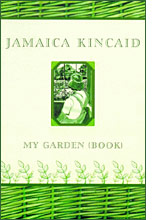

The protagonist of Jamaica Kincaid’s 1985 novel “Annie John” remembers her mother in Antigua this way: “Sometimes she might call out to me to go and get some thyme or basil or some other herb for her, for she grew all her herbs in little pots that she kept in a corner of our little garden. Sometimes when I gave her the herbs, she might stoop down and kiss me on my lips and then on my neck. It was in such a paradise that I lived.” The remembrance of that paradise lost is at the core of just about all the fiction and memoirs Kincaid has written. With her new collection of essays, “My Garden (Book):,” the author pays, perhaps inadvertently, her most heartfelt homage to the Caribbean island where she was born and from which she exiled herself to become a writer.
“My Garden (Book):” assembles the pieces on gardening and gardens that Kincaid has published in the New Yorker and elsewhere. This is not a how-to volume, but rather a series of meditations on the joys and frustrations of gardening. It is a book for anyone who loves looking at plants and gardens — a breed, Kincaid reminds us, who are often not the same as gardeners.
Connoisseurs of delectable prose will find much to savor here, though a few of the pieces do not fully crystallize. One in particular, about Monet’s garden, offers little insight about Monet, his garden or even Kincaid’s psyche. Furthermore, Kincaid’s dashing style, with its mixture of Katherine Mansfield’s delicacy, Virginia Woolf’s lyricism and Gertrude Stein’s melodious repetitiveness, is sometimes too precious; its girlishness (the way “What to do?” becomes a ritornello in “Wisteria”) can sound affected. Because these essays were written over several years, information is sometimes repeated (that Kincaid was born in Antigua; that once she and her father were ill at the same time, she with a tenacious case of hookworm). Yet these are minor quibbles about a book that affords many pleasures — not the least of which are Jill Fox’s eloquent drawings, which suggest stories and feelings in their own right.
And most of “My Garden (Book):” is prime Kincaid. “To Name Is to Possess” is a revealing meditation on colonialism and the erasure of identity that it imposes on the conquered: “It is not surprising that when people have felt themselves prey to it (conquest), among their first acts of liberation is to change their names.” Later, aware of the poignant irony of her own situation, the woman who renamed herself Jamaica Kincaid writes, “I have joined the conquering class.” In “What Joseph Banks Wrought,” Kincaid astutely pinpoints the relationship of colonized people to flower gardens: “It seems so clear to me, then, that a group of people who have had such a horrible historical association with growing things would try to make any relationship to it dignified (agriculture) and useful.” Coming as she does from a society and a class that planted gardens for food, the irony of having a garden of inedible things is not lost on her.
The collection is rich in vignettes about gardeners and neighbors, and one piece, “The House” — an extended profile of Robert Woodworth, the gentleman who built the Vermont house where Kincaid and her family live — is an affectionate and perceptive reflection on Yankee tradition. There are also startling portraits of the workers who toil in her garden and her traveling companions on a trip to China. Kincaid paints with quick brush strokes, showing these characters with intensity and clarity, their quirks rendering them fully alive.
The “lady writer” who emerges from these pages makes me think of a female E.B. White. Reading her, I feel as though I am lying in a hammock on a balmy summer day, surrounded by a garden of lovely colors and intoxicating fragrances. My favorites pieces are the ones in which Kincaid unleashes the closeted poet within: “Spring,” an enraptured psalm to the month of May; the humorous and sensual “The Season Past”; and the marvelous “The Garden in Winter,” a fable about racism that is also an elegiac and tender mood piece illuminated by the author’s intelligence.
I’ve long admired Jamaica Kincaid, yet her work has seldom elicited my love. Her chilly-hearted adult narrators, often so full of rage and sometimes even hatred, can be off-putting. Here and there, these essays contain misanthropic flare-ups in that mode. More often though, the writer who emerges is a brilliant and complex woman whose company we enjoy. “My Garden (Book):” is Kincaid’s most companionable book — the work of a writer to whom we gladly give our ear, the way we listen to friends whose wisdom is all the more appealing for the gentle way they deliver it.
