

If you go to Google Maps, search for Hazard, Ky., and select the satellite view (or just click here), you will see Appalachian hills as they appear from above: thin gray lines, like lightning, against a background of undulating green. These are some of the oldest and most diverse woodlands in North America, a mixed mesophytic forest — 290 million years in the making — that is home to nearly 80 species of trees. Scattered in this green landscape, you will also see oblong patches of gray and brown. These are the scars left by a coal-mining technique known as mountaintop removal, in which hillcrests are blasted and scraped away to expose coal seams, and the leftover topsoil and rock is dumped into valleys below. When this satellite image is next updated, there will be many more scars, as by now half of the mountains of Perry County have been sheared, a small fraction of the more than 500 square miles of forest that have been cleared in all of Appalachia.
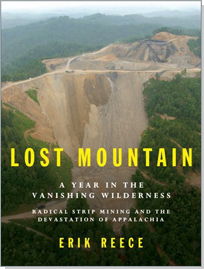
Among the newly shorn is Lost Mountain, a once modest peak a few miles north of Hazard that Leslie Resources Inc., a Kentucky coal company, began stripping in the fall of 2003. As it happened, journalist and University of Kentucky writing professor Erik Reece was looking for a doomed Appalachian hill to be the focus of his reporting on mountaintop removal for Harper’s magazine; Lost Mountain had the perfect name. So over the course of the following year, Reece made frequent, covert visits to its slopes as Leslie clear-cut its trees, blasted and bulldozed its topsoil and rock, and hauled away its coal. “Lost Mountain: A Year in the Vanishing Wilderness,” parts of which first appeared in Harper’s in April of last year, is Reece’s full account of what he witnessed and of the broader effects of this radical form of strip mining.
The chapters of “Lost Mountain” alternate between monthly updates on the peak’s devastation and episodes in the history, economy and politics of coal mining in America. All in all, it’s a grim picture. On his visits to Lost Mountain, Reece watches bulldozers shove piles of felled trees into burning pyres; trucks send hundreds of tons of sandstone and slate spilling down the mountainside; and blasts of ammonium nitrate and fuel oil transform hillsides into plumes of debris and acrid yellow smoke. Reese’s description of his last trip to the summit typifies his tone of controlled, yet piercing anger: “Stepping over a final berm of spoil, I find myself standing where the capstones once sat. Now all the vegetation has been shaved away. A long yellow fuse winds up to what once was the mountaintop but is now only an awful black knob.” Reece surveys his surroundings — “gray mounds of rock,” “black pools of rainwater mixed with coal” and a “wide black crater” — and concludes: “I am standing in the middle of a wasteland, a dead zone, a man-made desert.”
The shame and sadness of such a scene — of a richness built up over millions and millions of years undone in a matter of months — should be obvious, but many would no doubt argue that the destruction was worth it for the energy supplied and the money made, that plenty of other mountains remain untouched, and that this one will be made into something as good or better after “reclamation” — the term for coal companies’ legally mandated efforts to restore mined land to equal-to or better-than pre-mining conditions. The intervening chapters of “Lost Mountain” are largely an effort to address these arguments. In them, Reece exposes the moral, economic and ecological bankruptcy of mountaintop removal with a forcefulness to match the drag lines by which it is done.
Reece unravels the tortured and absurd language of environmental regulation whereby poisonous waste is reclassified as benign “fill material” and prisons, tourist stops and abandoned industrial parks count as “higher or better uses” for land than forests that serve, in essence, as the planet’s lungs, storing carbon and releasing oxygen in complementary inverse to our own lungs. He uncovers the shell game by which large coal companies set up smaller outfits in order to protect themselves from state regulators: “These [small] operations lease equipment from the ‘good’ company, and post a small bond that will supposedly cover the cost of reclamation should the company declare bankruptcy. Which is exactly what they do. The shell company forfeits its bond, which is never enough to complete the reclamation, and local communities are left with cracked foundations, a contaminated creek, poisoned wells, and steep slopes that pour mud down when it rains because there is no vegetation to hold the soil in place.” Reece further observes that surface mining accounts for only 4,000 jobs in eastern Kentucky and has failed to bring greater wealth to Appalachia, where the poverty rate has hovered at 31 percent for four decades. And he notes that, as wilderness areas grow smaller and more isolated, we are witnessing the sixth mass species extinction since the beginning of life on earth.
The list of social and ecological damage done by strip mining is long, but most bitter of all is the simple fact that we know better. The information, traditions and laws that would keep us from such ruinous behavior are out there; we have simply chosen to ignore them. Much of what we know about the costs of strip mining is codified, for instance, in the Surface Mining Control and Reclamation Act (SMCRA), which Jimmy Carter signed into law in 1977. Were it enforced according to its original wording and intent, SMCRA would change the practice of coal mining substantially and for the better. The requirement that coal operators restore mined land to its “approximate original contour” would make mountaintop removal practically impossible, as would the stipulation that “no damage will be done to the natural watercourses.”
But the will to enforce SMCRA has vanished since Carter left office. Instead we have men like Steven Griles, George W. Bush’s deputy secretary of the interior and a former coal industry lobbyist, who, while still collecting $284,000 a year from his former employer, has gone about hedging the language of SMCRA with phrases such as “to the extent possible” that render the act close to meaningless. Of all the episodes of negligence, corruption and greed that Reece recounts in “Lost Mountain,” none better illustrates the government’s betrayal of public trust and evasion of responsibility than the Martin County disaster of October 2000, when a coal slurry impoundment broke through an underground mine shaft and spilled 300 million gallons of toxic sludge on the eastern Kentucky community of Coldwater Creek. Though it was 30 times the size of the Exxon Valdez disaster, the spill garnered little public attention.
Under the pressures of corporate patronage, what should have been declared a Superfund site instead received a perfunctory and cosmetic cleanup, and what should have been a damaging criminal negligence suit against the responsible company, Massey Energy, instead ended in a $5,500 fine. This is what happens when Bush’s appointee for labor secretary, Elaine Chao, who oversees the Mine Safety and Health Administration (MSHA), is the wife of Kentucky Sen. Mitch McConnell, who has received millions of dollars in campaign contributions from the coal industry. Chao appointed a former mining company manager to take over the Martin County investigation and he produced a report that let Massey off the hook with barely a slap on the wrist. The wolves have been put in charge of the sheep.
When the bankrupt Horizon Resources, the parent company of Leslie Resources, sold its assets in the summer of 2004, the Lost Mountain mine came under the control of New York billionaire Wilbur Ross and his International Coal Group (ICG). Ross has made a lucrative practice of buying bankrupt coal and steel operations, canceling their employees’ healthcare and retirement benefits with the permission of the federal courts, and then unloading his investments at a steep profit, effectively shifting the costs of the business onto the working class and the profits to the investment class. (The Sago Mine in West Virginia, where 12 miners died last month and a 13th slipped into a coma after an explosion left them trapped for more than 40 hours, is, incidentally, another of the operations ICG acquired from Horizon. Sago had a long history of serious safety violations for which it had been fined a negligible $24,000.)
While it is both appropriate and easy to curse dishonorable politicians and ruthless corporate moguls, the difficult truth remains that we are responsible both for their power and for the energy demands that drive their actions. U.S. coal companies now extract a billion tons of coal per year, 70 percent of which comes from surface mines like the one on Lost Mountain. The overwhelming majority of that coal feeds coal-fired power plants that provide electricity to more than half of American homes, whose demand for electricity has risen 70 percent in the last 20 years. There is a good chance that as you read this review — and as I wrote it, and as Reece wrote the book that it is about — we are all participating in the destruction of Appalachia.
Reece’s acknowledgment of this shared responsibility and his sensitivity to how the controversies over strip mining play out in the culture help make “Lost Mountain” more than a mere screed. Though he lives in Lexington, Ky., and once worked as a janitor at a coal-fired power plant in Louisville, Reece knows that in the eyes of many in Appalachia his residence in western Kentucky and status as a professor make him just another outsider who cares more about trees than he does about country people. In one passage, Reese surveys a protest and counter-protest in Lexington over the release of the Department of Interior’s Environmental Impact Statement on mountaintop removal (the handiwork of Steven Griles) and deftly sums up the cultural divide. “You’ve seen them before,” he writes of the protesters. “They wear tie-dye shirts, Birkenstock sandals, and earnest expressions. They give fiery speeches about corporate greed and human arrogance. They play bongos.” And the counter-protesters: “You’ve seen them too — the golf shirts, the khaki shorts. They hang out in cigar bars and like the president.”
Yet, despite the embarrassing small-mindedness of the culture wars, Reece is unafraid to throw in his lot with the bongo players, at least for now: “The fighting between conservationists and the coal industry — between an ethic and the economy — will rage for years. That’s clear. And the fight might have to get quite ugly before substantial, sustainable change occurs,” Reece writes. “We will have to choose sides, it seems, to reach the point where we realize there are no sides, and that there are no sides because there is no outside.” This is the refrain of “Lost Mountain,” that we’re all in this together, and Reece can be forgiven if he sometimes hits us over the head with it. He cannot reshape the lost hills of Appalachia, so he aims to reshape our consciousness to conform not to the flat and barren logic of the market but to the health and wisdom of an old-growth forest.
But what kind of an economy would such an ethic construct? Would it survive being “mugged by reality”? To this Reece offers the example of the Ecovillage, a collection of apartments, gardens and greenhouses on the campus of Berea College outside of Lexington that is devoted to housing single parents. The Ecovillage recycles its own wastewater and, thanks to careful design, uses 75 percent less energy and water than the average American neighborhood. Its residents, meanwhile, live a perfectly comfortable lifestyle with washing machines, fluorescent lights and all the rest.
On a grander scale, Reece suggests that a carbon tax be levied on coal and other fossil fuels and that a large part of the revenue be used to subsidize reforestation projects. (The carbon tax is a notion that New York Times columnist Thomas Friedman has recently begun pushing as part of his “geo-green” political agenda.) Or failing that, Kentucky could at least raise its coal severance tax (which is levied on coal operators per ton of coal extracted) to a par with other coal-mining states and dedicate the extra revenue to fostering regional economies based around “furniture makers and cabinetmakers, tree farmers, fish farmers, foresters and people raising non-timber forest products such as mushrooms and herbs.” For many years, the people and hills of Appalachia have been paying a stiff price for the cooling, heating and lighting of our homes. Much of what weve taken cant be returned, but we can at least begin to create a system in which health and wealth are returned to their sources. We can, in the words of the ecologist Aldo Leopold, begin to “think like a mountain.”
