
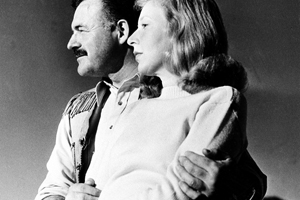

If Martha Gellhorn had not existed, George Cukor would have probably invented her. Born into an affluent St. Louis family in 1908 and educated at Bryn Mawr (where she was two years behind Katharine Hepburn), Gellhorn went on to become one of her generation’s most respected foreign correspondents, sending back dispassionate, shrewd dispatches from the Spanish Civil War, World War II and the Vietnamese conflict. Blond and beautiful, she married Ernest Hemingway and counted among her lovers legendary World War II Gen. James Gavin and billionaire Laurance Rockefeller. Her seemingly infinite list of famous friends included Eleanor Roosevelt, Leonard Bernstein, H.G. Wells and Adlai Stevenson. By her own estimate she traveled to more than 50 countries and owned houses in at least six of them. On the downside, she was by all accounts a lousy cook, though one imagines Cukor would have been able to find comic relief in that shortcoming.
Given Gellhorn’s iconic status, perhaps the greatest virtue of Caroline Moorehead’s dexterously edited selection of her letters is the way it depicts the irascibly human personality behind the legend. Though Gellhorn was usually on the side of the angels when it came to politics, she could also be willfully naive on the subject of Israel and downright repellent when speaking about the Arabs. Possessor of a remarkably full dance card of charming lovers, she was by her own admission indifferent to sex and continually disappointed by romance. A woman whose wartime reports were filled with compassion for children, she could be a mother from hell to her adopted son. Most notably, her letters reveal that her glamorous exterior and her cool journalistic prose concealed a volcanic, lifelong anger at the liars, frauds and politicians she deemed to be ruining the world she loved to travel.
Although the man with whom Gellhorn will always be most closely associated is Hemingway, he was by no means her first big love. That honor goes to Bertrand de Jouvenel, an unhappily married left-wing French journalist whom the 22-year-old Gellhorn met soon after her arrival in Paris with a typewriter and $75 in cash. Her letters from this time are among the book’s most poignant, not just for their tales of impossible love (de Jouvenel’s wife would not divorce him) but also for the prescience with which Gellhorn already viewed her role in a world hostile to ambitious, self-reliant women. “It’s all getting me down,” she wrote to a former high school teacher in 1931. “I think it’s horrible to scare people about life merely because they are female and have the emotional make-up — in certain respects — of males, or what males supposedly have.” Later, she writes with remarkable foresight about what will be her lifelong difficulty embracing domesticity. There is, she already knows at the age of 24, “too much space in the world. I am bewildered by it, and mad with it. And this urge to run away from what I love is a sort of sadism I no longer pretend to understand.”
After a break with de Jouvenel and the unexpected death of her beloved father, the 27-year-old Gellhorn met Hemingway at Sloppy Joe’s bar in Key West, Fla. Although the world’s most famous novelist was still married to Pauline Pfeiffer, it was Gellhorn who accompanied him to Spain, where she covered the civil war as a special correspondent for Collier’s magazine. Her letters from Spain to Eleanor Roosevelt are among the book’s most memorable (and its saddest, as it is doubtful that our current first lady cultivates similarly provocative and enriching correspondents). “And you know something else,” Gellhorn writes Roosevelt from Barcelona in 1938, “this country is far too beautiful for the Fascists to have it. They have already made Germany and Italy and Austria so loathsome that even the scenery is inadequate, and every time I drive on the roads here and see the rock mountains and the tough terraced fields, and the umbrella pines above the beaches, and the dust colored villages and the gravel river beds and the peasant’s faces, I think: Save Spain for decent people, it’s too beautiful to waste.”
Gellhorn moved with Hemingway to La Finca Vigia, their famous Cuban estate, in early 1939, but before long the spacious world beckoned her, and she was soon back in Europe to cover the Russian-Finnish war. From the beginning of their marriage, there is evidence in her letters that she was living with an egomaniacal child who did not like sharing a bed with a literary rival. A spoof pre-wedding contract contains what turns out to be some unintended truth when Gellhorn promises Hemingway that “he and his business are what matter to me in this life, and that also I recognize that a very fine and sensitive writer cannot be left alone for two months and sixteen days.” Readers who are tempted to look unkindly on Gellhorn’s wifely dutifulness here will be relieved to find that 10 years later, upon reading Hemingway’s “Across the River and Into the Trees,” she writes to a friend that “I feel quite sick, I cannot describe this to you. Shivering sick. I watch him adoring his image, with such care and such tolerance and such accuracy in detail … I weep for the eight years I spent … worshipping his image with him, and I weep for whatever else I was cheated of due to that time-serving.” After the bitterness wore off, Gellhorn was able (in a 1969 letter to her son, Sandy) to view her relationship with Hemingway with as much wisdom and equanimity as any of his celebrated biographers:
“He hated his mother, with reason. She was solid hell. A big false lying woman; everything about her was virtuous and untrue. Now I know enough to know that no woman should ever marry a man who hated his mother … Deep in Ernest, due to his mother, going back to the indestructible first memories of childhood, was mistrust and fear of women. Which he suffered from always, and made women suffer; and which shows in his writing.”
As their marriage dissolved during World War II, Gellhorn focused on her career, though she was frustrated by the U.S. Army’s refusal to let female correspondents serve on the front lines. To overcome this, she simply evaded her handlers and worked without escorts from D-Day until the war’s end. When she was picked up by soldiers of the 82nd Airborne, she managed to avoid deportation by causing their legendary young commander, Gen. James Gavin, to fall in love with her. At war’s end she adopted an infant from an Italian orphanage whom she named Sandy and moved to Mexico, then Rome, from where she watched the plague of McCarthyism squander European goodwill toward her native country. “Having spent my youth reporting on Fascism in Europe, I have a haunted sense of déjà vu, as I watch the ugly, pointless, witless process beginning at home and spreading back to Europe,” she wrote to two-time Democratic candidate Adlai Stevenson. “As a new experience, [Americans abroad] realize what it is to suffer from moral shame for one’s country.”
In 1954 she married former Time magazine editor Tom Matthews and settled down in London to a cozy life of socializing. “The main thing to keep firmly fixed in your mind is: Tom is not Ernest. Correspondence will reach the addressee, unopened. Lunch will never be à trois. Passes will be freely received in the spirit in which they are delivered. All is well. No purdah, no chains, no scenes, no one shooting out the living room windows. Times are different now.” Not surprisingly, security brought Gellhorn an ample dose of discontent. Marriage to Matthews taught her something most readers will have spotted 10 years earlier — she was not built for lengthy cohabitation. Although she was prone to intense relationships with remarkable men (a long, secret affair with Laurance Rockefeller, brother of David and Nelson, was to come), her heart was never wholly in it. Nor, it seems, was her body, according to this 1972 letter:
“I started living outside the sexual conventions long before anyone did such dangerous stuff and I may say hell broke loose and everyone thought unbridled sexual passion was the excuse. Whereas I didn’t like sex at all … all my life idiotically, I thought sex seemed to matter so desperately to the man who wanted it that to withhold was like withholding bread, an act of selfishness … what has always really absorbed me in life is what is happening outside. I accompanied men and was accompanied in action, in the extrovert part of life; I plunged into that; that was something altogether to be shared. But not sex; that seemed to be their delight and all I got was a pleasure of being wanted, I suppose, and the sort of tenderness (not nearly enough) that a man gives when he is satisfied. I daresay I was the worst bed partner in five continents.”
After her inevitable breakup with Matthews, Gellhorn remained in London, which was to be her home until her death in 1998, though she also spent time at her houses in Kenya and Wales. Late middle age was tough on her, as she watched her looks and energy fade at just the time her professional star dimmed. “I have always looked forward to my old age,” she wrote in 1960, “being more and more convinced that it would be far funnier than this neither fish-nor-fowl period of middle age, which I am bound to admit bores me.”
The one quality she did not lose was her anger, which only seemed to increase as she got older, allowing her to become the sort of feisty grand dame who always seems to be surrounded by a coterie of younger artists and intellectuals. “I never for a moment feared Communism in the U.S. but have always feared Fascism; it’s a real American trait,” she wrote after observing Barry Goldwater in 1964. She was particularly incensed by the Vietnam War. “I cannot endure this hideous wicked stupidity; to be at once cruel and a failure is too much,” she wrote about Lyndon Johnson. “Our President is a disaster and will get worse; never trust a Texan farther than you can throw a rhino.” Her white-hot rage at the war was only stoked by a 1966 trip to Vietnam for the Guardian newspaper (that she was forced to pay for herself). Her 1971 letter to Pentagon Papers liberator Daniel Ellsberg is eerily prescient about our current constitutional mess: “The President assumes that the American people are moral imbeciles … The Founding Fathers cannot have intended a President and his small group of appointed advisors to perform like a monarch surrounded by his court. As if the people’s representatives and the people themselves were a general nuisance, and the job is to keep the whole tiresome bunch quiet: manipulate them.” Even more prophetic is a 1962 letter to Stevenson, in which she claims that the “people of the United States of America need suffering to learn dignity; but I hope to Christ they are spared it, simply because they would not suffer alone and the rest of the world has had enough.”
Less inspired is her lifelong fealty to Israel (brought about by a 1945 visit to a newly liberated Dachau), which caused her to refer to an Egyptian soldier in the Suez crisis as a “Wog” and leads to the following regrettable passage in a letter to Leonard Bernstein: “[The Arabs] are not endearing … depressing and idiot, is my feeling, and inimical as well. I see perfectly why they hate Israel; it’s too clean, and it makes some sense out of real life.” Her bluntness also falls flat when turned upon her 20-year-old son Sandy, who is on the receiving end of a letter that might have just as easily come from the pen of Lady Macbeth. “You are a poor and stupid little fellow in my eyes. I’d be so damned ashamed to be you, I’d want to jump off a cliff.”
Despite these sour notes, Gellhorn’s capacity for anger remains the most beguiling aspect of this fine collection. Although there is plenty she can teach her successors about what it means to be a truly independent woman and a ferociously truth-seeking journalist in a world that does not always appreciate either of these virtues, it is her rage that truly endures, as freshly appropriate to our dark times as it was for the era in which it was born.
