

Mention the name Edward Abbey among literary folk in Manhattan, and they give you looks of condescension and pity, thinking you’ve mispronounced the name of a well-known playwright. In the five years I lived in New York almost no one I met had read him. In this part of the world, west of the Mississippi and east of the left coast, mention Cactus Ed and people’s eyes light up with either fury or reverence. Larry McMurtry anointed him the Thoreau of the American West. Wendell Berry praised him as a first-rate autobiographer. His friend Dave Foreman called him a “Mudhead Kachina,” a fond reference to the multifaceted clowns in Hopi religious ceremonies. Others were not so kind. In papers and magazines across the political spectrum, from the National Review to the Nation, he was labeled xenophobic, puerile, dopey, racist, sexist, an “eco-brutalist,” a “creeping fascist hyena.” One reviewer suggested he be “neutered and locked away for life.” He never failed to provoke a response. Love him or hate him, it was impossible — remains impossible — to read him with indifference.
In what may be our final chance to sample his previously unavailable work, Milkweed has now published Abbey’s selected letters as “Postcards From Ed: Dispatches and Salvos From an American Iconoclast,” a book that mostly reads as one last series of broadsides against the greed and lust for power that were the enemies of all he cherished. It arrives at a strange and foreboding moment, when many of Abbey’s fears and premonitions have come to pass. What little wilderness remains has come under brutal assault by oil, gas, coal, timber, mining and agricultural interests, both in America and elsewhere. Our government claims an unassailable right to spy on anyone it chooses; habeas corpus is apparently moot. Our military is bogged down in a feckless, asinine war. The planet is in the midst of warming irreversibly, and none of our politicians have the guts to be honest about what this means for our future.
Our lifestyle, we are told, is sacrosanct, any sacrifice in “our way of life” not only unnecessary but unpatriotic. Our elected leaders treat us as children or consumers — ideally both, monstrous in our appetites, unable to discriminate between our wants and our needs. As early as 1954 Abbey wrote presciently in his journal about the culture of Texas, an assessment with even greater relevance today, given the source of so many of our troubles: “Why pick on Texas? Because it typifies, concentrates and exaggerates most everything that is rotten in America: it’s vulgar — not only cultureless but anti-cultural; it’s rich in a brazen, vulgar, graceless way; it combines the bigotry and sheer animal ignorance of the Old South with the aggressive, ruthless, bustling, dollar-crazy brutality of the Yankee East and then attempts to hide this ugliness under a facade of mock-western play clothes stolen from a way of life that was crushed by Texanism over half a century ago. The trouble with Texas: it’s ugly, noisy, mean-spirited, mediocre and false.”
Such observations make reading Abbey a stiff tonic in almost any form — and make his letters, rich in passages like this, a kind of solace just now.
It’s been nearly 40 years since he wrote his masterpiece, “Desert Solitaire,” without which there would be less interest in the letters. Despite its stated purpose as a eulogy to a lost world, it seems hardly to have aged at all. In a series of linked essays Abbey telescoped his three seasons — 1956, 1957 and 1965 — at Arches National Monument in Utah into one “season in the wilderness.” Part of the book’s staying power resides in the synthesis Abbey created between the American desert — the red-rock canyons, “Abbey’s country” — and the beautiful, hard-chiseled prose, as rough and gorgeous as the land itself, that he used to celebrate its harshness and mystery. There were other lovers of the arid American West before him — Mary Austin, Joseph Wood Krutch — although they were far outnumbered by those who feared and loathed it, and none were as vociferous in its defense, before or since. None have matched his style. Like many good writers, he misjudged what was best in his body of work, preferring the vastly inferior novels “Good News” and “Black Sun,” the first an apocalyptic comedy, the second a saccharine love story. His biggest gripe was being pigeonholed as a “nature writer,” and for years he refused to allow any portion of “Desert Solitaire” to be anthologized.
For most of his writing life he was the creator of his own myth, the myth of a man who shared his name if not all the details of his actual biography. Late in life he employed misdirection to ward off pilgrim admirers, signing letters from “Oracle” or “Wolf Hole” in Arizona, but the creation myths begin in his idealized youth. He often claimed to have been born on a submarginal farm near Home, Penn., an actual town where his family moved when he was 14, but he was in fact born in 1927 in the larger nearby town of Indiana, better known as the birthplace of the actor Jimmy Stewart. His mother taught school. His father, a radical socialist, sold real estate and later magazine subscriptions. Aside from a summer spent on the road during the Depression, camping in state parks while his father moved from job to job, Abbey seems to have enjoyed a comfortable if modest upbringing. His life changed the year he turned 17. That summer, in a family tradition shared by his brothers and his father, Abbey hitchhiked west for several months and fell irretrievably in love with the land he would defend and celebrate for much of his life: the Sonoran and Chihauhuan deserts of Arizona and New Mexico. (Only later did he find his way to Utah.) He subsequently wrote that on his virgin trip to the Grand Canyon, “the first thing I did was urinate off the rim onto a little aspen tree waiting patiently below. It was a semiconscious act, no offense meant, signifying a claim to territoriality. But I have belonged to the Grand Canyon ever since, possessing and possessed by the spirit of the place.”
This, in a nutshell, explains much worth knowing about the man. Territoriality, for Abbey, did not mean actual title to the land, in the sense of private property. For most of his life he was peripatetic, and for more than two decades he lived half of each year in various national parks, national forests and wildlife preserves, where he supplemented his writing income as a seasonal ranger and fire lookout. The places he revered most were usually part of the federal land-management map, and therefore “owned” by none and by all. Territoriality to Abbey meant something deeper. It meant a love that didn’t seek to dominate or tame, a love that encompassed even the harshest of the wild creatures that knew it as home. “I’m a humanist,” he wrote, in “Desert Solitaire.” “I’d sooner kill a man than a rattlesnake.”
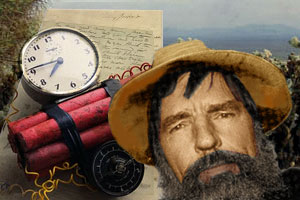
Typical Abbey: the overstatement for dramatic or comic effect. As grim and fierce as his enemies made him sound, he preferred the comedic form in disseminating his radical ideas. “The Monkey Wrench Gang,” his 1975 comic novel, did more than any other book to cement his notoriety. It also sparked a political movement, a distinction shared only by a handful of American novels, including “Uncle Tom’s Cabin” and “The Jungle.” The merry pranksters and eco-freaks at the center of the novel borrowed much from the lives of Abbey’s friends — the renowned grizzly bear expert Doug Peacock (model for George Hayduke), the river runner Ken Sleight (known as Seldom Seen Smith in the novel) — and he even named a major character after Bella Abzug, the spunky New York congresswoman whom Abbey often recommended as a candidate for secretary of state. Their fictional exploits have given succor to a couple of generations of environmental activists, most clearly in the form of Earth First, and more recently in the case of the Earth Liberation Front. Earth First founder Dave Foreman worked in Washington as a lobbyist for the Wilderness Society when he first encountered “The Monkey Wrench Gang.” In 1980, exasperated by the indifference of elected officials to wilderness preservation, he quit and moved west to begin a colorful and dangerous career in civil disobedience and direct action against those who befouled the West for their own profit. One of the group’s first public acts came straight from the pages of Abbey. On March 21, 1981, with Abbey in attendance, it gathered several people at the Glen Canyon Dam in Arizona and unrolled a huge black plastic strip down the dam’s face, simulating a crack that dramatized their hopes for its eventual destruction.
The “Damnation of Glen Canyon,” as Abbey referred to it, did more than anything else to shape his ideas about what was permissible in the defense of wild places. He had been among the last to float through that labyrinthine world of sandstone cliffs, deep grottoes and golden rivers, before it was submerged. In “Desert Solitaire,” he wrote: “To grasp the nature of the crime that was committed, imagine the Taj Mahal or Chartres Cathedral buried in mud until only the spires remain visible.” But this was worse. The Taj Mahal could be rebuilt if necessary; in no way could the human hand replicate the lost world of Glen Canyon, drowned under Lake Powell.
Abbey liked to say that he wrote “to entertain [my] friends and exasperate our enemies,” and when “The Monkey Wrench Gang” was first published he refused to endorse the view that it was a clever fictional guidebook for would-be saboteurs. Yet over time he made clear his distinction between sabotage and terrorism by stating that the destruction of property was distinct from a willingness to take innocent human life; killing a bulldozer was not the same as killing a man. Industrial sabotage, in Abbey’s reckoning, was a means of halting or slowing far worse forms of destruction: dam building, strip mining, clear-cutting, road building in places where wilderness came under assault by the avaricious appetite of techno-industrialism. He knew whereof he spoke. In the 1950s, while studying philosophy at the University of New Mexico, he burned and cut down billboards around Albuquerque; later he monkey-wrenched bulldozers at work on a road through the red-rock country of Utah — “field research,” as he called it, for certain scenes in “The Monkey Wrench Gang.” “Growth for the sake of growth,” he liked to say, “is the ideology of the cancer cell.” Those who would willfully destroy the earth in search of short-term profit “would never understand that an economic system which can only expand or expire must be false to all that is human.”
It should come as no surprise that the FBI did him the honor of beginning a lengthy dossier when he wrote a public letter in favor of young men burning their draft cards, in 1947. (In the current climate, this piece may have a similar result, so why not go whole hog: save a tree, burn a ski resort! I say ha-ha, you say incitement to terrorism.) He would later request his file under the Freedom of Information Act — “130 pages of tedious dithering,” as he discovered. His enemies were legion, from political left to right and everywhere in between; yet his friends were fiercely loyal, and his fan base bigger than that of any other serious writer in the West, with the possible exception of McMurtry. His books have sold in the millions. All across the mountains and deserts of the American West, in lookout towers and tavern pissoirs, people have scrawled the words “Hayduke Lives!” a reference to the anarchist wild man and Vietnam vet who leads the eco-saboteurs at the center of Abbey’s most famous novel.
– – – – – – – – – – – –
After a writer for the New York Times called him “thirty years behind the times,” Abbey feigned outrage. Ever the jokester, he claimed he was closer to a hundred years behind. As “Postcards From Ed” reveals, though, Abbey is always topical.
“But hell, I do like to write letters,” he admitted. “Much easier than writing books.” David Petersen, editor of not only the letters but also Abbey’s journals, which appeared in 1994 as “Confessions of a Barbarian,” informs us in his introduction that Abbey liked to begin his writing day by firing off a couple of missives, to limber up the writing muscles and get the imagination moving. He enjoyed the economy of postcards, but when the mood struck he could write for pages on the moral duties of the novelist or the philosophy of Spinoza. Although he honed a direct and vigorous prose style, his early education in philosophy reveals itself in his love for lofty argument and his easy mixing of big ideas with close observation of the natural world. He once hoped to become a professor of philosophy, even enrolled in graduate school at Yale; he lasted two weeks before he was tripped up by the abstractions of symbolic logic. As he later wrote to a friend, “When I hear the word ‘phenomenology,’ I reach for my revolver.”
Even for those who think they know the real Abbey, the letters hold surprises and delights. He writes tenderly to his parents and his children — a side of him largely absent from his substantial nonfiction, and too slightly represented here as well, probably in part because of a flood at his family’s home in Pennsylvania, which destroyed four early journals too. Certain of his friends also lost their personal archives by flood or by “being zenlike” and throwing them out after Abbey’s death.
More surprising, though, is the exasperation he admits over his status as social gadfly and eco-radical, a persona he’d carefully cultivated in public. “I often tire of my role as the sneering buzzard on the dead tree,” he writes to George Sessions, a philosophy professor at Sierra College in California. “There are times when I envy those with the freedom to hurl themselves into the mob, to lose themselves in the flood of life.” And elsewhere: “I doubt that my sense of personal freedom is any stronger than anybody else’s.”
Readers of “Desert Solitaire” and certain of his essays may find this an unlikely statement. Abbey’s finest writing celebrates the kind of freedom he cherished above all — the freedom to experience the natural world and humans’ ancient place in it without the meddlesome, mediating influence of “the caterwauling of commerce.” He had an affinity for anarchism; he wrote his dissertation on “Anarchism and the Morality of Violence” at the University of New Mexico. Yet in that same letter declaiming any monopoly on notions of freedom, a further, clarifying statement spells out the credo so many of us cling to in a political climate thick with double-chinned sycophants and barking simpletons: “I’m happy to respect authority when it’s genuine authority, based on moral or intellectual or even technical superiority. I’m eager to follow a hero if we can find one. But I tend to resist or evade any kind of authority based merely on the power to coerce. Government, for example. The Army tried to train us to salute the uniform, not the man. Failed. I will salute the man, maybe, if I think he’s worthy of it, but I don’t salute uniforms anymore.”
Some of Abbey’s most entertaining letters involve skirmishes over literary reputation, one of his enduring obsessions. In a letter to the Nation, he contrasted Kurt Vonnegut’s “concern for justice, love, honesty and hope” with “novels about the ethnic introspection project (Roth, Bellow)” and “the miseries of suburban hanky-panky (Updike, Cheever, Irving).” He disparaged Jack Kerouac as “that creepy adolescent bisexual who dabbled in Orientalism and all the other fads of his time, wrote stacks of complacently self-indulgent, onanastic books and then drank himself to death while sitting on his mother’s lap, down in Florida.” He called Tom Wolfe a “faggoty fascist little fop” but later defended “Bonfire of the Vanities” as a “novel that reminds us, in the end, that defiance and resistance, manhood and honor, are still possible.”
Later in life, Abbey wrote less to friends and more to newspapers and magazines whose stories had raised his ire. Letter writing became a laboratory for his nonfiction and a way to stay engaged with issues he cared about while he worked on novels. He loved to provoke merely for provocation’s sake and often wrote in a caricature version of himself to goad other writers and editors. In a hilarious note to Ms. magazine — Mizz, as he put it — he deliberately cloaked himself in the ignorance and misogyny that certain of his detractors claimed were his signature: “Dear Sirs,” he sarcastically began. “Some of us menfolks here in Winkelman ain’t too happy with this magazine of yourn. Are old wimmin is trouble enuf to manage as is without you goldam New Yorkers shooting a lot of downright sub-versive ideas into their hard heads. Out here a woman’s place is in the kitchen, the barnyard and the bedroom in that exack order and we dont need no changes.” This sort of clowning is entertaining, no doubt, but it’s also belied by his serious, thoughtful, encouraging exchanges with writers such as Annie Dillard and Ann Zwinger. In other instances he implores writers he admires to join the fight against the exploitation of the West: “I am puzzled by your attitude toward environmentalists, conservationists, eco-freaks, whatever you want to call them,” he wrote to Tom McGuane. “They are not, as you seem to think, a bunch of doomsayers and despair-mongers … What they are mainly concerned with is letting people know what’s going on and then organizing intelligent opposition to the greedy and stupid; intelligent support for the good and generous. That’s all, and that’s enough … If we love our country, how can we refuse to defend it?”
The most brutal intellectual battle of Abbey’s life arose when he began to sound off about illegal immigration. This was in the 1980s, when even to mention the subject was to violate a liberal taboo, and Abbey’s critics were quick to accuse him of xenophobia. The old coot couldn’t help baiting them. “It seems to me you might as well change your name to the Daily Estrellita,” he wrote to the Arizona Star, in 1982. “Better yet, set up your editorial offices in South Nogales, where you can enjoy today the poverty, misery, squalor and gross injustice which will be the fate of America tomorrow, if we allow the Latino invasion of our country to continue.” The next year he wrote to New Times: “I will confess to cultural bias. Though an aficianado of tacos, Herradura tequila, and ranchero music (in moderate doses), I have no wish to emigrate to Mexico … At some point our Anglo-liberal-guilt neurosis must yield to common sense and enlightened self-interest.”
His proposed solutions, radical when he first made them 25 years ago, appear entirely mainstream now. In letters to the New York Review of Books and elsewhere he advocated a military presence along the southern border, construction of physical barriers in the larger border cities, and penalties for employers who hired illegal workers. His position was never as harsh as his critics claimed, as is clear from another belief generally deemed sensible now across the political spectrum: “I share the general opinion that illegal aliens who have resided in this country continuously for a period of, say, five years or more, and who can prove that they have established families, homes and livelihoods here, should be granted legal status of some kind. It would be cruel to do otherwise.”
Abbey was a man of profound contradictions. He wrote scabrously about Hispanic culture — a culture he claimed was based on “TV, welfare, the [Roman Catholic] church, drugs, crime, politics” — but served a stint as editor of the bilingual El Crepusculo de la Libertad (the Dawn of Liberty), the West’s first newspaper, founded in Taos in 1834. He believed overpopulation was among our most pressing problems but married five times and fathered five children. Even as he railed against the despoliation of the natural world, he reveled in long car trips on which he measured distance not in miles but in six-packs, tossing his empty beer cans out the window. In short, it’s impossible not to find something to quarrel with in the man. I can’t say I agree that the right to bear small arms would have much of a deterrent effect against the overweening tyranny of the state; it sure didn’t work at Ruby Ridge. Or to take an example dearer to my own heart, this one from his journals: “Jazz: The destruction of melody. The rigid meter. The elaboration and direction of deliberately banal tunes Big-city music. American? The American Negro loose in the slums. Crafty, cunning, subtle, arid music The jazz cult: professors, monographs, addicts, puritans. The terrible fear of emotion, significance, direct statement. Music for aesthetes, purists and cold-bellied geometers.” This is offensive and wrongheaded on so many levels you want to grab him by the ear and force him to recant after an hour spent with Louis Armstrong and Duke Ellington’s masterpiece “The Great Summit,” to pick merely one example that shatters every word of his argument.
These contradictions seem perversely to have aroused an impulse to pigeonhole Abbey, to gloss his complexities. Those who don’t fixate on one or another of his un-p.c. positions make facile comparisons between his work and that of other “nature writers” such as Thoreau, Muir and Aldo Leopold. Yet it seems to me, after reading both men’s letters, that the most apt comparison is with Hunter Thompson, that other wild-eyed scourge of official pieties. Both were habitual letter-writers. Both could be brash in print and shy in person. Both served a stint in the military. Each was footloose in his youth, Thompson jaunting to the Caribbean, Abbey first hopping the rails and hitching the highways of America, then serving as an M.P. in Italy after World War II. Both made geographic journeys from East to West: Thompson from Louisville, Ky., to Colorado, Abbey from Pennsylvania to the Southwest. Both invented outlandish personas in their writings that bore only some resemblance to their actual lives.
Both wrote fiction but did more lasting work in polemical essays and inventive memoir. They each looked upon their country with a mixture of outrage and affection, and both were at their best in work that was occasionally profane, sometimes self-contradictory, and often hilarious. Each enjoyed mind-altering substances to excess — Abbey booze, Thompson anything he could get his hands on. (Abbey took LSD only once, an experience he called an “uncomfortable and inconclusive failure: the stars quivered in a cloudy cobweb but the big spider-God failed to appear.”) Both did themselves in: Thompson with a bullet, Abbey with the bottle (officially “esophogeal varices,” exacerbated by drink). Both wrote compellingly about the death of a certain kind of American dream. Each was a patriot, but that which they loved most about America seemed to pass toward oblivion during their lifetimes.
Now, more than ever, we need patriots like them. Not Patriot Act patriots, not flag-waving chauvinists, but writers willing to hold the clay feet of American ideals to the fire. When he died in 1989, Abbey’s friends buried him — illegally — in the Arizona desert, beneath a rock in which were carved the words “No Comment” — one more joke at his own expense. At a memorial service outside of Tucson his friends drank tequila and dined on “slow elk,” one of the public-land cattle, shot by Peacock (so the legend goes), that Abbey detested as hooved locusts and destroyers of streams. In his letters and in his books, the best of which will endure as long as hominoids read, he still speaks to us from beyond that desert grave.
