

When I landed in Togo in mid-2000, I shared a ride with a young Congolese woman who had just arrived to work on a poverty alleviation initiative at the United Nations Development Program. When I left Togo two and a half years later, the program had still not managed to spend any of its allocated $2 million on poverty alleviation projects, but the young lady had managed to embark on an affair with a son of the country’s brutal dictator. The UNDP office in Togo was divided between lackadaisical, corrupt staff and dedicated, energetic ones; the country representative, a brilliant and sincere woman, directed promising programs toward the more proactive staff, while carefully placating the sluggards. The office was, in other words, like much of the U.N.: Making it work demanded someone of enormous diplomatic talent and patience. Someone like Kofi Annan.
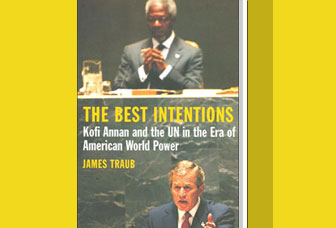
James Traub’s inside account of several years in the life of the retiring U.N. secretary-general is a chronicle of diplomatic talent and patience, and it makes for a fascinating, if sometimes exasperating, read. In Traub’s telling, Annan, a sympathetic but meek hero, is repeatedly abused by powerful agents posing as benefactors or suitors, escaping only to be again beset by disaster. It’s a picaresque adventure in the mold of “Candide” or “Great Expectations,” as the title, “Best Intentions,” suggests; though “A Series of Unfortunate Events” might have been equally apt. The book works, not just as a portrait of Annan but as one of the U.N. itself, in part because Annan personally encapsulates many characteristics of that inspiring but maddening organization.
Annan is a quiet man, tolerant to a fault, committed to the highest ideals of humanitarianism, but resigned to the constrictions of his office. He is a wily politician, but his caution sometimes shades into paralysis. Where Annan and the U.N. can act, it is because the United States and other member nations demand it; where he fails, it is because the members don’t demand it, or they disagree among themselves. The great powers take credit for the actions, and blame the failures on Annan and the U.N. It demands a particular kind of character to serve as the world’s scapegoat for two consecutive five-year terms, and the book poses the question of whether the U.N. has a future, or whether the Bush administration’s repeated warnings of its impending irrelevance are, in part self-fulfillingly, correct.
Traub takes a minimally optimistic view: The U.N., though diminished in stature, is not irrelevant. But some readers may come away from the book more sanguine than the author himself about the U.N.’s chances. The organization’s existential crisis in early 2003, when its bitter divisions in the face of U.S. demands for an authorization to invade Iraq seemed to portend collapse, looks far better in retrospect, as that invasion has been revealed as a colossal error. And U.N. involvement on a variety of fronts over the past several months, including North Korea, Darfur, Congo and global warming, suggests that while the organization may often be ineffective, it remains indispensable.
As Traub recounts, this is hardly the first time the U.N. has faced a crisis of relevance. It has never lived up to its founders’ vision of a proactive international security organization. The Cold War froze the Security Council, and the first few secretary-generals were inoffensive creatures. The exception, the maverick Dag Hammarskjöld, pushed through an aggressive 1960 U.N. peacekeeping mission in the Congo that, while arguably successful, was so bloody that it scared the U.N.’s member states away from such ventures for a generation. Hammarskjöld, killed in a plane crash during the fighting, was succeeded by ineffectual figureheads.
Meanwhile, decolonization transformed the General Assembly into a body dominated by the Third World, especially the non-aligned “G77” countries. The G.A. was thus frequently at odds with the Security Council and its mainly European and American permanent members. And the U.N. gave birth to a series of agencies — the U.N. Development Program, the U.N. Population Fund, the U.N. Educational, Scientific and Cultural Organization, etc. — that attempted to accomplish humanitarian and development goals while being yanked this way and that by the political demands of the member countries. Poor countries treated U.N. agency staff positions as sinecures for their elites. Rich countries, especially the U.S., threatened to withhold funding unless the agencies adhered to their ideological agenda.
The end of the Cold War ushered in a new optimism. With Russia and China now amenable to cooperation with the West, the Security Council seemed capable of fulfilling its original mandate of forceful intervention. Such hopes were dashed by the disastrous U.N. peacekeeping experiences in Somalia, Bosnia and Rwanda. The failure in Somalia was blamed on excessive adventurism; those in Bosnia and Rwanda, on excessive timidity. Liberal internationalists in Europe and America were furious with U.N. headquarters for refusing, in Rwanda and Bosnia, to authorize their blue-helmeted peacekeepers to use force to protect civilians. But third-world governments opposed any non-consensual interventions as a violation of sovereignty. With the Dayton Accords, the Clinton administration turned decisively toward humanitarian intervention, and against Secretary-General Boutros Boutros-Ghali, a Francophone Egyptian who had vetoed airstrikes in Bosnia. When his first term expired, the U.S. maneuvered Boutros-Ghali out in favor of the less prickly Annan, the Anglophone head of the U.N.’s peacekeeping operation, whom it expected would be more amenable to American wishes.
Traub thinks the Americans were unprepared for what they got. Annan turned out to be a quiet but methodical advocate for the U.N. with an unexpected kind of star power. When he was elevated to secretary-general, the far-right isolationist wing of the Republican Party was reaching the apogee of its opposition to the U.N., complete with myths about “black helicopters.” In concert with Clinton administration U.N. ambassador Richard Holbrooke, Annan reached out to then-Sen. Jesse Helms, who had been leading an effort to slash the U.S.’s contribution to the U.N. if it failed to undertake a range of practical and ideological changes. Annan and Holbrooke ultimately won Helms over, and neutralized the anti-U.N. faction in Congress — for a while.
Meanwhile, Annan was pushing the U.N. toward a rethinking of its doctrine on intervention. Here, he found himself caught between the interests of the powerful Euro-American bloc, which wanted U.N. approval for its interventions in places like Kosovo, and the G77, which considered sovereignty rights absolute. Annan carefully edged toward a stance supporting human rights over sovereignty rights, tipping his hand with his September 1999 opening speech to the General Assembly. At the time, third-world nations roundly denounced Annan’s speech. But by 2005 every U.N. member endorsed the so-called Responsibility to Protect: the principle that the international community had a duty to protect people against their own murderous governments. Traub cites U.N. official John Ruggie’s characterization of Annan as a “norm entrepreneur,” gradually shifting the terms of global debate, not through direct confrontation, but by subtly reshaping the moral landscape.
Annan pursued the same strategy in the field of development with the “Millennium Goals,” which emerged from the 2000 Millennium Summit of world leaders. The summit won, among other things, commitments from the world’s wealthy nations to increase foreign aid to 0.7 percent of their countries’ GDPs, while slashing poor countries’ foreign debt. And poor countries committed to meeting concrete development goals of their own by 2010, an incentive for their governments to improve fields like education and health or face public embarrassment. But the fact that, six years on, most of these goals are nowhere near being met points out the weakness of Annan’s norm entrepreneurship: Such norms can quickly come to resemble so much hot air if there is no real political will behind them.
For those who take a sour view of Annan, his willingness to embrace hot air and his aversion to conflict are his defining characteristics. That view took hold among hawkish Americans in early 1998, when Annan flew to Baghdad for frantic negotiations with Saddam Hussein to avert a looming war over Saddam’s restrictions on U.N. arms-control inspectors. (Annan won an agreement, but Saddam soon reneged, and the Desert Fox bombing campaign ensued.) Annan was similarly unable to act forcefully enough to punish his son Kojo when it emerged that he had lied about his employment with a Swiss firm that benefited from the corrupt U.N.-administered oil-for-food program in Iraq. Annan has a notorious inability to fire people; his closest officials have been with him for decades, and when he was pushed to fire one of his deputy secretary-generals, he ended up promoting her instead.
Traub’s book really kicks into gear in the aftermath of the Security Council’s confrontation over the invasion of Iraq. Angry American conservatives push investigations into the Oil-for-Food program in order to depict the U.N. as collaborating with Saddam’s regime. Annan is driven into a depressed funk as the investigation of his son Kojo tars him personally. His attempt to get the U.N. involved in post-invasion Iraq leads to the bombing deaths of dozens of U.N. staff, some of them personal friends. Headquarters staff are bitter at Annan for allowing the U.S. to yank the U.N.’s chain; the U.S., his former patron, now sees him as part of the U.N. problem. But Annan gradually hauls himself, and the organization, out of this funk, establishing a panel to hash out a deep program of comprehensive reform. He pushes long-standing senior staff members aside in favor of a new reformist cadre, appointing the dynamic head of UNDP, the British Mark Malloch Brown, as his new No. 2. (This in turn leads some staffers to accuse Annan of abetting an Anglo-American putsch.)
It is in this sequence that the great merits of Annan’s slow, inclusive but relentless mode of persuasion become apparent. The driving force behind the U.N. reforms is American, and to some extent European, anger at the organization’s corruption and listlessness. But the only internal U.N. constituency for reform comes from a number of countries that want to win permanent seats on an expanded Security Council, for reasons of prestige — Germany, Japan, India, Brazil and a coalition of African countries. Annan deftly insists that these countries advance the broader reform program as the price for continued work on Security Council expansion. Over a period of months, he nudges the reform package through working groups that water it down into a set of proposals with broad, if unenthusiastic, assent. At each step along the way, Annan uses sympathetic contacts in the U.S. State Department to ensure that the proposals are acceptable to Condoleezza Rice. The target is to approve the reforms at the World Leaders Summit, the follow-up to 2000’s Millennium Summit, in September 2005.
And then, in the summer of 2005, the new U.S. ambassador John Bolton descends upon U.N. Headquarters, more or less like a bat out of hell. Many Americans of an internationalist bent were dismayed at the Bush administration’s choice of the combatively unilateralist Bolton, who had famously stated in the early ’90s that if 10 stories were lopped off of the U.N. Headquarters building, no one would notice. But after his failed confirmation hearings and recess appointment, Bolton dropped out of the headlines. It was a poor choice, many felt, but how much damage could one guy do?
Traub provides the answer: Bolton was a disaster, not just for the U.N., but for the U.S. Arriving after the reform document had been largely agreed upon, in discussions involving over a hundred member countries, Bolton suddenly announced he wanted more than 140 changes in the final document. He wanted all references to the International Criminal Court deleted. He wanted references to wealthy countries’ Millennium Goals commitments of increased foreign aid taken out.
Annan and the reform party in the U.N., who had been carefully clearing the document’s language with the U.S. State Department, were shocked. Bolton seemed to have a different agenda than Rice. What did the U.S. actually want? Did it even know? In any case, the effect of Bolton’s new demands was the opposite of what he intended: They opened the door for obstructionist third-world dictatorships to introduce their own objections. Countries like Cuba, Algeria and China were unhappy with U.S.-driven efforts to reform the U.N.’s Human Rights Council. They had gone along with the reform drive rather than be seen to torpedo much-needed changes, including Security Council expansion. But now that the U.S. could be blamed for the reforms’ failure, all bets were off. Bolton’s incompetent diplomacy had succeeded in holding the U.N. reform process hostage to Fidel Castro.
Traub’s depiction of Annan’s battle of wills with Bolton, as the September 2005 deadline draws near, is nothing short of thrilling. It’s like watching a practiced cowboy break a mustang. By the time Annan has Bolton tied down so he can whisper gently in his ear, the U.N. reform package has suffered considerable damage. But a package is passed, and the momentum for further reform is kept alive.
Liberals and other internationalists will enjoy watching Annan redeem himself, and the U.N., with a victory over the arch-neoconservative Bolton. It’s the satisfying ending to Traub’s version of “Great Expectations,” with Annan at last defeating his selfish American benefactors, who raised him up and then tried to control him. But the dirty secret, for internationalists who have experience with the U.N., is that we know Bolton was partly right. A large proportion of the U.N.’s staff is occupied in doing nothing of any value, and the U.N. as an institution has very little power except where its member nations want it to. The U.N.’s own top staff recognize this. Traub quotes Deputy Secretary-General Mark Malloch Brown: “The fact is, I do think what a lot of people do here is basically crap. Being in this position, I’ve discovered how bad things really are.”
The flip side of such criticisms, however, is that nothing can be accomplished in a multilateral institution like the U.N. with threats and ultimatums. Moving the U.N. does require the occasional dose of Boltonesque straight talk, but what it requires much more is a very un-Boltonesque willingness to engage in agonizing negotiations, to pay people compliments they don’t deserve, to embrace hot air. In the aftermath of Bolton’s resignation in early December, some of his opponents magnanimously praised him as a sincere man. The genius of “Best Intentions” is to show how Annan’s willingness to skirt or stretch the truth, in order to advance the U.N.’s principles of humanitarianism and global cooperation, represents a different and, in this case, more powerful kind of sincerity.
