
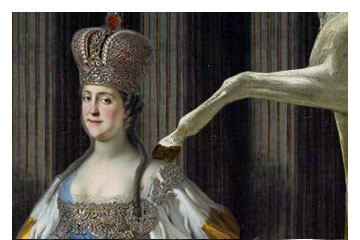

“The real Catherine,” reads the flap copy on “Catherine the Great: Love, Sex and Power,” Virginia Rounding’s new biography of the Russian empress, “was more interesting than any rumor.” This seems a pretty tall order, since the only rumor most people know concerning Catherine the Great is that she died while attempting to have sex with a horse. The slightly better-informed might also be dimly aware that she is the monarch for whom “Potemkin villages” — false fronts designed to present the appearance of thriving towns where none actually existed — were supposedly built along the road to Crimea. It turns out that neither of these legends is true, and while reality can hardly hope to compete with such yarns when it comes to sheer sensationalism, the stories raise a provocative question: Why did people tell them in the first place?
“Catherine the Great” will surely turn up on the display table at my neighborhood bookstore, which is already more than half-occupied by biographies of European queens, princesses and other aristocratic ladies. Women who may have achieved little politically during their actual lives — such as Lady Jane Grey, the subject of a new biographical novel by Alison Weir, “Innocent Traitor,” to name just one — have managed to conquer significant chunks of retail real estate after their deaths. The ideal subject for these “princess books” is Anne Boleyn, the indirect subject of Philippa Gregory’s very successful historical novel “The Other Boleyn Girl,” which is told from the point of view of Anne’s sister, Mary, who preceded Anne as a mistress of England’s Henry VIII. The heroine of a princess book ought to be beautiful and spirited, so much so that she’s awarded with a crown (and many scrumptious gowns). But most important, she must meet a tragic end in order to demonstrate the principle that, for women, power and happiness do not mix.
If that sounds familiar, no wonder: The fabulous popularity of Princess Diana was largely due to how well her life fit this preexisting formula. The more persuasively the princess (or queen or duchess — see Amanda Foreman’s bestselling biography, “Georgiana: Duchess of Devonshire”) can be cast as a victim, the more she mesmerizes the public. What, otherwise, explains the ongoing fascination with Lady Jane Grey, who was maneuvered onto the throne by her parents and ruled for only nine days before being usurped and executed by her cousin Mary at the age of 16?
Catherine II of Russia, who reigned for 34 years, kept a series of young lovers (a few of whom became her closest advisors), coolly eliminated at least one pretender to the throne and died at the ripe age of 67, does not fit this mold, which may explain why there are few bestselling novels about her. Yet Catherine was a remarkable ruler, who greatly expanded the power and prestige of Russia, achieved many internal reforms (without challenging the deeper inequities of her society), instituted free public education and, perhaps most impressive of all, survived for decades in charge of the conspiracy-ridden world of imperial Russian politics. She corresponded with Voltaire and Diderot, acquired most of the artworks that make the Hermitage one of the world’s great museums and constructed many of the grandest buildings in St. Petersburg.
Rounding dedicates herself to redeeming Catherine from the infamous “horse story” and other calumnies, and as a result tends to play down the caprice and extravagance of the Russian court. Still, “Catherine the Great” abounds in at least one of the requirements of royal biographies: detailed descriptions of the lavish ceremonies and sumptuous trappings of royal life. There’s lots and lots of jewelry here; the principal players are forever exchanging emerald-encrusted hunting knives and diamond-covered fans (as well large quantities of tea and, mystifyingly, rhubarb). To celebrate the birth of her grandson, Alexander, Catherine threw a party at which the guests strolled under a pair of 2-foot-high letter A’s made of diamonds and played the card game macao using diamonds for gambling chips.
Likewise, when the empress traveled, it was usually with a gigantic retinue: hundreds of horses, squadrons of soldiers, dozens of courtiers and countless servants — including, in one instance, a “preserve-maker” and “a man to make the coffee.” Rounding favors her readers with a few too many inventories of these processions, but even readers with little taste for “lifestyles of rich and aristocratic” voyeurism may find themselves a bit dazzled by a Cleopatrian fleet of “gold and scarlet galleys,” each with its own orchestra, and a coach, pulled by 30 horses, containing “a bedroom, sitting room, office and library.”
Yet for all this luxury, Catherine’s daily life — especially her first years in Russia, when she was merely the grand duchess, married to the Empress Elizabeth’s nephew and heir, Peter — could be pretty uncomfortable. Russia, viewed as a barbaric, if wealthy, cultural backwater by the rest of Europe, was under construction. Wolves and bears still roamed the streets of St. Petersburg and sometimes the imperial party had to live in tents while their mansions were being hastily built. One house the grand duke and duchess stayed in collapsed in the middle of the night, almost crushing them, and in another “water flowed down the paneling” every time it rained. Yet another burned to the ground, and Catherine described witnessing “an astonishing number of mice and rats coming down the staircase in single file, without even bothering to hurry.”
Born to a minor princeling in Anhalt-Zerbst, one of the confusingly numerous and fairly insignificant states that would later join to become Germany, Catherine was not Russian. The Empress Elizabeth (illegitimate daughter of Peter the Great) had won approval in part for minimizing German influence in the government, but she had no children of her own and Elizabeth’s chosen heir, Peter, was also German, with strong and unpopular Prussian inclinations. He cut an unimpressive figure, though Catherine always claimed that she could have loved him if he had at least tried to be agreeable. Instead, he loved puppets (he filled the marital bed with dolls and insisted on playing with them when Catherine wanted to sleep) and was obsessed with military regalia and exercises, a hobby that amounted to the model-train enthusiasm of his time and class.
Life for the newlyweds under Tsarina Elizabeth was a sometimes hilarious inversion of a contemporary adolescent’s situation. The grand duke and duchess preferred to play with toys (him) and giggle with friends (her), while the grown-ups were forever trying to get them to have sex. They were forced, usually against their inclinations, to sleep in the same bed every night, and still no heir. Peter was apparently unclear on the procedure involved (although he was already in his late teens) and the widow of a court painter had to be called in to give him a little training. Even then, he was “immature,” and Catherine hinted around that her only legitimate son, Paul, was actually fathered by one of her lovers. Rounding, like most historians, thinks not, noting that Paul strongly resembled Peter and seems to have inherited the grand duke’s passion for military uniforms and marching soldiers in formation.
In her autobiographical writings, Catherine always depicted her husband as a boor and a dolt, but then again, in 1763 she usurped his throne in a coup d’état, so she had a stake in running him down. Although few experts believe she was directly responsible for Peter’s death a few months later, she rewarded, rather than punished, those who may have been responsible. (The official cause was a “hemorrhoidal colic.”) “It seems most likely,” Rounding writes, “that Catherine had given at least tacit consent to Peter’s assassination.” An attempt to overthrow Catherine and install the long-imprisoned Ivan VI on the throne was foiled when Ivan’s guards, under Catherine’s orders, killed the prisoner at the first sign of an attempt to free him.
In her introduction, Rounding promises to illuminate the theatricality of the Russian imperial court and show how all its successful players “were very conscious of themselves as actors.” She doesn’t entirely follow through. (Choosing a strictly chronological approach, she has written a biography that’s a little too mundane and diaristic.) Yet she does give some sense of how this obscure German princess managed to win over the Russian people. Catherine did it by completely committing herself to her empire, by quickly learning the native language, by publicly championing Russian culture to her famous learned friends and most of all by expressing perfect devotion to all the demanding rituals and observations of the Orthodox Church, to which she had converted upon her engagement. Her husband, on the other hand, made little effort to conceal his contempt for the Russians, and so the rather laudable reforms he imposed during his brief reign passed uncelebrated.
Catherine was also fortunate in her taste in men, once she gained the power to exercise it. Her two most significant lovers, Grigory Orlov and Grigory Potemkin, were bold, strapping, intelligent and able men who remained her valued friends and advisors long after they stopped sleeping with her. Potemkin in particular was essential to Catherine’s later successes, not the conclusion you would have expected to their tempestuous affair of the late 1770s. Rounding observes, “That she eventually managed to accommodate Potemkin, giving him almost enough power to satisfy him while never compromising her own position as Empress, and working through to a personal relationship that sustained them both for the rest of Potemkin’s life, represents one of Catherine’s most extraordinary achievements.”
The ex-lovers achieved this in a surprising way: Potemkin became Catherine’s procurer. Her official “favorites” (the title given to a man whose relationship with a female sovereign resembles an official mistress’ relationship with a king) were chosen, vetted and approved by Potemkin, who was careful to pick handsome, dashing young fellows who lacked the political wherewithal to threaten his own status. Catherine’s devotion to Potemkin always came first, no matter how delirious her current infatuation. Only after Potemkin’s death in 1791 did she invest too much trust and authority in a favorite, Platon Zubov, who got out of hand and made many enemies.
Although Catherine’s weakness for young men was notorious, the empress Rounding portrays here has an even more demanding addiction: Her Catherine the Great is a “workaholic.” From 6 a.m. to 5:30 p.m., every day of the week, Catherine studied government documents, met with her ministers, drafted manifestoes and legislative agendas, read and wrote to political philosophers, negotiated with other heads of state and boned up on history (she was keen to prove the Slavic roots of many European place names). At times, she reported falling into “legislomanic moods,” in which “all was fire and genius, enough to send into raptures; alas, I don’t eat, or drink, or sleep.” Overwork sometimes made her physically ill.
When traveling, Catherine would insist on meeting as many of her subjects as possible, to the exhaustion of aides half her age. “What I need,” she explained to one complainer, “is to give people the means to approach me, to allow access to their complaints, and to make those who might abuse my authority fear that I will discover their mistakes, their negligence or their injustices. That is the profit I claim to draw from my travels; even the announcement of them does good: my maxim is that the master’s eye fattens the horses.” She advised rising early and made it a rule “to begin always with the most difficult, most awkward and most tedious matters, with that out of the way the rest seems easy and agreeable.” It’s not difficult to imagine some contemporary self-help author turning this stuff into a book of management tips from Catherine the Great.
It was only in her final years, without Potemkin, that the woman who prided herself on being the ideal “philosopher king” of the Enlightenment, prizing order and reason above all else, lost heart. The French Revolution undermined Catherine’s faith in the philosophes she had once so admired. She grew more conservative, although she was never remotely a republican or a democrat. Despite her intelligence, she could not understand how the pursuit of reason would inevitably lead to the obsolescence of autocrats like herself.
All this is a far cry from the legendary image of Catherine as a sexually voracious barbarian queen, so how did that image come about? Rounding attributes the rumors to anti-Russian sentiments abroad, remarking that “the male-dominated power circles of Europe could never quite get used to the idea of this husband-less woman constantly increasing the size and influence of her Empire.” The female ruler she most closely resembles, Elizabeth I of England, finessed this issue by crafting a mystique around her own “virginity,” and even if we no longer believe in that particular myth, the comparison is instructive.
Take the most recent film version of Elizabeth’s life, the HBO drama starring Helen Mirren. Like the 1998 film “Elizabeth I,” with Cate Blanchett in the title role, it depicts Elizabeth as a Renaissance version of the characters Joan Crawford and Rosalind Russell played in the Hollywood melodramas of the 1940s, “career women” who paid the price for their ambitions in ruined romantic relationships. Miranda Priestly, the imperious fashion magazine editor in last year’s “The Devil Wears Prada,” is another incarnation of the same tragic figure, a powerful woman who can’t hold her marriage together.
Our unease with such women continues whatever we may claim. It’s true that Elizabeth I never married, although she had to keep pretending she might do so at any moment in order to quiet concerns about the succession. Film versions of her life insist on depicting this as her great sorrow, yet there’s no evidence that she ever regretted it or felt that she had sacrificed her happiness for the throne. To the contrary: She once flatly stated, “I would rather be a beggar and single than a queen and married.”
Catherine, having produced an heir and relieved herself of an inept and obnoxious husband, was even more fortuitously situated. Possessed of absolute power and one of those rare people who knows exactly what to do with it, she behaved much as a man would in the same situation, right down to the string of pretty bedfellows. She did not suffer as a result of her ambition; she flourished. This alone makes her a kind of monster in the eyes of conventional wisdom, even, I suspect, in the secret heart of the average reader of princess books. If Catherine the Great was so unnatural as to ruthlessly seize a crown and not wind up brokenhearted or beheaded as a result, then surely copulating with a stallion wasn’t beyond the pale. The woman, after all, was capable of anything.
