
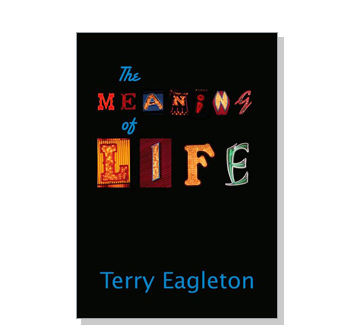

The British academic Terry Eagleton has the unusual — possibly unique — distinction of having written a bestselling book about late-20th-century literary theory. The book, “Literary Theory: An Introduction,” is reputed to have sold 1 million copies, chiefly on the strength of Eagleton’s extraordinarily lucid prose. He may well be the only writer capable of making some of that stuff comprehensible to the intelligent lay reader, and so the news that he has tackled a bigger problem — the meaning of life — in a book of a mere 185 pages shouldn’t raise any eyebrows. If anyone can pull it off, it’s probably Eagleton.
“The Meaning of Life” is more a long essay than a full-length book, and its publishers probably hope it’ll hit the same sweet spot as Harry G. Frankfurt’s surprise success, “On Bullshit,” another slim volume of intellectual nonfiction. That’s unlikely; “The Meaning of Life” intends to challenge its readers — not, like the Frankfurt, to provide them with the opportunity to sneer at other people (because who reads “On Bullshit” thinking it’s about them?). Eagleton, unsurprisingly, has written an elegant, literate, cogent consideration of a maddeningly slippery topic, one whose conclusions run contrary to conventional wisdom, especially in this country. To be sure, “The Meaning of Life” is also occasionally waspish, condescending and even a little unfair, though always enjoyably so. It’s saucy too; it takes cheek to suggest that George W. Bush is the ultimate postmodernist.
Two primary tributaries feed into the body of Eagleton’s thought: Marxism and the tradition of Catholic intellectualism in which he was educated as a boy. Although no longer a member of the church, Eagleton retains much respect for religious ideals, a respect that lies behind his recent, scalding review of Richard Dawkins’ “The God Delusion” in the London Review of Books. These two influences might seem incompatible today, but in the 1970s, when Eagleton was coming up as a working-class boy turned Oxbridge scholar, liberation theology and other exhilarating currents of social change combining faith with socialism were in the air. However much his work may have changed on the surface since then, Eagleton’s underlying values remain much the same.
In essence, “The Meaning of Life” is a brief against postmodernism, a movement Eagleton calls “superficially radical” but “secretly in cahoots with a Western ideology for which what matters is the meanings we stamp on the world and others for our own ends.” Them’s fightin’ words in an academic climate where accusing someone of wanting to oppress anyone (let alone the whole world) is the ultimate insult. But before Eagleton delivers this coup de grâce, he takes his readers on a short, illuminating journey through the knottier aspects of the question “What is the meaning of life?”
Being a literary critic, Eagleton must interrogate nearly every word in that question — beginning with “is,” in a manner vaguely reminiscent of Bill Clinton’s famous testimony before Ken Starr. A presiding spirit here is Ludwig Wittgenstein, who, as Eagleton explains, was highly suspicious of such questions and many other philosophical preoccupations he dismissed as mere “language games.” “I am not myself a philosopher,” Eagleton remarks on the first page of “The Meaning of Life,” “a fact of which I am sure some of my reviewers will point out in any case.” Not being a philosopher myself, I won’t attempt to evaluate his interpretation of Wittgenstein’s ideas — some of the most difficult and gnomic in an inherently hard-to-crack field. It may not matter much; Wittgenstein mostly just pops in now and then, like the ghosts in “Topper,” to offer a few words of advice that might actually be jokes, and vice versa.
The answer to the question “What is the meaning of life?” used to be fairly clear to most Western thinkers: The meaning of life was God, and his will, and his plan for the human beings who lived the lives he gave to them. Only when the bedrock faith in that particular answer began to erode did the question become a source of anxiety and even torment. The movement called modernism followed from, as Eagleton puts it, “the belief that human existence is contingent — that it has no ground, goal, direction or necessity, and that our species might quite easily never have emerged on the planet. This possibility then hollows out our actual presence, casting across it the perpetual shadow of loss and death. … There is no unimpeachable foundation to what we are and what we do.”
For those who don’t believe in God, or at least in a God with a plan for the human race, the question “What is the meaning of life?” seethes with puzzles. Can existence mean anything at all without someone (i.e., God) to mean it? Those famous 100 monkeys, pounding away on 100 typewriters for eternity, might eventually produce the exact text of “Hamlet,” but they won’t mean “Hamlet” the way that the man who intentionally wrote it did.
Eagleton brings contemporary linguistics-based theory to bear on the idea of “meaning,” pointing out that it takes several forms. I might mean (that is, intend) to say the word “poisson” (“fish”) to a French waiter, but I might actually say “poison,” which in turn means (that is, signifies) something else entirely. (“Poison” has the same meaning in French, actually, as it has in English.) There’s what I intend to signify or communicate when I speak, and then there’s what my words mean in a larger system, such as a language. For linguists, the first kind of meaning is an “act” and the second is a “structure.”
If this distinction is making your eyes cross or is conjuring up ancient, bleary memories of trying to fathom Ferdinand de Saussure at a 3:30 p.m. study section, take heart. Eagleton has more in mind than just a technical discussion of the workings of language. But language is central to any discussion of the meaning of life, because language is what meaning is made of. Meaning is a human artifact, Eagleton points out; material objects — a tomato, a hammer, ink on a page in the shape of the letter “I” — have no meaning in and of themselves, only the meanings we human beings assign to them, and the main tool we use to make those meanings is language.
Here is where the postmodernists come into it, specifically those thinkers (Eagleton doesn’t name them) who argue that nothing has a fixed or deep meaning. Meanings, they insist, are the creations of human culture, not properties of reality itself, so things, experiences and people can mean whatever we damned well please. This philosophy is intended to be liberatory; theorists who claim that certain identities — “male,” “female,” “homosexual,” “black,” and so on — are culturally “constructed” believe themselves to be freeing people from the straitjacket of social roles that have been falsely presented as bedrock facts of nature.
This “constructivism” is a form of the “relativism” that cultural conservatives in this county love to denounce, so some might be surprised to see the left-wing Eagleton condemning it, too. (In fact, Eagleton has been criticizing deconstructionism and its spinoffs for decades.) Eagleton strenuously objects to the constructivist rejection of absolute or inherent meanings. “Nobody actually believes this,” he remarks of constructivism, and he’s right about that in more ways than he realizes. Outside of academia, hardly anyone even pretends to believe in this stuff, so seeing it eviscerated isn’t as important to the civilian reader as Eagleton seems to think. Of course we all realize that, to use Eagleton’s example, “it just would not work for us to ‘construct’ tigers as coy and cuddly”; that’s idiotic. Complicated identities like gender roles are another matter; we know they’re at least partly configurable because they’ve changed in the course of history.
Eagleton goes on to cite the scholar Frank Farrell, who has linked the postmodern insistence on an infinitely malleable reality to roots in early Protestantism. The old Catholic idea that things have “essences” or “determinate natures” could not be reconciled philosophically with the doctrine of an all-powerful God; any given thing’s inherent nature would limit what God could do with it. “God’s arbitrary will,” as Eagleton puts it, cannot be constrained, so things can only be what they are “because of his say-so, not because of themselves.” In this belief Eagleton sees the seeds of the 20th century’s “cult of the will.”
Eagleton never details how the Catholic conception of an all-powerful God handles this dilemma, an omission that makes this particular bit of the book sound suspiciously like special pleading. Nevertheless, he draws a provocative comparison between the anti-essentialist “cult of the will” and some modern political figures. Still not naming names, he writes:
“Torture is morally wrong because God’s will has determined it to be so, not because it is wrong in itself. In fact, nothing is right or wrong in itself. God could easily have decided to make failing to torture each other a punishable offence. There can be no reason for his decisions, since reasons would hamper his absolute freedom of action. … He is the source of his own law and reason, which are there to serve his power. Torture could well be permissible if it suited his purposes. It is not difficult to identify the inheritors of these doctrines in our own political world.”
To Eagleton, postmodernism, with its repudiation of inherent or “deep” meanings, is, for all its revolutionary rhetoric, a variation on the same theme. To get back to the question driving his book, the motto “Life is what you make it” may sound banal, but it reeks of a similar hubris. It “reflects an individualist bias common to the modern age” by insisting that we all find our own meaning of life in a personal, private realm. But if meaning has its own roots in language, then claiming this, Eagleton argues, is like claiming that everyone gets to make up their own personal meanings for words.
While the words I’ve used to write this piece reflect a meaning of my own individual making, they’d be nonsense if I decided to make up all their meanings from scratch. I could, like Humpty Dumpty in “Through the Looking Glass,” insist that “glory” really means “there’s a nice knockdown argument for you,” but then my words would become useless as a form of communication — in other words, they’d be meaningless. To judge by the way language works, says Eagleton, meaning is always at least partly shared and collaborative. “We are woven through and through with the meanings of others — meanings which we never got to choose, yet which provide the matrix with which we come to make sense of ourselves and the world.” While Humpty Dumpty’s absurd unilateralism maintains that when it comes to handling words, “the question is, which is to be master, that’s all,” Eagleton insists that “meaning is in fact the product of a transaction between us and reality.”
According to Eagleton, people who cherish the notion of a purely private, interior and individually constructed meaning of life are indulging in a delusion fostered by late capitalism. As long as citizens believe meaning can best be found in, say, studying the kabala or concentrating on nuclear-family relations, they won’t demand more from public life than the empty utilitarianism of the free market. Eagleton prefers Aristotle’s practical version of the good — that is, the fulfilled — life (even as he registers some caveats about the inequities of ancient Greek society). “The meaning of life is not a solution to a problem,” he writes, “but a matter of living in a certain way.” It is not an idea but a behavior, “not metaphysical, but ethical.” And the ethics involved are not a lot of mystical mumbo jumbo but “an embarrassingly prosaic affair — a matter of feeding the hungry, giving drink to the thirsty, welcoming the stranger and visiting the imprisoned.” He might add, working to change the social order so that more people have the ability to live according to this ethos.
These are, of course, the classic directives of Christian charity, but Eagleton isn’t making a religious argument on their behalf. The need to do these things, to live this life, he says, arises not from God but from the nature of human beings themselves. We can’t get away from it; it’s our essence. We are social animals who thrive on love; not just love for our kith and kin, but the kind of love, called “agape” — caring for our fellow man — that is “a practice or a way of life, not a state of mind.” The more this type of love circulates in our community, the more meaning we find in life itself and the happier we become.
Outside of the academy, essentialism– usually in the form of evolutionary psychology — is almost always used to justify a conservative or libertarian, dog-eat-dog view of human nature, so it’s a treat to see it recruited here for the leftist cause. Perhaps, irony of ironies, Eagleton has demonstrated that essentialism is what you make of it? Maybe so, but having seen him make mincemeat out of his ideological opponents in “The Meaning of Life,” I wouldn’t want to be the one to tell him that. I’d sooner try to scratch a tiger under the chin.
