
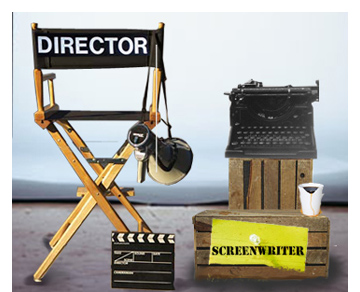

“A screenwriter is not really a writer; his words do not appear on the screen. What he does is to draft out blueprints that are executed by a team.” So wrote Paul Schrader, writer of “Taxi Driver” and co-writer of “Raging Bull,” two of the greatest films of the late 1970s — though chances are you were only dimly aware of that, and think of them both as Martin Scorsese pictures. That the writer on any film project is regarded as a second-class talent, negligible at best and a nuisance at worst, is one of the hoariest chestnuts of the movie industry, and even the writers themselves can’t seem to help polishing it every now and then. So Marc Norman — a screenwriter himself, winner of an Academy Award for “Shakespeare in Love” — abundantly documents in his new book, “What Happens Next: A History of American Screenwriting.”
Last week, American screenwriters (for television as well as film) overwhelmingly voted to authorize a strike, their first in nearly 20 years, if their union, the Writers Guild of America, can’t agree to a new contract with the Alliance of Motion Picture and Television Producers. Rather than settling cutting-edge issues like Internet and cellphone rights, they are going to the mat over several long-standing quarrels left over from a previous contract, most surprisingly (to some) the payment of residuals, royalties dispensed to writers whenever their work is resold in another format — cable, home video and other technologies. According to reports, it came up again as part of an elaborate dance of feints and parries typical to labor negotiations, but it testifies to the way that, for writers in Hollywood, resentment never dies; there’s always another kick coming along to revive it.
Why should this be? A good script seems an essential ingredient of a good movie, and what director in his right mind would start filming without one? D.W. Griffith, for one. Norman launches his book with a description of the making, in 1914, of “The Birth of a Nation,” an ideologically dubious, decidedly racist but nevertheless seminal picture that was apparently shot without a screenplay. Of course, there had already been a play, based on a novel, “The Klansman,” that Griffith knew well. (He’d acted in the play.) But the tendency of a mere stack of paper to seem irrelevant once you have cameras rolling, horses galloping and girls screaming for help was established at the very beginning.
The long, sad saga of mistreatment at the hands of ruthless moguls and Napoleonic directors unfolds from there. Mack Sennett, director of the Keystone Kops and other classic silent comedies, kept a team of writers working in his “Gag Room” in cell-like conditions, without telephones or newspapers, and forbade them to eat anything beside a tuna sandwich and milk for lunch because “eating heavy stuff makes writers logy.” Jack Warner, of Warner Brothers Studios, called his staff writers “schmucks with Underwoods” and used to sneak over to their building to check that the typewriters were going. The infamously nasty Harry Cohn of Columbia Pictures did the same thing, and when he heard the clacking of keys as he passed the window, would scream, “Liars!”
Norman attributes some of this animosity to the essential mystery of the writing process. To the tough, practical, working-class men who founded the movie industry, it looked suspiciously like loafing. “None of them were quite sure what a screenwriter did,” he writes, “or even how he did it. Certainly he or she delivered an artifact, a screenplay, that worked or didn’t, but where did it come from? … Did it take them a year to write a screenplay, or only one day and then they waited a year to hand it in? There was no telling because nobody could see the work occur.”
That’s the thing about any kind of writing: It may be difficult, but it sure looks easy — you can do it in your pj’s! Until the advent of reality TV talent shows like “American Idol,” most of us existed in blissful ignorance of the sheer number of completely untalented people who remain convinced that they are destined for stardom. But consider this: Although practically anyone can instantly recognize tone-deafness when they hear it, in a world where fewer and fewer people read at all, bad writers can go on believing in their (unappreciated) genius indefinitely.
People realistic enough to recognize they’re not cut out to be actors or directors can nonetheless persuade themselves — after reading a manual or two or by taking one of Robert McKee’s famous “story seminars” — that they can write. In recent decades, as Norman observes, this has led to jokes about “how everybody in Los Angeles was busy writing something; industry professionals were constantly having manuscripts thrust at them by hairdressers, by pool men, by their shrinks.” And why not, when an editor and art director from Esquire magazine seemingly pulled the original screenplay for “Bonnie and Clyde” out of nowhere in 1965, launching two brilliant, glamorous, lucrative careers?
Screenwriters have it worst of all because (and Norman really only grazes this point) writing is invisible and internal and movies are all about — really only about — what you can see. The movies need writers, and are intermittently struck with the desire to celebrate and enrich this one or that one, but can never entirely trust them, and vice versa. The movies and writing transpire in fundamentally different worlds. Norman winds up his book with a paean to the screenwriter’s privilege in getting “to see the movie, first, entire, in their minds,” but the whole point of a movie is that it’s not in your mind — it’s right in front of your face, 15 feet high. Otherwise, it’s a radio play, maybe. Or a novel.
Even getting a fix on how screenplays have been created over the years seems to be next to impossible, which may explain why “What Happens Next” is not so much a history of American screenwriting as it is a history of American screenwriters. Norman gives us the very earliest scenarists — newspaper caption writers, “trained in writing snappy stuff” and thrilled to be making four times their old salaries, and a surprising number of women. Gene Gauntier, the leading actress for one of the early, tiny, East Coast film companies, wound up writing its adaptation of “Tom Sawyer,” probably because she was the only one who’d actually read the book (or, you get the impression, any book at all). She not only did all her own stunts (horseback riding, rope climbing, roof jumping), she thought them up, too.
Once the industry really got up and running in Hollywood — where many would-be producers fled to escape the goons Thomas Edison hired to enforce the patents he was too short-sighted to secure legitimately — they began to toy with the idea of hiring real writers. Samuel Goldwyn imported a passel of bestselling novelists to write screenplays in 1919, for a spinoff company he called “Eminent Authors”; the results were disappointing. In the 1920s and ’30s, gushers of Hollywood money wooed novelists like F. Scott Fitzgerald and William Faulkner westward, along with those writers of less definitive talent who clustered around the Algonquin Round Table: Dorothy Parker, Robert Benchley, George S. Kaufman. All of these people looked down on the industry. Stephen Vincent Benet wrote to a friend, “Of all the Christ bitten places and businesses in the two hemispheres this one is the last curly kink on the pig’s tail.”
How much was snobbery and how much a legitimate response to the writer’s low status on the Hollywood totem pole? This is hard to determine, though Norman tries. He points to a much publicized telegram that Herman Mankiewicz sent to his journalist friend Ben Hecht, urging him to come west to partake of the gravy train: “millions are to be grabbed out here and your only competition is idiots.” Hecht, when he arrived, was even more scathing, between writing seemingly hundreds of terrific films, often uncredited, from “Scarface” (the original 1932 version) to “His Girl Friday.” “The movies,” Hecht announced, “are an eruption of trash that has lamed the American mind and retarded Americans from becoming cultured people.”
As tough as the moguls were, they didn’t much appreciate being sneered at by scribblers who were not too high and mighty to cash their checks. They, in turn, treated writers like assembly-line workers, randomly pulling them off one job and assigning them to another, demanding strict adherence to all the dopey conventions of mass entertainment, capriciously imposing drastic changes and rewrites, and “following” — that is, covertly assigning more than one writer (or team of writers) to the same project and assembling the final screenplay via a mix-and-match process. Most of the copious product the studios churned out in the years before television originated in studio “story conferences,” not with the writers themselves, and the results were work for hire; the studio owned it all. Oh, and one more thing: Writers routinely went uncredited on screenplays that they substantively wrote, while people who did nothing, or next to it, got their names on the screen, and sometimes even the Oscar nominations.
Disrespect was mutual, as Norman follows Hollywood’s writerly community through the radical 1930s, when the Communist Party was all the rage, to the war years, when everyone enjoyed a rare moment of unity and common purpose. Labor unions seemed to promise better working conditions and the beginning of some intellectual property rights, but this was mostly squelched after the war, with the trauma of the blacklist. Besides, various economic pressures — from tax laws to antitrust suits — eroded the studio system, and soon everyone would be a freelancer, with all the liberty and anxiety that entailed.
As he goes along, Norman picks representative writers from each period: forgotten troupers like Gauntier and shameless con artists like Hecht and his longtime writing partner Charles MacArthur, who once tricked a producer into hiring a “writer” who was really a gas station attendant with an English accent. (MacArthur wanted to find out how little a contract writer could produce without getting fired.) Billy Wilder and Preston Sturges demonstrate the emergence of the writer-director, a difficult job, but one that guaranteed you’d get your movie, as you intended it to be, in the can. Then there are the tortured prestige hires like Fitzgerald and Faulkner — the first trying and failing, pitifully, to succeed as a screenwriter, the latter wanting little more than to be left in peace to drink.
Dalton Trumbo is the quintessential blacklisted writer, of course, inching his way back into the industry after relocating to Mexico, and churning out bales of scripts at a fraction of his previous fee, under assumed names and behind fronts. The ferociously uncompromising Paddy Chayefsky got started writing one-acts for the Philco Television Playhouse in the 1950s, and insisted on being given the same level of creative control when he moved on to film in the 1960s. He rarely achieved that, but set a standard for writerly integrity until he made the mistake of approving the kitsch maestro Ken Russell to direct what should have been his magnum opus, “Altered States.” Things really fell apart when the writer and director disagreed over the size of one of the film’s props (an isolation tank), and Chayefsky stormed onto the set with a chain saw to lop off the offending part. Legally obligated to film Chayefsky’s dialogue as written, Russell ordered the actors to recite it incomprehensibly fast or while cramming food in their mouths.
Then come the wild men of the late 1960s and ’70s. Terry Southern supplied hipster expertise on “Dr. Strangelove” and “Easy Rider,” but was too cool to fight for the credit he deserved. A new generation — raised with TV and the masterpieces (and trash) from Hollywood’s past that broadcasters used to fill the off hours — went to new film schools and soaked up Andrew Sarris’ auteur theory, the one that attributes all creative vision and distinctive style of a film to its director. This cohort — Norman calls them the “film brats” — hijack the narrative for several chapters. Francis Ford Coppola, George Lucas, Steven Spielberg, Paul Schrader were, as Norman himself acknowledges, really directors at heart. They initially wrote screenplays in order to break into the business or to wrestle some personally significant material onto the screen. Then, they gave it up for the most part: “They were passionate about movies as no other generation had been, but not for the writing of them, for any sort of writing.”
The closing notes that Norman sounds include Joe Eszterhas, a strutting blowhard who nevertheless managed, in the slick 1980s, to become somewhat famous among the general public, a rare feat. Norman describes him as a “good” writer, by which I assume he means “successful,” since Eszterhas (“Basic Instinct,” “Showgirls”) never wrote a genuinely good film and faded from view after producing five flops in a row. Finally, “What Happens Next” praises Charlie Kaufman (“Being John Malkovich,” “Adaptation”), the rare screenwriter capable of overshadowing his directors, as an example of a writer who has incorporated the influence of postmodernism. (Norman’s conception of this is a bit muddled, but then, whose isn’t?)
Again, most of this is about screenwriters, and the business of writing for the screen, not about the actual writing itself. “What Happens Next” will tell you next to nothing about how the art of screenwriting evolved, how the major breakthroughs (if any) changed the form, what new things writers tried or wanted to try and why. Perhaps my surprise at this betrays my literary bias; it’s impossible to imagine a history of the 20th-century novel that talked about Fitzgerald’s high jinks with Zelda in Paris or Virginia Woolf’s dealings with publishers but not about what these writers actually wrote in any depth.
Norman does describe how certain significant films — “Double Indemnity,” “Casablanca,” “Apocalypse, Now” — came to be written, but these descriptions mostly consist of anecdotes. Billy Wilder and Raymond Chandler were locked up in a room at Paramount, hating each other, as the old-ladyish Chandler complained about all the calls Wilder got from women and insisted that he couldn’t work with “a man who wears a hat in the office. I feel he is about to leave momentarily.” “Casablanca” was thrown together higgledy-piggledy, with the exact ending only settled on at the last minute, after Humphrey Bogart objected that his character, Rick Blaine, wouldn’t shoot a man, not even the evil Nazi Strasser, in the back. And then, of course, there are the (by now pretty shopworn) tales of Coppola facing the same dilemma while running amok in the Philippines — until he decided to pilfer his ending from the somewhat dubious anthropological theories in Sir James George Frazer’s “The Golden Bough.”
The lack of real literary criticism in “What Happens Next” is understandable in a way; most of the people who wrote these scripts weren’t taking the product very seriously as literature. They didn’t record their aspirations and the minutiae of their creative throes, as poets and novelists are wont to do. In fact, it’s not always easy, especially with studio films and other multi-writer projects, to detect who actually wrote what. Even the critic David Kipen, whose persuasive book-length essay “The Schreiber Theory” argues that the screenwriter is a better determinant of a film’s quality than the director, must mostly resort to listing the films each writer worked on as evidence. Norman could have done more to correct this situation — he apparently conducted no original research although he seems well placed to have done so. Instead, he derives most of the material in “What Happens Next” from other books.
It’s true that anecdotes and biography make better copy. Norman, as a screenwriter himself, is acutely sensitive to the fact that writers enter the upper echelons of Hollywood on sufferance. He quotes film critic David Thomson’s withering observation that to the industry’s elite, “a writer is like a divorce lawyer or a private eye: when you want them you have to have them; but later you despise them.” The writers who cling to a place at the table know they can only keep it by virtue of their wit and charm, so as soon as Norman has our attention, he turns raconteur, spinning yarns and repeating quips by larger-than-life characters like Hecht and Wilder. You want to pat him on the shoulder and say, “Relax, Marc. You’re among your own people now. We are the readers.”
Alas, to quote Norman paraphrasing another industry proverb in this book, “Hollywood is high school with money.” The most popular kids still appear as gods to the mere rabble. As with all entertainment industry insiders, Norman’s attention seems to drift inexorably in the direction of magnetic north: whoever has the most power. There’s more in this overlong, if entertaining book about moguls and producers and directors than, strictly speaking, there ought to be. These men distort the gravitation field of the story Norman is trying to tell, and he winds up retreading stories about figures like Irving Thalberg and Coppola, people who, however charismatic, have already been well sung. Five hundred pages after we learn that Griffith made “The Birth of a Nation” without a script, screenwriting, that occult process by which a script is created, remains invisible.
