

The makers of “The Times of Harvey Milk” (1984) and “Common Threads: Stories From the Quilt” (1989) long ago proved themselves masters of the elegiac movie. But they have continued to grow as filmmakers by conducting provocative and open-ended inquiries into matters more elusive than Harvey Milk’s martyrdom or the AIDS scourge. Rob Epstein and Jeffrey Friedman first worked together when Friedman was a consultant for Epstein on “Milk.” They then teamed up full-time on “Threads.” In “The Celluloid Closet” (1995), they demonstrated conclusively that Hollywood’s depiction of homosexuality has been malicious at worst, tentative at best. Yet their deftly culled clips and conversational interviews with gay and straight movie people (from Gore Vidal to Tom Hanks) formed a mosaic of impressions and opinions rather than a monolith.
Three years ago, Klaus M|ller, the U.S. Holocaust Memorial Museum’s chief expert on and investigator of gay issues, approached Epstein and Friedman at the Amsterdam premiere of “The Celluloid Closet” and pitched them an idea for a movie. The result is the gravely beautiful “Paragraph 175.” The team’s healthy respect for the variety of ways people respond to historical phenomena energizes this chronicle of what Richard Plant, in his groundbreaking 1986 book “The Pink Triangle,” calls “The Nazi War Against Homosexuality.”
Paragraph 175 was the section of the German penal code that in 1871 forbade homosexual contact between men. The original law read, “An unnatural sex act between persons of male sex or by humans with animals is punishable by imprisonment; the loss of civil rights might also be imposed.” It predated the Nazis and outlasted them, and was not stricken from the books until 1969.
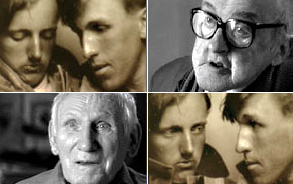
But it was the Nazis who strengthened and brutally enforced the paragraph. Convicted men were either sentenced to prison or sent to concentration camps (sometimes thrown into prison and then into camps), where they wore the pink triangle. Although Nazis did not round up gays as single-mindedly as they did Jews or Gypsies, only a third of the gays who were interred in camps survived. The other inmate groups tended to shun them, and the Nazis often subjected them to pseudo-medical experiments. Fewer than 10 are alive today. The filmmakers talk to six of them. (Plant estimates that from 50,000 to 63,000 homosexuals were detained in the Nazi years and that from 5,000 to 15,000 died in camps; the film puts those numbers, respectively, at 100,000 and 10,000 to 15,000.)
Epstein and Friedman’s film is neither an apocalyptic horror movie nor a dirge. It probes how history can turn on a dime — or a single paragraph.
Nothing is simple in “Paragraph 175.” The filmmakers remind us that when homosexual Ernst Rvhm headed that rabid Nazi unit the S.A., Hitler declined to denounce Rvhm’s personal behavior, which led anti-Nazis to paint the National Socialist Party as a homosexual hotbed. After Rvhm and the S.A. fell in the Night of the Long Knives, Heinrich Himmler, the head of his own elite guard, the S.S., put a campaign of homophobia into brutal full swing. But by then — when it came to gays — the propaganda battle line had become hopelessly confused.
Even after the war, vital testimony to Nazi atrocities was silenced because homosexuality remained illegal in Germany for another quarter-century. The film reflects how difficult it is for men to testify to Himmler’s reign of terror even now. One camp veteran in Poland and one in Germany refused to talk to the filmmakers. One survivor interviewed for the movie declines to summon up harsh memories, while another is still so apoplectic he can barely articulate his rage.
Yet another blithely talks about joining the German army after he emerged from prison, so he could still be among men. Lucid and involving, “Paragraph 175” draws you into its complexities and haunts you for days afterward with its mixtures of courage, compromise and frailty. It premieres theatrically in New York and San Francisco in mid-September. I spoke to Epstein and Friedman two weeks ago at their San Francisco office.
Your office is a block and a half from the San Francisco Public Library. Just now, when I went there and typed into the computer, “Gays and the Holocaust,” it asked me to reword my search; I tried “Gays and the Nazis” and “Gays and the Third Reich” and “Gays and Germany,” but the computer couldn’t locate any book on the subject. This film must have differed from your others in requiring more pure historical research — you weren’t documenting or interpreting already well-reported events.
Epstein: When Klaus M|ller presented us with his research it was an opportunity that we couldn’t pass up. He had witnesses we could interview. But the big difference between this film and some of the other ones we’ve done isn’t that we were discovering the history of this subject as we went along. The biggest difference is that it had a history that couldn’t be presented or told in black-and-white terms — contrary to what we naively may have thought before. It became much more confusing.
What did you think the story was before you actually got into it?
Epstein: You know: the classic story of victims and victimizers. Just as you couldn’t find anything in the library, what we found was almost all mythology. We had to figure out what was real and what was myth.
Friedman: On one side, there was the mythology that there was a gay Holocaust. On the other side was the mythology of the gay Nazi. Both of those were wild extrapolations based on a grain of truth. There was no gay Holocaust. There was persecution of gay people. But there was no systematic annihilation and there was never any clear policy about homosexuals except that, from the time of the Rvhm putsch on, homosexuality was contrary to Nazi ideology. And Rvhm was the basis of the myth of the gay Nazi.
So, in terms of well-known movies, you have “Bent” on one side, for the myth of the gay Holocaust, and “The Damned” on the other, tying homosexuality itself to Nazism.
Epstein: Exactly. We tried to use “The Damned” to make that point, but that film didn’t make it into our film.
Friedman: As we started to talk to these guys, we had to deal with our own feelings about being Jews and going to Germany and talking to Germans of that generation. They had a really different experience of that time than we’re used to hearing. Some of them made you uncomfortable. Some of them made you wonder whether they were very nice people.
Epstein: In fact, they may have been “nice people” and may also have been sympathetic to national socialism. One guy who is in the film did say to us in the pre-interview, “All would have been fine, but for the fact that I was homosexual.” Which sent chills up my spine.
At one point, this dapper character named Albrecht recalls volunteering for the German army after being released from prison. We hear one of you gasp, “Whu — Why did — Why?”
Friedman: That’s Rob.
It is a freak-out for the audience as well, because he is a charming guy. But in order to understand him, you have to take this step you didn’t think you’d have to take.
Epstein: That’s what I mean. As filmmakers who try to engage an audience’s sympathies, we tend to be drawn toward sympathetic characters. Here, all that was clear from the beginning was that we were dealing with gray areas.
Friedman: I think they’re all sympathetic characters, but they contain a lot of contradictions. The film got interesting for me when these problems started to arise. It also got scary because we weren’t sure how we were going to deal with them.
Was there a point when you thought you couldn’t make the film?
Epstein: There was a point at which we thought it should be made by Germans. It was so particular to Germany and what happened during that period that it seemed natural to ask, “Why aren’t Germans doing this?” Then, as we made the film more our own, it made sense that we were coming at it from the outside. Being outsiders made it easier for us to get at different levels.
Well, why didn’t German filmmakers ever make this film? And why didn’t Klaus approach a German documentary team?
Epstein: Klaus approached us because he felt we would make an accessible film, based on our previous work; also, that it would get an international audience and not just be localized.
Friedman: One reason that a film hadn’t been done in Germany before is just historical accident. It had to do with the timing of these men deciding to go public with their stories. They made their choice at a bad time in terms of television programming. German TV had just done a whole year on the 50th anniversary of the end of the war.
The impression you give is that the six you film include every gay survivor there is, except two people who wouldn’t talk to you.
Friedman: Right — everybody known to be alive. There is just a small number because the survival rates were so bad for homosexuals in the camps. The death rates for homosexual prisoners were among the highest for non-Jewish inmate groups. And the numbers were relatively small to begin with. But I can’t help thinking that there are more than the eight or so that we know of.
I’m fascinated by your ambivalence — to me, it feeds into the look and the feel of the film. It has a twilight emotionalism. Right at the beginning you have this survivor, Gad Beck, talk about a person having to see the period “romantically” in order to understand it, already upsetting expectations of what a documentary of the Nazi era would be.
Friedman: That has to do with memory; it’s certainly a film about memory, about telling history through the memories of very old people recalling things that happened to them 50 years ago. That defined the style for us — the rhythm, how we told the story.
Epstein: The first interview we did was with Gad Beck. He did set the tone, because love was such an important theme for him in getting through those times.
Following Klaus M|ller’s figure, all in black, as he boards a train, with that percussive music evoking railroad tracks even when he’s off the train, you feel as if you’re part of a detective story.
Epstein: Good, good. That was what the story became for us — we were on this journey of discovery with Klaus as our guide. Even though the film is about memory, doing it, for me, was about being aware of what is going on in the moment and being willing and able to use that. I think that paid off time and again: When we were confronted with a problem, turning that problem into something that became part of the film. The train, for example.
The train ride came to us because we were supposed to do an interview with this guy named Karl, who ended up in the film only briefly. He’s the one who says “I’m not going to talk about these shitty, shameful deeds anymore.” He had agreed to do a full-length interview and then he decided he just wouldn’t. We took the train ride to see him and see what might happen. We made that part of the story. And we put Klaus on the train and that’s how Klaus started to become our guide.
It all happened organically. It was an exciting time to be in Berlin because it was like the moon was being developed for the first time. There were construction cranes all over the city. It was early in the fusion: You could tell that it was just starting to feel like the East and West of the city were coming together. That immediately felt metaphoric to us: this whole reconstruction and rebirth of a city in the midst of people trying to preserve the sense of what it was, before that was lost forever.
Friedman: All that provided a dramatic, immediate structure. But there also was the historical structure. And we had to find a way to marry those two.
You marry them with the imagery: the trains, for example. Near the beginning, Gad Beck talks about sneaking in some lovemaking in stalled trains during bombing raids. Near the end, when one of your other witnesses talks about nearing the end of his life, you have a brief shot of a train receding in the snow. That’s typical of the poetic quality this movie has, even when you chronicle the most atrocious events.
Friedman: We knew we were going to have to rely on archival footage, but the kinds of archival footage that we were finding only tangentially applied to gay life, because all the gay stuff was destroyed. The stuff that related to the Nazis and the Holocaust all felt over-familiar. So we struggled to use that material in a way that felt new — that would make you look at it in a different way. We had a creative collaboration with our editor, Dawn Logsdon, who did find poetry in that archival material.
People won’t be surprised to see Weimar-era Berlin presented as the homosexual Eden of the ’20s. We know that from the “divine decadence” of “Cabaret.” But you emphasize how German homosexuality also grows out of romanticism and nature love and youth cults. It’s wild — a whole spectrum of sexual stimulus and emotion that you’re not used to seeing in homosexual histories. Was that a discovery for you, or did you know about it going in?
Epstein: I think my image of German youth groups was of the Hitler Youth. We had to educate ourselves before we realized that the Hitler Youth was a co-opting of a grass-roots movement that encompassed a whole range of ideologies from the far left to the far right to nudism and vegetarianism. And it seemed, at least anecdotally, that homoeroticism was very much a part of it. But it’s dangerous to draw [sweeping] conclusions — partly because it’s dangerous to apply 21st century notions of homosexuality to early 20th century German culture. At the time of these youth movements, the concept of homosexuality was less than half a century old. It wasn’t until Magnus Hirschfeld [the gay founder of Germany’s Institute for Sexual Research] started studying it and publicizing his ideas of the “third sex” that people started thinking of homosexuals as a “type.”
I don’t think you do draw conclusions. But introducing that stuff and saying “Look, this was part of Germany, too,” opens the film up and — again – lets you add a different visual component.
Friedman: Yeah. We were able to get some flesh in there. [Laughter.]
Did you feel an obligation to include at least a little bit of each interview because there are so few of these survivors left?
Friedman: After almost every interview I had major doubts about whether we could possibly make a coherent story out of this. That was partly because of the language problem — it was all being translated simultaneously — and partly because some of the men speak very, very slowly. It’s really not until we saw it written on paper could we figure out what they were talking about, because by the time they got to the end of a sentence we’d often have forgotten where they’d begun.
You follow a loose chronological structure, yet the connections among speakers always seems to be thematic, juxtaposing one guy’s point of view to another’s — or in the case of the Alsatian, Pierre, his vs. everybody else’s. His testimony and his rage are so potent. He can barely talk to Klaus because Klaus is a German.
Epstein: Pierre actually came to the Berlin Film Festival, incidentally. He made his peace with Germany through this film.
Friedman: Each of the people in the film serves a dramatic purpose; I think their stories dictate how they’re used. Annette’s story is essentially the Weimar story and it ends at the time that the lesbian subculture was pushed underground and she was forced to leave the country.
Epstein: Annette’s story was probably the hardest to work in because it was a lesbian story, and lesbians weren’t affected in the same way that homosexual men were. But nonetheless we knew we had to address it in some way. In a sense, we were addressing the absence of their obvious victimization, and we hope we found a way to have Annette represent that. That’s typical of what we tried to do: to find out early on what the essence of each person was and then make it work for the film overall.
Few of us are used to seeing people talk as blithely as these old men about being teachers and group leaders yet having sex with their pupils or followers — or, in the case of Gad Beck, being a student and jumping his phys ed teacher in the shower. They have the total openness that can come with feeling you have nothing to lose. When you were hearing these things, were you still thinking, “Why can’t they talk faster?” [Laughter.]
Friedman: It was fun when these old men started talking about sex and you saw a gleam in their eyes; it was encouraging!
Epstein: I had more faith in the material than Jeffrey, which is a reversal of our roles. He’s usually much more the optimist and I’m much more the pessimist. But I thought there were enough moments there to make it function.
I think the contradictions and murkiness you present actually spur a viewer to try to find out more about the subject. The movie is a series of twists: Hitler initially defends his bully-boy Ernst Rvhm, the homosexual at the head of the S.A.; Hitler’s enemies use Rvhm’s homosexuality to attack the Nazis. We’re used to a Manichean view of the Nazi era, but your movie presents history as a series of feints and retreats and odd choices. Why wasn’t there a total Nazi roundup of all homosexuals?
Friedman: For one thing, they were by and large Christian German men and they were potentially “curable” in the eyes of some of the authorities. And also, there was no real systemized way of dealing with homosexuals. In the courts, it was up to the whim of the judges. And in the camps, how they were treated was really up to the camp commander.
I think it also speaks to how difficult it is to make analogies between persecutions based on behavior and persecutions based on heredity.
Epstein: I’m sure back then that homosexual men did not think of themselves as being one class of people. They did not see themselves as a type, no matter what their homosexual behavior. For Jews the situation was very different.
And because of Rvhm, the Nazis couldn’t say they had no experience of homosexuality or no homosexuals in their ranks.
Friedman: Yeah, but does that mean that the Nazis were gay? Or does that mean that homosexuality was more integrated into German culture than you think it was, when the Nazis came into power? That’s my interpretation, but I’m not a historian.
Epstein: The whole Rvhm situation was something Jeffrey homed in on really early into the project. I think we went as far as we could with it in terms of specific information. But there’s a whole other component to the theme of homosexuality in the camps that we were interested in, and couldn’t really get into in this film, which is how homosexual acts were used abusively within the camp system. For a lot of other victim groups, like Jews, their association with homosexuality comes from having been victimized by Kapos and commanders who raped them and committed other homosexual abuse. That has nothing to do with homosexual identity. But it has helped to perpetuate the mythology of the homosexual Nazi.
What’s the most pernicious effect of that mythology, apart from it being a misreading of history?
Epstein: In the long run, it demonizes homosexuals. At the time, I think it also made it more difficult for the Nazi persecution of homosexuals to be made public, because there was a prevailing notion that the Nazis were homosexual.
Friedman: It was the German opposition, first in Germany and then exiled in Europe, who used the homosexual angle in their anti-Nazi propaganda, and it was picked up after the war. It’s become a convenient trope in movies.
Even though viewers may not identify totally with any of these characters, we experience the events they describe subjectively. This eerie intimacy comes from that poetic, impressionistic approach you keep talking about — like your evocation of the “Singing Forest,” where gays and Jews were hung on hooks from poles. That metaphor gets inside your brain, but you do it very sparingly with shots of limbs of trees and then an actual photo of the torture. To get to that place, where you experience these things fully enough to know how to communicate them, must have been hard.
Epstein: I think your job and hopefully your art as a filmmaker is to have a combination of connection and detachment. It’s a dance; you constantly go back and forth.
Even when you shoot talking heads, you take care in the way these guys are framed, from the lenses you choose to the settings.
Epstein: Years ago I was accused, quite pejoratively, by a lefty documentary filmmaker, of coming from the “interior decorating school of filmmaking.” Now I can say that’s true with pride. We certainly work with the director of photography on what’s in the frame and what the light is and what you can see in the room.
What was it like, coming from San Francisco, which is perceived to be a contemporary homosexual Eden, to do a history of Weimar Berlin, which was seen the same way in the ’20s?
Epstein: I think that something I learned from the film — and also, having lived long enough now, in my own life — is that you can’t assume the permanence of things. Even here in San Francisco, the city thought to be the homosexual Eden, we’re seeing vast changes from what it was when we moved here 20 years ago. You realize how much of life is transitory. You can’t take things for granted; you can’t be complacent.
Friedman: Making “Paragraph 175,” I kept being aware of parallels with “The Celluloid Closet.” We were dealing with the same period of history in a completely different context, and it was the same story really. There was this time of freedom and openness, in the teens and ’20s. Then came a clampdown in the ’30s. I had to go through realizing again that life is not just a progression toward more freedom or progress. It’s cyclical, and things are going on that can jump boundaries.
Maybe your next film should be the study of a year.
Epstein: 1933 would be the one, I think. It was the year of the Production Code. It was the year Hitler came to power. I don’t know what the connection is!
Friedman: But it could be an interesting area to explore.
