
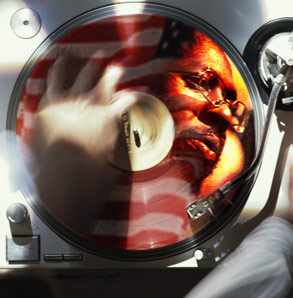

A hopeful vision for our nation, in these troubled times:
World Series, 2002, Game 1: Sixty-five thousand screaming fans have packed into a gargantuan stadium bearing the name of a not-yet-disgraced major conglomerate, eagerly awaiting the first pitch. The players have been introduced, the Marine Corps honor guard has brought out an American flag that will cover half of right field, and it is time. The celeb singer of the day, Whitney or Britney or Celine, or maybe even Robert Goulet (!) steps to the mike as the P.A. booms: “PLEASE RISE FOR OUR NATIONAL ANTHEM.”
The crowd swells, a patriotic gesture but yeah let’s get on with it (we almost didn’t have a World Series because of the fractious dispute between opposing camps of millionaires). The singer steps to the mike.
“SISTERS!” The crowd responds with a cheer, though they aren’t sure where this is headed.
“NIGGERS!” Sixty-five thousand fans fall into stunned silence.
“WHITEYS! JEWS! CRACKERS!” The last word echoes in the charged air of the stadium, “-rackers, -ackers, -ackers, -ackers.”
“Don’t worry … If there’s a Hell below, we’re all — gonna GO!”
Over the confused noise of the crowd, the band strikes up. A fat, menacing bass line snakes forth, then a team of three — no, wait, there are four — conga players, the brass section of the Boston Pops, headed by the Uptown Horns, Yo-Yo Ma leading a string section made up of volunteers from the New York Philharmonic, and an electric rhythm section made up of former members of Parliament, this whole mighty ensemble launches into Curtis Mayfield’s 1970 hit “Don’t Worry (If There’s a Hell Below, We’re All Going To Go).”
The crowd (let’s remember this is my vision) goes crazy. Over the “wikka-tikka” funk guitar riff and wildly syncopated groove, lyrics like “Top billing now is killing/ For peace no one is willing” reach those who are listening and some freeze, faces fixed with a look of recognition. But then the rhythm picks them up, snaps them awake, and they continue dancing as a wry smile blends with the expression on their faces. We get it. We are Americans.
The band jams out the national anthem for a quarter of an hour, and when they are done, the ethnically diverse crowd is united in applause that lasts for 10 solid minutes.
Well, it’s a vision that inspires me, anyway. And not just for the notion of a crowd on its feet, representing one nation under a groove (wipe that smile off your face — this is serious). It gives me hope that we might, one day, ditch “The Star-Spangled Banner” as our national anthem.
Here’s another vision, one we’ve all seen:
Following a deadly terrorist attack, one of the most shocking and devastating moments in our nation’s history, many members of the United States Congress gathered on the steps of the Capitol building for an impromptu press conference, a show of unity and spirit and resolve. After the brief comments, the assembled lawmakers joined in a rendition of … “God Bless America.” Perhaps it was spontaneous — if they had discussed whether to sing “The Star-Spangled Banner” instead, a partisan debate might have erupted that could have pre-empted their show of patriotism. (Of course, many of the assembled patriots were participants in the impeachment farce that took place while these attacks were being planned and prepared.)
Even Congress knows it’s time for a new anthem. In the past year, haven’t we heard “God Bless America” or “America the Beautiful” far more often than “The Star-Spangled Banner”? Like Congress, we all gravitate toward the other songs because we know the old anthem just doesn’t cut it anymore.
“God Bless America” has its adherents, certainly, but there are a great many other songs that would work. John Ashcroft, no doubt, would be happy to offer “Let the Eagle Soar” as a possible contender. (Let’s place that into the shrinking category of “unthinkable” for the moment. And let’s not linger over the fact that the man is the attorney general of the United States of America.)
I would still argue for the Curtis Mayfield song, if for no other reason than its sense of paranoia. I think we as a nation need a national anthem that expresses, perhaps cathartically, the fear and stress that is a natural part of living in America right now.
Not so incidentally, “The Star-Spangled Banner” is full of anxiety. First of all, its whole premise is a question — “Oh say can you see” right up to “Does that star-spangled banner yet wave …” The lyric was written by Francis Scott Key during a battle, when British warships were attacking Fort McHenry on Chesapeake Bay, and there was a good chance that the flag of the fledgling new republic would not be seen in the dawn’s early light. This is common knowledge. What is less widely known is that the melody is borrowed from an old English drinking song, “To Anacreon in Heaven.” What’s more important, however, is that even though the song is about victory and perseverance, its subject is the flag. Our national anthem does not feature the name of our country in the lyric.
Before we can consider changing the anthem, it is necessary to acknowledge that a great deal of sentiment has grown in each of our hearts for the song, since we have heard it throughout our lives. For better or for worse, it is the song that represents our country at the Olympics, at official state visits, at military funerals or at the end of the broadcast day (back when broadcast days used to end), so we associate it with the emotions these events inspired. The suggestion of changing the anthem is seen as a sacrilegious attack on America itself, not unlike burning the flag. Were our nation an individual, a psychiatrist would say this is clearly indicative of insecurity, deeply rooted in an identity crisis.
I am not merely taking potshots at our anthem, nor do I mean to suggest if al-Qaida had a better theme song, I’d suddenly sympathize with them. Most anthems, or at least the ones I’ve heard, bear a plodding similarity to one another — they all seem to have evolved around a 19th century idea of waving banners and parading off to war. Maybe it’s time for a new kind of anthem.
Our current national anthem represents a woefully outdated national image, one that does not recognize the last 100-plus years of our cultural history, or the modern realities of our society (not that any nation’s anthem really does this). “The Star-Spangled Banner” represents a vision of America as a flag. We are a nation of immigrants — why not an anthem that acknowledges our e pluribus unum society?
In the 21st century, we are theoretically more sophisticated, and we can do better than the 19th century’s wholly unrealistic and romanticized vision. Besides, our nation has produced some of the best popular music the world has ever heard — why shouldn’t we have a song that exemplifies America’s rich contribution to world culture?
Curtis’ “Don’t Worry” is similar to “The Star-Spangled Banner” in that it comes from another time of national crisis. The tumult of the late ’60s and early ’70s — Vietnam, race riots, assassinations and the general paranoia of the Nixon administration — all went into the song. As the epithet call-out at the beginning suggests, the song acknowledges racial and ethnic disharmony, a kind of anxiety of multiculturalism. At the same time, the impact of the epithets is lessened by throwing them all out together, and the point of the lyric is that, whatever our differences, “We Will All Go Together When We Go,” as Tom Lehrer once sang. (Lehrer’s song, by the way, is a sort of progenitor of Mayfield’s, the vaudevillian, white-Uncle-Tom grandfather to the strident funk anthem.)
The references to Nixon are outdated, and certainly all ethnic groups are not yet represented in the litany of slurs at the beginning of the song, but only a few changes would make it applicable to 2002. One could argue, of course, that Mayfield’s vision of America does not represent many people’s viewpoint, and of course this is true. But did Francis Scott Key’s line about “land of the free and the home of the brave” resonate with Dred Scott or Karen Silkwood, or with Native Americans living on reservations, or with the multitudes of sweatshop workers, past and present (at home and overseas)?
More important, there’s the music itself. One reason why most anthems sound alike is that they wheeze out from the tired horns of marching bands or military ensembles. These bands are built around the arrangements of 19th century martial music, so uniformity in the results is no surprise. And sure, the Lithuanian Coast Guard Auxiliary band is going to mangle “Don’t Worry,” but consider: Since the “standard” arrangement calls for horns, strings, a funk/rock band lineup and conga drums, we’d be creating jobs for unemployed musicians the world over, especially here at home.
Workers laid off by airlines or scandal-plagued energy traders could make extra cash playing second violin or cello, the trumpet or the wah-wah guitar. More creative arrangements could include parts for theremin, autoharp, accordion, turntable or even banjo. Not to mention all the percussion. It’s practically a New Deal program!
Furthermore, being so radically different from other anthems, it would become an international pop hit — nations would look forward to visits from American dignitaries, just so they could get to hear, or play, our funky anthem. Foreign bands might compete to have the best interpretation, all striving to capture that uniquely American groove.
“Don’t Worry (If There’s a Hell Below, We’re All Going To Go)” is a driving, ultimately foreboding piece of music, but it’s also funny. Darkly funny, true, but what’s the harm in that? Why not have a little gallows humor in our anthem? We’re the richest, most powerful nation in the history of the world, surely we can afford it. America could start a trend (isn’t that what we do best?) — gallows humor and popular music in national anthems.
Think of how many other countries could argue for using the Mayfield song for themselves. Iraq, for starters — I’m sure lots of folks in Baghdad would agree with the tone if not the specifics of the song. Afghanistan, Venezuela, Indonesia and most of the nations of sub-Saharan Africa could, no doubt, make equal claim to the “Don’t Worry” message.
There is a certain defiance in gallows humor, a very human impulse to laugh in the face of doom. Why not an apocalyptic national anthem? Is singing sincerely about “rockets’ red glare” and “bombs bursting in air” any less morbid than singing about ironic damnation? At least there’s a chance that Hell isn’t real.
Of course, there is another song whose title begins with the same words, and someone will suggest that Bobby McFerrin’s tune would be a better replacement for our national anthem. No. “Don’t Worry, Be Happy” is the song of a person who is unaware of the safe about to drop on his head, the Ebola virus on his spork, the proximity of his lit cigarette to the gas tank. I suspect it was playing constantly in Colin Powell’s office during Gulf War I, and no doubt it is in heavy rotation at Dick “Dr. Strangelove” Cheney’s undisclosed bunker location. “Don’t Worry Be Happy” is one of the most potently panic-inducing pieces of music I’ve ever heard.
If our national anthem is going to be the soundtrack for our leaders’ march to war, can’t we, who will be doing the marching and paying for it (in some cases with our lives — civilian as well as military) have a choice as to which song it’ll be? As the nation that created jazz, the blues, Motown, rock and fucking roll for crying out loud, don’t we deserve better than an English drinking song?
If Sept. 11 is going to be the new Prime Meridian of our nation’s history, the moment when “everything changed,” why not take the opportunity to change or at least examine our national self-image? Aren’t we, the home of the brave, strong enough to recognize our mistakes? And if our anthem admits that we aren’t perfect, might we not reconsider our self-righteous stance as global policeman? Might we not think twice before we start bombing? Is it possible that, with a more realistic self-image, the U.S. might become a better citizen of the world?
