
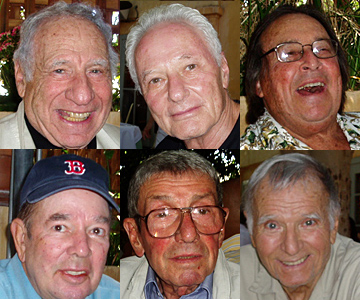

Orso is an unpretentious restaurant located on Third Street near Robertson Boulevard in Los Angeles. It’s almost right across the street from Cedars-Sinai hospital, so those of us who choose to dine outside in the garden almost constantly hear the sound of ambulances rushing to drop off new arrivals at the emergency room. It makes for an exciting lunch. The customers at Orso vary from established showbiz agents and managers to hot stars and lukewarm wannabes, plus assorted normal people and almost always some very attractive babes.
About four or five years ago a group of us began meeting there for lunch almost every Friday. Our table included Mel Brooks, Michael Gruskoff, Alan Ladd Jr., Jay Kanter, Freddie Fields and me, Paul Mazursky. The group seemed to be about the men who had toiled on the third floor at Twentieth Century Fox studios in the ’70s. The studio was run by Laddie with the help of Gareth Wigan and Jay Kanter. On the third floor, in offices that faced each other and always had wide-open doors, were Brooks and Mazursky. Nearby was Gruskoff, who produced “My Favorite Year,” “Quest for Fire” and “Young Frankenstein” (or is that Frankensteen?). Freddie Fields was my agent and a legendary figure in his own unique way. Sometimes sporting a pencil-thin mustache and other times looking a bit like Sinatra, he was, I think, the man who coined the phrase “bottom line.”
Early in my career I was represented by both Freddie and David Begelman. One day I saw them work in tandem and they truly shocked me. I was in early preproduction on “Alex in Wonderland” and I knew that Mike Frankovich (my producer and a man I truly adored, since he had given me my first shot at directing with “Bob and Carol and Ted and Alice”) really wasn’t happy about “Alex.” The movie would open with a scene of Donald Sutherland taking a bath with his 4-year-old movie daughter. Frankovich thought it was disgusting. I thought it was real. So in order to avoid later arguments I told Freddie and David that maybe we should switch the movie to another studio. This was a very tricky thing to pull off, but one day I got a call from Freddie and David asking me to come up to the office. “We think we’ve got a way to get Frankovich to let you move the project. The trick is to make Mike think it’s his idea,” Freddie explained. The saturnine David calmly told his secretary, Toni Howard, to get Frankovich on the phone. Then came the shocker.
“Hi, Mike,” said David, “this is Freddie.”
“Hello, Mike,” Freddie said, “this is David.”
In about five minutes they got Frankovich turned around and the movie was moved to MGM. It was an amazing performance. At times, even though I was sitting there, I wasn’t sure who was who. When the conversation was over, I asked them why they had switched roles. David smiled. Freddie laughed, “Just to relax, kiddo. Just to relax.”
Freddie was also the man who told me after “Harry and Tonto” had been turned down about 15 times, “you only need one yes, kid.” How right he was. The yes came from a young Alan Ladd Jr., who had just been ensconced at Fox as an executive. We met for dinner at La Scala (then on little Santa Monica Boulevard) with Jeff Berg, then one of my agents at CMA (now called ICM). Laddie was very quiet, a bit like his famous father, the man who played “Shane.” He told me that if I could do the film for under $1 million, he thought he could get it made at Fox. The rest is history. It cost $980,000, Art Carney won the Oscar for best actor, and Josh Greenfield and I were nominated for best original screenplay. That was the beginning of my stay at Fox for three more films. They were tricky movies to greenlight, but Laddie always said yes. How could a goyisheh boy brought up in cloistered old Hollywood get “Next Stop, Greenwich Village,” a story about a Jewish kid from Brooklyn who moves to bohemian Greenwich Village? But he did. And then came “An Unmarried Woman,” “Willie and Phil” and an OK on the screenplay of “Tempest,” all quirky movies, risky movies. But that was the joy of the ’70s.
Across the hall from my office was zany Mr. Brooks shouting into the phone so loudly that I knew all his plans. Laddie OK’d Mel’s wacky, irreverent and often brilliant comedies. Brooks and I became friendly. It was easy. He was like one of the guys I grew up with in Brownsville, Brooklyn, only funnier. He often called me “Mr. Greenwich Village, the man who makes great art films.” I didn’t know whether to like that or get pissed off. Then Mel cast me in “History of the World, Part One.” I guess that’s when I began to love him. Anyone who gives an actor a job is immediately adored. Then I met the divine Anne Bancroft. I got to know her better and better because Mel and I went to Pritikin to lose weight, get healthy and eat better. Anne was there with Mel. She was thin and gorgeous and had a great sense of humor. Dom DeLuise would show up, but just for the low-cal meals. The portions were tiny, especially the Jell-O desserts. Dom handled that by sucking up a dozen at a time. Mel and I did our best to score laughs while we were on the treadmill or stretching on the mat. It was often hilarious. Annie was our biggest laugher. Years later, when Mel lost her, somehow the table at Orso became more and more important for him. Our small group became an island of some relief and compassion for Mel, and we were touched to be a part of this.
As the weeks and months passed we got to know each other in a deeper way. Here I was at the age of 74 finding myself getting more and more emotional about these showbiz guys. I began to feel a certain love for Freddie and Mike and Jay and Laddie and Mel. They cared about me and I cared about them. Really cared, something rare in La-La Land. When one of the group couldn’t make the lunch because of the flu, the prostate, the heart or the knees, we quickly exchanged phone calls and sent e-mails with medical advice. We wept when Anne died. It was too painful to bear. But life goes on and so does the table.
Let me run down the particulars of the group. Jay Kanter started out as a junior agent at MCA. One day he was given the task of picking up a client at the Union train station in L.A. When Marlon Brando, fresh off his enormous success in “Streetcar Named Desire,” stepped off the train, Jay said, “My name is Jay Kanter. I’m here to take you to your hotel. Mr. Wasserman (the great Lew) wants you to meet your new agents tomorrow morning.” Brando looked at Jay and said, “I don’t need any more agents. I’ve got you. One agent is enough.”
So Jay became Brando’s agent forever and ever, and even when Jay quit the agency business to work with Laddie he was still the man to go to if you wanted to get a script or a meeting with Brando. The table tries every week to pry some choice bit of gossip out of Jay about Brando or Marilyn Monroe or Grace Kelly — they were all represented by Jay but his loyalty goes very deep. (Now and then there’s a tiny nugget. Laddie was once with Jay and they were both a little boozed. Laddie asked Jay in a very casual way if Grace Kelly had ever had affairs with Frank Sinatra or Gary Cooper or Bing Crosby, all men who had costarred with her. But Jay just smiled and stumbled out of the room.)
When I finished the script of “Tempest” (with Leon Capetanos) I asked Jay to get the script to Brando. Here was a perfect part for him. A crazy middle-aged man stuck on a desert island with his teenage daughter. “We could shoot it in Tahiti,” I told Jay, “right on Brando’s island.” Jay got the script to Brando, and four weeks later he called me at my office at Fox and asked me to meet him downstairs at the parking lot. “Marlon is ready to meet you.” I rushed down. Jay proceeded to give me the rules for the Brando meet. “Follow me in your car. Marlon lives up on Mulholland. When we get through the gate, don’t get out of the car. He’s got an armed guard there and two vicious attack dogs. So wait till the guard says it’s OK.” We arrived at the house and sure enough there were two insane-looking police dogs and a Latino guard with a pistol at his side. As soon as the guard saw Jay, he smiled and shouted something at the dogs. They sat obediently and Jay and I got out of our cars. Gingerly, I followed Jay into the house.
It was sort of Japanese in style. There didn’t seem to be anybody at home. Jay called out “Marlon. It’s Jay. I’m here with Paul Mazursky.” Then I heard the unmistakable voice of Brando, “I’m in the bedroom, Jay. Come on in.” My heart began to pound. I was about to meet the greatest American actor of my generation, the Godfather himself. We entered the bedroom. I saw the huge figure of a man in blue denim overalls with his back to me. Could this be Brando? Then he turned to face us. Although he was about 300 pounds, his face was beautiful; his hair was blondish and was cut in the style of Marc Antony. He took an enormous sip out of a large plastic container. “I’m on this damned liquid diet. I hate the taste of it. So I chew a lot of grape bubble gum. Want some?” I shook my head. “No, thank you, Mr. Brando.” I peeked into the bedroom. There were lots of books and magazines strewn around and a small video camera set up on a tripod. I wondered if the camera was for shooting hot sex in the afternoon.
After a moment of silence Jay said, “Well, I’ll leave you two alone. Goodbye, Marlon.” Marlon nodded to Jay and turned to me as Jay left the room. “Mazursky? Is that Polish or Russian?” “It’s both,” I told him. “My mother’s father was Russian and my father’s father was from Poland.” Brando took another giant swig of the diet drink and said, “Do you like Tchaikovsky? Or Mussorgsky?” “I love them,” I said, eager to get on Brando’s good side. “I love Russian music.” But where was all this stuff going? I wondered. When the hell would we get to “Tempest”? For the next 45 minutes Brando and I discussed Russia, Shelley Winters, global warming and the plight of the American Indian. Finally, I got up my courage and asked him if he liked the script of “Tempest.”
“Tempest”? he asked me with a furrowed brow. “What’s ‘Tempest’?”
I felt a bit nauseous and told him it was the reason I was there. “I never got a script for ‘Tempest,'” he muttered. I was dumbfounded. Why the hell had he told Jay he was ready to meet me? Was this some kind of Brando ploy? A way to see what Mazursky was made of? I knew from talking to Shelley Winters that he had seen “Next Stop, Greenwich Village” and liked it. So why would he play games with me? I quickly gave Brando a thumbnail résumé of the plot. “You can do it in Tahiti,” I told him. He smiled and said that he’d love to read it. “I’ve got a copy of the script in my car,” I offered. “Good,” said Brando. “But I’d better go out to the car with you. We don’t want my doggies to get angry,” he chuckled. We went outside and I gave Brando the script.
“I’m working on a 12-part series for HBO on ‘Wounded Knee,'” Brando told me. “Maybe you could direct one of them.”
“I’d love to,” I said, more confused than ever. We shook hands and I drove away. When I got back to my office, I called Jay and told him about the weird meeting. “He never read the script, Jay. Or was he putting me on?” Jay was surprised but he had no explanation. “You never know with Marlon,” was the best Jay could offer. To this day we still don’t know why I had the “Tempest” meeting.
One of the mysterious aspects of our table meetings is that Mel doesn’t want any more regulars to join us. We know that there are folks in town who would love to come to the party, but somehow it never happens. “He wasn’t on the third floor,” Mel shouts as he stabs at a piece of chicken and a forkful of braised cabbage. “This table is about the third floor.”
“But Larry David is so clever,” I offer.
“Clever, schmever,” says Mel. “He wasn’t on the third floor.”
But now and then we do have a guest. My favorite was Peter O’Toole. The great O’Toole had starred in “My Favorite Year.” Mike Gruskoff, who produced that very funny film, informed the table that O’Toole was coming to town for the Oscars. “He said he’d love to come to lunch.” Mel liked the connection between Mike, the third floor and “My Favorite Year.”
“Wonderful,” said Mel. “Tell him to come.” So the next week we were joined by Peter O’Toole and Richard Benjamin, who had directed the film. I was very excited to meet Peter. I wasn’t disappointed. First of all I’d never seen an outfit quite like Peter’s. A white linen jacket, some sort of suede-ish vest, a Panama hat and an ivory cigarette holder that he chain-smoked from. He was divine. Of course the gawkers at Orso couldn’t stop staring. When the meal was over Peter very shyly asked us if there was a chance he would be invited back again. “I’ve had a jolly good time,” he said. I hope he’s up for another Oscar soon.
Just a few weeks ago we flew up to Seattle for a preview of “Young Frankenstein, the Musical.” After we checked into the Fairmount Hotel, Mel had a car pick us up and take us to meet him at the Cheesecake Factory restaurant. This time the table was absent Freddie Fields, who was a bit under the weather. We waited excitedly for Mel to arrive. We knew from past conversations that this was a big, expensive show. Mel had already sung us three or four tunes from the show (at Orso, with the rest of the customers listening avidly). It all sounded funny. But we knew that Mel would be nervous. No matter how cool we played it he knew we’d have strong opinions and we knew we had to be careful. Then Mr. Brooks breezed into the restaurant and joined our booth. His energy was higher than ever. “It’s great,” he said. “A great show! But I don’t want to hear about Act 3. I gotta fix it!”
Strangers kept coming up to the booth asking for Mel’s autograph. Two girls from Cleveland asked him to pose for a picture with them. He graciously obliged. The joint was jumping. It was fun. I realized how different the crowd was from Orso, where a customer would never dare ask for an autograph. As much as I like Orso, it was refreshing to be here with the real world. Mike took out his cellphone and called Freddie. Soon the five of us were wishing Freddie well and promising him another call that night after the show.
That evening Laddie, Mike, Jay and I were escorted to our seats at the Paramount Theater. The place was packed with 2,900 very noisy fans. I spotted Peter Bart in the audience. Bart, the editor of Variety, is the uncle of Roger Bart, who was playing Doctor Frankenstein. I knew that his reaction would be important to Mel. But Mel was so busy ushering us to our seats that he appeared unconcerned. “I’ll meet you guys after the show. We can grab a bite next door at Ruth’s Chris,” Mel shouted. The noise in the audience was humongous. A few minutes later the lights went down, the stage darkened, and the audience roared with applause and cheers as the show began. Thunder, lightning, music, Transylvania! At the end, the audience gave the cast a long standing ovation.
The table group was clearly relieved. Mel ran down the aisle and corralled us. “Come on! Let’s go backstage to meet the cast.” Backstage proved to be four flights up a winding staircase. But it was worth the trip. Gorgeous, long-legged showgirls, a joyous cast, the smell of hit, hit, hit! Of course, by the time we reached the restaurant my group had all agreed that the show was about 20 minutes too long, that it could use a few cuts and trims, etc., but that it was definitely going to be a hit.
The next morning we all met for brunch at the hotel. We told Mel how much we loved the show. We advised him to cut a few minutes. He nodded in agreement. “I told you. I gotta fix some stuff.” But he was relieved and so were we. Then Mel suddenly turned dark. “I know you guys think I’m on top of the world. But right now I feel like an empty shell. I wish Annie could be here with us.” Tears came to his eyes, and to mine. We all commiserated, but we all knew it couldn’t do much good. “I love you guys,” Mel said.
By the time we reached Los Angeles we all agreed to make the New York opening on Nov. 8. In the meantime, our group will once again assemble at our table. Mel will be there, and we all anxiously await the inside dope on what he’s done with “Young Frankenstein.”
And if by any chance, dear reader, you dine at Orso one Friday afternoon you are welcome to gawk, but please don’t ask for a seat at our table. It’s only for the third floor at Fox in the ’70s.
