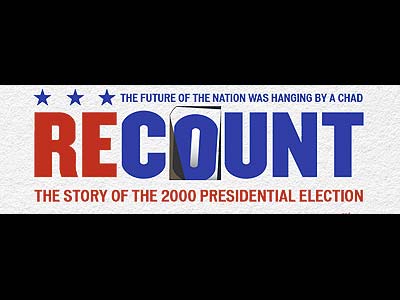
From the overly decorous Gore team to the bought-and-paid-for Supreme Court, HBO's enraging docudrama shows the Florida recount like it was.
By Gary Kamiya
Read more: Republican Party, George W. Bush, Democratic Party, Al Gore, HBO, Florida, TV, Supreme Court, Arts & Entertainment, Gary Kamiya, Arts & Entertainment Features, Florida Recount
HBO / Gene Page
Laura Dern as Katherine Harris in "Recount."
May 23, 2008 | "Recount," director Jay Roach and screenwriter Danny Strong's first-rate docudrama about the disputed 2000 presidential election, is almost too painful to watch. Close to eight years have passed since a divided Supreme Court ended the epic 36-day battle over the votes by halting the recount in Florida, thus handing the election to George W. Bush. The bitterness over that judicial outrage may have subsided, but it never died, and HBO's "Recount" brings it all back. In fact, it's almost more unbearable to revisit this black chapter in American history than it was to experience it at the time. Beyond the manifest injustice of the ruling, after eight years of George W. Bush, we now know exactly what that ruling resulted in. It is impossible to watch "Recount" without experiencing a constant stream of agonized what-ifs.
Faced with this explosive subject, HBO could have played it safe and approved a mealy-mouthed "both sides made mistakes" film, the sort TV networks usually churn out on the rare occasions when they dare to tackle controversial current events. To its credit, it set the bar higher. "Recount" reveals what actually happened in Florida. And that's an audacious feat.
For those who may have repressed all memory of what happened in Florida, way back at the beginning of time before 9/11, Iraq and the Bush presidency, here's a quick primer. The election was a cliffhanger, the closest in modern American history. Gore won the popular vote by 540,520 votes, but the Electoral College tally -- the only one that matters -- came down to Florida. The networks called Florida for Gore. But then Bush took the lead, and first Fox, then the networks called it for Bush. Following the revised calls, Gore informally conceded to Bush and was about to formally concede when an aide intercepted him at the last minute. The aide told Gore that the numbers were closer than the networks were reporting -- so close that an automatic recount would be triggered. Gore withdrew his concession, and the 36-day battle began.
The Gore team, headed by William Daley (son of the Chicago mayor, who was long suspected of throwing the 1960 election for Kennedy), hired former Secretary of State Warren Christopher to head its political and legal campaign. Bush's lead after the automatic machine recount had dwindled to just 327 votes. The Gore team decided not to ask for a statewide manual recount, but to request one only in four heavily Democratic counties: Palm Beach, Volusia, Broward and Miami-Dade. It was to prove a fateful -- perhaps fatal -- decision.
Katherine Harris, the Florida secretary of state who was also a co-chair of Bush's campaign in the state, promptly ruled that the deadline to certify the vote was the next day, and that manual recounts would not be permitted. When three of the counties requested that their manual tallies be included, she ruled against them. But then the Florida Supreme Court, which was to become Gore's crucial ally in the GOP-dominated state, stepped in and ruled that manual recounts could proceed.
Bush's lawyers, who had been prepared for a legal defeat at the hands of the Florida court, appealed the ruling to the U.S. Supreme Court. Meanwhile, the indefatigable Harris denied Palm Beach County's request for more time to finish its recount (had she granted it, Gore would have cut Bush's 337-vote lead by either 215 or 176 votes) and certified Bush the winner in Florida.
Gore formally contested the election, but a conservative judge ruled against him. Gore appealed the decision to the Florida Supreme Court. In a dramatic turnabout, the Democrat-dominated court not only ruled in his favor, but ordered that all ballots in the state that had recorded no vote for president (so-called undervotes) be manually recounted. Bush appealed to the U.S. Supreme Court, which by a 5-4 vote ordered that the manual recount stop immediately. Bush and Gore lawyers filed briefs with the high court, which heard their arguments the next day. Again by a 5-4 vote, with the five Republican justices concurring, the Supreme Court overturned the Florida court's decision, rejecting further manual recounts.
In telling this story, screenwriter Danny Strong draws heavily on four journalistic accounts: "Too Close to Call" by Jeffrey Toobin, "Down and Dirty" by Jake Tapper (now an ABC news reporter who covered the story for Salon), "The Accidental President" by David A. Kaplan, and "Deadlock" by David Von Drehle and Ellen Nakashima. Toobin, Tapper, Kaplan and Von Drehle, along with Time's Mark Halperin, were paid consultants on the film. Strong also interviewed 40 principals, including Bush's chief strategist James Baker and chief counsel Ben Ginsberg, Gore's initial representative Warren Christopher, and Ron Klain, the Gore strategist who, played by Kevin Spacey, is the protagonist of the film.
Strong sent the script to the consultants, as well as to Baker, Klain and Ginsberg, all of whom signed off on it. In fact, Strong told Politico that "Baker really liked the script and couldn't have been more supportive."
That Baker -- the Bush family consigliere whose icy, authoritarian performances during the battle epitomized the GOP's win-at-all-costs approach -- liked the script, is both unsurprising and disconcerting. It's unsurprising because Baker himself comes off pretty well in the film. Played with uncanny verisimilitude by Tom Wilkinson, Baker is a coldblooded, highly effective strategist who rolls over his hopelessly wimpy, but principled, Democratic counterpart, Warren Christopher (played with ossified gravitas by John Hurt). Perhaps as a self-protective nod toward balance, the script goes out of its way to humanize Baker. In one of the few moments in which the film explores a character in any depth, Baker explains to Ginsberg that he became a Republican in middle age because George H.W. Bush, in a compassionate gesture, offered him a job after Baker's wife died. And in an invented scene, Baker and Klain meet on the tarmac when it's all over. There's a Homeric, noble-adversaries quality to the encounter: Baker treats Klain with respect, and acknowledges that each of them believes his candidate was the better man. The Baker portrayed in "Recount" is no rigid ideologue but, rather, a consummate professional who is also a decent human being.
But it's also disconcerting that Baker liked the script, because "Recount" shows just what an outrageous, profoundly anti-democratic coup he helped pull off.