
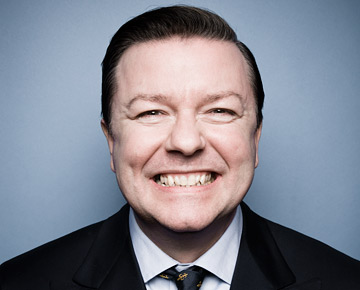

Ricky Gervais, speechless, is gazing longingly into Leonard’s eyes. Seated in a plush armchair, his face within intimate range of Leonard’s, all he really wants is for Leonard to bark. Just once. This is a genuinely awkward moment for Gervais, the celebrated British actor-comedian who has made an art of playing characters prone to terribly awkward moments.
Leonard is being played by a pampered performer named Jazz, a Great Dane supposedly trained to deliver on cue. But the hound with the Hollywood gravy train is gazing right back at Gervais without so much as a sniff. After a moment, he lets loose a floppy tongue, pants a couple of times. He is going way off script. Everyone on the set is holding their breath. The stone-faced Gervais normally loves to improvise, but this time he’s baffled. It’s hard to decide if the impasse between the two is hilarious or weird or a fair bit of both.
It’s mid-December in Brooklyn, and Gervais is hard at work on the final day of shooting for “Ghost Town,” a romantic comedy due in theaters this September. Alongside actors Greg Kinnear and Téa Leoni, Gervais stars as a misanthropic dentist whose near-death experience leaves him with special powers of perception and caught in a wacky love triangle reaching beyond the grave. This is rather a departure from the kind of material with which the comedy whiz made his mark — two acclaimed TV series, “The Office” and “Extras,” which sent up workplace and celebrity inanity by way of brutally funny satire.
Although it’s been two months and a rare long stint away from his home in England, Gervais says he loves spending time in New York City, the world’s primo fondue pot for pop culture. He is characteristically jovial about his first lead role in a Hollywood film. But this production is a different pile of string than the TV projects that brought him international fame. The scene at hand will require several more takes and a little postproduction magic to coax the hound’s compliance.
Gervais looks anxious as he steps over to view the footage on a nearby monitor and begins suggesting how the different takes might be cobbled together. He catches himself: “Look at me. I’m such a control freak!” He seems at once excited and agitated with this attempted transition from cult phenom to movie star. His TV success has already led to side roles in several Hollywood productions, but the forthcoming movie promises to plaster his mug on full-page ads across America.
Even so, maybe it’s the pampered pooch who’s acting the prima donna here.
“Yeah, it’s tough,” Gervais muses. “He was never going to bark and I knew it. He just wasn’t going to do it.”
A bit more on this point, before we get to chatting at length about his improbable TV career and emerging Hollywood trajectory.
“Have you worked with animals much before?”
“Only in porn,” he quips. His deadpan look cracks open with that signature thousand-watt grin, the one punctuated by the pointy incisors and the high, impish guffaw.
It’s an apt moment. Gervais has long frolicked at the edges of taste, heckling what he calls “broad comedy” and insisting that he does creative work only on his own terms. He says flat out that he doesn’t want any dummies in his audience. (The misery of selling out to a mainstream audience was a central theme of “Extras.”) Yet he loves American pop culture and admits to indulging regularly in watching “reality TV.” And he is eager to make a bigger splash across the pond — here he is, wrapping work on what by all appearances is an archetypal Hollywood tale.
Indeed, as he stands at the Hollywood crossroads, Ricky Gervais also stands as something of a paradox. Shortish and rotund, he makes up in comedic charisma what he lacks in leading-man looks. He’s a genial and witty conversationalist, zinging one-liners like ammo fired from a toy gun and then giggling along with you as you duck and dodge. But can the unlikely middle-aged maverick — who favors uncomfortable humor but only jumped into comedy in his late 30s — really make the leap to Hollywood movie star? And why, exactly, does he care to try?
If it’s not so much about seeing his “big fat face” on the screen, as Gervais goes out of his way to put it, the answer may lie in his zeal for collaboration. It starts with the writing and spills into all manner of revising and tinkering, a hallmark of his carefully sculpted TV creations. Even when peppering a comedy with blatant gags, he says, “It’s not the jokes that keep you hooked. It’s the story that keeps you hooked.”
After television success delivered Hollywood scripts to his doorstep, Gervais resisted for a while. “A project really has to offer so much potential and possibility,” he says. He found the script for “Ghost Town” distinctively funny. Additionally, director David Koepp, who also co-wrote the movie, offered the kind of access Gervais craved. “We fiddled with the script together for a couple of days and then I knew I was definitely in,” Gervais says. “I feel like I was part of it from the beginning.”
The Brit’s approach impressed Koepp, who has written scripts for several Hollywood blockbusters. “You want input from your actors; they’re not really doing their job if they’re not actively involved,” Koepp says. “For someone who has written so much himself, Ricky was an interesting combination of wanting to play the part as written on the page but also paraphrasing and going off on riffs.”
As the day sprawls forward inside the cavernous Brooklyn studio, Gervais looks a little weary. It’s been 12-hour days, here and around the city, for eight weeks straight. But the gleam stays in his eye. “I love the hard work,” he says. “Winston Churchill said, ‘If you find a job you love, you’ll never work again in your life’ — and it’s true.” Gervais ponders this for a second. “He also said, ‘Give me some more brandy.'”
The laugh that bubbles up when he delivers such lines is familiar to actor Aasif Mandvi, who has a supporting role in “Ghost Town.” “We’ve had a hard time getting through the scenes because we kept cracking up,” says Mandvi, who gained notice as a correspondent on “The Daily Show With Jon Stewart,” the popular fake newscast on Comedy Central. “Ricky is a great person to bounce stuff off of because he likes to play. I love to work with people who just want to explore the possibilities like that. Sometimes you come up with crap, but sometimes you come up with gold. It makes it very alive.”
“I get very excited about creating stuff just from scratch,” Gervais says. “You’ve got to be in this work for the right reasons — being rich and famous ultimately doesn’t mean anything.”
It would be hard to overstate Gervais’ fortune and fame, both due primarily to “The Office,” which he wrote and directed with his longtime creative partner Stephen Merchant. Although the series didn’t get much attention when it first aired in the U.K. in 2001, it soon became one of the most successful television comedies in British history, winning prestigious awards, selling more than 4 million DVDs and catching fire with audiences beyond U.K. shores.
Set in the dreary town of Slough, England, the meticulous portrait of workplace tedium, insecurity and latent depravity starred Gervais as David Brent, a pitifully self-inflated middle manager of a paper company. He was a transfixing spectacle of awkward bravado and inappropriate conduct — a royal putz of a guy who, acutely aware of the faux-documentary’s camera, was desperate to impress more than just his employees with his off-color jokes and bungled truisms. The ensemble cast was equally vivid, both in their aversion to David Brent and their own moronic and degenerate behavior.
Reaching across the Atlantic, the series won two Golden Globe awards and rare critical reverence. It’s not often that you see a top TV critic gushing like this: “Nobody who has seen the BBC series ‘The Office’ has anything bad to say about it, and there’s a reason for that: It’s perfect,” wrote the New Yorker’s Nancy Franklin in October 2004. “It’s a comedy that doesn’t make you laugh, and at times it is close to unbearable; some people like it so much that they can’t watch it. That’s how good it is.”
Yet, although the show found a strong cult following here, Gervais is hardly a household name in America. Survey the pop-culturally savvy in, say, New York or San Francisco, and you’ll find devotees. But mention “The Office” to most American TV viewers and you’re likely to hear only about NBC’s hit spinoff of the same name, set in Scranton, Penn., and starring funnyman Steve Carrell. Ricky Gervais? Who the hell is he?
The man who inadvertently put Scranton on the map (he’s an executive producer of the NBC version) followed a circuitous path to stardom. Gervais, now 47, grew up in a suburb of Reading, in southern England. In the early 1980s he attended University College London, where he studied biology and philosophy and met his longtime girlfriend, TV producer Jane Fallon. He played in a pop group that blipped briefly on the U.K. charts, worked various odd jobs (including in an office, of course) and got into music and entertainment management.
By the mid-1990s Gervais landed a job at London radio station Xfm, where he and Stephen Merchant first met. The two began writing sketches together, incubating what would become the demo for “The Office.”
Gervais describes a rare creative partnership with Merchant. “Stephen and I trust each other so much. We never put anything in unless we both want it,” he says. “There’s no compromise, really. It feels like I’m always getting my own way, and maybe he feels the same.” To anyone who has ever collaborated on creating anything, this sounds far-fetched — until you rewatch “The Office,” a series so well crafted that every detail, from an actor’s glance to the grace note of a clacking copy machine, counts.
“We wanted every word and nuance to be real and to mean something,” says Gervais. “I’ve seen so much stuff that’s been ruined by writers’ getting carried away with getting a good joke in. We threw jokes on the floor if they made someone look too clever or undermined the story.”
The success of the series uncorked things for the comedy duo. Subsequent work included a weekly podcast that was downloaded by millions, and their next TV series, “Extras,” the wickedly funny torching of celebrity culture. That series, also starring Gervais, featured A-list cameos from the likes of Kate Winslet, Samuel L. Jackson, Robert De Niro and David Bowie, who delivered a particularly astonishing moment of musical degradation. Gervais also wrote and appeared in an episode of “The Simpsons,” and he delved into stand-up comedy, touring with shows across the U.K. — although in this realm he has drawn more mixed reviews. In May 2007 he did his first U.S. show, at Madison Square Garden, as part of David Bowie’s High Line Festival. He’s bringing his latest show to Los Angeles and New York for several nights starting July 11, a string of performances also to be filmed for an HBO special.
“I like the romance of doing stand-up,” he says. “It’s the last bastion of self-censorship outside the novel, and that excites me. I can go onstage and say anything I want.” He laughs at the notion. “Well, I pretty much do that on the telly as well. I guess I can get away with it because I put forward a good argument.”
Gervais admits that taking a shot at stand-up was also about feeling like he needed to earn his spurs. “I suppose I felt guilty about walking into a great job like ‘The Office,’ you know? Most comedians slog around for 20 years before they get a part in a sitcom or a chance to write something.”
Although his second effort, “Extras,” gained only a modest U.S. audience, it too raked in the accolades, including Emmys in 2006 and 2007 and a Golden Globe in early 2008, shortly after the series finale aired. In that feature-length special, Gervais’ main character (the self-absorbed actor Andy Millman) had a surprisingly dramatic turn, leading one American TV critic to suggest that an evolving Gervais could be the next Bill Murray or Jim Carrey.
Still, it’s unclear whether Gervais can carve out artistic autonomy in Hollywood. He’s been criticized for a couple of side roles that, by his own admission, he took primarily for the chance to work with some of his film heroes. The big-budget “Stardust,” for example, put him in a scene opposite Robert De Niro but implicated him in a schlocky fantasy-adventure that came off like a bad Terry Gilliam imitation for the Disney Channel.
Gervais greatly admires American film and television. “All of my favorite comedies and dramas are coming out of America,” he says. “The ‘British film industry’ is nearly an oxymoron.” As for the reality TV zeitgeist, he says, “Yeah, we’ve got too much of it in Britain as well. But I do watch a lot of the shows coming back over from here — ‘Top Chef,’ ‘Fit Club,’ ‘The Apprentice,’ ‘American Idol.’
“I think American TV has even been beating film over the past few years,” he adds, citing “The Sopranos” as a favorite. “I love the way that TV can relax now. It’s audacious to plan for an audience to get into a show after the third episode.”
His own audacity has led some in the media to treat him like an animal — a variety of them, actually. He has been compared to a hyena (his laugh), a tiger (his grin), a walrus (his shape) and a puppy dog (his disposition), among others. Sometimes it has been done in admiration, sometimes not. And some critics have accused him of being a one-trick pony, playing essentially the same character in everything he does.
Gervais appears to take it in stride. For him there is the legitimate press (“There are some wonderful journalists in Britain and America”) and there is the gutter press (“I don’t care whether Britney Spears is a good mother or not — it’s just cheap speculation”). He has made use of the latter: One memorable segment in “Extras” mocked tabloid reporters who set off fact-free frenzies across the media.
“No doubt about it: American press is nowhere near as bad as the British press with this,” Gervais laughs. “You’re amateurs. You have bitchy Internet people here … Well, they get jobs on big papers in England!”
But never mind the paparazzi and the pundits; after two months of toil in New York, what interests Gervais is tweaking the taste of American audiences. Will his sensibility come off smooth like Velveeta or pungent like so much Stilton?
Aasif Mandvi, who also grew up in England, thinks Gervais can appeal more widely here. “Just as a fan, I’m excited he’s making this leap to Hollywood comedic leading man,” Mandvi says. “He’s just so funny.”
Forecasting the next turn in Gervais’ career, however, may be no easier than deciphering his contradictions. He’s jolly and generous — no, he’s raw and uncompromising. He doles out pop culture barbs but lounges at home (mostly in his pajamas, he says) binging on reality TV. He pronounces judgment on “broad comedy” — then trades on his hard-earned renown to do a mainstream Hollywood movie.
But watch Gervais labor for a day and it’s evident he means it when he says the satisfaction of the work itself trumps all else. Like other wayward entertainers, he is driven in part by the way his chosen medium once riveted him.
“I’ll tell you what,” he says, kicking back after the final shoot of the day has wrapped. “I’ve always wanted to get this one moment back: I wish I’d never seen ‘The Godfather’ before, because I remember how good it felt the first time I watched it. I’d say the same about ‘The Sopranos.’ I want that experience again.”
It’s clear this motivates him not only as a fan. He’s got fame and fortune to spare, and has rubbed creative elbows with some of his artistic demigods. But even though he has conjured some pretty serious comedy, Ricky Gervais would probably like nothing more than to move audiences with that same kind of magic.
This article was first published in Arrive Magazine and is reprinted with permission.
