

Returning to a movie that delighted you when you were younger can be a dicey proposition. We’ve all re-viewed some once-beloved picture only to find that we no longer connect to it, that our previous affection was based on who we were and where we were in life when we first saw it, that experience has shaped our outlook in a different way. Watching “E.T.” 20 years after it was first released (half my life ago), I can’t say that the movie holds the same sense of discovery it did in 1982. (Narrative discovery is a casualty of knowing what’s going to happen in a story, for one thing.) But for people who saw “E.T.” on its first go-round, particularly moviegoers who were kids back then, the pleasure of seeing it now is the joy of feeling your responses deepen. It’s no news to anyone that “E.T.” is one of the loveliest and happiest of American movie entertainments. It’s also a greater picture than we could have known.
Introducing a screening of Steven Spielberg’s first feature, “The Sugarland Express,” at the Brooklyn Academy of Music last week, my friend and Slate colleague David Edelstein remarked that it might strike some people as strange to be showing a Steven Spielberg movie at a nonprofit repertory house. I know the people he was talking about, those who are convinced that popular American movies (even American culture) are beneath the serious consideration of anyone interested in the art of movies. For some critics and upscale viewers, Spielberg is a convenient symbol of Hollywood dreck and the triumph of commerce over art, even a stand-in for American cultural imperialism.
This reaction against Spielberg is based at least partly on his optimism, and the false assumption that tortured and tormented artists are more profound than happy ones (try applying that notion to Mozart or “A Midsummer Night’s Dream” or “I Want to Hold Your Hand”). Part of the problem is simply timing. Nobody really objects to the serious consideration of commercial directors like Howard Hawks, Alfred Hitchcock, Ernst Lubitsch, George Cukor or John Ford. But these filmmakers belong to Hollywood’s “golden age,” a time far enough away and different enough from our own that critics and moviegoers can mythologize it (and sometimes, in the process, falsify it).
Spielberg began his commercial career late in the second Hollywood golden age of the ’70s, and his contemporaries were Francis Ford Coppola, Brian De Palma and Martin Scorsese, directors whose relationship to classic Hollywood genres was more complex, ironic and tragic than Spielberg’s. These filmmakers were updating the conventions of westerns and gangster pictures and horror films to see what they still had to tell us about American life. Spielberg simply wasn’t interested in that kind of sociological study. He loved the old genres for their sheer pleasure, and he wanted to be the best entertainer he could be.
Deciding to give pleasure to an audience is one of the most honorable ambitions any artist can choose. Only the greatest are able to achieve that ambition and respect the emotions of their audience, to bring laughter or tears or thrills without cheapening themselves or their material. That’s the tradition that Spielberg belongs to. From “The Sugarland Express” in 1974 to “E.T.” in 1982, he had what may be the greatest run of any entertainer-director. (No, I’m not forgetting “1941.” Spielberg’s cut, available on DVD, is a wildly ambitious funhouse slapstick, the work of a director constantly upping the ante, testing himself to see if he can make the laughs as big as the movie’s gargantuan scale. It’s a roadshow-size version of a Preston Sturges picture, and the fact that Spielberg succeeds so much of the time is a marvel.)
Every one of those movies — “The Sugarland Express,” “Jaws,” “Close Encounters of the Third Kind,” “1941,” “Raiders of the Lost Ark,” “E.T.” — is, at heart, a comedy. Sometimes, as in “Close Encounters” or “E.T.,” the comedy comes from the way the movies act as wish fulfillments, validating the moonstruck dreams of their protagonists, the very dreams we in the audience have been made to share. (Think of the big goofy grin on Richard Dreyfuss’ face as he boards the mothership in “Close Encounters.”) And sometimes the comedy lies in the way Spielberg makes us aware of how susceptible we are to the manipulations of movies. I’ve never heard anyone talk about the experience of seeing “Jaws” without relating how, after every jump scene, the audience broke into laughter at its own fright. When Indiana Jones smiled at a Nazi before sending him spilling out of a speeding Jeep, the audience grinned with him. The sadistic pleasure we took in seeing the bad guys get it was right out in the open, a shared dirty joke.
Spielberg is often spoken of as a heartless manipulator. But in these movies, his sense of comedy defuses any impulses toward jerking tears. Toward the climax of “The Sugarland Express,” essentially a chase movie, he allows a feeling of inevitability to take over the movie’s constant sense of forward motion, like a slow leak in the tire of a souped-up Chevy. In “E.T.,” the scenes other directors would milk for tears are the most dry-eyed — it’s in the happy moments that the tears come.
I understand that there are people who don’t respond to Spielberg’s movies. Much as I dislike dogmatic statements, though, I think that if you look at his work from this period and don’t realize you’re seeing a master of framing, timing and rhythm, a born moviemaker, then in some essential way you don’t understand movies. Gently satirical and loving, and often set in middle-class or working-class households and towns, Spielberg’s work reminded you of what was good about America — the optimism, the oddball enthusiasms of ordinary folks and the way people stake out their own space in the noisy, free-for-all bumptiousness of family life. (People talk at the same time in Spielberg’s movies, the way they do in Howard Hawks’ work, and Robert Altman’s.)
Spielberg’s movies, despite the way they’re often characterized, are not Hollywood idealizations of families and the suburbs. The homes here bear what the cultural critic Karal Ann Marling called “the marks of hard use.” The furniture is functional and beat-up, and might have a few unmade payments left to go. The garages carry the detritus of a hundred forgotten projects. Toys and laundry never seem to get picked up. The TV jabbers in the background. The phone keeps ringing. Kids and their friends are always underfoot. Controlled chaos carries the day.
Nobody just sits down to dinner in Spielberg households and talks about what they did that day. The kids (and sometimes the adults) play with their food, keep jumping up to attend to other things, talk over one another and in general create such a hubbub that eating becomes the last thing on anybody’s mind. Spielberg also reminded you of what could be good about popular American movies: their capacity for reflecting and celebrating that native casualness, and the way the best of them become communal experiences, modern versions of passed-down tall tales and legends that become part of our common popular heritage.
The disappointment of watching the “serious” Steven Spielberg, the Spielberg of “The Color Purple” and “Amistad” and “Saving Private Ryan” and “A.I.,” reminds me of Woody Allen’s ridiculous remark about comics not sitting at the grown-ups’ table. It’s the sad spectacle of a director rejecting what made him good in the first place. You can’t blame Spielberg for wanting to move beyond the increasingly closed-off movie world of the “Indiana Jones” and “Jurassic Park” series. But — with the exception of “Schindler’s List,” a more ambiguous and thorny movie than is generally understood — Spielberg’s adult dramas have less connection to the real world than his fantasies do. Like those fantasies, they also belong to a Hollywood tradition, but it’s the tired, inflated tradition of worthy, impressively mounted prestige pictures. He’s the good student in these movies, working less for his own joy in moviemaking than for the approval of those he perceives to be his betters.
There is always a danger that a director’s inferior work will be used against him to prove that even his good work was a sham. So it is that a clanking, impersonal thriller like “Jurassic Park” has been used by his critics as if it were indistinguishable from the wit and invention of “Jaws.” Or the square self-importance of “Amistad” and “Saving Private Ryan” is used to prove that there was never any real content in Spielberg’s movies.
For me, the real drama lies somewhere else in his movies. The single most despairing moment in any Spielberg picture may be at the end of “The Sugarland Express,” when Goldie Hawn realizes she’s not going to be reunited with the child authorities have taken away from her and, in a frenzy, throws a copy of “The Wizard of Oz” out a car window. That’s the act of someone who has reached a point where life has become too painful to accommodate even the possibility of fantasy. But fantasy can be a way back to life rather than an escape from it.
All great fantasies, from “The Wizard of Oz” to the Harry Potter books to “The Lord of the Rings” to “Buffy the Vampire Slayer” to “E.T.,” the greatest of all American fantasy movies, are grounded in emotional reality. They provide ways of talking about elemental things that might be considered banal were they treated in a straightforward, naturalistic manner. In the context of fantasy, the emotions associated with basic experiences and rites of passage are heightened and intensified.
The crushing sadness of a teenage girl who sleeps with her boyfriend only to find him turned into a strutting bastard the next morning is a familiar tale. When the girl is Buffy, a vampire slayer, and her boyfriend, Angel, is a vampire with a soul who (thanks to a gypsy curse) loses that soul after achieving a moment of perfect happiness, banality is transcended the way it is in grand opera. Which is not to say that all fantasy takes place at the highest emotional pitch, or on a superhuman scale.
“E.T.” is often mentioned in the same breath as the big special-effects extravaganzas that took over Hollywood in the ’80s and have never left. What’s startling about seeing it again is rediscovering how small a film it is, how intimate and personal. The first shot tells the story. Opening on the starriest night sky you’ve ever seen, the camera pans down until the stars begin to fade and we reach the pinkish dusk above a scrubby, suburban forest. It’s Spielberg’s way of saying that we are watching a story about this world. Cinematographer Allen Daviau envelops the movie in supple, warm light, making that world seem both familiar and strange. When Elliott (Henry Thomas) ventures bravely into his backyard to investigate the strange noises coming from the shed where E.T. has holed up, a crescent moon hangs in a foggy sky, and the effect is as if Maxfield Parrish had designed the nighttime scenes of F.W. Murnau’s “Sunrise.”
The movie is that simple and that lovely. Spielberg doesn’t use the effects to wow us. When we first see E.T.’s spaceship in the opening, there’s no big buildup, no swell of music on the soundtrack. Spielberg simply cuts to the ship sitting in a clearing. And even in this rerelease, promising new footage and “enhanced” effects, the special effects are matter-of-fact, subordinate to the story. Some of E.T.’s movements have been digitized, but Spielberg has wisely left alone the slight jerkiness of the models designed by Carlo Rambaldi, that endearing side-to-side shuffle that makes E.T. look like nothing so much as an old man, still spry despite his pot belly. (Apart from one added scene where E.T. luxuriates happily in the bathtub, I can’t detect what was added, and that’s a good thing. Spielberg doesn’t deface our memories the way he did with the “Special Edition” of “Close Encounters,” the New Coke of movie rereleases.)
One reason Spielberg was able to maintain the intimate scale is the spareness of Melissa Mathison’s screenplay. As in her screenplays for Carroll Ballard’s “The Black Stallion” and Martin Scorsese’s “Kundun” (perhaps the director’s best film) — both of which, like “E.T.,” are stories of boys who find wonders in the real world equal to their fantasy lives — Mathison gets into the heads of little boys with peerless sweetness. She bypasses all the “snakes and snails and puppy-dog tails” clichés of how boys are presumed to act, allowing for their vulnerability and tenderness. Mathison builds good, solid foundations that can support the visions directors bring to her stories. She lays the groundwork, and the directors ascend into the stratosphere. Except that Spielberg, like a boy soprano hitting a clear, sustained note, never takes his feet off the ground.
For Spielberg, who thought he was making a movie that would have limited audience appeal, the impulse behind “E.T.” lay in his own memories of his parents’ divorce. He wanted to make a film about a 10-year-old boy who feels abandoned and, in classic storybook fashion, finds a friend who understands him. Elliott and E.T. (the second name a shorthand version of the first) understand each other so well they’re telepathic, feeling each other’s feelings. (When E.T. gets into the beer, Elliott gets drunk, too.) “He’s a boy,” Elliott announces definitively to his little sister Gertie (Drew Barrymore) when he introduces her to E.T. (Of course, to a little girl, E.T. would have been unquestionably female. We never learn what gender he is, or whether the concept is even relevant.)
We’ve all seen and read stories of children dreaming about journeying to faraway places. “E.T.” offers a charming reversal on those fantasies: Lonely Elliott invites E.T. to share his world, that familiar Spielberg world of lived-in suburban houses. For most of the movie, E.T.’s view of earth is confined to Elliott’s bedroom, the center of every kid’s universe. And Elliott’s explanation of the world is just as self-contained. Trying to explain this strange planet to a stranded visitor, Elliott is less a tutor than a kid eager to share his enthusiasms with a new friend. The look of puzzlement on E.T.’s face as he’s told about Coke, pet fish, action figures and Pez is the perfect punch line to Elliott’s breathless delivery. For her part, Gertie dresses E.T. up as if he were one of her dolls, and inadvertently teaches him English by watching “Sesame Street.”
Spielberg isn’t sentimental about these kids. He repeatedly uses the gooey way people treat kids to get laughs. When Elliott tries to keep Gertie from telling their mom (Dee Wallace) about E.T., he tells her, “Only little kids can see him.” In the wised-up voice of a child who hates being talked to as if she were Cindy Brady, she responds, “Give me a break!” Spielberg’s most daring joke comes after Elliott finds that E.T. has come back to life. In order to buy time from the government scientists who want to cart E.T. away for study, Elliott pretends to be a wailing little boy in floods of tears. Of course they fall for it and the audience howls, the parents in the audience laughing at the times they’ve fallen for the same routine from their own kids.
Nor is Spielberg sentimental about the way families work. Elliott and Gertie love their mom, Mary, whom they address by her first name. But that doesn’t stop their lives from seeming like one ongoing rumpus, with jokes and wisecracks tossed in among the disciplining and task-mastering. As in the family scenes of “Close Encounters,” you feel, watching “E.T.,” that you’re seeing family life as it is: affectionate but perpetually harried, the bonds that hold people together (and make people nuts) more taken for granted than expressed.
There isn’t a mugger among the young leads. Twenty years have done nothing to diminish the comic weirdness of 6-year-old Drew Barrymore’s timing. Her face is almost as gnomic as E.T.’s; she plays Gertie as alternately a sharp little cookie and a blissed-out oddball. When she blabs something to Mary that she knows she shouldn’t — and she does it frequently — she’s like a midget Gracie Allen, rapt in her own obliviousness. As Elliott, Henry Thomas carries the spirit of the movie’s delicacy. (He’s a good little comic, too, as in the classroom scene when, drunk, he lets loose the frogs awaiting dissection and enfolds the class beauty, Erika Eleniak, later of “Baywatch,” into a kiss.) It’s a remarkably intuitive performance. Elliott is as much of a dreamer as a kid can be while still being grounded in the world, and Thomas plays his gentleness without ever getting icky or forced.
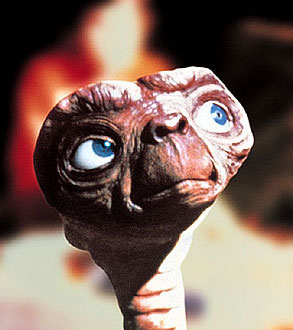
There’s another amazing performance here: E.T.’s, or, I should say, his realization by Rambaldi and his team of technicians. I can’t pay them a greater compliment than to say that we accept E.T. as a real creature, not some techno-wizard’s trickery. Leathery and bumpy, with a child’s wide-eyed stare and the rolls of a middle-aged man’s gut, E.T. himself is one long grace note. The details of the creature are often sublime, from that gargling coo of a voice (supplied, among others — human, animal and electronic — by the amateur photographer Pat Welsh) and the joyous comedy of the slide-whistle way he says “E.T. phone ho-oh-ohm” when he comes back to life, to the unexpected delicacy of his giraffe’s neck and long, knobby fingers and the heartbreaking gentleness of his gestures, as when E.T. embraces Elliott and we see those digits gaining a purchase on the boy’s back.
“E.T.” remains the most fluid movie Spielberg has ever made. It moves forward not on the pop propulsion that powered his previous films but on the waves of its own enchantment. In both tone and execution it’s about as pure as a commercial movie can be. When a movie is as of-a-piece as this one is, the snags in tone are more apparent. Spielberg pushes things once, in the sequence where the government scientists (needlessly made to seem like scary bad guys) invade Elliott’s home and try to save E.T. from death. The whole rhythm and mood of the movie changes; the tempo speeds up and you feel jolted out of its tone of sustained wonder.
Spielberg gets right back on track in the sequence that follows, and that can stand for the decency of his work here. A hack might have squeezed tears out of the scene where Elliott, believing E.T. is dead, says goodbye to his friend. Spielberg shoots it dry-eyed and that’s how Thomas plays it. “I must be dead,” he says, “because I don’t know how to feel.” Spielberg lets the line, and Thomas’ unfussy delivery, speak for itself, for the confusion of a little boy first encountering adult feelings.
In the midst of the scene where the doctors are working on E.T., there’s a shot of Elliott’s older brother, Mike (Robert MacNaughton), withdrawing in tears to the closet of his bedroom. Surrounded by the toys he’s outgrown, he’s a teenage boy trying to retreat into the emotional safety of childhood. Mike, a teenager going through his cool phase, has fallen under E.T.’s spell as surely as his younger siblings.
What’s perhaps most amazing about “E.T.,” what distinguishes it from many of the other fantasy films of its era, is its ability to put an audience under a spell of childlike wonderment without infantilizing it. This comforting fantasy, made by a man who could still remember what it was like to feel like a hurt child, is really about leaving the reassurance of childhood behind. It’s about Elliott learning to accept loss and parting. Perhaps the most emotional moment in a movie full of them is the one, during Elliott and E.T.’s goodbye scene, when the alien beckons his friend by saying, simply, “Come.” Elliott responds: “Stay.” E.T. closes his eyes and leans his head back, a look of exquisite agony on his face that wouldn’t be out of place in the most rhapsodic passage of Puccini or Verdi.
When we’ve been caught in the spell of a book or movie, we often talk of the disappointment of turning the last page or having the lights come up and having to return to the real world. “E.T.” ushers us gently back into the world. It takes the most basic of longings, the longing for home, and tells us that at some point the very idea of home, no matter how it calls to us, will change. The miracle of “E.T.” is that it unites the audience in that elusive and communal dream of moviegoing that can make us feel we’ve found home, and been greeted with open arms.
