
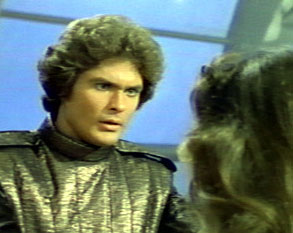

“Well, it’s done. It’s happened. The stars are clear. The planets shine. We’ve won. Oh, some dark force, no doubt, will show its face once more. The wheel will always turn. But for now, it’s calm. And for a little time, at least, we can rest.”
— Christopher Plummer, as the galactic emperor in “Starcrash”
We’ve given George Lucas his chance to recapture the magic of “Star Wars.” For “Episode III,” why not give Luigi Cozzi a shot?
Cozzi, 54, now works the cash register at Profondo Rosso, a horror movie shop and museum in downtown Rome, and he loves “Star Wars.” He should. He’s also the director of “Starcrash,” an Italian take on galactic civil war that was released in 1979, about midway between Lucas’ original “Star Wars” and the first sequel, “The Empire Strikes Back.”
“Starcrash” features a then-unknown David Hasselhoff as a galactic prince wielding a light saber against stop-motion droids, along with a one-time Bond girl (Caroline Munro) as a pilot who makes the kind of remarks you’ve come to expect from space smugglers (“I hope this star buggy holds together!”), only in a bikini.
Now, Cozzi might not have experience overseeing a special effects budget on the scale of the Skywalker Ranch’s. The spray-painted vessels that rumble through his galaxy of neon lights are built with model airplane trees, aerosol cans and what look like car parts. When a planet explodes like a small firecracker, bits of papier-mâché waft downward. But a Luigi Cozzi movie will never be accused of being “a technological exercise that lacks juice and delight,” as Roger Ebert says of “Star Wars: Episode II — Attack of the Clones.” “Starcrash” has both.
No sensitive, lovesick ’90s teen hunks will be found pretending to be the young Darth Vader in the spaghetti space operas of ’79. Once upon a time, galactic villains were content to work evil schemes, the way a Dark Lord should. “Starcrash” offers caped desperado Count Zarth Arn (googly-eyed Joe Spinell, producer of the infamous “Maniac”), who does the Lord of the Sith proud. He owns a Doom Weapon the size of a planet and isn’t about to apologize for it. And while a Texas-accented sheriff robot (Judd Hamilton) confesses that hyperspace makes him nervous, and Amazon women give deadly chase, Christopher Plummer, as the stately ruler of the universe, re-creates his Duke of Wellington character from “Waterloo” and tries to push the movie beyond Shakespeare.
First Italians reinvented the western. Then they reverse-engineered “Star Wars.” “Starcrash” (or “Scontri Stellari Oltre la Terza Dimensione”) was one of a host of low-budget space epics of the late ’70s unleashed on a world that was suddenly ravenous for space adventure.
“At that time, everyone was crazy about ‘Star Wars,'” says Cozzi. He’d written the outline of a space epic, and hadn’t had any luck selling it until May 1977, when “Star Wars” arrived. He wanted to model his movie after Ray Harryhausen’s “Sinbad” series and other classic fantasy films. But producers “wanted a clone of ‘Star Wars,'” Cozzi says. “I had to fight to keep it original.”
Of course, Italians weren’t alone in imitating “Star Wars.” Japan’s “Message From Space,” also released in 1979, told a familiar story of a princess fleeing interstellar tyranny. Starring Vic Morrow as a general, “Message” cops five especially wistful notes from Princess Leia’s theme for use as title music. At home in America, the makers of the TV series “Battlestar Galactica” were sued by 20th Century Fox, the “Star Wars” studio, which accused them of stealing Lucas’ looming space cruisers and cocky starfighter jocks.
But the sincerest and most prolific form of “Star Wars” flattery was born in the studios of Rome, in Cinecittà, the mightiest movie-cloning vat of all. The success of Sergio Leone’s “A Fistful of Dollars” had turned an industry known for Hercules sagas into a western-generating machine on the Tiber river, shipping out more than 500 six-gun shootouts between 1962 and 1978.
American moviemakers sell ideas by combining things. “It’s ‘Executive Decision’ meets ‘Dunston Checks In,'” they’ll say. The rule in ’70s Italy, unless you were a famous director, was simpler, Cozzi says. You said, “This is like” — and inserted the name of just one Hollywood film.
By 1977, American cinema had turned gritty and bleak, and the same was true in Italy. Westerns had given way to movies that were “like Dirty Harry.” The countless rip-offs (or polizias) had names like “Violent Naples.” In them, mustachioed police inspectors drove around in small European cars, hunting masked thugs and serial killers. Meanwhile, a wave of horror films like “Cannibal Holocaust” and “The Beyond” boasted more agonizing death scenes than any Wes Craven flick, often accompanied by disco music. Britain even banned several under the mistaken assumption they were snuff films.
With “Star Wars,” everything had changed overnight. The golden age of Italian space opera would admittedly be brief; it would rapidly become more cost-effective to set sci-fi in the post-World War III wastelands of “Mad Max” and “Escape From New York” than in a galaxy far, far away. “You could just get a few broken cars,” as Cozzi says. Some of the results of this next trend included “Yor, the Hunter From the Future” (1981), and the 1983 movies “After the Fall of New York” and “Exterminators of the Year 3000,” which depicts 31st-century life as dominated by savage gang leaders and early ’80s Oldsmobiles.
But Cozzi, who’d grown up with fantasy movies of the ’50s and ’60s, would not be the only Italian director to create galactic epics on a shoestring. Others included Alfonso Brescia and Aldo Lado, who was now going by the somewhat misleading pseudonym “George Lewis.”
By 1980, Brescia alone had released “La Guerra dei Robot,” “Beast in Space,” “Captive Planet” and “Sette Uomini d’Oro” (“Seven Men of Gold in Space.”) Then there was Lado’s “The Humanoid,” which begins with the tilted, yellow words “Directed by George Lewis,” scrolling into a starry backdrop, but blinking and hiccuping as if someone is having trouble cranking the credits machine.
One day in the late ’70s, French film producer Patrick Wachsberger (“Vanilla Sky”) got on the phone with composer John Barry. Wachsberger wanted the creator of the Bond theme to add John Williams-style grace to the picture he was shooting in Rome. “I’ve got the biggest fucking science-fiction movie ever,” Wachsberger remembers telling him.
There was just one flaw in his argument: The movie in question was “Starcrash.” The special effects budget was rumored to be in the five digits, and a wave of trepidation hit Wachsberger: What if Barry saw the tacky spacecraft, the ludicrous acting or the lumbering stop-motion giantess with nipples before signing the deal to write the music? Wachsberger says he decided to show the composer dirty black-and-white prints, and claim the effects weren’t actually finished yet.
Barry did score the movie, and when “Starcrash” was forgotten, he would recycle the main theme into “Out of Africa,” making it a little less jaunty and winning an Oscar for his trouble.
Anyone loosely throwing around the term “B-movie” to describe the appeal of “Star Wars” has yet to see “Starcrash,” which in a just world would be a midnight tradition at every college campus. It’s a very, very loosely connected series of cliffhangers, not unlike the early movie serials Lucas has cited as inspiration. Heroine Stella Star swims through space, is kidnapped by troglodytes and is turned into a human popsicle on an ice planet, only to revive with makeup fully intact. She responds to each of Cozzi’s loony plot twists with the same sultry look at the camera.
And the script is as quotable as that of “Plan 9 From Outer Space.” After Stella Star reaches the illogical conclusion that her sidekick (ex-evangelist Marjoe Gortner, as a Mork-ish space mystic) can see into the future, he cheerily reveals: “You would have changed the future, which is against the law. I can therefore tell you nothing.”
In “Starcrash,” a claw-shaped spaceship is the target of Death Star-like bombing runs. It’s then boarded by people hiding in torpedoes, which crash through plate glass windows, causing no decompression whatsoever. The space marines in Renaissance-influenced helmets hop out of the coffins, laser rifles at the ready.
“Starcrash,” as far as its imported American cast knew, “was going to be this wonderful sci-fi picture,” in the words of actor Judd Hamilton, who plays the robot. “Star Wars” had been released three months before shooting started, and the film world was delirious with space fever.
The innocents abroad took in the lush Italian scenery, when not avoiding brawls with local ruffians and angry tourists atop Mt. Etna. There was even a rumor Wachsberger might arrange for an audience with Pope John Paul I. Hamilton stayed in apartments overlooking the Forum with then-wife Munro, Gortner and Hasselhoff, who was then a young soap actor. Plummer was reportedly on the set for just two days, during which he delivered perhaps the most shocking deus ex machina in the history of drama: His character saves the heroes from a time bomb with the command, “Imperial battleship, stop the flow of time!”
As for “George Lewis,” aka Cozzi’s rival Aldo Lado, he was best known for 1975’s “Torture Train” when he made “The Humanoid,” which earned a major worldwide release from Columbia Pictures. Cozzi regards Lado/Lewis as a hired gun rather than a true sci-fi fan. “The Humanoid” isn’t the bubbly labor of love that “Starcrash” is, but it provides a priceless glimpse into what seemed special about Lucas’ movie in 1977. “The Humanoid,” which was at least marginally higher-budget than “Starcrash,” rearranges almost every new visual idea from “Star Wars” into a jaw-dropping new creation.
Perhaps a trilogy of “Humanoid” prequels will be necessary to understand some of the mysteries of the movie: For example, why Earth, in the distant future, has come to resemble Luke Skywalker’s Uncle Owen’s farm. The architecture is similar, and people get around in cardboard land speeders. We learn from a scrolling introduction that Earth (now called “Metropolis”) is being menaced by Lord Graal, a cruel, Mediterranean tyrant who looks as if he is peering out from the back of Darth Vader’s helmet.
“The Humanoid” is heavy with actors from Bond movies, including unlikely leading man Richard Kiel (who played the steel-dentured villain Jaws in “The Spy Who Loved Me” and “Moonraker”). Here he’s a space pilot named Golob with a sidekick, Robodog, a barking version of R2-D2. One day Graal attacks, shattering the duo’s workaday boredom. “The worst that can happen is we spend 2,000 years in suspended animation,” Golob tells his companion. “Still, beats a desk job.”
But something much worse happens — the villain uses a torpedo called the Kappatron to turn Kiel into his personal monster. Kiel’s beard disappears; he becomes an unstoppable juggernaut with the personality of Chewbacca at his worst. In short, he becomes the Humanoid.
Here the movie reveals it has brazenly wrapped the look and feel of “Star Wars” around an Italian zombie movie. Further evidence emerges in a subplot about an evil scientist stealing the life essence from topless women with a painful-looking juicing machine, all for the purposes of keeping Barbara Bach (yet another veteran of “The Spy Who Loved Me”) eternally young.
Now the fate of Earth rests with scientist Corinne Clery, another Bond girl, and a mysterious, Jedi-like mystic who, unlike Obi-Wan, is a small Tibetan boy. “Our lives are in danger, and I can’t find the counter-Humanoid notes I took,” Clery says in frustration, as a blaster-proof Jaws terrorizes the citizens of Metropolis.
Finally, as his humanity wins out, the Humanoid joins the heroes in their struggle. Along for the ride is curly-haired space pilot Nick, who suddenly begins copping a lot of Han Solo’s attitude. He says things like, “Kid, you’ve got to be out of your gravity zone,” and blasts incoming fighters in a retread of “Star Wars'” rotating turret sequence. In the sleek halls of a Death Star-like fortress, Ennio Morricone victory music plays prematurely as Kiel kills storm troopers by hoisting them through the ceiling while Robodog winks and lays oil slick.
To bear witness to this earnest but witless series of events is to see just how much more George Lucas’ movie had going for it than B-movie virtues. You long for a story that makes sense, like one about a restless youth who leaves a life on the farm to fight an evil empire. Still, it beats hearing about Naboo again.
Now “Attack of the Clones” has hit theaters, and we need not fear cheap imitations. No one, for the time being, seems keen to replicate the puzzling formula of the Clone War trilogy. Even Luigi Cozzi, a devoted fan, calls “The Phantom Menace” a disillusionment: “It was technically perfect, but the characters were ridiculous.”
And the once-vigorous exploitation trade has long ago collapsed. These days Cozzi can only rest on his laurels — which also include a 1980 version of “Alien” called “Alien Contamination.” There are no actual aliens in “Alien Contamination,” due to budget restrictions. But there are space eggs that cause people’s intestines to eject in slow motion, like snakes from bloody peanut-brittle tins.
Today Cozzi writes books about sci-fi and horror, and co-manages Profondo Rosso with Dario Argento, his mentor and the acknowledged master of Italian horror. Their industry had died out by 1990, administered the kiss of death by competition from deregulated television in Italy and straight-to-video in America.
Low-budget horror and sci-fi imports, at least for the time being, are a thing of the past. Ours is a world of chilly digital effects, where the charms of stop-motion robots and exploding plaster heads have been lost. Fans of this daffy and often delightful genre can only hope that, as Plummer intones at the end of “Starcrash,” some dark force will show its face once more. The wheel, after all, will always turn. Imperial battleship, stop the flow of time!
