
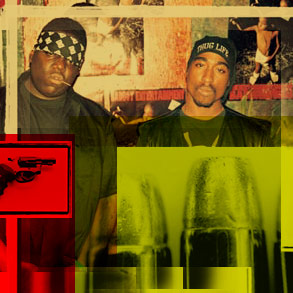

Nobody has yet suggested that a second shooter was perched on the grassy knoll, but that might be just a matter of time. It’s been six years since rap heroes Tupac Shakur and Notorious B.I.G. were gunned down in a hail of bullets during two separate, operatic shootings that rocked the rap world in late 1996 and early 1997. Both murder cases remain unsolved, which means conspiracy theories among hip-hop fans are helping fill the void. (One online favorite: Shakur faked his death to escape the pressures of fame.)
Now, two new high-profile entries try to unravel the entertainment industry’s unprecedented whodunits. Opening this week in several major cities is “Biggie and Tupac,” a documentary film by director Nick Broomfield. It comes on the heels of a recent Los Angeles Times exposé. Each uses similar facts to come to completely different conclusions.
What we know for sure is that during the mid-’90s a deadly East Coast vs. West Coast rap rivalry erupted. It was fought between the New York-based camp of Sean “Puffy” Combs and his Bad Boy label, home to Brooklyn’s Biggie Smalls (a.k.a. Notorious B.I.G., whose legal name was Christopher Wallace), and West Coast riders at Marion “Suge” Knight’s Death Row records, home to Shakur. The feud quickly escalated from CD disses to real-life crime.
In 1994 Shakur was shot five times in the lobby of a New York recording studio. He recovered, but blamed Wallace for setting up the hit. The next year at the influential Source magazine rap awards, Knight insulted Combs from the stage. Months later, a Death Row bodyguard was killed outside an Atlanta nightclub; Knight blamed Puffy and his entourage, who were present.
That was the backdrop for the events of Sept. 7, 1996, in Las Vegas, where Shakur, 25, was gunned down, gangland-style, at a traffic light as he sat in the passenger seat of Knight’s car. Six months later Wallace, 24, was sprayed with bullets while sitting in an SUV outside a Los Angeles music industry party. Neither crime has been solved. In fact, nobody has ever been arrested in connection with the killings.
“Biggie and Tupac” suggests that Suge Knight, with the help of crooked Los Angeles police, arranged Shakur’s murder in Las Vegas because the multiplatinum rap star was about to bolt from Death Row and sign with another record company. (Months later, Broomfield suggests, Knight set up the Wallace killing as well.) The L.A. Times, meanwhile, argues that Shakur’s killing was an episode in the long-simmering East-West feud and came with Wallace’s personal blessing.
Ultimately, rap fans face a tough choice between the Times’ conspiratorial account, which is hard to believe, and Broomfield’s inferior documentary, which is hard to watch.
In 1998 the muckraking director scored notoriety for his documentary “Kurt and Courtney.” In it he tried to prove, through interviews with a string of questionable characters, that rock singer Courtney Love played a role in the death of her husband, grunge icon Kurt Cobain, who police say committed suicide. (Love has adamantly denied the allegation.)
Broomfield’s shtick is that he’s something of a modern-day Lt. Columbo, schlepping around in a slightly disheveled state, stalwartly searching for the truth. Within minutes of the movie’s opening, the filmmaker appears puckishly on-screen, where he remains for most of the movie, boom mike in hand, acting as both interrogator and cut-rate soundman. It’s the low-budget, polish-be-damned style that’s supposed to win viewers over, as Broomfield admits in “Biggie and Tupac” that he ran out of sound during one Q&A and apologizes for a cameraman who seems incapable of focusing on the subject during another crucial interview.
From the boyhood ghetto homes of Wallace and Shakur in Brooklyn and Baltimore to a California jailhouse interview with Knight, Broomfield crisscrosses the country questioning friends, family, bodyguards, investigators and teachers in an attempt to understand the men and the deadly rivalry that grew up between them. Broomfield does a nice job using old home videos and other obscure clips to bring the charismatic rappers momentarily back to life.
The problem, though, is that Broomfield’s not a journalist, meaning he does not know how to conduct coherent on-screen interviews. It’s no exaggeration to say that roughly half of the interviews in “Biggie and Tupac” are worthless, offering no new information or insights about the rappers or their deaths. And the film’s much-touted jailhouse sit-down with Knight turns out to be utterly anticlimactic.
In one dreadful sequence, Broomfield interviews the former girlfriend of two LAPD officers who Broomfield thinks were also tied to the Shakur killing. What does the interview with the girlfriend consist of? Questions about the “crazy sex” she had with both men and whether those episodes were ever videotaped. Broomfield doesn’t even try to explain what that has to do with the rap killings he’s investigating.
Other parts of the film simply do not ring true. Early on, Broomfield tries to line up an interview with former LAPD detective Russell Poole, an outspoken critic of the department who insists that the brass didn’t allow him to investigate the rap killings because crooked cops were working for Death Row and higher-ups didn’t want the bad publicity.
Initially, Poole refuses Broomfield’s interview request “on advice of my counsel,” which is odd because over the last few years Poole has spoken at great length to Rolling Stone, the New Yorker, the Los Angeles Times and VH1. In fact, Poole’s conspiracy theory is laid out in elaborate detail in Randall Sullivan’s recent book, “Labyrinth.” In the end Poole agrees to help Broomfield, but the whole thing seems like a ruse; who won’t Poole talk to about his LAPD conspiracy theory?
And what should viewers make of Poole? He’s a central player in “Biggie and Tupac,” but he hardly comes across as an authoritative figure on-screen. At one point he tells Broomfield that when LAPD bosses took him off the rap murder cases, he almost committed suicide. No doubt the passage is supposed to illustrate Poole’s dedication (“The case is the most important thing in Poole’s life,” says Broomfield); instead, it raises questions about the man’s stability.
Perhaps worst of all, “Biggie and Tupac,” which runs about 20 minutes too long, is also at times amazingly dishonest. In what passes for a moment of drama, Broomfield interviews Wallace’s bodyguard, who was present the night the rapper was murdered in Los Angeles, and shows him a series of head shots of possible trigger men. The bodyguard immediately picks out a man named Amir Muhammad as the killer, and tells a shocked Broomfield that police had never shown him that man’s picture before.
Broomfield shows that footage to Poole who crows on camera, “I think it’s a breakthrough in the case.”
But the angle is hardly new. In December 1999 the Los Angeles Times broke the story about Muhammad’s possible connection to the case in a now-infamous front-page exclusive. The breathless account, citing anonymous law enforcement sources (i.e., Poole), speculated that Muhammad, a gang member, had been hired by a crooked cop to kill Wallace. The paper said that Muhammad had disappeared since the shooting, making it impossible for detectives to question him.
But months later, and after much internal wrangling, the Times ran an embarrassing retraction of sorts when, after just three days of searching, another reporter at the newspaper located Muhammad. He was brokering real-estate loans out of his Southern California office. “I’m not a murderer, I’m a mortgage broker,” he told the newspaper. At that point the LAPD detective exonerated Muhammad, telling the Times that he had not been considered a suspect for at least a year.
Broomfield doesn’t allow those facts to get in the way of the story he wants to tell, and includes none of that information in his film. After smearing Muhammad’s name with circumstantial evidence and identifying him on-screen as a possible assassin, Broomfield limply narrates that he was unable to contact the man in question. The director then has the nerve to suggest that Muhammad come forward because, “If nothing else, his name should be cleared.”
What’s so troubling is that casual viewers — and movie critics — may come away thinking Broomfield scored a coup. He did, but only by cleverly concealing the truth. Is that how puckish filmmakers are supposed to score points?
In contrast to Broomfield, Chuck Philips at the Los Angeles Times is a Pulitzer Prize-winning reporter who covers the music industry. Over the years his dispatches on the deadly rap wars have been considered the definitive reporting by many observers.
Philips’ recent Sept. 6 exposé, which exploded like an M-80 inside the hip-hop community, reported that Tupac was gunned down by members of the Southside Crips, a legendary Compton, Calif., gang. The killing was reportedly in retaliation for the beating a Crips member, Orlando Anderson, took that night in Las Vegas at the hands of Tupac and his roving Death Row crew in the lobby of the MGM Grand Hotel.
The Crips theory has been floating around for years. But the Times shocker was that Wallace himself signed off on Tupac’s murder, offering to pay $1 million for the hit. Not only that, Philips for the first time placed Wallace in Las Vegas on the night of the killing. The 300-pound Brooklyn rapper even gave his gun to Crip killers, wrote Philips, because, “He didn’t just want Shakur dead. He wanted the satisfaction of knowing the fatal bullet came from his gun.”
Within hours of publication, Wallace’s friends and family members condemned the Times report as “patently false.” If they can prove without a shadow of a doubt that the rapper was not in Las Vegas on the night in question, then Philips’ entire yearlong investigation would be worthless. And the reporter, well known for his due diligence, must have known that before he ran with the story.
Wallace’s estate quickly provided MTV with documents from a New York recording studio that suggest the rapper was on the East Coast the day of the Vegas shooting. But the paperwork in question merely indicates that studios were reserved in Wallace’s name. There were no dated signatures, for instance, or at least none that MTV showed on its news special. The fact is, no videotape stamped with a date has been produced to prove where Wallace was on Sept. 7, 1996, which means the Times’ claim cannot be dismissed.
Hip-hop fans, though, might well be wary about other elements of the Times piece. For instance, the article is very lightly sourced and reads less like a detached piece of investigative journalism than like a screenplay. (“The city’s neon lights vibrated in the polished hood of the black BMW as it cruised up Las Vegas Boulevard.”) Philips notes early on that the story is based on “police affidavits and court documents as well as interviews with investigators, witnesses to the crime and members of the Southside Crips.” But it seems that most of the blockbuster charges are drawn from those anonymous Crip gang members, which raises the question: What was to stop them from simply spinning a tale they want to tell?
Philips’ chronology of events on the night in question also raises a red flag. Shakur and his Death Row posses beat Anderson down at approximately 9 p.m. Roughly two hours later Anderson allegedly gunned Shakur down on the Vegas strip.
What happened between 9 and 11? Anderson picked himself up off the MGM lobby floor and was detained by hotel security personnel, who wanted to know if he was going to press charges. (He declined.) Anderson then made his way back to his room at the Excalibur Hotel, where he talked by phone to fellow Crips members who’d already heard about the fight. He changed his clothes and headed over to the Treasure Island Hotel, where a gang meeting was convened to discuss revenge and where it was decided that Anderson would take out Shakur that night.
Then the Crips, hoping to earn a payday for their assassination, arranged a rendezvous with Tupac’s rival Wallace, who agreed to sponsor the killing. The Crips sent a posse over to the MGM Grand to meet with Wallace, who gave them the gun. Crips members then set out by car to find Shakur in the Las Vegas night.
All that was accomplished in just two hours by gang members who, according to the Times’ own reporting, were operating that night in a haze of marijuana and booze?
One fact overlooked in the latest Times account is that back in 1997 Anderson actually filed an assault and battery claim against Shakur’s estate and Death Row Records, seeking approximately $1 million for physical injuries and mental suffering stemming from the MGM assault. If Anderson was the trigger man in Vegas, he was an amazingly brazen one, knowing a lawsuit like the one he filed could open him up to pointed depositions with attorneys. (Anderson was killed in a 1998 shooting at a Compton carwash; police said it was unrelated to Shakur’s murder.)
In the end, neither the Times nor Broomfield’s “Biggie and Tupac” can offer a definitive answer to the gangsta whodunit. In moving forward, hip-hop friends and family members would be wise to focus on Philips’ professional effort and forget about Broomfield’s sensational flick.
