

Contemporary audiences have become spoiled by movies that make sense, have great acting, and feature nudity only when absolutely necessary: No wonder hardly anyone goes to the movies anymore. We sit at home, alone in our semi-darkened living rooms, hoping that “About Schmidt” or “Little Miss Sunshine” will answer our deepest questions about the human predicament.
But what about our littler questions? Questions like, Can nuclear splooge really turn us into flesh-eating zombies? Is it such a good idea to go into the basement of the last house on the left? And that naked girl sure looks great zooming down the highway on that motorcycle — but did she at least wipe the seat with a towel first?
To answer questions like those — or at least to render them academic — you need an audience, a large roomful of like-minded individuals to hoot and holler at dialogue that sounds as if it had been written on a square of institutional-grade toilet paper, to jump when zombie-victim blood splatters the screen, to flinch collectively when the sniggering rapist gets an ax to the groin, to peer at the screen through parted fingers as the crazy speed demon on the dark country highway trails a carful of giggling, scantily clad teenage girls.
In your living room, no one can hear you scream. And where’s the fun in that? As movies have gotten more sophisticated, so have we, and in their double-feature B-movie homage “Grindhouse,” Quentin Tarantino and Robert Rodriguez suggest, with the subtlety of a buzz saw headed for a villain’s private parts, that we’ve lost something along the way. “Grindhouse” is the filmmakers’ love letter to the cheaply made, rough-edged action and horror pictures that, in the ’60s, ’70s and early ’80s, would play the crummiest, most run-down movie houses in the worst part of town, or perhaps, if you lived in a more suburban locale, the drive-in. Typical fare included blaxploitation and/or women’s prison pictures like Jack Hill’s “Coffy” and “The Big Doll House”; psycho-killer creep-outs like Wes Craven’s “The Last House on the Left” and Herschell Gordon Lewis’ “Blood Feast”; el cheapo car-chase extravaganzas like H.B. Halicki’s “Gone in 60 Seconds”; and any number of other imported or domestic pictures (kung-fu adventures, sexploitation cheapies) that might put warm fannies in seats. These theaters would show three or four features at a stretch, which made them attractive havens for bums and assorted ne’er-do-wells: The wag sitting next to me at the “Grindhouse” screening offered to pee on the floor to make the experience more authentic.
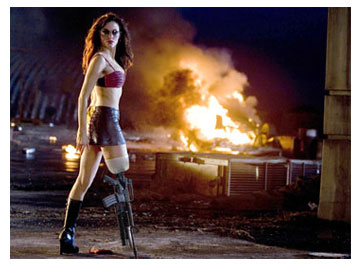
It was a chivalrous gesture, but an unnecessary one. “Grindhouse” — which consists of two full-length movies, one by Rodriguez and one by Tarantino, as well as several faux trailers by guest directors — is a grand collage of drooling zombies, bounteous breasts, spurting blood and careering cars, a rambunctious and unapologetically disreputable entertainment as well as a comprehensive catalog of B-movie references. It’s also recklessly joyous and deeply affectionate, a celebration not just of an all-but-lost approach to moviemaking but of the nearly lost experience of communal moviegoing. The audience I saw “Grindhouse” with didn’t pee on the floor (at least, not as far as I could tell). But we did hoot and holler and groan together, united, if only temporarily, by the happy recognition that most of what we were seeing on-screen was sick as hell: We’re sane, thank God; it’s the world around us that’s gone mad! Our sanity confirmed, we all settled in to watch Rose McGowan, as an amputee stripper, take out a slew of baddies with the machine gun attached to her stump. Why ever not?
The charming, saucy McGowan is one of the chief attractions of Rodriguez’s “Planet Terror,” which makes up the first half of “Grindhouse”: With those cartoon-pussycat eyelashes, that distracted pout, those killer gams (both of them), she’s its heart and its hottie. In “Planet Terror,” a biohazardous leak of something-or-other turns people into cannibalistic zombies. It’s up to McGowan and her bad-boy hero boyfriend (Freddy Rodriguez) to stop them. Marley Shelton plays an anesthesiologist with a killer arsenal of hypodermic needles (they’re strapped to her leg in a specially fitted garter); Josh Brolin is her wacko doctor husband. Naveen Andrews shows up as a scientist with a scarf tied around his head and a single hoop earring — in other words, an “ethnic” villain. (He also carries a jarful of pickled testicles around with him, but never mind.) Two young Venezuelan actresses, Elise and Electra Avellán, billed as the Crazy Babysitter Twins, play — what else? — crazy baby-sitter twins. (They’re also Rodriguez’s nieces.) Tarantino appears, in a small part, as a rapist — talk about grabbing the plum role for yourself.
“Planet Terror” is the sillier, more raucous of the two movies, a model of cheerful, demented, cartoonishly violent excess. Rodriguez, true to the movies that inspired him, goes for the gusto. More is more, especially when it comes to blood, which never just spurtles from squibs in tasteful quantities; it shoots out, geyserlike. (Legendary makeup artist Tom Savini, who designed the zombie effects for “Dawn of the Dead,” appears in “Planet Terror” as a clumsy deputy who loses a finger.)
Explosions, car chases, women cavorting in skirts the size of hankies: “Planet Terror” packs it all in, but even though the movie may seems haphazard on the surface, it was clearly made with a Zen master’s meticulousness. The picture’s surface has been scratched up in some places, and jerks and jitters raggedly through the projector in others; scenes are tinged pink or red, as if the print has been fading for years; and when the characters talk to each other, their dialogue sometimes sounds as if it were being beamed from a radio transmitter in Sheboygan. Back in the day, just a handful of prints of any one “grindhouse”-caliber movie would circulate among hundreds of theaters across the country. A picture’s scraped and scratched surface, its fading and discoloration, its funky sound, were the scars of being run through too many ancient, badly maintained projectors — they’d become part of its identity. The prematurely aged look of “Planet Terror” is partly a novelty, but it also suggests the way movies — lousy ones as well as good ones — endure: In our memories, they outlive the fragile celluloid on which they’re captured.
Love it or hate it, you sure get your money’s worth with “Grindhouse”: Rodriguez and Tarantino enlisted several modern-day schlock filmmakers to direct the phony trailers clustered around the two main features. Eli Roth, director of “Cabin Fever” and “Hostel” (he also has a small role in Tarantino’s portion of “Grindhouse”), gives us the sickest one, for a slashfest called “Thanksgiving.” (Its superb tag line: “This year there will be no leftovers!”) The “Thanksgiving” trailer caused the Motion Picture Association of America to waggle its reproachful finger: Roth had to trim a few frames — involving a protruding butcher’s knife and a gymnastically inclined topless cheerleader (use your imagination) — to get the all-important R rating, but the thing is still sufficiently depraved. Edgar Wright, director of “Shawn of the Dead,” offers a sweetly twisted, tantalizingly vague promo for a horror pileup called simply “Don’t.” My personal favorite, though, is the one featuring the wonderful actor Danny Trejo as a rebel peacekeeper and ladies’ man (as evidenced by the naked cuties he cavorts with) in a hot little number called “Machete” — which also happens to be the name of the gadget whiz Trejo plays in Rodriguez’s “Spy Kids” movies (the first two of which are terrific).
The “Grindhouse” feature directed by Tarantino, “Death Proof,” is somewhat pokier than “Terror Planet.” But it’s also, in the end, more exhilarating, and in its perverse, twisted way, more elegiac. In the first section of “Death Proof,” a posse of tough girls — played by Sydney (daughter of Sidney) Poitier, Vanessa Ferlito and Jordan Ladd; their rival is played by Rose McGowan, this time in hippie-blond tresses — show up at their favorite local watering hole and encounter a seemingly benign older dude who goes by the name Stuntman Mike (Kurt Russell). The second act of “Death Proof” features another set of girls (Rosario Dawson, Tracie Thomas, Mary Elizabeth Winstead and Zoë Bell) and one very cool car: a 1970 Dodge Challenger, the same car featured in Richard C. Sarafian’s groovily existential 1971 car-chase drama “Vanishing Point,” a movie revered by two of the girls; the other two have never even heard of it.
In the first half of “Death Proof,” Stuntman Mike is a laid-back charmer, an aging hunk who knows just what to say to melt a girl’s heart, or at least get her, momentarily, to stop rolling her eyes: “There are few things as fetching as a bruised soul on a beautiful angel,” he tells one. Later, he’ll reassure another that, as a former stuntman, he’s made sure his souped-up, skull-emblazoned car is “better than safe — it’s death proof.”
Some bad stuff happens in “Death Proof” — it chiefly involves flying limbs and decapitation — because Tarantino isn’t just riffing on the style of these old movies; he’s also capturing their heartlessness, the ways in which, even when they followed a rough code of justice, they didn’t always bother with niceties like allowing characters we’ve grown to care about to live. But the sustained climax “Death Proof” builds to is purely a thing of beauty: At one point Stuntman Mike reflects that most stunt work is now, unlike in the old days, enhanced by computer graphics. In “Death Proof,” Tarantino does everything the old-fashioned way, with fast cars and real human beings doing crazy things. Even if you’ve seen it all before, you’ve never seen anything quite like it.
“Death Proof” has an unusual, loping rhythm: Whole chunks of it focus chiefly on dialogue (Tarantino’s specialty), featuring the girls yakking idly about what they do with their boyfriends, or about why they carry guns instead of knives. (If you need to know the answer: “You know what happens to the folks carry knives? They get shot!”)
But the centerpiece of “Death Proof” is a car chase in which Zoë Bell, the New Zealand-born stuntwoman who was Uma Thurman’s double in both of the “Kill Bill” movies, and who makes her acting debut here, spends most of her time outside the Challenger, instead of driving it — while it’s barreling down two-lane Tennessee blacktop. Bell is an extraordinary presence, supremely likable even as she radiates a sunny intensity. Dawson, with her perky bangs and high, original-Barbie-style ponytail, is a ballerina goofball; Poitier, a classy Amazon in short-shorts. (Tarantino, who acted as the movie’s D.P., gives us a wonderful shot of her stretched languorously on a couch, a visual echo of the enormous blow-up of Brigitte Bardot in “The Night Heaven Fell” on the wall above her.) Russell, superb as always, gets a great introduction here: The camera lingers on him, his face artfully and obliquely lit, as he demolishes a plate of nachos. It goes on for so long that each successive instance of finger-licking and lip-smacking is funnier and funnier.
Russell’s Stuntman Mike is a lost soul speeding toward hell, a man out of time in every way: He tries to impress a cluster of young women by telling them about the TV shows he’s done stunt work on, shows like “The Virginian” and “Vega$.” They stare at him blankly, until he finally asks them if they’ve ever heard of any of the shows he’s talking about. When they say they haven’t, he’s not surprised, and neither are we.
The first half of “Death Proof” has a definite ’70s vibe, while the second half is undeniably contemporary in its look and feel. It doesn’t matter that Poitier uses a cellphone to text-message her boyfriend: When she sidles her bodacious booty up to the jukebox, it’s Joe Tex’s 1966 “The Love You Save (May Be Your Own)” that comes streaming out, a song that makes us forget what year it is and transports us, in a feat of supersonic magic, into a place called the past.
“Death Proof” straddles the past and the present: It’s not sure where it should be living, or where it wants to live. Like all of Tarantino’s movies — the bad ones as well as the good — it’s marked, and energized, by restlessness. Tarantino is sometimes a marvelous director and sometimes a maddening one: “Vol. 1” of the “Kill Bill” epic is a clutter of references with no emotional glue, but the second half, “Vol. 2,” is bitter, dark and gorgeously poetic. I’m not a fan of “Pulp Fiction” — stylized violence served up with a smirk generally leaves me cold. But “Jackie Brown” — which Tarantino once called, aptly, his “Howard Hawks movie,” and which took part of its inspiration from his love for Pam Grier — is, simply put, one of the finest pictures of the last decade.
And now, in 2007, Tarantino, formerly a renegade and a groundbreaker, has become something of an old-fashioned filmmaker. His movies have always been filled with references that only true movie eggheads would get. But as the original audience for his movies ages, younger moviegoers aren’t as likely to get his jokes, his asides, his visual fillips. That isn’t to say they won’t enjoy his movies: Tarantino is a smart filmmaker, and a lively one — I think he’ll always find his audience. But even at his relatively young age, he’s already on his way to becoming Stuntman Quentin, the guy who remembers “Rio Bravo” and “Foxy Brown” as the youngsters gather ’round to listen. That’s not the worst fate that can befall a director: We need filmmakers who can move us forward even as they maintain a sense of the past. To that end, “Grindhouse” captures a bit of rowdy movie history in a bell jar. Tarantino and Rodriguez can tell it like it was, because for better or worse, they know how it is.
