
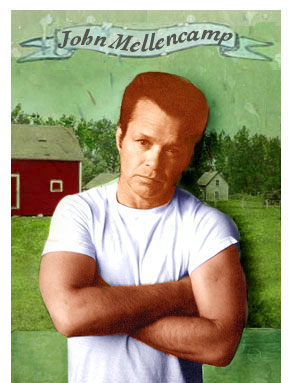

“The whole thing was surreal to me,” says John Mellencamp. He’s remembering the three-month period during the winter and spring when America was wrestling with the notion of war against Iraq. The roots-rocker found himself caught in the public fray after he released an antiwar song at the height of the debate, with some radio listeners comparing him to Osama bin Laden.
It was a startling charge for the Hoosier recently dubbed “Mr. Middle America” by ABC News. After nearly 30 years on the public stage, Mellencamp and his lunch-bucket rock and populist tales have come to signify heartland values like faith, hard work and, yes, a healthy skepticism toward authority. But anti-Americanism? “Get the fuck out of here,” he scoffs.
His protest song “To Washington,” with its thinly veiled jabs at President Bush, struck a chord with listeners on the left and right alike. “Isn’t it funny?” he asks. “A 51-year-old guy who’s made as many records as I have can still piss off the right wing.”
Born in 1951 in Seymour, Ind., the son of a fundamentalist father and a Miss Indiana runner-up, Mellencamp joined his first band at the age of 13. After graduation and a failed job installing telephones for Indiana Bell, he landed a record contract despite, he says, having no discernible talents. “I had a deal when I was a kid not because I could write songs or sing. It was the way I looked,” he says. “The idea of actually writing songs had not even dawned on me.”
The songs, and the hits, came later, as Mellencamp honed his vocal and songwriting prowess and fought his way onto portions of the pop charts usually not occupied by bar band singers. In 1986, the top three selling artists of the year were Whitney Houston, Madonna and Mellencamp.
Through the years the headstrong Mellencamp has remained one of the few major recording artists not to cash in by selling his songs for use in television commercials or to accept corporate sponsorship for his concert tours, decisions that have cost him millions of dollars.
Wrapping his workmanlike rock in what he calls his “left-of-center” politics, in the ’80s Mellencamp teamed up with Willie Nelson to begin staging charity concerts and raise millions of dollars for Farm-Aid. In 1989, at the height of commercial appeal, he penned “Jackie Brown,” among the most stinging indictments of American poverty ever put to record. (“We shame ourselves to watch people like this live.”)
As the late Timothy White, his good friend and the longtime editor of Billboard, wrote in 2001, “Mellencamp’s best music is rock ‘n’ roll stripped of all escapism, and it looks directly at the messiness of life as it’s actually lived. This is rock music that tells the truth on both its composer and the culture he’s observing.”
More recently, Mellencamp has been tackling the topic of race relations. The title track to 2001’s “Cuttin’ Heads” featured Chuck D. rapping about the word “nigger”: “I connect the word with pain, now some smile when they scream the name?/ Die, N-word, die. I want to live.”
The album’s second song, the sweet-sounding single “Peaceful World,” was equally blunt: “Racism lives in the U.S. today.” Not exactly Top-40 fare.
While Mellencamp’s radio hits in the ’90s couldn’t match such ’80s anthems as “Pink Houses” and “Lonely Ol’ Night,” they were always among the smartest on the airwaves, featuring his trademark American Bandstand sound that’s always easy to dance to: “Love and Happiness” (1991), “Human Wheels” (1993), “Dance Naked” (1994), “Key West Intermezzo (I Saw You First)” (1996) and “Your Life Is Now” (1998).
Mellencamp has amassed 29 Top-40 singles in a career spread over 21 albums, including his latest, the steel-tipped, blues-flavored “Trouble No More.”
As the years pass, however, it’s gotten progressively harder for Mellencamp to get his music heard on FM radio, or even VH1. “I was standing outside a restaurant the other night,” he recalls with a laugh. “And a guy, about 37, says, ‘Man, are you John Mellencamp?’ I said yeah. He said, ‘I love your songs,’ and then he said, ‘Did you stop making records?'”
Thanks to “To Washington,” fans have been likelier to read about Mellencamp in the news pages than the arts section. Originally written in 1903 as “White House Blues,” a commentary on the 1901 assassination of President William McKinley, the folk classic has previously been updated as political commentary by the Carter Family and Woody Guthrie. Mellencamp continued that tradition:
So a new man in the White House
With a familiar name
Said he had some fresh ideas
But it’s worse now since he came
From Texas to Washington.
During a recent phone call from South Carolina, Mellencamp talked at length about the song, his politics and contemporary pop culture, as well as the ailing music industry.
Talk about people’s reaction to “To Washington.”
Initially I was surprised. My album wasn’t going to come out for a few months and I had the song recorded so I put it up on my Web site and asked for people’s comments. And there were some mean damn comments coming back.
How about today?
It’s changed. Now they’re almost totally in favor of the song. Because people are starting to realize, “Now wait a minute, what really happened in Iraq?” I see the climate changing tremendously. But when people hear those drums of war pounding, and Fox News is showing it on television, people got pretty riled up. People were afraid, and when people are afraid they make emotional decisions.
Did that include people in your hometown of Bloomington, Ind.?
When the song first came out I was in the car one day and we were driving to the airport and I had my kids with me and a radio station was playing “To Washington” and having callers call in. Some guy comes on and says, “I don’t know who I hate the most, John Mellencamp or Osama bin Laden.” My kids heard that and my 9-year-old said, “Dad, are they talking about you? Why are people mad at you?”
I just thought that was really jerky and wrong. Why would you play a song on the radio and tell people to call up and say what they think about it. What is this? Is this like a football game? Tit-for-tat? I don’t like this sporting-event mentality to people’s lives, which is basically what it became.
In retrospect, there were only a handful of famous musicians who opposed the war in their music. Were you surprised, or is it just not feasible today for artists to put out songs like that on major record labels?
Major record companies don’t want those songs. You know, when the record company heard “To Washington,” it was kind of like “Whoa, wait a minute. We don’t want you to do this.” Understandably so, because this record was on the same label that has the Dixie Chicks and that had just blown up in their face.
Were there discussions about not including the song on your record?
I was asked not to put it on the record.
Where did it go from there?
I think the people who asked me knew what my response would be, but they felt they had to ask. They were polite about it.
Did they say it just didn’t feel right, or the tone wasn’t right for the record?
No, it was more, “You’re asking for trouble, and look what happened to the Dixie Chicks, which was based on just an offhand comment they made.” And my point to them was, “Look, I’m John Mellencamp, I’ve been doing this 25 years. For anybody to say I’m un-American is laughable.”
But people have said that recently, haven’t they?
Oh yeah. But who knows what people are going to say. I read a list of un-American people and there was Jimmy Carter on there. He’s probably the most honest president we’ve ever had, since I was alive, and now he’s un-American?
You said earlier that when people hear the drums of war they react out of fear. Were you surprised at the heights the rhetoric reached this spring?
Well, the whole thing was surreal to me. I have watched Vietnam and a bunch of other skirmishes, but I’ve never seen another point in time where I felt that McCarthyism was rearing its head. And that’s how I felt.
But I don’t feel it now. These [pro-war] people are having a hard enough time defending what they did in Iraq, they don’t have time to fuck with anybody about being un-American now.
You also mentioned Fox News and the role they played during what you call that surreal period. What’s your take on how they covered the war?
I did an interview two weeks ago for Fox News. They invited me to come on their national news show and talk about “Trouble No More.” And I thought, well wait a minute, am I going to have to go on TV and argue with somebody and defend myself? That’s not my job. I’m a singer, a songwriter, I’m not going to go on TV and debate and all that bullshit.
They said, “No, no, no. This is strictly about the record.” So I said OK. So I go in there and they ask me a few questions about the record. Then all of a sudden the guy says to me, “You wrote a song that took some potshots at the president.” I said, “Whoa, motherfucker! I didn’t take any potshots at anybody, that’s not my style. I’m not yelling from the back of the crowd or giving somebody the finger. That’s not what I do.” I said, “Listen, I wrote a song and got the lyrics out of any newspaper in the country.” He said, “Well, you saw what happened to the Dixie Chicks.” I said, “Listen, people have died in World War I, World War II, the Korean War, Vietnam and a bunch of little wars in between so that people will have the freedom to speak out, and then the administration gets on the news and says there’s a price for freedom. Yeah, and these dead guys have already paid for it. For people to drive by those women’s houses [the Dixie Chicks] and call them on the phone and threaten them is criminal. What the Dixie Chicks did was legal.”
What’s your take on George Bush?
Well, what I think of George Bush doesn’t really matter, does it?
I think people would be interested to know.
I’m a songwriter. I kind of like the way he struts around sometimes. [Laughs.] Let’s leave it at that.
There was a recent story in the Philadelphia Inquirer about the gap between the facts and people’s perceptions about the war, about how a majority of Americans thought Saddam was behind the 9/11 attacks, and that a large portion thinks we found the weapons of mass destruction.
There’s no point in even talking about people’s perceptions. I’m always amazed at what people think about me, just a dumb singer in a rock band, let alone some important topic. People are really involved, and rightfully so, in their own lives. You can’t say anything negative about people not being informed, because they don’t have time to be informed. It’s a hard world to get a break in.
Have your politics changed much over the last 10 or 20 years?
I’m proud to say they haven’t.
Do you think the country’s politics have changed?
I’m un-proud to say I think they have.
Your parents were Democratic Party activists in Indiana, weren’t they?
Oh, they were active locally, in our county. My mother campaigned for Bobby Kennedy. I was surrounded by Democrats. And I don’t understand, in this day and age — most people who are Republicans, they’re not rich enough to be Republicans! I don’t get it. My best friend is a Republican. He and I vowed a couple months ago never to talk about politics again. He’s just a normal guy with a normal job and I’ve known him since I was 5 years old. But I just said to him, “Man, you don’t have enough money to be a Republican. How can you afford this?”
When your friend Timothy White died a year ago, you said that rock ‘n’ roll had lost its conscience. What did you mean by that?
Tim would stand up against the record companies when he felt they needed to be stood up against. I remember one day Tim called me and said, “John, you’re not going to believe what just happened. You know on your recording contract, how your songs and your albums revert back to you after 35 years?” I said yeah. “Well, they don’t anymore.” I said, “What?” He said, “Yeah, it was pork in some bill that just got signed.” Well, come to find out they did it. But it got overturned.
One of the things I’ve noticed about your music videos over the years is their racial diversity. So many of them feature both black and white people, and it’s unusual, in a rock video, to see black and white people side by side, especially if they’re real people and not extras in a dance line. I’m assuming that’s not just a coincidence.
I’ll tell you, when I wrote “Peaceful World,” one of the problems I had with the record company was that they didn’t understand why I was even writing a song about racism in America today. I found that reaction to be awe-inspiring. That they thought there was no problem in America. What? You guys live in New York City and you don’t see any race problems? Once I heard that I thought, “Oh shit. They don’t like the record.”
Because of the content? The lyrics?
Yeah, because it was about racism. And it mentioned being politically correct. They had a long laundry list of problems. Their complaint was, “You have this beautiful chorus [‘Come on baby take a ride with me/ I’m up from Indiana down to Tennessee’], why do you have to fill the song with these things that will agitate people?” Well, that’s what the song is.
Did they come around in the end?
No. That’s why I left Columbia Records.
Because you didn’t feel you could work with people who felt that way?
Because I always thought it wasn’t the record company’s job to like the song. I thought it was their job to sell them. And I just didn’t see the point of me arguing with people about the material.
But the fact that the disagreement was about race relations, was that particularly upsetting? I mean, it seems to be a topic that has been running through your music for years.
Yeah, and I don’t think many people get it either. I think people look at me in a different way. If Elvis Costello writes a great song, nobody is really surprised. He writes a lot of great songs. But if John Mellencamp writes a great song it’s like, “Wow, what the fuck?” So I’m kind of a Hoagy Carmichael.
How about this: You’re more the John Fogerty, the Creedence Clearwater Revival, of today?
Well, I was a kid and very much into music when Creedence was popular on the radio. Critics tore those guys up. They tore poor John Fogerty up.
Because he wrote pop singles.
Yep. The rock critics were so mean to that guy. I never really understood it.
If you look back now, the Creedence catalog is just amazing.
There’s just one great song after another.
But with Creedence, there’s a much closer fit with you, right? Very roots — there’s something uniquely American about that sound.
John Fogerty was an American original, no question about it. But in the moment of the late ’60s, he just didn’t fit. But now you listen to those records, like “Fortunate Son” — there was a guy who was saying something, saying it plainly. It was plainly played. Very American. People just didn’t get it.
Do you think that comparison could apply to your career?
I don’t know. I just don’t even want to think about it, because if I start thinking about it I’ll get pissed off. See, that’s what happened to John. John Fogerty, through a long list of reasons, got so mad that he really couldn’t make records anymore. He just got so sick and tired of everything, and when you get sick and tired of everything you can’t put things in a way where you’re trying to learn.
I heard that not long ago you added “Gimme Shelter” to your playlist. What’s that about?
Yeah, a couple tours ago I was starting the show with that. I don’t really know why I did that. I just like playing the song, I guess. I really don’t think much of the Rolling Stones these days. I don’t mean to come off sounding pompous but I just think, I don’t know, some of the stuff the Rolling Stones say and stand for today is a little too corporate for me.
What do they stand for, do you think?
I don’t think they stand for anything. Being the oldest rock band, I guess. And, “Man, didn’t we write some great songs when we were kids.” But there’s too much American Express. Too corporate. Listen, I got nothing against people making money, don’t misunderstand me. If you can make money, go make it.
Do advertisers even bother calling you to ask about using your songs in commercials?
Sometimes we still get calls. Tim [White] and I used to fight about it, too. Because there have been some offers over the years I’ve almost done, big money. I remember once I said, “Tim, goddamn, this is a song, why are we being so precious about it?” I was so close to taking the money, and he said, “If you fucking do this I’ll never speak to you again.” [Laughs.] I hung up the phone and told my wife, “I can’t do this.” I decided my relationship with Tim was more important than that.
Are there any songs of yours where you think, “I don’t want to play them this year?”
I don’t want to play “The Authority Song.”
Why not?
It just seems a little juvenile. Don’t get me wrong, I’ve got a lot of fucking juvenile songs: “Hurt So Good.” Mike Wanchic, who is my guitar player and public conscience, he’ll actually stand there and argue with me about it:
“What do you mean we’re not playing ‘The Authority Song’?”
“Mike, I don’t want to play that song.”
“But do you see the audience, do you see what happens when we start in on that song?”
“Yeah, but I don’t care. They’re fucking perking up and I want to throw up.”
One of the biggest changes in the music business over the last five years has been the massive consolidation of the companies that own radio stations and control the tour business. A few weeks ago the FCC voted to allow major TV and newspaper owners to consolidate.
Now you know why Fox was so supportive of the war.
You think there was a connection there?
I don’t think, I know.
What’s your take on Clear Channel Communications and its influence on the radio and concert business?
I’m not going to single out Clear Channel, but I just think that when you control so much … When a person owns the horse, the track and the other horses in the race, it’s probably not going to be a fair race.
Another topic that’s come up lately is pay-for-play in the radio business — the way artists and labels actually get songs on the radio by paying indie middlemen. I was just wondering if you had any thoughts about that process.
You might be surprised about how I feel about that: That’s the way it’s supposed to be.
In what sense?
That’s the way the music business has always been. And to take that away from a business that has never really operated aboveboard? [Laughs.] Listen, there is no way that you can devise it so that people are not going to figure out how to get around it.
When it comes to getting songs on the radio?
Sure. There is no way it can be done. Look, in the ’80s when people were paying openly to get songs on the radio, here’s the way it worked. “We want you to play this record and we’re going to give you a spiff [kickback] of $100 to get it on the radio.” OK, the guy plays it for a week and says, “I’ve been playing the song for a week and nobody likes it.” “Well, here’s $200 to play it next week.” They’ve been playing the song for two weeks and nobody likes it. Guess what, they’re done paying. It’s over at that point. You cannot pay your way into having a hit. It won’t happen. The only thing you can pay your way into is having the opportunity to have a hit. If you don’t pay, you don’t even have the opportunity. That’s the way it should be done.
What about the folks who can’t afford to have an opportunity?
I hate to be cruel about it, but that’s the way it’s always been. Look, you’re talking to a guy right now who doesn’t have a chance [of getting on FM rock radio]. What am I going to do about it? What’s Tom Petty going to do about it? We could write “God Bless America” and nobody wants to play it. It doesn’t matter what we do.
You’ve always been pretty upfront about the fact that you were playing this game to be on Top-40 radio, to have hits. Meaning if you’re going to put time into a project, you might as well have as many people hear it as possible.
You’re right. I always said there’s no reason to make these records if nobody’s going to hear them. What’s the point, unless you can do something positive with the song, or entertain people? These things are too hard to make, they take too long, they cost too much money and there’s no reason to make them unless the record company is going to support you and try to sell the fucking thing.
Is this your last album?
I don’t know. Listen, I never planned anything in my life. It depends what comes my way. I’m not out looking for a record deal. I’m not calling anybody up. I don’t have anybody who represents me calling people up. But I would imagine I’d make another record.
You’ve been doing this for a long time. If you do leave the stage, do you think it’s not a bad time to do it, considering all those things you just said?
Look, my reward for “Trouble No More” has already happened. The fact we had so much fun making that record. It was challenging. It was interesting. That was reward enough. It would be like my painting. I don’t paint for anything other than enjoyment. I look at other artists like Neil Young, that’s the way he lives. I admire the guy. I don’t know what goes on in his private conversations with his manager, but I see Neil and he doesn’t care. He doesn’t go on television. He doesn’t promote these records. If they sell half a million or they sell 3 million, it’s all the same to Neil.
You’re not there, though, mentally?
I’m not there yet, but that doesn’t mean I won’t get there. Let’s not forget I’m the luckiest guy in the world.
So you’ve had a good time?
Did I have fun in the music business? Are you kidding me? More fun than most guys deserve to have in their life. I have laughed so hard at myself that I couldn’t get up off the floor.
