
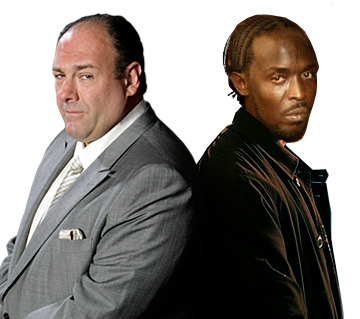

An opera on the turnpike: Rebecca Traister argues for “The Sopranos”
You know how one perfect moment can make a movie? A crafty shot, a wonderful line or an inspired soundtrack choice can cement a great film’s place in the pantheon or sear a mediocre flick into our collective gray matter. Sometimes these moments are universal, sometimes personal. For some, it’s not the beginning of a beautiful friendship, but La Marseillaise; it’s not Alvy sneezing on the cocaine but Annie singing “Seems Like Old Times.” Then there are the just plain indisputable moments, where music marries dialogue marries beauty and a baseball hits the light, Lauren Bacall asks if you know how to whistle, John Travolta does the twist or Gloria Swanson says, “We didn’t need dialogue. We had faces.”
Television has arguably had fewer of these moments: Mary Tyler Moore and her colleagues at Chuckles’ funeral, Bob Newhart waking up next to Suzanne Pleshette, Carol Burnett in drapes.
But what about a TV show that had all this?
“What, no fuckin’ ziti now?” “It’s good to be in on something from the ground floor. But lately I feel like I’m coming in at the end.” “What’s different between you and me is you’re going to hell when you die.” “What ever happened to Gary Cooper?” A shot of a soaring New Jersey church as a portly father tells his whining teen daughter, “Your great-grandfather and his brother, they built this place … They didn’t design it, but they knew how to build it,” moments after having gleefully busted the kneecaps of a gambler while Frankie Vallee trilled, “Don’t know why I love you, don’t know why I care.” Or the pause that contained a million truths, as a shrink told her new patient that if he reveals that anyone is about to get hurt, she’s supposed to alert authorities … technically.”
All those moments unspooled in the first hour of “The Sopranos.” Of course, the following 85 episodes were imperfect; they contained meandering plotlines, interminable hiatuses and strings that would never be tied into bows.
But looking back at the beginning of “The Sopranos” now is startling. Because as untamed and untrimmed as the show often felt, watching the first hour, you realize that the themes into which it would delve, both deeply and at its own maddeningly erratic pace, were all in place. There are even things embedded in that first show that we think arrived later, but were actually there from the start, like Tony’s malapropisms (he tells Carmela that she’s making him feel like “Hannibal Lecture or something”) and Drea de Matteo (who appears as a restaurant hostess who seats Dr. Melfi and her boyfriend). It’s eerie, actually. But also a sign that David Chase both designed and knew how to build his masterpiece right at the outset.
Stratospheric plaudits now jangle cacophonously in the media echo chamber that has been lauding this show for 10 years. In the New York Times, Vincent Canby compared “The Sopranos” to “Berlin Alexanderplatz,” the New Yorker’s David Remnick called Tony’s mother “the Medea of Bloomfield Avenue” and the show “the richest achievement in the history of television,” and New York Observer editor Peter Kaplan saw in it “The 400 Blows.”
But the fact that praise is often repeated does not make it untrue. “The Sopranos” was quite simply a fine piece of narrative, an opera on the turnpike that was simultaneously lush and spare in its depiction of American life. Tony and his buddies were many things that marked them as “other”: Italian, murderers, fat. But in all their extraordinariness they were just ordinary Americans.
From the moment it hit the cable airwaves, “The Sopranos” was in the pantheon, but as it aged it deepened and grew, not only matching great filmed epics line for line and shot for shot but blooming into a work of literature. It examined the evolution of the American dream with as much precision, if less economy, than Fitzgerald, and took apart the experience of American masculinity with the sometimes heavy-handed symbolism of Melville. (In fact, several years ago, Soprano family members tipped their hand by mentioning “Billy Budd” and literary critic Leslie Fiedler, who was a great fan of the show before his death.)
As a uniquely American story, “The Sopranos” had all the big themes: class, ethnicity, sexuality, mothers and daughters, fathers and sons. It ruminated both on the thickness of blood and on the unsettling ways it can thin with time; it examined the intricate steel on which marriages are built, the high costs of loyalty and even steeper price of betrayal. And then there were the deaths — both natural (Livia Soprano) and wrenchingly manufactured (Big Pussy, Adriana).
To call it the best show ever would be hubris, and a hubris that reeked of exactly the same kind of self-absorbed futility in which Tony and company wallowed. No. “The Sopranos” was a great, transformative show. And to transcend the gloomy here and now in which the boys ate their gabagool, I will optimistically predict that because of it, there will someday be even better shows. Perhaps they already exist.
But before it drifts out of our national consciousness, consider the other moments inked on our brains, the ones that both elucidated and made beautiful our quotidian anxieties and put them in modest perspective by casting them in the shadows of crime and cruelty. From Johnny Sac’s devotion to his overweight wife to the scorn heaped on Corrado Soprano Jr. for going down on his girlfriend (not to mention the violence with which she pays for unwittingly unmanning him), from Meadow’s college tour to Carmela’s visit to Paris, from Phil Leotardo’s skull popping under the wheel of an SUV to Adriana’s pooch, Cosette, getting smushed under the weight of a drugged-out Christopher, there was always the heartbreaking etched in the mundane.
The poetry of “The Sopranos” was large and small, visual as well as verbal: Just take a look at the Hopper-esque tableau of the orange cat and orange Paulie Walnuts on the sidewalk in front of Satriale’s in the final episode.
But no matter how many highfalutin comparisons there are to be made, there is no better evidence that “The Sopranos” remained to the end its own peculiar animal than the end itself. As soon as the pounding piano notes ushered Carmela through the door of onion-ring Mecca Holsten’s, the final scene was electric, sparking with suspense and heart-swelling beauty. Here was the extraordinary ordinary tribe, living its extraordinary ordinary life, but about to do so out of our sight for the first time in nearly a decade.
The degree to which the show’s final narrative interruptus frustrated and beguiled us was the final reminder of how much we were going to miss these people who had become our family, in so many senses of the word.
It’s like Tony says, back in Episode 1, about his beloved ducks. “It was a trip having those wild creatures come into my pool and have their babies. I was sad to see ’em go.”
Us too, T.
A classical masterpiece: Laura Miller argues for “The Wire”
For a while, people — not just critics, but the show’s creators, too — were going around claiming that “The Wire” is like a novel. What can this mean, except that the series is not like what most of us think of as TV? Specifically, it’s not like the cop show you’re picturing as I tell you that “The Wire” is about the Major Case Squad in the Baltimore Police Department and the black drug dealers it tries to bring down. The series is complex, with a lot of characters, and it’s never going to hold your hand through the intricate curlicues of each season’s story line. You have to pay attention, even when you’re not sure what’s going on.
But since a novel may or may not share these qualities, since a novel can be just about any kind of story these days, it might help to know that “The Wire” is also not like, say, a Dickens novel. It indulges in neither sentimentality nor moral goading. Each season has a social theme — the failure of the war on drugs, the collapse of labor unions, the hash of local politics and, last time around, the crippled public school system — but “The Wire” lacks the Victorian naiveté to believe that any of us will be sufficiently riled up by these tragedies to do anything about them, or that we’d succeed if we tried.
“The Wire” is also not like the crime novels produced by some of its most celebrated contributing writers (George Pellecanos, Dennis Lehane, Richard Price) because, as is only proper, those books deal in questions answered and narratives resolved. Novels end, but the vast, fascinating, unspooling mess that is the Baltimore of “The Wire” can have no conclusion. The storytellers may stop telling it, but the story itself will go on. If every last character we’ve loved and hated in the series over the past five years were to roll over and die, it would still go on, with us or without us.
What “The Wire” is about is the game. The “game” is what the show’s black characters call the drug business, but the smarter players know that the game’s boundaries are not so finite. Although the series is scrupulously realistic (its creator, David Simon, is a former Baltimore Sun crime reporter and his writing partner, Ed Burns, is an ex-homicide detective), there is one improbably romantic character: the maverick stick-up artist Omar Little — beholden to no one, afraid of nothing, resolute in his abstention from curse words and the injury of “taxpayers,” and, last but not least, gay. Leave it to Omar, the show’s only true outsider, to state the series’ premise while pulling off a bit of prime courtroom rhetoric in a scene from Season 2. Testifying against a soldier of the dreaded Barksdale gang, accused by the gang’s sanctimonious lawyer of leeching off the drug trade, Omar coolly tells the shyster: “Just like you … I got the shotgun; you got the briefcase. It’s all in the game.”
But, like I said, Omar is the exception. The rest of the characters in “The Wire” are trapped, and depending upon their intelligence and insight, they are more or less at peace with that fact. When thinking about the mood, the ethos of “The Wire,” what comes to mind (rather than “War and Peace” or “For Whom the Bell Tolls”) is a moment in the last book of “The Iliad” when old Priam, the king of Troy, sneaks into the camp of the Greeks to plead with the Greek warrior Achilles to return the body of his son, Hektor. Priam implores Achilles to remember his own father, who hopes to see his son again someday, and who (both men realize) never will.
“A single, all-untimely child he had,” Achilles replies, relenting, “and I give him no care as he grows old, since far from the land of my fathers I sit here in Troy and bring nothing but sorrow to you and your children.” From the hotheaded Achilles, this comes as a weary sigh. He is far from the father he loves, embroiled in a pointless war, mourning the death of his best friend and facing a grieving man whose son’s corpse he has desecrated in a fit of misdirected rage. Someday he, too, will be similarly bereft. Yet how could it be otherwise? These men are warriors, born to fight; this is what the gods who control their destinies decree.
“The Iliad” is only one poem from a series known as the Epic Cycle (“The Odyssey” is another; the rest are lost), full of dead heroes and the fathers (and mothers and wives and children) who mourn them. This story, too, goes on and on. Death, loss, enslavement, the ruination of all their hopes and dreams, and yet in the midst of the world’s stony realities, as inevitable as the wine darkness of the sea and the rosy fingers of dawn, there can be heroism, courage, honor. Just don’t expect things to change; all of this is part of the game, and in “The Iliad” the game is war.
The characters in “The Wire” inhabit such a world. The gods may have different names; instead of Apollo and Juno pulling the strings, it’s the bureaucracy, party politics, the free market: all equally capricious and implacable. Anyone who tries to alter the system — be it Stringer Bell aiming to turn legit businessman, Bunny Colvin experimenting with decriminalizing drugs in “Hamsterdam” or Frank Sobotka struggling to save his beloved stevedores union from its inevitable demise — will be crushed. The best they can hope for is to clean up one little corner of their world; Bunny may not be able to save the neighborhood, but at the end of Season 4, he managed to save one kid. To thrive, you have to learn to fly low and kiss up, and if you’re unfortunate enough to be afflicted with a sense of vocation, you play it like that smooth operator, Bunk Moreland, not like that perennial troublemaker, Jimmy McNulty.
In a way, it doesn’t make sense to talk of “The Wire” as the best American television show because it’s not very American. The characters in American popular culture are rarely shown to be subject to forces completely beyond their control. American culture is fundamentally Romantic, individualistic and Christian; when it’s not exhorting you to “follow your dream” it’s reassuring us that in the eleventh hour, we will be saved. American culture is a perpetual pep talk, trafficking in tales of personal redemption and the ultimate triumph of good over evil. We don’t do doom. “The Wire” is not Romantic but classical; what matters most in its universe is fulfilling your duty and facing the inexorable with dignity.
I can’t argue that the classical view is superior to the Romantic one; to even introduce the idea that art is meant to nudge us toward moral improvement and social awareness is to concede to Romantic hope. But for some people, in some places, the classical view is more true, and in such cases, the artist’s duty is to show us that these lives are no smaller for that. And it is — as we always, always seem to forget — not depressing but strangely exhilarating to see this truth about humanity acknowledged for once. It may not be the only truth, but it’s a truth all the same.
* * * *
For more Salon TV Week coverage, click here.
