
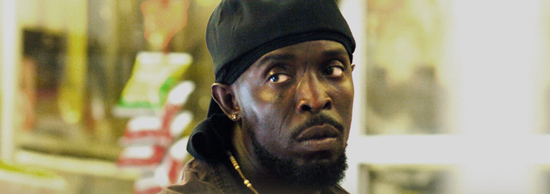

Salon contributors will include: Heather Havrilesky, TV critic; Sarah Hepola, Life deputy editor; Alex Koppelman, staff writer; Kerry Lauerman, New York editorial director; Farhad Manjoo, senior writer; Laura Miller, senior writer; Joan Walsh, editor in chief.
BEWARE: Spoilers ahead!
Havrilesky: Sweet Jesus! So Omar drops, just like that, without fanfare or suspense. You had to figure it was only a matter of time, him hobbling around like he had a death wish or something. Even so, that was seriously brutal. At least those who’ve complained that “The Wire” has turned to neat resolutions, convenient coincidences and Hollywood endings this season should be silenced by that sad little exit.
Leave it to McNulty, of all people, to unknowingly sum up Omar’s end: “You start to tell the story, you think you’re the hero, and then when you get done talking…” Omar, the hero of the street — hell, the hero of “The Wire” — is on his valiant crusade one minute, and the next minute, there he is, on the floor of a corner store, shot in the head by a little kid. He even turned and saw Kenard walk in the door, but didn’t suspect a thing. Watching that scene was like seeing Tony get his head blown off in a diner in the last scene of “The Sopranos” (except without the Journey playing in the background).
You think you’re the hero, and then the paper doesn’t even have the space to run a short piece on your murder. You think you’re the hero, but to the cops who once knew you and used you as an informant, you’re just a passing anecdote. You think you’re a hero, but even the morgue gets your birthday wrong, and mixes up your body up with another corpse. The message is clear: Omar may have been a legend on the street, but the street doesn’t mean shit to anyone outside of the street.
McNulty’s fall is next, but not until we have a little fun at the FBI’s expense. Clownish though it was, I loved the FBI bigwig marching in to brag about his TV appearances. “What the hell, it’s a chance to get the word out for the bureau and sell some books… ‘Human Hunters: The Rise of the American Serial Killer’?” A little obvious, maybe, but you can bet that’s how that conversation would sound if a guy like that happened to stumble on two strangers who didn’t work for him and therefore didn’t give a damn about his books and TV appearances.
“We don’t see a lot of serial stuff actually,” McNulty replied. “Drug murders. 300 or so a year.” You know, those insignificant 300 or so murders that no one is losing any sleep over? But forget those, serial killers are sexy.
FBI guy: Art was actually lead investigator on the Unabomber thing.
Greggs: That was like 16 years, right?
FBI guy: Yep.
McNulty: Yeah, then his brother ratted him out?
But the joke is on McNulty in the end, as the FBI suits come up with a profile of the killer that fits him to a T: The mythical serial killer is likely “employed in a bureaucratic entity,” “has trouble with lasting relationships” and seeks to “assert his superiority and intellectual prowess.” Ouch.
There’s a lot more to dissect here, but I don’t want to hog all the good stuff. So in parting, let’s all raise a glass to Omar, best TV character ever. We’ll miss you!
Lauerman: To Omar! And to Michael K. Williams, for helping create — I agree — the best TV character ever! Now, I really need a drink.
The banality of the hit made it awful, especially after his superheroics this season. But that it came at the hands of Kenard, that little angel-faced devil, made it all the worse. I loved how they showed Kenard about to light a cat ablaze in a back alley (and thank the lord they had the discretion to show no more), just to make sure we knew he had no redeeming factors, a pure baddie. I guess it would’ve been worse if Marlo, Snoop or Chris had pulled the trigger, but not by much. Kenard reminds me of those pre-adolescent thugs in “City of God,” it’s uniquely unsettling to see young kids, the presumed next generation, show the potential to be even more cold-blooded than their predecessors.
I have to say, I thought the scene with the celebrity FBI profiler (obviously aimed at “Mindhunter” John Douglas) a little too broad and clownish. But that scene with McNulty smirking/squirming through the profile of the serial killer was my favorite scene of the season so far. Dominic West does a pretty great job portraying McNulty as a man self-aware enough to know how screwed up he is, but doubtful there’s anything he can really do about it. When he finally breaks a little, and tells Beadie about the scam — with the quote you cite, Heather — it ends brutally when she points out that instead of being a hero all he’s really done is jeopardize everyone around him.
I’m enjoying the slow unwinding of Scott Templeton, and I thought the way Gus spiked the lead to his homeless story was a particularly accurate depiction of how newsrooms operate. It’s a completely exposed environment, and so it would make sense that Gus would find some backup support with a few key peers before he launches his attack, and then do it as loudly and as publicly as possible, making it much tougher for Klebanow to bigfoot him like he did the last time, editing it himself behind closed doors. I still think Gus is maybe a little too saintly (the bit where he told the reporter to “take a few weeks, see what you see” on a potential profile of Bubbles? Only a true newspaper romantic like Simon could come up with that). But I now find myself thoroughly enjoying the Sun storyline, and look forward to the way it ends — though it’s the only one that’s remotely predictable at this point.
Walsh:No, Heather, I didn’t see that coming. I was distracted by the rolls of toilet paper and paper towels haloing Omar’s head in the grim convenience store when lil’ Kenard whacked him. Kenard, the one who called Omar “gimpy as a motherfucker” when he appeared on the corner last week. We thought Marlo was Simon’s idea of the ultimate amoral killer spawned by Baltimore’s streets, a new mutant superpredator without even the street code of Stringer Bell, Prop Joe or Omar. Now we’ve got Kenard, who we first see trying to set a cat on fire; a few minutes later he takes down Omar as he waits for his softpack of Newports. Omar deserved better.
But let’s think happy thoughts: How great is it to watch Scott coming undone? Terry Hanning, the homeless Iraq vet whose story Templeton shamefully embellished, could be speaking for both fake plotlines when he snaps, in his meeting with Haynes and testy Scotty: “There’s some things that happen, you don’t ever fuck with them.” I think I’m being slowly corrupted by the violence in this show: Was it just me, or did everyone want Hanning to just sock Templeton in his pink little pouting face before Gus got him out of the room?
Now that Omar’s been dispatched with so little sentimentality, I’m dreading watching McNulty meet his fate. I thought an angry Beadie set up one possible ending, chillingly, talking to a suddenly contrite McNulty about whether his drinking buddies will be around to come to his wake. “They don’t show up at your wake,” she tells him, because they don’t even know his last name, he’s just “Jimmy the cop,” if they know him at all. “Family, that’s it, family, if you’re lucky, one or two friends. Everything else is just…” Beadie trails off, and I could hear Bunk finish her sentence: “random pussy.” McNulty is then moved to tell Beadie about his hoax, and how worried he is about it, and she’s furious and walks away. The very next scene is the morgue, where a cold, dead Omar has the wrong name and birthdate on his body bag. No family there.
I loved the FBI scene, hokey as it was. Kerry’s right: Watching McNulty squirm as the analysts describe, well, McNulty was one of the best scenes of the season. Not only is the homeless killer using the crimes as “an opportunity for him to assert his superiority and intellectual prowess,” he’s “sexual to a point, but inhibited,” and an “alcoholic” who has a “problem with authority.” Ouch.
Every week McNulty descends another level deeper in hell. First he was the good Father McNulty, blessing strong police work; then he heard himself being called “boss,” and it stopped being fun. This week a cop who’s trying to blackmail him into funding a golf trip to Hilton Head is back with the Father Jimmy imagery, accusing him of “taking the detail money and doling it around like a priest passing wafers.” A miserable McNulty signs his paperwork. Maybe he can start to see how Clay Davis slid into end-stage corruption.
The background plot of Dukie making his way around the city looking for work broke my heart, especially when he wound up riding on top of the junkman’s cart – a young prince, or just more junk? — and calling out to Bug like he was in a parade. I’m already making my deals with Simon; I can handle anything but something happening to Dukie or Bug. I’m losing hope for Michael, who mouthed off about whether he should tell Marlo that Omar killed Savino, “If I was Marlo,” he ventured, only to get a shove in the chest from Snoop. “You ain’t Marlo.”
I find myself worrying what Greggs is going to do, now that she knows about the homeless hoax. She did not seem happy, at all: Is it possible she snitches? I don’t think so, but her alienation seemed complete, and Lester looked devastated. Bunk is happier now that McNulty helped him get the DNA work done to link Chris Partlow to the murder of Michael’s stepfather. But when does he serve the warrant? How long will Lester and McNulty ask him to wait so they can ensnare more of Marlo and the gang? And will their audacious plot somehow undo what Bunk’s accomplished with “no shuckin’, no jivin’ police work”?
And did anyone watch the trailer for next week? I’ll be watching Episode 9 asap Monday night.
Koppelman: I agree with Joan — Omar deserved better. If he had to go, and I think it’s been clear for a little while now that he was going to go soon enough, I wanted him to have a hero’s end. But then, I think Omar’s death was exactly what we deserved. I can’t help but compare it to the overwrought scene from the last season of “The Sopranos” where Bobby Baccalieri met his end. There was no onrushing train as a metaphor for the approaching end, no drama, just an unseen little kid well on his way to being a sociopath getting a lucky drop on Omar. Made me sad, same way I was sad when Bodie fell, and Joe, and D’Angelo, even Stringer. But it was a great scene, precisely because it didn’t succumb to what I’m sure must have been great temptation to kill Omar off in the Shootout Of The Century.
But Omar’s death was just one of the factors that I thought made this the best episode of the season thus far, if not of the entire series. I may not have liked the initial arc of the homeless killer plot, but I love seeing it shatter. The other day, I was reading an interview David Simon did with Newsweek, in which, asked about the serial killer plot and its connection to reality, he said, “We legalized drugs in West Baltimore in season three and did so in full view of half the police department, if not the community itself. Certainly, on that basis it required as much a leap of faith as anything conjured in this season.” I don’t agree — I think that on the face of it, both are pretty implausible, but what made Hamsterdam feel more real was that Bunny Colvin had just been introduced and wasn’t acting out of previously established character with his actions. Now that we see the toll McNulty’s actions are taking on him, his realization that he’s no hero here, this feels a lot realer to me.
Hepola: I feel a bit speechless, guys. I was just sitting there, contemplating the brand of cigarettes Omar smokes (Newports? And what does that meaaan?) when suddenly, the contents of his brain were splattered on the glass. I don’t know what end I expected for Omar — although the Shootout of the Century sounds about right — but I never expected him to go at the hands of a little boy. From its first season, “The Wire” has been challenging our romantic ideals of childhood, but damn if I still don’t get sucked in by the idea that these children could be saved somehow. I’m a former high school teacher, dammit. Still, even Omar wasn’t cynical enough to think a little kid could do him in. Like Heather pointed out, he saw Kenard come in and never even blinked. Omar was a hunted man, and he had to screw up sometime. But the mistake I never expected from Omar was to misjudge the streets. Turns out, shit’s worse than even he knew.
Boy, McNulty was the confessor tonight, wasn’t he? I felt vindicated that Greggs was outraged. I’ve been waiting all season for someone to slam a few doors about this — someone other than Bunk, who finally caved. (Moral compromise or just another good man eroded by the system — or both?) Speaking of outraged, I wanted to cheer when Beadie finally gave McNulty the who’s what (“this is my fucking house”). I loved the speech Joan quotes — “They don’t show up at your wake” — but frankly, she should have given this talk to him about 10 anonymous blondes ago.
By the way, does anyone else worry Gus just signed his walking papers? I envision a scenario where he gets the boot, and Templeton stays. Grim times for heroes, indeed.
