
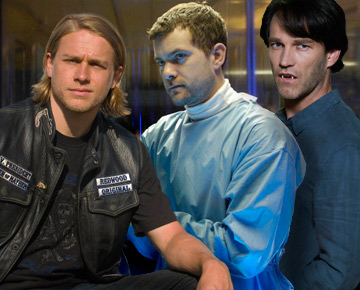

America loves a misfit. We were once the world’s valiant heroes, but our less-than-diplomatic meddling and bullying overseas has transformed us into global pariahs and outlaws. It’s no wonder, then, that we’ve come to embrace outcasts of every stripe on the small screen, whether they’re the motorcycle outlaws of FX’s “Sons of Anarchy” or the misunderstood vampires of HBO’s “True Blood.” As our leaders bend the rules to suit their whims, tapping our phones and invading sovereign nations based on elaborate lies, criminals (FX’s “The Riches,” Fox’s “Prison Break,” Showtime’s “Dexter”) and those with secret, special powers (NBC’s “Heroes,” CBS’s “The Mentalist”) intrigue us more than ever. Whether they’re Greek gods living in the Hollywood Hills (CW’s “Valentine”), talking cars (NBC’s “Knight Rider”) or scientists who can read a comatose man’s brain waves using LSD (Fox’s “Fringe”), we’re more willing than ever to suspend our disbelief for the sake of fantastical story lines.
Even the more formulaic genres have slipped into the realm of magic and ill-defined moral ground. Once upon a time, the spies, cops, detectives and public servants on TV were relatively straightforward, upright citizens, looking to protect the public (NBC’s “ER,” CBS’s “CSI”). Then, in the wake of “The Sopranos,” we encountered a wave of bad cops, corrupt detectives, double-dealing spies and alcoholic firemen (FX’s “The Shield,” Fox’s “24,” FX’s “Rescue Me”). On our newest TV shows, a healthy dose of magic has been sprinkled into the picture: The networks want spies with split personalities (NBC’s “My Own Worst Enemy”), cops transported back in time (ABC’s “Life on Mars”) and unconventional detectives who are also brilliant physicists (CBS’s “Eleventh Hour”).
This new breed of TV outcasts slogs its way through a crazy, mixed-up world, armed with enormous power but confused about how to use it. Sookie (Anna Paquin), the psychic waitress of “True Blood,” strains to avoid hearing the ugly thoughts of her closest friends — she doesn’t want to know, really — but she can’t help catching a few incriminating snippets anyway. The young motorcycle outlaw/hero of “Sons of Anarchy” shakes his head over the unfortunate (but unavoidable!) pileup of dead bodies during the raid of a rival gang’s gun warehouse. The superpowered freaks of “Heroes” regularly become almost inconsolable over the horrible responsibility that comes with an ability to kill everyone within a 5-foot radius in a matter of seconds.
Taken together, our TV dramas form a fairy tale with a misunderstood superpower at its center: “If I’m the world’s valiant hero, why do they boo and hiss at me when I drop my enormous bombs on their cities? Can’t they see what a terrible burden it is, to be this big and powerful?”
Beyond this recurring fairy tale for citizens of a nation in decline, the morality of TV dramas has evolved, slowly but surely, from clear-cut battles of good vs. evil to ambivalent characters struggling to navigate moral quicksand. If you follow the ethical dilemmas of “NYPD Blue” as they evolve into the outright lies and murderousness of “The Shield,” if you trace the struggles with political corruption of “The West Wing” as they transform into the manipulative, self-interested public officials of “The Wire,” if you start with the buffoonish, ignorant murderers of “The Sopranos” and land with the murderous rebel-heroes of “Sons of Anarchy,” you’ll see how rapidly our exploration of morally questionable lifestyles has yielded to a chaotic, uncharted realm of ethically insupportable behavior. And while a departure from Hollywood’s big, obvious moral lessons may have been a long time coming, our ability to stomach debauchery may have reached an extreme. Our attempts to reflect a morally shaky universe have slid past sketchy and landed firmly in the realm of the depraved.
On some shows, the exploration of moral slippage is both explicit and deliberate: In the final season of “The Wire,” detectives Jimmy McNulty (Dominic West) and Lester Freamon (Clarke Peters) went to great lengths, logistically and ethically, to invent a mythical serial killer that might lead officials to pump more resources into an ineffective and disastrously underfunded Baltimore P.D. On the current season of “Weeds,” Nancy Botwin (Mary Louise Parker) has progressed from dealing pot to bored suburbanites to conspiring with drug kingpins and dirty politicians who deal coke, illegal weapons and sex slaves. And on the final season of “The Shield” (premieres 10 p.m. Tuesday, Sept. 2, on FX), Vic Mackey (Michael Chiklis) faces the prospect of bringing violence to the streets of Farmington just to keep his own family safe. By presenting fictional characters with impossible dilemmas or placing them on unconscionable moral ground, TV writers reflect the challenges this country is confronting on an international stage: How much damage to others are we willing to inflict in pursuit of our own happiness and prosperity?
But while investigating questionable behaviors and deeply conflicted characters has yielded some of the best shows in TV history, FX’s new motorcycle-gang drama “Sons of Anarchy” proves just how difficult it is to walk this line gracefully. Creator Kurt Sutter, a longtime writer for “The Shield,” has said that he wanted to create a West coast version of “The Sopranos,” but the world he created sometimes feels like “The Sopranos” without any discernible moral compass. On “The Sopranos,” most of Tony’s associates were depicted as self-interested thugs who had no understanding of the value of human life. Buffoonish brutes like Paulie Walnuts, Ralphie and Richie were never meant to be seen as heroes. They killed on a whim, and only through constant reminders of their utter ignorance and short-sightedness (as well as their odd, comical charms) were viewers able to tolerate their company over the years. And then there was Tony, who, despite having more than a few traits in common with his fellow miscreants, constantly struggled with ethical questions and ambivalence about his role. Most of all, Tony didn’t want his children following in his footsteps — he hoped for their sakes that they might live more normal, honorable lives.
In contrast, the thugs at the center of “Sons of Anarchy” are vaguely shrouded in sepia-toned heroism, shunning mainstream society to swagger around town in black leather jackets or ride through town on big, impressive motorcycles at sunset. Instead of hoping for a better life for their son, Jax (Charlie Hunnam), his mother, Jemma (Katey Segal), and stepfather, Clay (Ron Perlman), whisper demonically to each other about getting him even more involved in the motorcycle club’s nefarious dealings. Despite such chilling behavior, we’re meant to believe that Jemma is “fiercely protective” of her brood, down to the moment when she sneaks a lethal dose of heroin into her ex-daughter-in-law’s hospital room so the “junkie whore” will OD and be removed from Jax and his newborn son’s life once and for all.
But Jemma is the tip of the iceberg. While the rest of the motorcycle club may present itself as a highly organized, civilized alternative to mainstream society, with Clay, the club president, guiding club meetings with the steady demeanor of a seasoned businessman, soon all of that melts into a haze of semi-automatic weapons, messy standoffs and pointless murders. Yes, the club members do try to keep crime and drugs out of their little town of Charming, Calif., but the rest of the world can go to hell as far as they’re concerned. When motorcycle club member Tig admits that he had been “hitting” two Mexican whores before they died in a fire at the club’s secret gun warehouse (which meant his semen’s DNA might tie the motorcycle club to the warehouse), Clay merely shakes his head like he’s dealing with a naughty but still lovable child. The scene tries to address the sick side of Tig’s indiscretions, but lands in morally tone-deaf territory.
Meanwhile, local law enforcement is portrayed as not just hapless and vaguely distasteful (as the feds were on “The Sopranos”) but deeply uncool and slightly pathetic. The aspiring sheriff is such a desperate, glory-seeking dork that he looks hopelessly ineffectual and impotent next to Jax’s effortlessly cool, cocky rebel, making it crystal clear whose side we should be on. The bleakness of life outside the club is demonstrated most clearly by Opie (Ryan Hurst), a former member who’s hectored into a straight life by his nagging wife, but whose low-paying construction job leaves him miserable and in debt. Like the sullen Super Friends of “Heroes,” the hoodlums of “Sons of Anarchy” may discover that the total freedom to trample on others can feel oppressive at times, but that freedom sure does come in handy when you need it.
We’ve come to see misfits as daring and heroic simply by dint of their ability to live outside society’s rules, but sometimes outcasts are cast out for a very good reason. The misunderstood vampires of “True Blood” may try hard to fit in among the small-town folks of Louisiana, but they also have to beat back the urge to murder innocent human beings and drink their blood.
Sure, there’s something sexy and forbidden about those vampires — they tend to be pretty hot, and some of them have spent centuries perfecting their soulful, brooding stares. Bill (Stephen Moyer), the vampire Sookie falls for, struggles mightily to live the straight life (and as we later discover, he never actively chose to become immortal or leave his beloved mortal family behind). But the other vampires in town, the ones who live together in nests, seem to spend most of their time intimidating mortals, making “Poltergeist”-worthy sex tapes, and demanding blow jobs from their mortal sex slaves.
While the campy tone of “True Blood” and its subject matter obviously encourage us to take all of its depravity with a grain of salt, using vampires as a metaphor for homosexuals is undeniably a little insulting. Mainstream society shuns gays just as it shuns … blood-sucking fiends? As absurd as that sounds, this comparison is pounded home repeatedly. Townsfolk who remain suspicious of vampires are portrayed as ignorant, Bible-thumping rednecks. At least once per episode, our heroine Sookie reprimands anyone who would dare to treat vampires as freaks or outsiders, calling them “closed-minded.” But really, is it all that unfair to feel less than warm and fuzzy toward a subset of society that passionately wants to drink your blood? The whole thing plays like a conservative parody of the “all creatures, great and small, demonic and sexually perverse” attitudes of overly idealistic liberals.
Even though “True Blood’s” morally equivocal message almost feels like a running joke, it’s not alone. The slippery moral slope of so many TV shows has reached an almost farcical extreme; characters are given license to behave however they need to in order to insure their own survival or the survival of those closest to them. Where Jack Bauer of “24” is free to torture and kill for the greater good, Vic Mackey is free to torture and kill for his own good or, in some twisted logic, to solve larger public safety issues, while the super-hotties of “Heroes,” the outlaws of “Sons of Anarchy” and the vampires of “True Blood” are free to torture and kill by accident, because they’re hungry, because they’re bored, you name it.
Of course, there is always at least one ambivalent character around to question the mayhem. Bill the vampire demonstrates his unwillingness to murder and maim at random, Jax challenges the motorcycle club’s involvement in criminal activities, and Ellen (Rose Byrne), the newbie lawyer of FX’s “Damages,” speaks up against the moral breaches at her firm. Slowly but surely, though, it seems inevitable that Jax the idealistic biker will be pulled deeper into the ugly fold, just as Ellen compromised her morals by the end of the first season of “Damages.” The final message we’re offered is that in a world this compromised, you can’t possibly survive by merely getting your hands a little dirty — you’ve got to wade right into the mud with the rest of the pigs.
Eventually, the appeal of these outcasts and misfits with psychic powers or deadly weapons at their disposal becomes clearer: While the hero is held to an impossibly high standard (think of how disappointed the crowds are when “Superman” does anything that falls outside of his purely altruistic, self-sacrificing moral code), the misfit is beholden to no man or law. And the rebel with awesome supernatural powers is even less reined in by mortal man’s values, because his experience in the world is entirely unprecedented.
In the end, what most of these shows demonstrate is just how chaotic, unpredictable and dangerous life becomes when the principles and morals that guide us are stripped away. But then, we don’t really need a lesson in that, do we? We’ve been living that nightmarish reality for the past eight years.
As rich and dramatically compelling as this study of ethical erosion can be, at some point it’s hard not to wish for some voice of reason to remind us all of the truths that we once held as self-evident: That human beings are created equal, and no amount of alienation from mainstream society, special powers, high-level training, Harvard law degrees, criminal associates, top-level governmental access or alternate moral codes can free the individual from the laws and responsibilities of the ordinary citizen. The fact that TV writers have evolved far beyond the pat morality tales of past decades has undoubtedly enriched and enlivened the medium, bringing us complex, provocative dramatic works that once existed solely on the big screen. But when these tours through lawless alternative worlds stop posing uncomfortable questions and slip into the realm of morally equivocal fairy tales, it pays to reexamine our culture’s attraction to dissolving boundaries and roaming free of all laws and principles.
No one is proposing a return to the naive realm of villains in black hats vs. heroes in white hats, either on the small screen or in the real world. After all, so many idealistic facades conceal dark secrets, like a smiling Ronald Reagan who can’t quite “recall” illicit arms deals with renegade nations. But when, on every channel, the vile, immensely powerful outcast dons a white hat with pride? That’s when we have to worry just a little.
