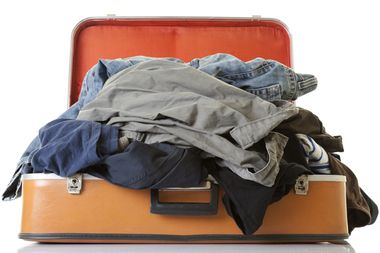
What's left behind when people lose their homes

My boyfriend and I repossess and clean out foreclosed houses. It's not easy picking up after the American dream
Pinched is an ongoing series about life during a recession.
Salon

He is the man you never want to see pull up to your house. He has eyes that go flat when you offer  excuses. Couldn't pay your mortgage? Too bad. A mix-up with the bank? Get yourself a lawyer. Paperwork says the bank owns your house now. Today is moving day.

My friends call him "Repo Joe." The crews call him "Bossman." I call him boss, too. But I also call him "sweetie."

My boyfriend owns a company in South Carolina that evicts people and cleans up foreclosed houses so they can be put back on the real-estate market. In his 20 years in the business, he has seen it all and then some. I've only been working for him for two years, but it's hardened me, too (and I was a pretty tough New Yorker). I couldn't have picked a better time to join his crew. No one used to care about this kind of grunt work. Now he is pestered by people who want to work for him. People who want to get rich too, cleaning up after the American dream.

On paper, the business is pretty straightforward: A house is assigned from the bank that has foreclosed on the property. Find the house. Take numerous pictures before, during and after the cleanup process. Go to the next house. It sounds so simple; in fact the Internet is filled with get-rich-quick tutorials on how to make money doing it. What's not on paper is how you feel cleaning up behind a family's dead hope.

In the beginning I would ask, "How did they lose their house?" What I really meant was, "Was it their fault?" But Joe doesn't know the answer. It simply isn't part of the paperwork. So I would try to extrapolate from the evidence: My first was a double-wide on a dirt road in the woods, filled with empty prescription bottles, a hospital bed, boxes of Depends, insulin needles. Maybe someone died, I thought. But the neighbor said no, the woman had just been unable to pay her bills, so they foreclosed on her. After a dozen houses, I stopped wondering what happened. People's lives take crappy turns. It happens to everyone, especially these days.

At the beginning, Joe and I were oh-so-polite to each other on the job. He gave me the easiest tasks, and I was so eager to please that I would knock myself out making sure the bathroom was the cleanest bathroom in America. We were still trying to impress each other back then. But the good manners wore away as the housing market meltdown tripled our workload. By summer we were openly yelling at each other. I started complaining about him to his crews, who spoke absolutely no English. They would offer me puzzled, vaguely sympathetic looks and bottles of water from the cooler we keep on the truck. "Agua, senorita?"

But Joe and I do share a curiosity about the people who once lived in the house. It's tempting to reconstruct their lives from the items they leave behind -- the wedding album discarded in the garage while the used condom sits inside a nasty pizza box in the living room. The stacks of unopened bills beside the "Get Rich in Real Estate" books. Empty liquor bottles. The crayons scattered in the bedroom with the peeling princess mural. Military uniforms. Family snapshots, more than you would think. Do I really want a visual of the people whose mess I am cleaning up? I don't care to study those pictures anymore.

Repo Joe is made of tough stuff. Good thing. It can be tricky tossing out belongings from houses people have been forced to leave. And we do this in plain sight, in the neighborhood where these people's friends and family may live. Or we are in the backwoods where land may have been owned by a family for centuries. Places where no one would hear you scream or even look up at the sound of gunshot. Sometimes the previous owners show up while we're working, and on these occasions, I am grateful for Repo Joe's toughness and Southern charm. My Yankee attitude doesn't work as well. Where I am curt and dismissive he will take the time to listen and commiserate. Anything to get the guy moving along so we can get on with our job. I'll keep working in the house while Joe chats with the man outside. He'll go on about crooked lawyers and evil ex-wives until the former homeowner feels like he's talking with a buddy. Someone he could go fishing with, not the man paid to fish out the trash he left in his wake.

One time, in a bad neighborhood, Joe and I made a point to arrive early -- "before the crackheads wake up," as he put it. The house was neat, no debris in the yard, and I was relieved to see all the furnishings and personal items gone from the living room. But then we opened a bedroom door: Hypodermic needles ankle-deep on the floor, a bloodstained mattress littered with disposable cameras, the kind you get at wedding receptions. Big glass containers meant for iced tea were filled with more used needles. Hundreds, maybe thousands of needles. Repo Joe pushed me out of the room and told me to get my gun.

Yes, my gun. I am licensed to carry a concealed weapon in South Carolina and have what we call "the work gun," a very small and very lethal .380 pistol that fits in my hand. My hands were shaking, but I got my gun out of the truck and put it in my front pocket. He gathered the safety equipment needed to clean the needle room (heavy gloves, a garbage bin and a large shovel) and got to it while I cleaned the rest of the house. I never touched anything more dangerous than a paper towel.

It's weird what we find in people's houses: loaded guns (promptly turned over to the police), abandoned pets, empty snake cages, dog carcasses in freezers, massive amounts of porn, evidence of drugs, and any variety of sex toys. We bond over these strangers' secrets. We lead a pretty straight vanilla life, so judging others comes easy to us. Our friends always ask about what we find, but after one or two stories they never want to hear any more. Like the small child's artificial leg I once discovered under a pile of clothes in a bedroom. (I don't tell that story anymore.)

"Don't you feel bad for the people?" everyone always asks. The short answer to that is, "No." But I do feel bad for the kids, the kids whose parents left behind their toys and their artwork, the kids whose school pictures I have tossed into a garbage bag. And for all the kids whose bedroom doors had locks on the outside.

At one point I left the repo field and took a "good" professional job. But I missed the work. I missed pulling up to a house and wondering what was inside. I missed the physical labor. I missed the camaraderie of the crew and the uncontrollable laughter that rises when you are sweat-soaked and exhausted and the funniest thing you have ever seen is someone spilling used motor oil all over their clothes. Even if the person is you.

And I missed the way working together made Joe and me tighter. Neither of us is very vocal about our feelings. We're not physically demonstrative. But doing this work has brought us closer. We are aware that some consider us the bottom feeders of the housing meltdown. So maybe we just need a witness, a witness to our goodness. Someone who knows we're just trying to clean up after others. Someone who knows we weren't the bad guys here. 

Here comes the recession bride

My fiancé and I couldn't wait to get married. Then I got laid off, and we couldn't afford it, either
Editor's note: Pinched is an ongoing series about life during the recession.
Cake toppers by Nakedpeggies
Just got engaged -- and laid off!

One morning in early January, I spontaneously proposed to my boyfriend on the living room couch. He was mid-gulp with his coffee. To my relief, he said yes as soon as he swallowed. Like besotted romantics everywhere, we couldn't wait a whole year to get married. So we opted for an August ceremony, giving ourselves just eight months to plan the wedding. Two weeks later, we had another, much less pleasant, surprise. I was laid off.

Even before then, we hadn't been planning a lavish event. The typical American wedding budget -- around $29,000 including the honeymoon -- was never an option for us. The prospect of spending my entire year's salary on a single day was surreal, even in boom time. But now our budget would be smaller -- we settled on $8,000, thankfully subsidized by our parents. Yet even with their financial support, we knew we'd have to be creative with money. We didn't even bother with an engagement ring. When people asked to see it, I told them the truth: "I haven't got one. But there is an engagement coffee cup."

I had no idea how to start planning my wedding. Like so many starry-eyed brides before me, I turned to books on wedding planning and bridal magazines as thick as a phone book, but my enthusiasm curdled into panic as I read expansive lists of "essential" wedding gear: Favors. Programs. Three-tiered centerpieces. A band that can play the Wedding March and "We Are Family." And that was before I saw a single price tag.

It's easy to criticize the astronomical amounts people spend on weddings -- until you actually have to plan one. I'd eye the Italian silk radzimir of a goddess gown from J. Crew only to start gulping for air when I saw the price: a mere $1,950, or one-quarter of our budget. Tell vendors the event is a wedding, and watch the price tag balloon. Even our city parks department was guilty of cashing in. To reserve a spot for a family gathering: $35. To reserve the same spot for a wedding: $110.

Of course we weren't alone in our sticker shock. The sprawling multibillion-dollar wedding industry has bred a whole subculture of DIY wedding bloggers and Web sites devoted to creative, budget-conscious couples trying to navigate around the money pit of that "one perfect day." In Portland, Ore., the East Side Bride assured me it would be OK to wear Converse sneakers if that was my thing, while from Seattle, the Offbeat Bride encouraged me to join her online social network of "kick-ass, independently minded couples." After hours of scrolling through these kinds of sites, I felt confident that our ideal wedding (whatever that was) could still happen. I stopped hyperventilating, and I dusted off those purple Converse.

We wanted to throw the best party we could for our friends and family, to thank them for getting us to this point in our lives. With this purpose in mind, some things were easy to cut, while others required a downgrade and a personal tweak. Favors? We didn't need to print up tacky magnets with our picture that would end up in most people's junk drawer. Stretch Hummers? At a couple hundred dollars an hour, no thanks. Since we're avid cyclists, we chose a $200 bicycle parade instead, complete with bicycle rickshaws for anyone like me who didn't want to ride in their fancy duds. How about champagne? At $80 a bottle, we opted out. Being lovers of good beer, some friends agreed to spend several evenings teaching us the craft of home brewing. A five-gallon keg costs about $45, so we'll all be raising a rich dark stout for the toasts.

It was only after we'd slathered glue onto homemade lanterns and watched them harden into a glumpy mess that we realized we needed more help. So we started asking people if they wanted to participate. Anyone with a good idea, and a willingness to get their hands dirty, was welcome to contribute. That's when, like a good old-fashioned barn-raising, our wedding day really began to take shape. Instead of an $800 cake, my fiancé's grandmother wanted to bake our favorite berry pies. My mother cut the fabric for the hand-sewn invitations. My mother-in-law the gardener promised to grow and arrange the flowers. One sister-in-law designed my dress while my brother's wife practiced her harp for when I walk down the aisle. The best part has been telling each person to be creative with their choices, from the song selections to the dress seams to the flowers. We only ask them to do what they think is beautiful or celebratory, or that reminds them of us. All of which makes the day a more old-fashioned communal celebration, as opposed to an exhibition of how much money we burned through. Which, frankly, feels like a nice alternative to the game of status-seeking brinksmanship that has defined weddings over the past decade and given the world such dubious self-satires as "Bridezillas" and "Bride Wars."

Sure, there may be some wrinkled suits after the bike parade. Martha Stewart may not approve of the mix-and-match wedding party. Our wedding day will not fit into a nice, neat rose-and-lavender theme. Then again, neither have our lives. Our friends and family have shaped us and carried us up to this point. So will it be with our wedding.

Excuse me while I stick my head in the toilet

Ever wonder what it would be like to clean strangers' homes for money? Well, I don't have to
Pinched is an ongoing series about life during the recession.
iStockphoto
Excuse me while I stick my head in the toilet

An unknown number lit up the tiny screen of my pink cellphone. Mindful of traffic, I pulled over into an empty parking lot.

“Is this the cleaner from the Craigslist?” asked the caller in a soft, lilting soprano.

“Um, sure,” I replied. “I clean houses.”

The parking lot was a cracked mess of broken concrete and foot-high weeds. The lot used to front Southwyck Mall, but the mall fell to a wrecking ball a few months ago, another casualty of the stagnant economy. My parents knew the people who ran the carousel at Southwyck. As I little girl, I rode the painted horses there for free.

“You can come clean tonight?” the woman asked. “Two bedrooms. Should be an easy job for you. Please.”

I gave her a number that seemed fair and sped off with my vacuum and a gallon of Clorox to a spanking new Ye Olde Village-style mall. I got a lost a few times; every building looked exactly alike.

A tiny, pale woman with a baby on her hip greeted me. She looked at once exhausted and imperious. She'd just come back from three months in New York, and her husband hadn't cleaned anything – he never so much as wiped the kitchen counter during the 90 days he spent alone in the condo. He didn't tidy up after shaving and left tiny pieces of hair on every surface. I could probably have braided the bathtub had I but time and inclination. (That tub alone made me want to kill myself just a little bit.) I instantly regretted giving my quote over the phone, but I’d given my word. And that’s how I ended up spending Sunday on my knees in front of someone else’s commode.

I clean strangers' toilets for money. I have two college degrees, and I sold a book to an overseas division of Random House. The money hasn’t come rolling in (though I pray to Oprah on a regular basis), so I clean houses as a way to pay the bills between royalty checks.

This toilet was particularly brutal: It mocked me with all its nasty human feces stains and the dusting of wiry black hairs around the base. White surfaces and human hair have become the bane of my existence. Hair clings to the outsides of toilets like Romeo to Juliet, Brad to Angelina, or me to the strawberry vodka and cranberry juice that this work makes me crave.

My college friends have prospered, and they worry about investments. The last guy who dumped me (“I can’t do the boyfriend-girlfriend thing,” he told me as we snuggled together in bed) drove three hours to Columbus so he could rescue his money from Charles Schwab. As I detail the rim of the bowl with a toothbrush, I think about Barack Obama.

I went to see him speak just before the election. Funny how politicians love to visit Ohio in the fall every four years or so.

“Your 401K might be a 101K,” he quipped. “The question isn’t, Are you better off than you were four years ago? but, Are you better off than you were four weeks ago?”

I have no 401K. I have no mortgage and am lucky to have rent money about half the time. I've struggled with disability all my life. I once weighed almost 600 pounds, leaving me chronically broke and underemployed. After having gastric bypass surgery and dumping most of the excess weight, I still rely on disability and the health insurance it provides. But I struggle. I had minus $200 in the bank as Obama promised to help send my (nonexistent) children to college.

Walking home from that speech, I passed a pawnshop, doubled back, and sold the gold necklace I’d put on that morning on the off-chance that I might appear in news photos or in television footage of the crowd. The pawnbroker counted a fifty and a hundred into my palm, and I deposited most of the money, bringing my total net worth up to an awe-inspiring minus $87.

Months later, with Obama in office, I'm certainly not the only one struggling. Even with the recession in full swing, though, my clients can still afford me. People who have money to keep their dogs in daycare can splurge for a Craigslist cleaner every once in a while to spare the lady of the house the indignity of scrubbing her own toilet. I meet compact, perfect women, their biceps toned and tan, and I feel large and shabby by comparison. They usually hire me only once; given the uncertainty in the job market, no one wants to make any long-term commitments.

I suppose I could find other ways to make ends meet. But cleaning has a physical aspect I relish. I could never have done this work before I lost the weight. I also like the feeling of having done something. When you transform a filthy hellhole into a clean house that smells faintly of orange furniture polish, you know you’ve accomplished something.

Cleaning a house will teach you a lot about its occupants. I clean a minister’s house and find propaganda videos about Muslims and their evil plans for Christendom. I find pornography. So much pornography. Almost none of my clients, even the very wealthy ones, own books. People have all manner of weird bedroom habits, too – habits that have nothing to do with sex.

“When the girls were young, I told them they had to make their beds. So they started sleeping on top of the bedspreads,” one client, 40-something and a doctor’s wife, tells me. She shrugs. Her daughters are 15 and 17 and they don’t remember what it feels like to sleep under clean bedsheets. Or how to clean their own bathroom vanity. I find a bowl of elderly body wax next to their sink, tiny pubic hairs thrusting up from the surface like a thousand football fans doing the wave.

Very rich people want the cheapest price for household service. A dainty blond surgeon shows me her home. Every hard surface gleams with marble or imported hardwood.

“I need windows spot-cleaned, I’d like the litter boxes emptied, and you’ll need to buy a canister vac. They’re the best on my floors,” she tells me. She wants me to clean her 4,000-square-foot house for $80. Cleaning a house that size could take as long as six hours. Between gas, supplies and equipment, I need to charge $20 an hour to turn a profit. I give her my estimate – $100 if I can do it in five hours. I never hear from her again.

My friend Adam got a divorce, and I clean his place once a month. We dated briefly. I liked him that way, and he liked me like a pal. But I've dated other men, too. In the last year, I’ve been out with a guy who was afraid of soup (“too much stuff … overwhelming”), a serial shoplifter, and a man who once faked his own death. Adam has a steady girlfriend. I wish him well. I tell myself I do. I pick up his-and-hers pairs of shearling slippers in Adam’s bedroom. I stare out the window for a long minute before turning on the vacuum.

The house full of husband hair made me long for all those wistful moments picking up children’s toys or hating Adam’s (very sweet) new girlfriend. The john seemed like the worst that apartment could do to me till I saw the stove caked with grease and the rotted remnants of a hundred spilled sauces. It was so wretched there was no way I could finish it all in one night. The client agreed, and I offered to come back the next day to tackle the rest.

It took me two hours to do the cook top alone. I scrubbed till my hands went numb. My nails looked like I’d stuck my fingers in an electric pencil sharpener and the wounds were saturated liberally with oven cleaner. The smell of chemicals burned my nose and eyes, and I wondered about the health effects of inhaling an entire bottle of Easy-Off. I could swear I felt a tingle in my ovaries. I can probably only make flipper babies now.

“Take these to the Dumpster,” she said, waving one manicured hand at a pair of enormous trash bags. I grabbed one bag – all I could carry with the vacuum and my bucket of cleaning supplies – and took it outside. I got in my car and hauled ass.

I drove a steady 80 miles an hour from the far 'burbs into the broken-concrete heart of the city and then the artsy neighborhood where I can afford (barely) a charming apartment in a building across from a vacant lot. I pass a burned church, a huge sign in front bearing the slogan “On Fire for the Lord!”

On the way up the stairs to my third-floor apartment, I calculated my profit. Eight hours of cleaning and two hours of travel time. $12 on gas and another $10 on supplies. My profit: $78 and a ruined home manicure.

I opened the door and was greeted by the stink of the cat box. My living room looked like a rogue nuke hit it. I should clean, but I'm not going to. I'm taking a long bath and having a large glass of pink vodka. If anyone asks, it's the maid's day off.

Tales of an accidental grease monkey

How the recession gave me an appreciation for hot rods, power tools and manual labor
Salon

It was only because of the recession that I moved in with a roommate, after more than a decade of living on my own. And it was only because of the roommate situation that I began renting a cramped office space in the garage of a hot rod and auto shop in Austin, Texas. There was a desk, a chair, Internet access. I’m a freelance writer. It was all that I needed.

My office came with other things: a dirty brown carpet, drum sets and car parts, a pit bull, a vintage record player, old issues of Playboy, Hot Rod, Super Chevy and Motor Trend magazines. It also came with the Guys.

"The Guys" is my collective name for Kenny, the owner of the shop, which is known as the International House of Hot Rods, and the three other men who work there: Miles the Brit and Oliver and Olivier, both French. The window in front of my desk looks out onto the smaller of the shop’s two car lifts, and on any given day, when I look up from my computer, I can stare out at the underbelly, for example, of a '59 Dodge, a '63 Lincoln Continental, a classic Pontiac Bonneville or a Chevelle SS. (Five months ago, I didn’t know the difference between any of them.) And at an assortment of regal motorcycles -- Triumphs, Harleys and BSAs -- parked below.

When I should be writing, I watch the Guys work. I marvel at their aptitude, their patience and ambition, especially when tackling the shell of the light blue Skoda that’s currently without an engine or a floor. Mine is a good office because it’s inherently collaborative, a noisy and friendly place where people can actually see the results of their work at the end of the day. It’s a good office because it couldn’t be more different than my last one, in New York, where I lived for 10 years.

Back then, every weekday morning I arrived at the same building in SoHo, said goodbye to the sun, then stepped into an elevator filled with nubile waifs and stunning young men. They got paid to be pretty -- a modeling company two floors above mine -- and I got paid to be an editor at an online literary sex magazine.

It may sound glamorous, the stuff of boom-time fantasy. But like many "offices," mine was just a desk with a computer and a phone situated among a dozen similar workstations. Presumably, the floor plan was open to foster dialogue and democracy. In reality, it was oppressively quiet, and all of us -- the editors, assistants, interns, designer and office manager who sat a few feet apart -- would IM each other rather than converse.

Whether this silent discourse was efficient or misanthropic, I’m still not sure. I do know that I felt alone in a roomful of people who were all working on a magazine devoted to intimate relationships. In fact, the isolation was a driving force behind my decision, in 2005, to pack up my desk and head back to Austin, my hometown.

But after a few years in Texas and myriad odd jobs, the economy went to hell, and I discovered I could no longer afford to live on my own. I tried to find a full-time job, but there weren’t any. So, I moved in with a roommate, also a freelance writer, who works in the quiet of a library, surrounded by erudite homeless people and unemployed CPAs. For me, that wasn’t an option. In the near silence of a library, I become autistic in my aversion to particular sounds, namely pen-clicking, gum chewing and sniffling. But because our house was a small two-bedroom with minimal air-conditioning, minimal workspace, a yappy mini-poodle (hers), and an ornery old feline prone to violence (mine), I needed to rent an office. And I needed it to be cheap.

I heard about the shop from a good friend, who was dating Kenny. The garage was cash-strapped, too, and looking for a little unconventional income boost. It was a match made in, well, the recession.

- - - - - - - - - - - -

During my first few weeks at the shop, I was tentative about being an interloper. I was 33, single, in a total state of professional and economic flux, and I couldn’t identify an intake manifold to save my life. The guys have all known each other for more than two decades. They are all 40-something, three out of four are musicians by night and gearheads by day, all are married or in a serious relationship, and all are beautiful in different ways, with taut arms and calf muscles from years of being in perpetual motion. They also all have respective glory days of bad behavior -- on the road with a band, as a roadie, a traveler -- evident in scars, worn tattoos, and lines rippling away from their eyes and across their foreheads.

In short, I was the sole female in a garage full of guys’ guys. I wore flip-flops and summer dresses. The guys wore work boots and grease-stained jumpsuits. They had a shop dog and now, it seemed, a shop girl: me. (One customer even asked if I was an intern.) But the guys made it easy for me to fit in.

"Tobeeeeen!" is how I was greeted by the Frenchies, along with a double-cheek kiss, on Day One. Miles gave me a slap on the back. Kenny gave me a single, innocuous kiss on the lips. It’s how I’ve been greeted every day since.

The guys never knew exactly what I was working on, but they were quick to empathize with my anxiety when my first story deadline rolled around at the shop.

Oliver, who works nights as a bartender, was the first to notice it. "You OK?" he asked, stepping gingerly into my office while I struggled to finish a story. I wasn't OK. I’ve never been good with deadlines. I stress and panic and curse and swear that, after this assignment is over, I’ll change careers. "You can do eeeet," he said. His accent is still thick even though he’s been in the states for 20 years. "When you do, come by the restaurant, and I’ll buy you a martini."

I made my deadline. And his was the best martini I’ve ever had.

With each deadline came a series of similar exchanges with all of the guys. They supported my work. So, when they needed to haul cumbersome car parts, I lent them my politically incorrect -- but invaluable when I spend time in West Texas -- black, four-door Chevrolet Silverado named Black Jesus (I’m a Jew) with an "I ♥ Bacon" bumper sticker (I’m a bad Jew).

After a month at the shop, I was finally comfortable enough to start asking questions: "Kenny, why is a workbench called a workbench, when really it’s just a table?" I asked.

"It’s an imprecise name," he said. "You’re right, a bench is something you sit on."

"Kenny, what’s a carburetor do?"

"It’s like a mouth," he said, patiently, not patronizing. "It blends air and fuel."

Then came my first lesson in car maintenance. I needed an oil change, so Kenny put Black Jesus on a lift and began the tutorial, first pointing out the muffler and the drive shaft and all the other under parts of my truck that I’d never seen before. Then, with one turn of a bolt, oil began spilling out into the oil pan. It was so much simpler than I thought.

"How long does it take to drain?" I asked, remembering the $75 I’d spent on my last oil change, assuming this would be a long, arduous process.

"Forty-five seconds," said Kenny. Then, with a tool that looked like a jar opener, he loosened the blue filter.

"Can I try?" I asked.

"Sure," he said, a natural teacher. I twisted the filter off using my hands. Soon, I looked like an extremely happy Pig Pen. Kenny handed me the new filter and showed me how to fill it with oil and then rub oil around the rim before screwing it back on, which I did. And then it was done.

"That was it?" I said, beaming.

"Yep," he said. "Don’t hit your head on the ..."

I jumped up and hit my head on the lift. "Crap!" But I was excited. We put in the new oil and changed my engine’s air filter. Then I called my mother and my father and my roommate to give them each a play-by-play.

"Next week, I’ll teach you how to weld if you’d like," said Kenny.

"It will be like 'Flashdance!'"

"Not really."

When I’m at the shop, and under my truck, I think about my grandpa, Harry Levy, who emigrated from Poland when he was a child and ended up in Dallas. He was a plumber who never went to school and who worked with his hands his whole life so that his son, my father, wouldn’t have to. Grandpa took pride in his work, in being able to fix anything -- his cars, a light fixture, a radio, a toilet -- and in sending his granddaughters showerheads when we first moved away from home, talking us through the installation over the phone. Even during the last years of his life, when his work was hampered by his loss of sight due to macular degeneration, Grandpa renewed his plumbing license every year. He was a certified plumber when he died, in 2005, at the age of 94.

But my grandfather’s determination to catapult his son into a white-collar career had the deleterious effect of making him too white-collar, the anti-plumber, if you will. My father is an excellent magazine publisher, but possibly the least handy person on the planet.

I always wanted to learn how to fix things, to spend time with my grandfather where he seemed happiest: at his plumbing company and in his garage, under the hood of his car. But my grandfather’s tutorials for his granddaughters stopped at showerheads. When it came to plumbing and car maintenance, he had an "it’s not for girls, you were made for better" attitude. Grandpa wanted me to be married and have babies. I wanted those things too. My fictional husband would kill spiders, assemble IKEA furniture, deal with our plumbing issues, and work on my car. But my husband hasn’t shown up yet. In fact, he may never show up. And I miss my grandpa.

A few months after I changed my oil, the toilet tank at my house cracked. I turned off the water and for days afterward, my roommate and I lived with what we referred to as a "Cambodian style" bathroom. In order to flush, we had to pour a bucket of water into the bowl.

"I do not know how to deal with this," my roommate said, shielding her eyes every time she walked by the bathroom. "So I’m going to ignore it." I appreciated her candor.

"My grandpa was a plumber, I can do this!" I finally said one day. I wrote down the tank’s model number and tracked down a new one.

"Ma’am, no offense, but we don’t get many women in here," said the guy at the toilet shop. I was wearing a dress and heels, having come straight from a job interview that had not gone well. I needed something to work in my favor. I needed to be able to make something work.

"No offense taken," I said. "Does the tank come with all the inside parts and with the flusher?"

It took me three hours, but I installed the new tank and called it a very good day.

Later that week, Kenny lent me one of his power drills to install towel rods and hang pictures. He calls it his "uncircumcised drill" because a conical piece of metal slides up and over the bit and the screw, guiding the screw into the wall. I felt like a dude. I felt like Bob freakin’ Vila.

The truth is, if I had more money, I’d still be working at home, spending my days in contented seclusion that melted into anxiety, only running into people when I went to the grocery store. That’s how I’d lived for years after leaving New York, and it wouldn’t be sad because I wouldn’t know the difference.

Instead, I know these brilliant men. I know their wives and girlfriends. And I'm learning things at my office -- and not just how to name classic cars or fix things (I have a long way to go in both departments). I'm learning that what I thought of as success, back in New York, is very different than what I want now. It's is no longer equated with business cards, mastheads and an annual pay raise but on work that is good because it is challenging, quantifiable and collaborative.

My idea of what makes a good life has changed, too. The guys at the shop all have good lives -- not because they involve a lot of money, but because they are chosen and unusual, lives that include youthful misadventures fondly remembered rather than lamented.

At the end of the day, usually over a cold beer purchased at the Shell Station next door, the guys talk openly and honestly about their lives and the women and cars and bikes that they love.

"Did you see that ‘67 Rally Sport Camaro?" says Kenny. "She was beautiful. What tears my heart out about that car is the black interior with the white insert all the way around the seat, like a tuxedo."

"Gigi made all A’s," beams Olivier, talking about his 8-year-old daughter.

"I wonder how much she’ll go for on the black market," jokes Miles, talking about the baby girl he and his girlfriend are about to have.

These aren't Oprah moments but they are hopeful ones, in which I’m fully included, and during which I have no regrets about this good, strange life I’ve chosen.

A couple months ago, my date and I went to see "Wolverine," the latest "X-Men" movie. In an early scene, Hugh Jackman is driving a brown vintage car.

"That’s a pretty El Camino," I whispered to my date.

"That’s not an El Camino," he whispered back. "It’s a Ford Ranchero. It’s Ford’s version of the El Camino."

I nodded, embarrassed and confused because the car looked almost exactly like Elmore, Kenny’s white El Camino. I’d been saying hello to Elmore every morning for months. Then the camera zoomed in to the back of the car, to CHEVROLET in silver block letters. Then it zoomed in to the side of the car, to the silver, cursive El Camino. My date was silent. I smiled; life was good.

I couldn’t wait to tell the guys.

Going down in the downturn

More women are turning to sex work in a bad economy. Does it beat working at McDonald's?
"Pinched" is a series about life during a recession.

Castro Valley, Calif. -- "Boob play," "pics of kitty," "topless housecleaning" and "hypno role play." The list, scribbled in a lined yellow notebook, is followed by a double-underlined figure: $725.

It's 9 a.m. on a Friday and 30-year-old Marie is sitting on her couch clad in Donald Duck pajamas, munching on buttered toast and staring at her cellphone like she can will it to ring. If someone calls in response to the ad she posted this morning on Craigslist, she can add $75 to her projected income for the month.

Five months ago, before being laid off, Marie was bringing in $45,000 a year at Enterprise Rent-A-Car. Now, she operates out of two offices: her living room and a regularly changing hotel room. Her uniform is different, too: Instead of conservative business attire, she dons a lace bra and booty-hugging capris. The former corporate supervisor has become a sex worker.

She's applied for every strait-laced office gig she can find -- regardless of hours, pay or whether her University of California degree makes her absurdly overqualified. She went from being a manager to fighting for personal assistant positions. But last month, after innumerable unanswered cover letters, overdue bills and a delay in her unemployment checks, she entered a world of code words and cash wads. It was baptism by -- bodily fluids: She peed on a guy in her own bed for $100. Since then, she's been paid more times than she can count, or cares to count, for sex, blow jobs, hand jobs and sensual massage.

Of course, Marie is far from the only woman pushed into the sex industry by these harsh economic times. Strip clubs, X-rated Web cam companies and escort managers across the country have reported an increase in job applications in the last several months -- ironically, at the same time that business is largely going down. The same phenomenon was seen after the dot-com bust, when out-of-work techies turned to everything from S/M dungeons to porn sets. Both booms saw a series of salacious news items about good girls gone bad, a narrative that is at least as old as the Bible -- but I wanted to know what was unique about this particular cultural moment.

Industry insiders like to say that they're seeing more "normal" people, girls "with good minds." Mike of A&M Studios, a producer of X-rated video chats, says: "A couple years ago, we'd have a lot of strippers or people who might be on meth -- a lot of shiftier people." He continues, "Now we're seeing performers who are more educated and used to working on a regular schedule. There's been a shift to a very different class of people." Much as his phrasing gives me chills, it isn't just a cliché that women with limited job opportunities often turn to sex work.

The difference in these dark days is that middle-class advantages, like a solid college education and professional work experience, don't offer the same level of protection that they once did from being pushed to make such a choice. Not to mention, it's easier now to make the decision because the Internet has bulldozed the barrier of entry into the sex industry. Just a few clicks away from Craigslist's job board is an array of immediate, cash-upfront adult gigs.

Last month, it looked like that might change: Craigslist announced it would replace its raunchy erotic services section with a costlier and human-monitored "adult" section to appease a threatening state attorney general -- but, so far, the only difference is that there are fewer ads and more euphemisms. Instead of hand jobs and BJs, women offer "sweet treats," "pleasure," "play" or, most popular of all, sensual or erotic "massage." Those looking to hire simply put out a call for a "personal assistant" or a "female teacher" under "adult gigs." Craigslist still allows "normal" girls like Marie to easily gauge the going rates, pick up the lingo and become plucky entrepreneurs, so long as they have Web access.

It took me all of five minutes, and a couple of hesitant keystrokes, to create a Craigslist account, verify my phone number and submit a fake adult ad reading, "Looking for some fun? I'm a 30-year-old professional woman who recently lost her job. Now I'm offering top notch sensual services. E-mail for details." An hour and a half later, the posting was approved and a $10 fee was charged to my credit card. The next time I checked my e-mail, I had 68 enthusiastic inquiries, and a photo of a penis, waiting in my in box.

Like a blogger or message board troll hiding behind a handle, I felt safe and unaccountable in my anonymity. I could lean back in my chair and detachedly watch my solicitation bobbing in a sea of nearly 100 other local adult ads. Some argue that prostitution always requires a certain level of disassociation -- letting your brain vacate and your body drive -- but the online marketplace allows for that on a whole new level. Our cultural hooker hard-on has also made selling one's body more tenable. In the age of Sasha Grey and "The Girlfriend Experience," "sexting," "Secret Diary of a Call Girl," Ashley Dupre, courtesan bloggers and strip aerobics, so many girls and women are already flirting with the idea of sex work. Nowadays, it seems we're capable of looking at prostitutes not just with pity, but sometimes admiration -- particularly escorts whose work affords snazzy clothes, designer handbags, fine dining and world travel. (Never mind that those women are largely mythical: As an upscale sex worker told Salon after watching Showtime's "Call Girl" series, "Guys aren't going to pay $1,000 for pussy.") That's not to say that it's socially acceptable to have sex for money, but we're so much more familiar with the idea these days. In fact, Hollywood has walked so many miles in working women's stilettos that HBO is turning to the opposite gender to give sex work some edge: In late June, the channel debuts "Hung," a series about a high school basketball coach who becomes a male escort. We know -- or think we know -- all about sex work, how it looks and what it feels like. The truth, according to most of the newbies I spoke with, is that it's much harder than they expected.

Take 55-year-old Jennifer of the Bronx, N.Y., who was laid off from her financial bookkeeping job: She talks about her entry into sex work with the shell-shocked detachment of someone who's recently lost a loved one. "It's hard. It's an awful thing to have to do."

"How do you cope, considering you can't turn to your family or friends?" I ask. Suddenly, there are sobs on the other end of the phone line and the rhythmic sound of air being sucked in. It almost sounds like she's hyperventilating. "You're the first person I've told," she says. Moments later she has to excuse herself to blow her nose.

Her husband, a subcontractor, also got the boot five months ago. He managed to find a part-time gig but, despite three decades of work experience in her field, Jennifer hasn't been able to land anything. Meanwhile, bills have piled up and they're six months behind on their mortgage; that's why Jennifer started turning tricks on Craigslist.

Jennifer's family thinks she has a temp job. She uses the same computer she shares with her son to post her ads online and e-mail back-and-forth with clients. Jennifer methodically deletes her browser history (although she worries about whether her son can read her e-mails). Her marriage, on thin ice for some time, is now submerged in frigid waters. Sometimes she starts fights with her husband, just so he doesn't get close enough to pick up another man's scent. "I feel like the family would disown me if they knew," she says.

Some women wade into the cesspool instead of diving right in. Alicia started doing adult modeling after losing her job last July as a nutritionist near San Francisco. The 23-year-old single mother masturbated for men in gnarly budget hotels for four months, lying to her boyfriend and living as "two people." Eventually she was doing POV shoots where a guy -- "older than my dad," she says -- would finger her while taking photos. Then, last month, she found a full-time job as a waitress and, much to her relief, hasn't seen the inside of a roadside motel room since.

Like most of the women I spoke with, Alicia wasn't willing to ask for financial aid or a place to crash from her family or friends. For her, it was a matter of pride, of independence, not to mention control. For them, slinging burgers at a fast food joint means you've really hit bottom, while sex work at least allows for the illusion of being in charge. Looking back, Alicia found that calculation didn't exactly compute: "Sometimes I'm like, Dude, why didn't you just get a job at McDonald's? It's a paycheck," she says, slipping into the second person. "But you were at a point in your life where you had zero money to put food on the table. You had to do what you had to do. It's a survival thing." Not to mention a money thing: When it comes to a paycheck, turning tricks trumps minimum wage.

After a while, even I began to wonder what kind of cash could be made -- after all, I wouldn't mind paying off my credit card bills and medical debt. Ken Viper of Viper Entertainment, an X-rated Web cam company, waxed poetic to me over the phone about how one of his girls got paid $1,400 for an eight-hour virtual date in which she ate popcorn and watched a movie. After calling me "babe" for the umptillionth time, he proclaimed: "I haven't even seen you, but just from talking, I know you'd do great." Later, speaking to his colleague at another Web cam company, I found that my reputation preceded me: "Ken told me, 'She sounds hot! You should get her to work.'" I won't lie: For a moment, I contemplated making mad money while talking to lonely divorcés and noshing on microwavable popcorn. (As they say, every woman has her price. Perhaps mine is popcorn.) Just like when you hear about women selling their eggs or auctioning off their virginity for large sums of money, it's difficult not to greedily run the numbers in your head. One Web cam operator told me point blank: You could make three times your current salary.

These Tony Robbins-esque industry pitches have an obvious seductive allure. It's like a late-night infomercial that promises to make your dreams of becoming a millionaire, or having blindingly white laundry, come true. (Buy now for the low price of -- well, the cost is different for every woman, now, isn't it?) When the responses to my faux-adult ad started rolling in -- at a rate of roughly five an hour -- I reflexively calculated the potential income with dollar signs in my eyes. It can seem like a "get out of jail free" card, a lottery ticket, a get-rich-quick scheme.

But the recession reminds us that there are few quick fixes, and there is no get-out-of-jail-free card. For the women I spoke with, sex work was like bailing water out of a leaking boat: You stay afloat, so long as you don't stop.

More and more, Marie seems to be reconsidering her position. One week she was giving a married man a blow job in his car, the next she was turning down a "sensual massage" client because he demanded sex before she offered it. She was signed on to film a porno, but pulled out when the director, and his roaming hands, took personal license with her body. For a few weeks, she talked about getting a professional massage table, so that she could continue doing physical therapy, without the extras, until she landed a corporate job. Now, she's looking for gigs cleaning men's houses clad in a teddy. But if that doesn't work out, a $10 sensual massage ad on Craigslist will net a guaranteed 75 bucks. As prostitution advocate Margo St. James once said, "A blow job is better than no job."

It's cheap -- but can you swallow it?

In this slumped economy, fast food restaurants are beckoning with their impossibly thrifty value menus. I tried them so you don't have to.
"Pinched" is an ongoing series about life during a recession.

The past few years have been an age of unprecedented food snobbery, a time of green markets and artisanal produce, when even casual foodies are addicted to "Top Chef" and restaurants list their heirloom ingredients like a wine list. From food blogs to best-selling books, food is not just part of a national conversation, it's also an aspirational lifestyle -- to eat organic is to live the good life.

 Meanwhile, fast food restaurants became symbolic of our cultural rot. "Fast Food Nation" and, later, "Super Size Me" waved tent-size flags about the dangers of American overindulgence. For a certain segment of the population, what once seemed like a guilty pleasure became more akin to moral defeat. Comedian Patton Oswalt seemed to sum it all up when he called one egregious KFC meal a "failure dish in a sadness bowl."

But an economic crisis has a way of upending the landscape. Whole Foods suffered a body blow, fine dining restaurants slashed their prices, while McDonald's emerged from 2008 one of only two stocks to actually close up, with a 4.5 percent increase. (The second was that other vilified corporation, Wal-Mart.) Fast food restaurants like Wendy's have seen a boost in sales, too, no doubt buoyed by a newfound desperation for cheap eats. And while I have no sense that penny-pinching gourmands have fled Chez Panisse for the Golden Arches -- I suspect, instead, they are at home, stirring their beans, curing their own bacon, learning to make their own cheese -- it sure does seem as if cheap, easy comfort food is making a comeback.

 And so fast food restaurants have been touting their value menus -- from McDonald's iconic dollar items to KFC's brand-new Ultimate Value Menu to Taco Bell's almost criminally cheap 79-99 cent beef-and-cheese volcanoes. What can you possibly get for a dollar? That's what I wanted to find out.

 Like a lot of suburban kids in the late '70s, I grew up in thrall to fast food restaurants. My parents were health-conscious, latter-day hippies who rightly suspected that choosing your dinner for the free gift that came along with it wasn't exactly a path to lifelong health. Because my access to fast food was limited, of course, I craved it all the more, sliding into the predictable college rut of delivery pizzas, Taco Bell bean burritos and Wendy's Junior Bacon Cheeseburgers. Ever since I stopped paying for dinner with the spare change from my couch cushion, however, my patronage of fast food restaurants has dwindled. I pride myself on having something of a palate. But I'm only human, and sometimes, when the moon is right, the hankering strikes.

 These days, like many Americans, I'm on a severely contracted budget. So I embarked on a bargain-hunting franchise crawl over the course of two greasy afternoons. Turns out you can get a lot for a buck -- though whether you want it is another question entirely.

 McDonald's

The McDonald's Dollar Menu has long been the savior of college students and families alike, and many a grateful, cash-strapped stoner can expound on the joys of the dollar double cheeseburger -- at least, they could until late October 2008, when rising food prices forced McDonald's to retire the beloved sandwich from its one-buck glory. (The company replaced it with something called a McDouble, which has one less slice of cheese; try as I might, I could not find one in New York.)

 The Dollar Menu at a New York McDonald's is a somewhat paltry, sad affair -- a handful of offerings, mostly dessert. On other parts of the menu, you find the lavish 800-calorie Angus Burgers and the much-touted $4 iced mochas. Despite recession-friendly bargain pricing, McDonald's also seems to be upscaling itself, nudging up its price point for food that's just a wee bit tastier and fresher, positioning itself as an alternative to struggling ventures like TGI Friday's and Starbucks. Meanwhile, my Dollar Menu choices had been whittled down to the following: four-piece Chicken McNuggets, a hot fudge sundae, two baked apple pies, a fruit and yogurt parfait and a small soda. It was like a 5-year-old's last meal request.

 I added a $1.09 hamburger onto the pile for curiosity's sake. I hadn't tasted one in decades. And though it arrived pale and pathetic -- a thin, grayish patty of spongy meat, which appeared to have been gnawed on one corner, tossed carelessly between a bun -- I was surprised to find that, contrary to appearances, it was not completely terrible, with its familiar tang of onion and pickle. That's the thing, right? Odious as it might be, most fast food is not completely terrible. Can't say that for the Chicken McNuggets, however; they were stale and lukewarm, and even gobs of barbecue sauce couldn't drown their mediocrity. (As for the soda, the low-carbonation, high-syrup Diet Coke at McDonald's has long been my favorite Diet Coke, even in my high-snob years. Yes, I have a whole taxonomy of Diet Coke, and no, I won't mention it again.)

 The duo of apple pies, meanwhile, were quite good. Baked now, rather than fried as they were when I was a kid, the pies make a tasty little hot pocket of a dessert, and at 50 cents a pop they practically feel like parting gifts, like they are almost literally giving them away. The hot fudge sundae, on the other hand, was a bust. It looked good. It sounded good. But the vanilla soft-serve was tasteless, the hot fudge congealed. The concoction tasted of cold nothing. It was like a dessert served on the Holodeck.

BEST: Apple pie

WORST: Chicken McNuggets

 Burger King

Over at Burger King, value menu items seem to be falling from the industrial ceilings. There are more than a dozen choices, including a small bacon cheeseburger, a side salad, chicken tenders and mozzarella sticks. Burger King has been struggling during the recession -- sales slowed in March, though profits went up in April -- and the kitchen-sink value menu had the same whiff of desperation palpable in its advertising, like when a dude in a Burger King mask dances with ass-shaking women wearing hot pants stuffed with SpongeBob Squarepants tiles.

 Compared to McDonald's, there was a veritable feast of offerings, but I found the food uniformly dreadful. Take, for instance, the BK Burger Shots, two "sliders" microwaved for a few seconds and delivered depressingly on a shriveled bun, achieving the rare feat of making White Castle seem fancy. The cheesy tots sounded like gooey state fair-style decadence but turned out to be greasy little pellets of starch, a cynical outgrowth of the "they'll eat anything fried" school of thought.

 The Whopper Jr. was a bargain, but its signature flame-broiled taste was almost comically fake, like "flame-broiled" in quotation marks. The slice of Dutch apple pie was a generous portion, but its crust and crumbled topping had become soggy from lingering on a shelf. The only bright spot was the Spicy Chick'n Crisp -- a decent breaded cutlet, a bit salty but with the right amount of heat. Even Burger King couldn't screw up a simple, quick chicken sandwich.

BEST: Spicy Chick'n Crisp

WORST: (TIE) BK Burger Shots/Cheesy tater tots

Wendy's

The third-biggest burger chain was the first to introduce a Super Value Menu in 1989, and nearly 20 years later, it's still pretty robust: Ten items, including three wraps and two burgers, for $1-$3. The Grilled Chicken Go Wrap was a misfire -- a chunk of processed chicken in a plasticky tortilla, gloopy with mayo and topped with an almost insulting smattering of cheddar. But my old sophomore year companion, the Jr. Bacon Cheeseburger, was still solid. And the Double Stack -- two square patties topped with melted cheese -- was the best sandwich I had in the whole value menu crawl. Simple, cheap, greasy satisfaction.

Years after I last stepped inside a Wendy's, I found that its still churns out the most dependable fast food burger fare this side of In-N-Out. Despite the over-the-top Baconator promotions and the gaggle of trendy mixed-in swirl dessert treats, Wendy's understands what it does well. For those who would slag the chain, I have but one word of defense: Frosty.

BEST: Double Stack burger

WORST: Grilled Chicken Go Wrap

HONORABLE MENTION: Frosty (not officially on the value menu but still an affordable $1.50)

Taco Bell

There is something unsettling about the audaciously punctuated "Why Pay More!" Taco Bell value menu. I don't mean health concerns -- though those are aplenty -- but the confounding question of how a restaurant could possibly profit selling nachos at 79 cents. The nachos come covered in refried beans and goopy fluorescent orange cheese drizzled with red sauce, a wan imitation of Tex-Mex that made me weep for my years spent in Austin, Texas, but still … 79 cents! Even for recession prices, that feels low. The 89 cent Cheesy Double Beef Burrito, meanwhile, was so hefty I could practically bench-press it. It was crammed with the chain's signature chili-cheese artery-clogging mix. Having not done a keg stand earlier in the evening, I found it a bit intense.

Not every item on the Why Pay More! menu was such a gut punch, however. The 89 cent Chicken Soft Taco is a welcome change in the value-menu world of mediocre chicken wraps -- nicely spiced chicken with shredded iceberg, cheddar and not a drop of mayonnaise. At less than 200 calories, it was even somewhat healthy. Having eaten approximately 5 billion bean burritos during my college stint, I felt no need to try one again, but more than a decade after I graduated, the price was the same: 89 cents.

BEST: Chicken Soft Taco

WORST: Cheesy Double Beef Burrito

KFC

Last week, word spread that a free promotion for KFC's grilled chicken erupted into a riot after a New York store ran out of free samples. The rumors turned out to be false, but I suspect no one will be shaking their fists in the street over the restaurant's recently added Ultimate Value Menu. That's not to say it's terrible, just that it's unremarkable.

The KFC Snacker is a puny chicken sandwich -- a sliver of a chicken tender on a doughy roll slathered with that ubiquitous mayonnaise again. The Toasted Wrap takes the same ingredients and slaps them into a tortilla. The best thing you can say about the KFC value menu is that it doesn't limit itself to drab chicken throwaways. The unrivaled star is two biscuits for a buck.

Anybody coming to KFC hoping to save money (and avoid that original-recipe fried chicken) would do much better to forgo the Snacker and the nasty wraps and order those biscuits with a few side dishes -- none of which are featured on the Ultimate Value Menu but each ringing in at only a buck and change: The Southern-style baked green beans, the BBQ baked beans and the mashed potatoes and gravy, which for my money is some of the best fake mashed potatoes you can find, the kind of decadence I crave when the fast food claw hits.

More than the other chains, the KFC value menu felt like a gimmick, a bait-and-switch -- perhaps because the restaurant was plastered with posters that screamed "99 cents!" but then offered so little in the way of variety and taste. I should add that, by the time I arrived at KFC, I was somewhat ill. Eating so much fast food had made me sluggish, even fuzzy-headed. My eyes were strobing, and not to pull a Morgan Spurlock, but I did, briefly, think I might be having a heart attack. This should come as a surprise to exactly no one.

But hey, it was a bargain!

BEST: Two biscuits

WORST: Toasted Wrap


Page 1 of 3 in Pinched Earliest ⇒

The recession in the news

Loading...

Currently in Salon