
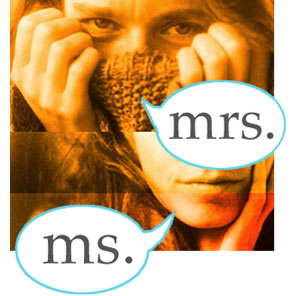

It started at a children’s backyard birthday party when a little girl I’d never met ran up to tell me about a puppet show, stopping first to ask my name. I gave her my given name, but she said her mother wanted her to use people’s “grown-up names — like Mrs.” When I told her she could call me “Ms. Mifflin,” I saw by her confusion that this hadn’t been offered as an option. So I found myself on my knees explaining it, secretly hoping that her mother wouldn’t come after me with a garden hose for imparting this feminist fact of life to her 5-year-old daughter.
In the next few weeks, I became acutely aware of how often I was not addressed as Ms. socially. School officials, car mechanics and telemarketers all used Mrs. or Miss, hitching it arbitrarily to my surname or my husband’s.
I began asking friends when and by whom they are called Ms. For most, it happens only at work. An administrator at my daughter’s elementary school told me that although many teachers choose Ms. as a courtesy title, most students call them Mrs. whether they’re married or not. And so it seems that Ms. — popularized in the ’70s and intended to elide marital status as Mr. does — has become the norm in the professional world. But it hasn’t stuck socially. Why?
Certainly, Ms. carries ’70s feminist baggage that’s anathema to post-feminists and anti-feminists alike: To them, it’s not just the name of an eye-crossingly boring magazine, it’s a title only fist-thumping proselytizers adopt.
They might be surprised to learn that modern feminists did not come up with Ms. in the first place. The title’s earliest documented appearance was on the 1767 tombstone of a Massachusetts woman named Sarah Spooner. Some scholars have theorized that it was first used, like Miss and Mrs., as an abbreviation for Mistress, a 14th century translation of the French maitresse (a term of respect for women of prestige).
In the 17th century, Mrs. was used for adult women, married or not; Miss was used for girls. Only in the late 18th century did these titles begin to denote marital status, possibly as a result of the Industrial Revolution, during which women began working outside the home, and needed their sexual availability clarified.
Though Ms. has been attributed to first-wave feminism, its use and specific meaning during the late 19th century are unclear. In the 1940s, however, it was appearing in secretarial handbooks as a counterpart to Mr. Second-wave feminists embraced it, and in the debut issue of Ms. magazine in 1972, the editors explained the title: “Ms. is being adopted as a standard form of address by women who want to be recognized as individuals, rather than being identified by their relationship with a man.” By the 1980s, according to public opinion polls, about a third of U.S. women endorsed its use.
In an increasingly egalitarian culture, with more women marrying later (or not marrying at all) and retaining their birth names after marriage, Ms. is more fitting than ever. It’s equally useful for divorced women who shed their married names.
But for a courtesy title intended as a neutral counterpart to Mr., Ms. is larded with sticky, often contradictory associations. For example, a 1998 survey of 10,000 Midwesterners revealed that women who use Ms. were perceived as better educated and more independent, outspoken and self-confident than those who use Mrs. or Miss. But they were also presumed by the respondents to be less attractive and less likely to be effective wives and mothers.
Of course, the resistance of traditionalist folk to Ms. comes as no surprise. What stumps me is the schizoid use of the term by female professionals. How does one explain the career women who use their birth names at work and their husband’s names socially? What about the divorced businesswoman who told me that her teenage son’s friends call her “Miss Thompson,” which she considers to be a nice conflation of Ms. and Mrs. Or the New York Times weddings page, which is filled with female lawyers and executives who “will use [their family names] professionally.”
Neoconservatives, socialites and the pre-feminist generation aside, why would a 21st century woman choose to identify herself foremost as a wife? And if she does, why only away from work?
Hoping for illumination, I turned to an arbiter of social etiquette, Miss Manners (columnist Judith Martin), and found my identity crisis theory immediately confirmed. I dialed her number wondering whether to address her as “Miss Manners” or “Ms. Martin,” but found that her secretary referred to her as “Mrs. Martin.”
In print, Miss Manners has called Ms. “a clever, useful invention.” But she wisely cautions that “in this period of transition, it is courteous to address people in the fashion with which they feel comfortable.” When I asked her if this transition would conclude with the exclusive use of “Ms.,” she said: “If we’re lucky, ‘Ms.’ will eventually become the standard female title.”
Miss Manners is usually a champ when it comes to balancing good sense with good form in tidy explanatory packages. But when I asked her about her personal choice, she let me down. “In the spirit of tolerance,” she answered, “I use them all: Mrs. for my married name, Miss for my pen name and Ms. for anyone who cares to apply it to either. Out of pity for those who are sick of hearing explanations, I will refrain from offering any.” So much for the imminent standardization of the clever, useful title.
One impediment to our widespread acceptance of Ms. is the cloud of misunderstanding that still surrounds it. A 1998 study by Barbara Kelly of “folklinguistic attitudes” to the use of the term Ms. showed that many people link it to marital status. They assume it refers to a divorced, widowed or unmarried woman; that it deliberately conceals marital status, highlights single status or shows that a woman is not committed to her husband.
How ironic that a title created to neutralize the issue of wedlock came to be so elaborately misconstrued in that very context. And let’s not chalk this up to men: Fully 49 percent of the women interviewed by Kelly didn’t understand how Ms. should be used.
Stranger yet is the fact that many interpretations of female courtesy titles directly contradict each other, indicating that each has its own social Rorschach effect. One woman told me that Ms. makes her think of “a stuffy socialite who lunches at Le Cirque.” Another said, “I do know some women who ‘tolerate’ being called Mrs. (with the husband’s first and last name) in social circles. This is common among the wealthy, where for some reason they can’t break tradition and give women individual identities.”
One woman who uses Ms. surmised that some people use Mrs. because they don’t want their husbands to think they’re “passing themselves off as not married.” (Would we ever suspect a Mr. of doing this?) Some women change their titles by the hour or the year (Ms. until 5 p.m., Mrs. after hours; Miss to people who knew them before they were married …), suggesting multiple personalities fragmented along the lines of work and marriage.
The contradiction I see has nothing to do with taking a man’s name, nor does it apply to befuddled youths who misuse Ms. simply because courtesy titles in general are in decline. It’s the conditional use of Ms. that jars, implying that sexual/marital neutrality is suitable in the workplace but not in the outside world.
Working women who shift to Mrs. once they are away from their desks assuage a distinctly Victorian fear: that professional achievement will magically unsex them. As Carl Jung put it: “In taking up a masculine calling, studying and working in a man’s way, woman is doing something not wholly in agreement with, if not directly injurious to, her feminine nature.”
So the Ms. who socked it to the district attorney at work and goes home to become Mrs. proves that she hasn’t sacrificed her marriageability on the altar of her career. Her feminine currency is validated with every utterance of the title, because at its crudest, Mrs. trumpets sexual status: taken.
In the context of women’s history, the fortification of this home/work divide is a dangerous business: It contradicts the logic underpinning some of the most important family-friendly initiatives on the public table: flextime, parental leave, job sharing and on-site day care — all designed to allow personal and professional identities to overlap by strengthening connections between them.
This division reinforces the Midwestern stereotype that an independent woman (Ms.) and a good wife (Mrs.) can’t be the same person, and it’s the reason Hillary Rodham, lawyer, was reborn as Hillary Rodham Clinton, wife, when her career became a potential liability for her husband’s. At its most extreme, this work/home, public/private dualism drives every repressive patriarchy in the land, from the Mormon Church to the Taliban.
On its evolutionary journey from feminist red flag to Everywoman courtesy title, Ms. still roils with semiotic undercurrents churned up during feminism’s second wave. But that’s no excuse for using it selectively. Tell me you reject Ms. because you’re not a feminist, or that the title is tethered to a movement that overlooked you, or that your mother shoved it down your throat. Tell me that your marriage is your greatest accomplishment, or that you were married in 1956. But don’t say Ms. describes you at work and not at home. It’s just so 20th century.
