

On Jan. 9, Feminist Majority leader Eleanor Smeal sat in on the first day of testimony in the Samuel Alito confirmation hearings and wrote in her Ms. magazine blog that “we are in better shape to stop Alito than we were at the time of the Roberts hearings.”
Monday night at 6 p.m., after Democrats lost the cloture vote and progressives came one step closer to losing the battle to keep Alito off the court, Smeal released a statement that claimed: “Progressives were strengthened by today’s battle.” How’s that? Smeal’s statement continued, “Each battle over these reactionary Supreme Court nominees is making this massive progressive coalition stronger.” This fight, she said, “lays the groundwork for a future filibuster of a right-wing Supreme Court nominee,” and “shows that African-Americans, women’s rights supporters, Latinos, people with disabilities, and workers are not going to quietly lose their rights.”
How the hell did we get here?
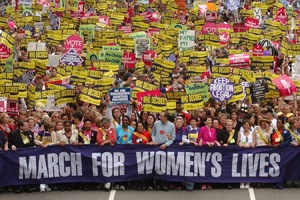
What happened between the spring day almost two years ago when hundreds of thousands of men and women converged on Washington, bearing signs like “Keep Your Laws off My Body,” and today, when the Senate confirmed a Supreme Court judge who 20 years ago wrote that in his legal opinion, the Constitution does not protect women’s right to abortion? What happened between Jan. 9, when Smeal declared the left “in better shape to stop Alito,” and yesterday, when visions of future filibusters and assertions that we’re not going to lose our rights quietly were somehow supposed to qualify as good news? Why weren’t we storming the Capitol? Why weren’t there enormous marches? Why didn’t someone buy some national television time or actually burn a bra or something — anything — to snap people out of their “Skating With the Stars” lassitude and make them face the fact that the wolf that has so long been cried about was finally on the Supreme Court steps?
Pro-choice leaders interviewed in recent days had lots of answers to those questions, and not all of them were as cheerful as Smeal’s assertions that the progressive movement is stronger than ever. There was a sheen of buck-up spin, an understandable reaction as groups gird for what is about to become a terrifying set of battles, but leaders also discussed a lot of ugly truths — brutal realities that should have been taken seriously before today.
“The most important point is something we’ve said for a long time: Elections matter,” said Planned Parenthood interim president Karen Pearl, speaking as the head of the Planned Parenthood Federation of America’s election-focused Action Fund. “No amount of advocacy can change who is in the White House and who is in the Senate. So when the Congress has majority leadership that is antichoice …,” Pearl trailed off, almost as though she was tempted to say, “this is what you get.” But she didn’t. “We told our supporters the losses were going to be real,” she continued steadily. “If we had a majority of senators who were pro-choice, Alito would not be confirmed right now.”
But Pearl seemed determined to project at least a partially upbeat image. She described how much work was done by her organization throughout the confirmation process: 250,000 letters from Planned Parenthood supporters sent to Capitol Hill, 90 events throughout the country, a national day of action, house parties, press conferences, phone banks, 100,000 petitions, meetings with senators in D.C. and locally. None of it was wasted, she said.
“We have made enormous strides in the Alito nomination,” Pearl said. “At first, the sense was he was absolutely going to get in and we now have more senators voting against him than [we’ve had] since the [Clarence] Thomas nomination.” That’s great, except of course that Alito is on the court, just like Thomas. But that kind of defeatism can be dangerous. As Pearl said, “the right will try to cast this as a defeat of all things positive and progressive, but I don’t think that’s what it is. This is a very pure political calculus. When the White House and Senate are both controlled by not only one party but the extreme of one party, it’s very hard to make change. But I think it’s a wakeup call for Americans about the very issue of who represents them. I think people get that now.” Isn’t it a little late to get it? “Well,” said Pearl, “politics does have that pendulum quality and we can hope that people will wake up and make change.”
Asked whether she believed that women understand — really understand — that this could be it, Pearl responded, “Absolutely they understand. And they are deeply committed to doing everything they can.”
Ann Stone, executive director of Republicans for Choice, didn’t seem to agree that women totally get that their rights are in serious and immediate danger. “There’s no fear that [Roe v. Wade] is going to be overturned,” she said. “Our grass-roots membership do not believe it.” Stone said that when RFC proposed to its membership a series of anti-Alito measures, including ads on the backs of buses and on the radio, “they told us, ‘We want to concentrate on stem cell research and the FDA.’ We didn’t spend a lot of energy on the Alito fight because our membership told us not to.” Stone herself said she believes that the court will still vote 5-4 on the side of Roe, counting Justice Kennedy as a sometimes friend of reproductive rights.
She also suggested that her membership wasn’t eager to spend money and energy fighting Alito because of the sense that it was a losing battle. “There was the attitude that he was going to be confirmed,” said Stone. Of course, that could be part of the attitude that led to disappointing votes for Alito from some pro-choice Republicans like Arlen Specter and Olympia Snowe, Senate candidates who had been supported by pro-choice groups.
Stone acknowledged that RFC is upset about the pro-choice Republicans who voted for Alito, but guessed that given the low number of senators coming out against him, “those votes weren’t going to make a difference anyway, so they didn’t want to throw them away.”
Asked if she was concerned that the Alito confirmation would send a message that choice had lost a battle, Stone responded, “I am very concerned about the impression that pro-choice has lost. And if I were a Democrat I would be concerned that it’s going to look like they didn’t stand up strong enough. But you know, sometimes you just have to pick your fights and go with it.”
Catholics for a Free Choice president Frances Kissling had a different take on what went wrong in the Alito fight. “Maybe one of the things that happened is there was only one woman on the Judiciary Committee!” she said, referring to Dianne Feinstein, D-Calif., and adding with exasperation that the committee was made up of “a bunch of white guys.”
She also acknowledged that pro-choice arguments have been effectively sidelined in the year since the 2004 election. “There was a desire for the public message not to be just the abortion message,” said Kissling, noting that it could indeed have been counterproductive to focus on Alito’s abortion views, since an elected antichoice president was unlikely to ever cough up a candidate who didn’t have a troubling stance on reproductive rights.
It would be ludicrous to hope that President Bush would tap anyone but an antichoice judge. But the marginalization of the abortion debate also speaks to the success of some on the left like Howard Dean, who said in April, “If I could strike the words ‘choice’ and ‘abortion’ out of the lexicon of our party, I would.” Women’s rights advocates have effectively been cast as the nagging fishwives, holding up party progress with their insistence on making reproductive rights the single issue on which to base support.
The unspoken agreement to tamp down the focus on abortion could be felt in the Alito hearings. Mainstream Democrats like “Dean and [Joseph] Biden have made it clear they don’t know quite what to do about abortion,” said Kissling. “They have said we need a new way of becoming open to pro-life Democrats. How could they come out squarely and heavily opposed to Alito because of his position on abortion? It would only cast them as ‘the abortion party,’ which is what they’re trying to avoid.”
Kissling said she agrees with the general consensus that the Supreme Court will not directly overturn Roe. “I think they have the votes to overturn Roe, but I don’t think that’s what they’re going to do,” she said. “I think they’re going to continue to make Roe meaningless. The availability of abortion will continue to decrease with this court.”
Kissling did not try to transform this moment of profound loss into a win. “This confirmation was and is a very high priority” for reproductive-rights organizations, she said. “But the crux of the matter is that where it is most important we have the least maneuverability. Our powerlessness is crystallized around Supreme Court appointments. It is a 55-45 U.S. Senate, a 10-8 Judiciary Committee, and a president entitled — in the minds of many — to his appointees.” She pointed out that while even damaging bills can “be maneuvered and delayed and futzed around with, a Supreme Court appointment is a moment. A judge has to be confirmed or not confirmed.”
Who’s to say whether a partywide explosion of horror over the threat posed to Roe v. Wade would have provided a different result — or at least a broader national awareness of what was about to happen to women’s freedoms. Instead we got a tepid debate and a slippery sound bite from Alito about how he’d “keep an open mind.” That clip was all the American people needed to see to get the impression that there were, as NARAL Pro-Choice America president Nancy Keenan put it, “no fireworks.” The Republican strategy, asserted Keenan, was “to make sure that Alito did nothing to cause alarm. They were careful to say he has an open mind. The other part of their strategy was to make him run from his record and look very moderate.”
This summer Keenan’s organization was under attack for fighting too hard and dirty against the John Roberts nomination, and it is now being targeted by bloggers for its support of pro-choice Republican candidates. An entry on the DailyKos blog Monday read, “When is NARAL going to realize that there are no pro-choice Republicans? Snowe, [Susan] Collins, [Lincoln] Chafee [who actually voted “no” on Alito] … cloak themselves in neutral views, but when a woman’s right to privacy is immediately threatened by a judge who has spent his life exhibiting an open hostility to Roe and its progeny, they cast that cloak off and show themselves for what they truly are — Republicans, loyal to their party … Congrats, NARAL. You got punk’d.”
By phone, Keenan herself sounded pretty pissed about the gang mentality of the right. “The real story is that so many Republican senators blindly endorsed Alito,” she said. “It’s like they’ve become a rubber stamp for George Bush.”
NARAL, like Planned Parenthood, actively organized against Alito. Keenan said that more than 200,000 NARAL-associated petitions were delivered to senators. Unlike others who felt the abortion debate was sidelined during the hearings, Keenan said she was not disappointed with the Judiciary Committee’s questioning of the judge. “I think they did a good job,” she said. “The issue of reproductive choice was front and center. And it’s not about how they grilled him, it’s about the way he avoided the questions and distanced himself from his 1985 memo that said Roe was wrongly decided. This guy didn’t answer the questions! He ran from his record! And he tried to appear to the American public as if he were a moderate — which he is not.”
The question now, said Keenan, is “how we begin to look forward and defeat those who will not protect privacy and freedom for women and families in this country.” She mentioned the ways in which the antiabortion movement is becoming increasingly — and hypocritically — rapacious in its desire to limit access to birth control that would decrease the demand for abortions. When asked if that makes them an even more dangerous enemy, Keenan laughed. “No,” she said, “because over 95 percent of women in this country have accessed birth control at some time in their life.” The more limitations the right tries to exert, the more they overstep, she said.
As a result of very unfortunate timing, Keenan will Tuesday night co-host NARAL’s annual “Party for Roe,” commemorating the anniversary of the decision. The dinner is expected to be attended by about 1,000 people; Madeleine Albright and Stockard Channing are scheduled speakers. It could well be a grim affair, competing as it is against a State of the Union address, on the very day that Alito was confirmed. Was Keenan disappointed about the timing? “Well, sure,” she said. “But we all know we’ll roll up our sleeves and continue to work very hard to send some of these elected officials back home.”
Other leaders agreed that it is time to look forward. Karen Pearl, who will step down as Planned Parenthood’s interim chief on Feb. 15 when Cecile Richards becomes president, said she will stay on through the transition, and darkly predicted that “we’re probably going to see some very, very bad court decisions and we will need to work out a strategy — working more locally with state legislators and with governors — to preserve services across America.” Of course, she means access to abortion, access to birth control, access to healthcare for all women, all of which are already gravely imperiled. According to reports last week, illegal abortions, performed by unlicensed practitioners or by pregnant women themselves, are on the rise throughout the United States, even as Roe stands now, weakened but intact.
Roe will probably not be overturned, but in the coming decades it will get chipped away until it is almost unrecognizable, until abortions are legal only for privileged women with notes from parents and spouses in the first four weeks of gestation. It’s worth remembering as we go back and forth on the technicalities about trimesters and spousal and parental notifications, and about how big a plank in the platform of either party abortion should be, that this fight is far from trivial or technical. What we’re on the verge of losing is the legal acknowledgment that women are human beings capable of making decisions about their own bodies. What we could be losing is our equality under the law.
And it is this mournful lesson that Frances Kissling was getting at when she sounded a dirge for Roe, as if it had already passed into history. “In a way,” she mused, “Roe was a socially transformative decision made in a country that was not socially transformed. In terms of social values, in terms of attitudes towards women, it was a profound anomaly. And it’s not surviving. Whether it gets overturned or continues on the road to restriction, the concept of women as moral agents in relation to their own bodies is being rejected year by year by year.
“It was so far ahead of its time,” she continued. “It was a visionary decision. The failure, the sad part of it, was that we weren’t ready for it. The sad, sad, sad thing is society is less ready for it than it was 30 years ago, but that’s not the fault of Roe.” Roe, and the larger philosophy behind it — that women are capable of moral agency — Kissling said, “was never really realized. But maybe what one can say is that in history, 100 years from now, or 200 years from now, when Roe is looked at, it will be looked at as one of the most-forward-thinking, principled decisions for women. Whether it survives or not, it existed. And it will be looked at as an important moment.”
