
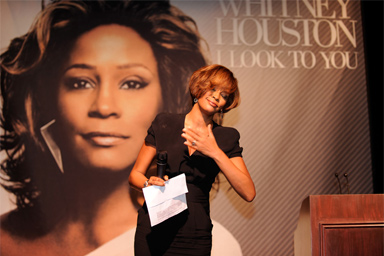

Whitney Houston is back … or at least that’s what she and her record label want you to believe. The pop diva who dominated the record charts in the ’80s and ’90s descended into drug- and Bobby Brown-fueled infamy during the last decade. And her last comeback, 2002’s “Just Whitney,” tanked commercially. After she gave an interview to Diane Sawyer the same year — in which she denied using crack, saying she made too much money to use the drug — the once-mighty Houston seemed relegated to being little more than the butt of late-night jokes.
But her much-hyped new album, “I Look to You,” drops today, and she plans to appear on Oprah in early September. As for the record itself, the reviews are already in. Can Houston return as a pop force? Has her voice been ravaged by excess? Here’s a look at what critics are saying about the album — and Houston’s troubled history.
On Whitney’s past: “Without adversity, a diva is just a singer. It’s the back story, the tale of struggle and tenacity, that draws audiences to read more than musicianship into her performances.”
On “I Look to You”: Pareles thinks it “is more subdued, canny and cautious” than her previous album “Just Whitney.” He writes, “She still sings about the power of love, though it’s not always benign anymore. The album is split between songs that hint at her travails and songs that try to ignore them.”
JIM FARBER, NEW YORK DAILY NEWS
On Whitney’s past: “The first thing you notice about Whitney Houston’s comeback-from-hell album isn’t what’s on it … It’s what’s not … As a hopeful bass line bounces in the background, Houston’s barely accompanied voice pours from the speakers, as if to instantly argue that, despite seven years in ruinous exile, everything’s fine in Whitney-ville.”
On “I Look to You”: Farber awards the album three stars out of five, writing, “Simply put, the voice we hear on ‘I Look To You’ isn’t the one that made millions of jaws drop, and caused scores of fellow singers to hanging up their mikes forever.”
On Whitney’s past: “After years of erratic behavior in which drugs took hold of her life and her marriage to [Bobby] Brown dissolved in full view of the public (thanks to an ill-advised reality TV show), Houston was persuaded … to re-enter the studio a couple of years ago.”
On “I Look to You”: “Step back from the competent but hardly inspiring quality of most of this material, and another theme emerges: that Houston is making music again at all is something of a small victory. Sure, she rides the production because her voice isn’t what it used to be. But then neither is the music industry that she once ruled.”
ALLISON STEWART, WASHINGTON POST
On Whitney’s past: “Among other things, the ’00s will be remembered as the decade of the diva flameout, a long national nightmare of public crackups, disastrous marriages and no-panty flashings from which only Christina Aguilera has emerged unscathed. Whitney Houston, 46, has had the most spectacular catalogue of troubles — rumors of hard-core substance abuse, her once-fabled voice poised at the edge of ruin, a marriage to bad-boy Bobby Brown — and her comeback has taken the longest; at times it seemed the most in doubt.”
On “I Look to You”: “‘I Look to You’ gets it right. It is a finely calibrated, just-modern-enough mix of mom-friendly club bangers and dauntless ballads that, in retrospect, seems like the only album she could have made. It’s an Oprah’s Book Club selection in album form, a collection of songs assembled around a familiar story line: a fall, a struggle for self-acceptance and love, a redemption.”
MARIO TARRADELL, THE DALLAS MORNING NEWS
On Whitney’s past: On Houston’s past albums, Tarradell writes, “They capture the loose, edgy and unpredictable woman who dived into a volatile marriage with singer Bobby Brown, developed the diva attitude so widely documented and experimented with drugs.”
On “I Look to You”: “I Look to You is easily better than 2002’s disjointed disappointment ‘Just Whitney,’ a disc that just about everybody (including Houston) has all but disowned. If anything, ‘I Look to You’ sounds like the New Jersey native on her best behavior. She does seem quite focused, but perhaps more so for the sake of career preservation than creative rejuvenation.”
On Whitney’s past: “When she was at her best, nothing could match her huge, clean, cool mezzo-soprano — not Madonna’s canny chirp, not Bono’s stone church wail nor Bruce Springsteen’s ramshackle growl … Then, like many a glorious edifice, Houston’s voice fell into disrepair. Drug abuse and a rocky marriage to New Jack jerk Bobby Brown made her a tabloid staple. More tragically (for listeners, at least), her excesses trashed her instrument, which age and normal wear and tear would have imperiled anyway.”
On “I Look to You”: “But should we begrudge the fact that Whitney Houston now has to work at singing? It’s all to her credit. What’s hard to give up is the dream of painless perfection that the young Houston represented, back in the yuppie era, when her voice sounded like the easy money that was flowing everywhere. Of course, that didn’t turn out so well for anyone else, either … Though ‘Look to You’ doesn’t soar like the old days, it’s fine to hear Houston working on her own recovery plan.“
On Whitney’s past: “The last time Whitney Houston made an attempt at a comeback, with 2002’s ‘Just Whitney,’ it was overshadowed by her continued free fall into tabloid infamy. Drug use, marital battles and wild behavior tarnished her once-regal image so much it was hard to focus on anything musical from Houston, and the fact that ‘Just Whitney’ was just OK didn’t help matters.”
On “I Look to You”: “She appears to have put her demons behind her, and with ‘I Look to You,’ she has delivered a very good album that shows the pop queen still has a dazzling voice that can leave you spellbound.“
LEAH GREENBLATT, ENTERTAINMENT WEEKLY
On Whitney’s past: “Pop stardom has
its privileges. Unlike schoolteachers and tax accountants,
creative types with personal demons are often able to take what doesn’t kill them and emerge not only stronger, but with a new sort of depth and pathos — and often, a wider audience for the pain they turn into art.”
On “I Look to You”: Greenblatt gives the album a B-, writing, “‘I Look to You,’ Whitney Houston’s first album in seven years, doesn’t pretend to offer the unblemished 21-year-old we met on her smash 1985 debut, but it never
truly lets listeners inside the heart and head of the woman she is today.”
