

In October, 17-year-old Dimitri Arethas posted a doctored photo on his MySpace page depicting his public high school’s black vice principal as RoboCop. Arethas said he found the photo, which had a racial slur scrawled on it, on another student’s Web site, and that he posted it to his own MySpace page thinking it was funny. Arethas, of Charlotte, N.C., claims he didn’t mean the post to be racist and says that most of his fellow students thought the post was funny too.
But one anonymous student didn’t, and brought it to the attention of school administrators. As a result, Arethas says principal Joel Ritchie, who did not respond to a request for comment, suspended Arethas for 10 days.
Arethas, who says he apologized and removed the photo when he was initially confronted, was incensed by the suspension, and contacted his local paper, the Charlotte Observer, and the American Civil Liberties Union. With the help of ACLU lawyers, Arethas was able to convince the school to end the suspension. He returned after two days.
“Maybe what I did was wrong, morally,” Arethas said in a recent e-mail, “but I had every right to express myself. I just chose to do it as a picture, instead of rambling down the hallways yelling, ‘Man! This school sucks.'”
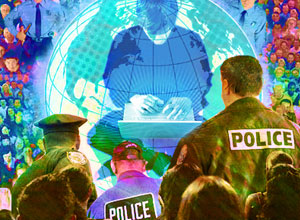
Arethas isn’t the only student to be disciplined for what he posted to his MySpace profile. The past few years have seen an explosion in the number of schools taking to the Web to find out what students are saying and doing. And punishment has followed, from a Pennsylvania school that suspended one student for creating a parody MySpace profile of his principal to a California school that suspended 20 students simply for viewing one student’s MySpace profile, which contained threats against another student. And some public school systems, like Illinois’ Community High School District 128, are even taking steps to monitor everything their students say on sites like MySpace. According to the Chicago Tribune, under new guidelines, students who participate in extra-curricular activities will need to sign a pledge in which they agree that the school can discipline them if it finds evidence that they have posted any “illegal or inappropriate” material online. Even some police are beginning to patrol MySpace, seeing the site as an effective tool for catching teenage criminals.
All of this new scrutiny poses a vital question for MySpace, which claims 76 million users and is now the largest of all the Web’s social networking sites: What will happen to the site if and when users no longer feel safe expressing themselves there? And in an age where teenagers are accustomed to living their lives online, what will happen when they learn that what they thought was private is, in fact, public, and not without consequence?
“I never thought [this] would happen,” Arethas says of his suspension. “I figured only my friends would see my profile page.”
Most large online social networking services have undergone similar challenges as they’ve grown, with users feeling safe in the widely held though mistaken perception that what they posted was private, or at least that it would only be seen by a select group of people. Other sites have also, like MySpace, dealt with users who have preyed on other more gullible ones, as with the recent high-profile arrests of men who used MySpace to lure young girls. But few sites have grown as large, and as quickly, as MySpace, which was acquired in July 2005 by Rupert Murdoch’s News Corp. for $580 million. And few have specialized so effectively in encouraging kids to get comfortable and open up.
As with all forms of electronic media, people still have a hard time wrapping their minds around the fact that little online is truly private. A sampling of MySpace’s offerings reveals the evidence: Posts explore almost every aspect of users’ personal lives, from typical teenage angst about acne and unrequited crushes to more incriminating fare — sexually suggestive images and photos of drinking and drug use — as well as professions of love, anger and every emotion in between.
“MySpace has encouraged its users to be aware that what they post on their MySpace profile is available for the public to see,” says MySpace spokesman Matthew Grossman, adding that “part of why MySpace has been so successful is because people can share their feelings.” While Grossman stresses that MySpace does not spy on its users, or share their information, the site will work with law enforcement “if they [law enforcement] go through the proper legal channels,” such as a subpoena or warrant. The site’s privacy statement makes that caveat explicit. But many users haven’t heeded those warnings. They do so now at their peril, because more and more, they are being watched.
“We patrol the Internet like we patrol the streets,” officer James McNamee, a member of the Barrington, Ill., police department’s Special Crimes Unit, says. “We’ll go in on a MySpace or a Xanga, we’ll pick out our area and we’ll just start surfing it, checking it, seeing what’s going on.”
McNamee says the fact that police have only recently realized what a powerful tool social networking sites can be for investigative purposes may be what makes MySpace users feel the site is their own private realm.
“We’re still playing catch-up,” McNamee says. “I wouldn’t say we’re super far behind, but we’re learning as we go and I think that’s the reason some [teens] feel like, ‘Oh, this is an invasion of our privacy.’ Well, no, it’s not, it’s just that we were behind on learning that we should have been paying attention to this, and now we’re paying attention.”
In the eight months the Barrington Police Department has been patrolling MySpace, McNamee says, they’ve found pictures of graffiti, with the artists standing next to it, “smiling, all happy about their activity,” they’ve found evidence of drug dealing –“where they could hook up, who was dealing drugs … photos of their money … photos of their drugs” — they’ve even found a “We Hate Barrington Police Department” blog. (“We don’t care,” McNamee says of the blog. “It’s kind of funny to us; we’ll let them vent that way.”)
The question of what public school students have the right to say, and where they have the right to say it, remains murky, with little in the way of definitive jurisprudence to guide schools and courts. Indeed, just about the only thing experts on the topic seem to agree on is that no one really knows what the law is.
“There have been some court decisions, and in all honesty they’ve been a little bit confused,” says Mark Goodman, the executive director of the Student Press Law Center. “And it really isn’t just Internet-based speech, but actually any kind of expression by students outside of school. There really have been relatively few cases going to court on this issue, so it’s understandable [to a certain extent] why there would be some confusion surrounding it.”
Goodman, for his part, believes that the law is on the students’ side.
“In a public school, I believe the law’s pretty clear that the school does not have the authority to punish students for expression they engage in outside of school. There are really important fundamental reasons for that. At the very least, it’s a major usurpation of parental authority. Outside of school, parents have the authority to discipline their children … I think the problem is a lot of people simply presume that the Internet in effect becomes school expression, and I simply don’t believe it does. I think there are legally important distinctions, and very good policy reasons why the school shouldn’t have that authority.”
Marc Rotenberg, who teaches information privacy law at the Georgetown University Law Center and is the executive director of the Electronic Privacy Information Center, believes the issue is not so clear-cut.
“The key point is whatever is publicly accessible,” Rotenberg says. “If a student writes an article in the town paper that defames one of the teachers, the fact that it didn’t happen in a school publication really is irrelevant. The school will still act on that information if it’s public and available to the community … The courts have not, particularly in the last few years, been sympathetic to student privacy claims, and I don’t think there’s any reason to think it would be otherwise when the conduct is posted to publicly available Web sites … The critical point here is that yes, I think students should have the freedom to express their views, and I don’t think there should be any type of prior restraint on publication, whether it’s in print or online media. But that doesn’t mean what you say may not have some repercussions.”
There are no such questions about whether the police have a right to patrol MySpace.
“If it is a public forum that is accessible to others, then presumably the police are welcome to participate, as they would be welcome to enter a shopping mall or something like that,” Rotenberg says.
Kurt Opsahl, a staff lawyer with the Electronic Frontier Foundation, a nonprofit organization whose mission is to defend Internet free speech, agrees.
“You have of course a Constitutional right not to incriminate yourself, but you have to exercise that right by not incriminating yourself,” Opsahl says. “If you post a photo of yourself engaged in apparently illegal activity with text confirming what you’re doing, that can be used against you. Anything you say can and will be used against you, as they say in the Miranda warnings.”
But according to James McNamee, MySpace’s younger users, or at least the ones he sees in his virtual patrols, haven’t yet caught on to that.
“Some people criticize MySpace, and there’s no reason to criticize it,” he says. “It’s a social networking Internet site that’s doing a great function, in my view. The problem is young people aren’t sure how to handle it yet. They’re not understanding that it’s the World Wide Web, they don’t get that concept. They think only their friends are looking at it.”
Eight MySpace users in Wilkes-Barre, Penn., learned the hard way that the people visiting their MySpace profiles were not just friends. Wilkes-Barre police, stumped by a rash of graffiti in the downtown area, turned to MySpace to seek suspects.
“The police dug very deep to find me,” says one of those arrested in the case, who asked to remain anonymous because of ongoing legal proceedings, and who would communicate only through MySpace. “I didn’t have my name, phone number or any info on me online. I’ve never used my real name, I’ve never had my own Internet connection (always another person’s name), and I never had my address or name at all posted or registered online.”
That user, who denies any involvement in the graffiti, says he was aware of the public nature of the site — “I always think that people are looking,” he says — but that some of his friends were not, and that he thinks the police overstepped their bounds.
“I feel that police shouldn’t lie and disguise their identity to gain friendship with people they can’t see, or ever meet without [informants].”
Dimitri Arethas also feels his rights were violated. “A home page is basically as private as it gets,” he told the Observer at the time of his suspension.
When asked recently if he still felt that way, his answer was much the same.
“Private like exclusive to only your friends? No, not that kind of private,” he said. “[But] someone has to personally seek out your name and find you in order to view your MySpace, which is what stirs me up. That’s where I got some sense of privacy. I could have never imagined someone printing out my profile page and then turning it in.”
Mark Goodman worries about the lessons students like Arethas will learn as more face consequences for what they post to sites like MySpace.
“What I would hate to see happen, and I think it has happened in some communities at least, is students deciding they can’t publish unpopular or controversial viewpoints on their MySpace page or an independent Web site because they’re afraid school officials will punish them for it. That, I think, is very disturbing, and those are the young people who, as adults, are going to believe the government should be regulating what the public says. It has very troubling implications for their appreciation of the First Amendment in the world outside of school.”
Arethas says that he has become more cautious about what he posts. “Gotta play the political game now,” he says. He took his MySpace profile down for a week after the incident, but decided to put it back up — without the offending photo — when he realized, he says, that he “could pretty much get away with it,” and that he “had won the case” by being reinstated to school. He still believes the school was wrong to suspend him.
Goodman thinks, though, that few students would act as Arethas did. He points to a study on high school students’ attitudes toward the First Amendment, conducted by researchers at the University of Connecticut. Released early last year, the study found that 49 percent of students thought that newspapers should need government approval for their stories, 75 percent didn’t realize flag-burning was legal and more than a third thought the First Amendment went too far. Half believed the government could censor the Internet.
“I think the point of it, ultimately, is how can we expect anything different [than the survey results],” Goodman says. “A direct result of these actions is young people’s dismissiveness of the fundamental values of free expression that we as a nation supposedly hold dear.”
The MySpace user arrested in the Wilkes-Barre case agrees.
“I think that MySpace is the epitome of free speech, and censorship, all rolled in one. And I think that America with[out] free speech is not free at all. Just think about the people that have been censored. Go to another country, like Denmark and there is no censorship at all, and the kids growing up there don’t look at it as dirty, just as life. When we make things illegal, or ‘dirty to look at’ we create the feeling that it’s bad.”
