
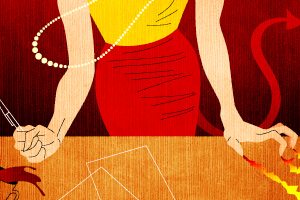

There’s a scene near the beginning of “The Devil Wears Prada,” the movie version of Lauren Weisberger’s novel about the degradations she suffered as assistant to Vogue editor (and reputed Boss From Hell) Anna Wintour, that signals this movie is fashioned from a finer grade of fabric than its literary source. Weisberger’s stand-in character, the I’m-too-brainy-for-this-job Andy Sachs, sniggers derisively while the Wintour character, Miranda Priestley, imperiously decides between two seemingly identical belts for a fashion shoot.
Miranda, played by a silver-coiffed Meryl Streep, levels her gaze at her frowzy lackey (Anne Hathaway) and delivers a calm, magnificent monologue about the fashion industry. In a matter of seasons, she explains, a particular shade of blue trickles from her office to magazine pages to couture collections, moving down the fashion food chain until the hue is all the rage in plain-Jane department stores and outlying retail outlets, finally winding up in “some tragic Casual Corner bargain bin,” the very bin out of which a holier-than-thou shopper like Andy has fished the blue sweater she’s wearing. Andy may find her boss’s attention to accessories beneath her but she should understand that on her back she sports a garment that would not have existed save for the decisions made in this very office, by the very person she’s sneering at.
There are several remarkable things about this speech, including the almost unseemly pleasure Streep takes in delivering it, and the fact that no such scene takes place in Weisberger’s book. But the most enchanting thing about it, at least at the screening I recently attended, was the murmur of a cheer that passed through the audience. It certainly rumbled in me, as I realized that instead of watching a cheap cardboard cutout of a standard-issue virago boss, I was watching an aggressive (and admittedly unpleasant) female superior who was also worth cheering for.
Even my companion, a 22-year-old colleague who spent most of the movie curled in fetal agony over the film’s injustices toward the recently graduated, turned to me with wide eyes and a big smile on her face. “Wow,” she whispered, as Streep finished explaining her profession to her assistant, “that was awesome.” Asked later how she felt about the whole movie, my colleague said, “I identified with the girl, but I was still on Meryl’s side.” She has some high-profile company. On Wednesday, New York Times’ devil in a red dress Maureen Dowd wrote that she was surprised to find herself feeling sympathy for a character described as “a notorious sadist, and not in a good way.”
One can only assume that Lauren Weisberger, who was in her mid-20s when she sold (and sold and sold and sold) out her boss in her lugubriously simplistic tale of good amanuensis vs. evil overlord, did not anticipate that the Hollywood embodiment of her labors might cause an audience to root for the evil overlord. But three years later, we welcome this summer flick with open arms and find ourselves unexpectedly embracing not the heroine with the heart of gold but the harridan with the soul of steel.
For all its basic adherence to backlash tropes of the past two decades — the frosty, ill-tempered, exacting, petty, socially dysfunctional female honcho who can’t keep her personal life together — “The Devil Wears Prada” manages to present one of the most nuanced lady bosses ever to grace the silver screen. “Devil’s” presentation of a woman chief who is more than a bloodless billboard on which to project all our anxieties about femininity and professional power may mean that Hollywood has finally come a short way, baby. It has figured out, in an era of Oprah Winfrey, Martha Stewart and Meg Whitman, how to show us a woman boss who is not a phantasmagorical figure but someone most of us have met, some have worked for, and many are on their way to becoming.
The dehumanizing female boss didn’t grace movie screens much in film’s early years, as the vastly male professional universe didn’t offer many models. There were some slightly terrifying careerists, most of them played by Katharine Hepburn (who as “Woman of the Year” journalist Tess Harding belittles her sportswriter husband until he informs her she “isn’t a woman at all”) or Bette Davis (whose ur-diva Margo Channing in “All About Eve” learns that without a man to turn to before dinner, “you’re not a woman”). There were hardworking girls like “Kitty Foyle” and hard-boiled go-getters like reporter Hildy Johnson in “His Girl Friday” (a part originally written for a man). As the women’s movement took off in the ’70s, we began to see plucky gals who risked their tails for righteous causes, like Sally Field’s “Norma Rae” and Streep’s Karen Silkwood. But women bosses? They remained a rare breed.
In 1976, though, a new archetype was cast with Faye Dunaway’s praying mantis executive in “Network.” Then, in the ’80s, when the specter of having to answer to real live women in the real live world became manifest, corporate succubi began to appear regularly on celluloid. Laced with ’80s terror over a liberated female sexuality, movies propagated the fear that a woman’s behavior in the boardroom might simply be an extension of her now-unpredictable behavior in the bedroom. In Hollywood, which has often served as a literal projection of our basest instincts, imaginary female honchos were frigid, needy, capricious, hysterical, manipulative and promiscuous. And that’s pretty much how they stayed through the ’90s and into the new millennium.
What else but the male erotic nightmare (Michael Crichton’s, to be exact) could have produced Demi Moore’s duplicitous (and horny!) Meredith Johnson, who puts the moves on Michael Douglas and then accuses him of sexual harassment in “Disclosure”? Jane Craig, Holly Hunter’s immensely likable but totally neurotic producer in “Broadcast News,” forces herself to cry every morning before work. Diane Keaton’s “Baby Boom” executive J.C. Watts has a corner office, a six-figure salary, and a loveless relationship; they call her “Tiger Lady” — rowr! Check out Glenn Close as live-action fashion queen Cruella DeVil in “101 Dalmations”: She berates peons, asks an assistant, “What kind of sycophant are you?” (reply: “What kind of sycophant do you want me to be?”), opines that “We lose more women to marriage than war, famine and disease!” and in her spare time, kills puppies. Castrating underworld boss O-Ren Ishii, played by Lucy Liu, decapitates a man who has displeased her in “Kill Bill.”
But greater than the fear that unleashed sexuality would taint business practices was the anxiety that killer professional instincts might shade the female romantic approach. It’s this paranoia that provided “Working Girl,” the mother of all Boss From Hell movies, with one of its most memorable lines. Sigourney Weaver’s self-assured patrician boss explains to her secretary, Tess, that she expects a marriage proposal soon. When Tess wonders what she’ll do if it doesn’t happen, Katherine responds, “I really don’t think that’s a variable. We’re in the same city now, I’ve indicated that I’m receptive to an offer, I’ve cleared the month of June. And I am, after all, me.” Back when “Working Girl” was released, Weaver, herself an ambitious product of American noblesse, admitted in interviews that her character was loathsome, but also snuck in a quiet defense of female higher-ups, noting that they have to be “aggressive but not too aggressive, feminine but not too feminine.”
Of course, were it easy to sort out attitudes about gender and power, we would have done it long ago. The Catch-22’s of Managing While Female have been cataloged before, but bear brief repetition here: Raise your voice at a man and you’re emasculating him; raise your voice at a woman and you’re humiliating her; stay completely cool and you’re an ice queen. Beyond these rudimentary double-standards lie beliefs about the differences between male and female leadership. Thus the recent book, “The Girl’s Guide to Being a Boss (Without Being a Bitch),” a how-to for the testosterone-impaired, and last Sunday’s New York Times story “A Tyrant Boss, Even Without the Y Chromosome,” which posits that “female tyrants can spread a different brand of misery than the more common male variety.” Why? Because as women, they are naturally collaborative and encouraging, lulling subordinates into their comfy web of collaboration and encouragement before knocking them out with an oversize handbag and disemboweling them with a stiletto.
A better way of saying this might be to point out that there are bosses who are fun to work for and bosses who are not fun to work for, and that both breeds come in male and female. At a panel following the “Devil” screening called “Mentor or Monster,” Star magazine editor Joe Dolce, who currently works under über-boss Bonnie Fuller (whose former assistants told Vanity Fair they used to blow their noses in her food) and once labored for Wintour at Vogue for 90 days, said, “Yeah, [Wintour] was that bad, for me. But she was also a brilliant and talented editor. Nobody has a legendary reputation for being nice.” He also said that as top banana at Star, “I’m an emotional man, I raise my voice. It’s not a problem. But if a woman does, she’s a bitch, or hysterical.” He paused, surveying the crowd. “I mean, does anyone not know this?”
Sure, everyone knows it. But that doesn’t mean that we don’t still get off on seeing the screechy sexless harpy brought to life and then beaten into submission until we all feel better about our place in the power hierarchy. For if the mold for the fictional female boss has held for 25 years, so have the modes in which she must be punished, infantilized, abashed and then maybe … if she begs for it … redeemed.
Glenn Close, the preening and parsimonious managing editor of a tabloid in “The Paper,” gets a bloody nose from Michael Keaton, socially humiliated by Randy Quaid, and finally shot in the leg by Jason Alexander before she does the right thing. In “13 Going on 30,” vituperative, shallow fashion editor Jennifer Garner gets possessed by her reassuringly virginal 13-year-old self; she must turn her aggressively sexual magazine into a bubble-gum yearbook, chastely refer to a man’s penis as “his thing,” and dance childishly to “Thriller” before she can win the criminally foxy Mark Ruffalo and forsake her fancy apartment for a pink suburban home. Diane Keaton gets spit up on before she finally sees the light, moves to Vermont, falls for a veterinarian and starts making baby food in Backlash-tastic “Baby Boom.” Weaver practically gets off easy in “Working Girl”; she only has to break a leg, lose a job and a man, and listen to two characters comment on her “bony ass” to pay for her sins of ambition.
As far as comeuppance goes, “The Devil Wears Prada” cleaves to this hoary template. Miranda gets punished with personal disappointment while young Andy rejects her and her way of life. But the movie, to use a pernicious turn of phrase, is two-faced. The bare bones of the revenge story are in place, but the flesh on them tells a different tale.
Weisberger’s book offered a limited perspective on its most intriguing character, the boss. The author was less interested in Miranda than in her own (and Andy’s) apprehensions of Miranda — apprehensions so clouded by entitlement, inexperience and resentment at being spoken to with anything other than the reverence she apparently got at Brown that it was tough to divine anything about the tormentor we were supposed to be hating. “She’s … pretty much the biggest bitch I’ve ever met,” Weisberger voiced through Andy in her novel. “I’ve honestly never met anyone like her. She’s really not even human.”
But the compelling thing about Miranda, the thing that makes her an editor a million girls would die to work for, and worth writing a roman à clef about, is that she is completely human. Weisberger and her fictional alter-ego may not yet have met anyone like her, or understand that it is she, not they, who can sell a million copies of a book and inspire a movie, but the world is populated with Mirandas. And while they may well be nasty bitches, there’s a good chance that’s not all they are. As Dolce said after the movie, “It was a book written by someone who didn’t know anything yet, who couldn’t see beyond the facade.”
The filmmakers do see beyond the facade and strip the original material of some of its silliness. (Editor’s note: Movie spoiler ahead.) The novel includes a ludicrous Good vs. Evil scenario in which Assistant must decide between toadying around Paris with Boss or going home when Best Friend hovers near death. Unlike Weisberger, the filmmakers understand that the professional tradeoffs we make rarely come in such melodramatic packages.
The film also appreciates that some of the over-the-top behavior coming from the executive suite is pretty funny. Miranda’s horrific habits are shown off with comic fondness: She delivers barely audible litanies of instructions to galloping flunkies, tells editors, “By all means, move at a glacial pace, you know how that thrills me,” and ends every conversation with a gratingly mellifluous, “That’s all.” This stuff isn’t Mephistophelian. It’s a dizzy self-involvement that’s funny in Auntie Mame and dastardly in someone who has power over you, especially if that someone is a woman. But “Devil” takes it in stride. We get why Andy is annoyed to have Miranda’s coat dropped on her desk every morning, but also understand Miranda’s vexation at the kiss-ass inefficiency of her staff.
Of course, all ball-busting bosses would be more appealing if played by Meryl Streep. But the movie swerves from the book’s narrative in other ways that almost uniformly favor the boss. Most important is that on-screen, Miranda mentors her apprentice. While on paper, Andy goes to Paris for the fashion shows only when senior assistant Emily gets mono and bows out, the film has Miranda actively select Andy to displace Emily because she sees potential in her junior charge. Worse-slash-better yet, she makes Andy break the news to Emily. “Do it now,” she coos into her cellphone.
In high drama, having to metaphorically off your colleague may be a moral low point, but in life, it’s often an unavoidable reality. Andy has not connived or schemed or stabbed her co-worker in the back; she just did her job and was rewarded for it. The assumptions about how women are naturally supposed to protect each other (encouragement, collaboration, yadda yadda yadda) mean that competing at work, and worse yet, winning, is demonized for girls. In fact, it’s just how demons like Miranda are made.
But anyone, male or female, who aspires to professional power must learn how to break bad news, make tough evaluative decisions that affect other people’s lives, and do these things humanely. The setup may cast Miranda as Sen. Palpatine, tempting young Annakin to turn to the Dark Side, but in life, she’s just conditioning her protigie, forcing Andy to exercise her nascent leadership muscles.
“Devil” is not exactly subtle about the inequities of being female in the working world. At one point, Miranda orders someone to pull “the Toobin piece on Supreme Court women” and then pauses to correct herself: “I mean, woman.” This is a movie about what it means for a woman to have a taste for influence, for a compelling vocation, for money, for power. “There is no one who can do what I do,” Miranda says with an earned self-assurance that still sounds funny coming from a chick. Even in her inevitable moment of vulnerability, Miranda doesn’t look weak or embarrassed; she looks un-made-up and sad as she informs (not confesses, but informs) Andy that her personal life is in shambles. But when Andy, grabbing at an awkward social advantage for the first time, twitters, “Is there anything I can do?” Miranda doesn’t flinch. “Your job,” she says.
And that’s what this movie is about: doing our jobs. Are we friendly or dismissive, cuddly or cold, do we take responsibility for the unpleasantries of business or avoid them? These are not moral questions but professional ones. When I was an assistant to Miranda-esque bosses, I was upbraided when the car was late or the cappuccino wasn’t foamy enough. At the time, I bubbled with all the resentment that Andy does. But the intervening years have made me reconsider. While warmth may be a lovely perk, it doesn’t always figure in a busy workplace. The men whose caffeine concoctions I fluffed weren’t monsters, and they weren’t getting their jollies by abusing me. They were human beings who were good at what they did, and from whom I learned an awful lot, including that professionally, at that point, I didn’t really matter much to their work, except in the ways that I could help them do it more efficiently.
In the end, the film simply reveals that Miranda Priestly is a far more interesting character than her assistant. Andy is bland, a whiner just as grating as her supervisor, but without the experience or success to back it up. And never more so than when she primly walks away from her responsibilities, offended to the core by the very business she signed up for when she accepted her first paycheck. She is put off by behavior that is not warm and squidgy, behavior that has allowed her boss to survive, behavior that happens not to be traditionally feminine.
“I see a great deal of myself in you,” Miranda tells Andy in the film’s denouement, moments after the boss has saved her own professional skin by manipulating a colleague. The line is supposed to send shivers down our spines as it does Andy’s. But getting offended by one of the most successful people in your profession telling you that you actually have a future is just dumb. You want to be a nicer person than she is? Great. Be nicer. But don’t get your feathers all ruffled because your impossible-to-please boss is finally pleased.
“What if I don’t want to live like you?” Andy squalls. Miranda responds, “Don’t be naive, Andy. Everybody wants this. Everybody wants to be us.” A horrified Andy proves her wrong by rejecting her proffered mentorship, hurling her BlackBerry into a fountain, and running back to her boyfriend, a young man who bitches about her long hours but is pretty stoked about his career as a chef.
But even though Miranda’s last line may be an ugly one, the filmmakers have given her the leeway to be right. Not everyone wants the limos and clothes and perks that this character clearly covets. But who hasn’t ever wanted to be in a position in which they could freely vent their frustrations? Who hasn’t wanted their opinions to matter to other people? You don’t have to be a power-mad climber to understand the appeal of being someone whose lip curls get noticed because they mean something. Miranda’s assertion that everyone wants to be like her isn’t nearly as nasty as it sounds. It’s just honest.
And that’s pretty remarkable. Miranda likes her position, she likes her power, she likes herself. She is calmly asserting that not only does she feel proud of her life but that she’s sure other people want it too. She’s neither man-eating Faye Dunaway nor bony-assed Sigourney Weaver, and she’s not about to apologize for her hard-edged behavior. Imagine her gall.
