
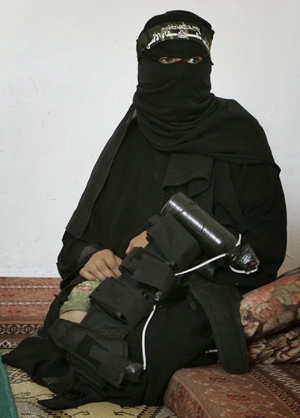

Last week, amid the chaos and confusion that followed the kidnapping of IDF soldier Gilad Shalit and Israel’s subsequent invasion of the Gaza Strip, Fatah’s armed wing, the Al Aqsa Martyrs’ Brigade, announced the creation of an all-female military branch. In a televised press conference held in Gaza, a heavily veiled woman calling herself Um al-Abed declared that 100 Palestinian women stand ready and willing to become suicide bombers on behalf of the nationalist party founded by the late Yasser Arafat. They intend to carry out strikes not only against Israeli targets, she said, but also against Hamas, Fatah’s longtime rival in the West Bank and Gaza Strip. On Tuesday, another group of mujahedat (women devoted to jihad) associated with the Popular Resistance Committees took to the streets of Gaza City, where they burned Israeli, U.S., British, and EU flags — some with missile launchers resting on their shrouded shoulders.
Though these fledgling female armies may surprise many in the West, a much bigger line was crossed in 2002, when Wafa’ Idris, a resident of al-Ama’ari Refugee Camp in the West Bank, became the first Palestinian female suicide bomber. Idris had been forced into an arranged marriage by her elder brother. Like most other Palestinian women, she was dependent almost entirely on male relatives for her economic well-being and survival and had no choice but to accede to her brother’s decision. In her heart, however, she remained defiant and never accepted the marriage or her new husband, a first cousin. When she became pregnant against her will, she secretly aborted the child. On top of her unhappy marriage, abortion, and subsequent divorce, Idris was further traumatized by her weekly exposure to blood and death in her work as a paramedic for the Red Crescent, where she volunteered every Friday, caring for large numbers of Palestinians wounded during the second intifada.
It has never been clear whether Wafa’ Idris intentionally blew herself up with the 22-pound bomb she was carrying or whether she was simply a courier, but she died in the blast, killing one Israeli and wounding a hundred more. Idris’ brother, for his part, said that her decision to become a suicide bomber was due to her work at the Red Crescent and that she was a hero.
Two years later, Hamas sent out its own female suicide bomber — a 22-year-old woman from a wealthy family in the Gaza Strip and the mother of two young children, one of whom, reportedly, was not yet weaned. Pretending to be crippled, Reem Riyashi arrived at an Israeli checkpoint and requested a personal security check so that she would not have to go through a metal detector. Minutes later, she blew herself up, killing four Israelis. Seven more Israelis and four Palestinians were also injured in the explosion, which was so powerful that it blew the roof off the building and scattered human remains to such a degree that the bomber’s body parts could not be distinguished from those of her victims.
Like Idris before her, Riyashi had a secret. She reportedly had had an affair initiated by a Hamas operative, and when she was offered the chance to redeem herself by carrying out a suicide bombing, she took it. Her husband, Palestinian security forces assert, drove her to the checkpoint. Hamas leader Ahmad Yasin had stipulated that a female suicide bomber must be chaperoned by a male.
Once a woman from each of the two major Palestinian factions had carried out a suicide bombing, it was inevitable that others would follow. Yet even as their numbers grow, what is most remarkable about these women is the way in which their stories are presented, particularly in the Western media. The usual motives cited for carrying out a suicide bombing — humiliation, despair, revenge, hate, fame, money, religion, nationalism, the occupation and combinations thereof — are deemed insufficient to explain female bombers. Male suicide bombers, of course, often have their own unofficial motivations, but they are rarely the focus of a report. In contrast, the innermost recesses of a woman’s psyche, her most shameful secrets — almost invariably sexual in nature — are displayed to a world eager for such an unveiling, eager to be shown that women do not truly relish the job of dying and killing.
– – – – – – – – – – – –
When I was a child, I had a Transparent Woman. Not the fancy free-standing type, with the removable pink organs and tiny fetus, but the 2-D type found interlaced between the printed pages of the Encyclopaedia Britannica. I never seemed to tire of turning the plastic leaves that, with each flick of the wrist, revealed more and more — skeletal system, vascular system, nervous system, and all the major organs — until at last there was hardly anything left to know. Everything had been laid bare.
A quarter of a century later, I met up with a different manifestation of the Transparent Woman as I was doing fieldwork for a book on suicide bombers in the West Bank and Gaza. One of the main figures in that book was a Hamas devotee who fantasized constantly about the hur, the perpetually virginal maidens of paradise who are said to be the martyr’s just reward. Hamza Abu-Surur, his family said, talked about these women all the time. He said that their skin was absolutely transparent, and when they drank water, you could see it flow down and through their bodies — an act of ingestion he found most beguiling.
Women also seem to find the idea of the hur irresistible. In February 2005, Manuela Dviri — an Israeli journalist, playwright and peace activist — interviewed Ayat Allah Kamil, an unsuccessful Hamas suicide bomber, in Hasharon Prison. When Dviri pointed out that male martyrs received 72 hur in paradise and asked what female martyrs received, Kamil replied, “A woman martyr will be the person in charge, the manager, the officer of the 72 virgins, the fairest of the fair.” When asked how she got the idea of becoming “head virgin,” the 20-year-old answered that God had sent her the idea of making an official request to become a suicide bomber and that she had been fortunate enough to get her request to the right person in Hamas, who happened to be female too. Her dream, she said, was for the world to become Islamic and, in addition, for there to be peace.
Americans often ask me questions that indicate that they take the hur as something of a literalist fantasy and, at the same time, find it utterly unbelievable. “How can anybody really believe that?” they ask. The idea of a female suicide bomber, in particular, strikes them as a contradiction in terms. Why would a woman do such a thing? Is it some sort of perverse feminism? Empowerment, perhaps?
The problem with such questions is that they are based on the assumption that a suicide bomber is an individual. In actuality, once someone decides to become a suicide bomber, she enters a martyr machine whose very function is to strip her of her identity — including, to some degree, her gender — and turn her into a rallying symbol for the living. She is treated as though dead, and she treats herself as though already dead. She’s a ghost.
– – – – – – – – – – – –
Suicide bombers, it should be clear, are not born but are rather made, meticulously and methodically; and in this respect, there is little difference between a male bomber and a female bomber. An entire apparatus is devoted to their creation, psychic maintenance and propagation; and this apparatus depends on a massive media system devoted to the glories of martyrdom. Images of martyrs are plastered everywhere as models to be emulated. Songs are sung in their honor. “Martyr cards” are created and distributed as something like souvenirs to visitors who come to pay their condolences to their families. Typically, these cards feature the suicide bomber’s image set amid guns or roses and appropriate verses from the Quran, the most popular of which attests to the fact that the martyr is actually not dead, but alive and dwelling forever with God in paradise.
Bombers are commonly photographed before they carry out their final act, and their last words are recorded. Before she set out on her mission, Reem Riyashi posed for photographs with her 3-year-old son in coordinated outfits and headbands. The mother held an assault rifle in her hand; the child held a rocket-propelled grenade. “I always wanted to be the first woman to carry out a martyrdom operation, where parts of my body could fly all over,” she said on videotape. “God has given me two children. I love them — a kind of love that only God knows — but my love to meet God is stronger still.” Martyr videotapes such as Riyashi’s are watched throughout the Bank and Strip, and serve as powerful calls for others to follow.
Palestinian suicide bombers are celebrated not only in Palestine but throughout the Arab world. After Wafa’ Idris blew herself up, Ghazi al-Qusaibi, the Saudi ambassador to London, made headlines in the West when he wrote a poem lauding her and her attack. Saddam Hussein called for a memorial to be built in her honor in a major square in Baghdad. An Egyptian newspaper presented her as an example for the Arab nation as a whole. “The bride of Paradise,” the editorialist opined, “preferred death to the pleasures of life so as to convey a powerful message to the Arab nation.”
The death of a martyr is commonly celebrated as a “wedding” — a metaphor that holds particular meaning for young Palestinians who are often forced to wait years before their families are able to afford a wedding and dowry for them. If the martyr is male, his bride is often said to be Palestine, with her mahr, or “bride price,” being blood rather than gold. If the martyr is female, she herself becomes the treasured bride, and the men of her village may gather together to marry her in symbolic fashion.
The issue of marriage has become ever more important as many countries refuse to fund the new Hamas government. Increasing poverty in the Bank and Strip has meant a significant decrease in the number of marriages; and this situation holds particularly dire consequences for women: A few years can make the difference between their finding a spouse or being exiled forever to the fringes of society, age and desirability being largely inseparable. Many of these women, Palestinians say, have grown tired of praying for husbands while their prospects dwindle with each passing year. The idea of a wedding in paradise may well appeal to the more desperate among them.
A wedding is, of course, largely a contractual obligation, but it is through marriage’s other meanings that suicide bombings are given an irresistible allure — a process that shouldn’t strike anyone as particularly odd, considering that the fastest way to sell anything, whether the latest version of an iPod or a brand of deodorant, is to sexualize it. The most remarkable manifestation of sexy terror I’ve ever seen is a video called “The Bride of the South,” which was made two years before the first Palestinian intifada. “The Bride” features 16-year-old Sana’a Mouhaidli, the first Lebanese female suicide bomber, as she heads off to blow up some Israel Defense Forces soldiers for Hafez al-Assad, the late president of Syria. In the video, the beautiful nationalist is shown over and over again driving off as if into the sunset to music both triumphalist and highly romantic. One would be forgiven for thinking that she might have been heading off for a romantic conquest, wearing Frederick’s of Hollywood underneath her clothes. The end of the world never looked as good as this — and Armageddon is, notably, part of the fantasy. Suicide bombings represent a form of oblivion that isn’t content with an ecstatic dissolution of the self — as in love or sex — but insists also on the symbolic blowup of the world.
Palestine is not Lebanon, however; and I doubt that anything like “The Bride of the South” can be found in all of the West Bank, not to mention the far more conservative and deeply religious Gaza Strip. Palestinian female suicide bombers, unlike some of their male counterparts, are not sex symbols but rather icons of purity, sacrifice and honor — and this holds true both for the Islamists and the nationalists, if to varying degrees. Whereas the Syrian Social Nationalist Mouhaidli adorned herself in a snazzy red Falangist beret and, later, in a white bridal gown and veil symbolizing her deathly post-bomb wedding, Um al-Abed appeared before the cameras in Gaza wearing a conservative Saudi-style hijab, or head covering, and a niqab, or face covering, with a small slot through which she looked out at the world. Despite her moment of fame, this new bride of Palestine was already faceless and invisible — as if foreshadowing her death — while the institution whose birth she announced promised to produce many more like her.
