
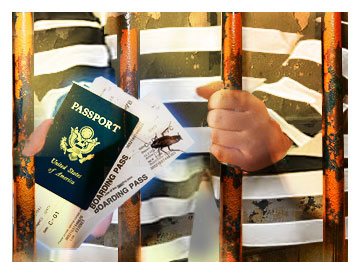

The following diary is excerpted from a journal I kept while incarcerated in December 2006 and January 2007 at Her Majesty’s Prison at Wormwood Scrubs, London. Until December, I had never before been in a prison of any kind, for any reason, let alone such a filthy, decrepit, Victorian heap of stone and sadism as the Scrubs. That I found myself there at all may be put down to a collision of intractable forces — first, my own loudmouth pigheadedness, which has landed me in trouble before; second, a humorless and probably exhausted flight attendant; and, third, the heightened tension now common to air travel, thanks to real and imagined threats to public safety resulting from the worldwide “war on terror.” What follows is my story alone, though I have no reason to suspect that under like circumstances, other hapless saps would not find themselves in similar straits. And so, I offer my reflections on the experience here more or less as a cautionary tale.
On Dec. 6 of last year, I boarded a British Airways flight from JFK in New York on what was meant to be a four-day research trip to London, to examine documents recently released by Scotland Yard relating to a book I’m writing. I left the states on the spur of the moment, after I noticed that I had only seven days left on my passport before it expired. That’s why I went when I did — to take advantage of the time remaining. I expected to be back home in Vermont within a week — not knowing, or having forgotten, about a law in Britain that demands that you have at least six months’ time on your passport in order to be admitted into the country. This law has been on the books for ages, apparently, but, to my knowledge, it was rarely enforced. No longer: Travel documents and other identification papers are now screened in Britain with all the watchfulness of the doomed.
My flight was delayed by a couple of hours; it was nearly midnight when we boarded. By that time, I’d had a couple of scotches and a full dinner at one of the airport’s generic bars, but I can state for sure that I was not “intoxicated.” I certainly wasn’t “plainly intoxicated,” as the airline staff later told the courts, because if I had been, they wouldn’t have let me on board. (I also feel safe in assuming that they wouldn’t have offered me free bottles of wine after we took off: The last time I’d flown from London to New York, “security” actually canvassed people in the bars at Heathrow, interrogating passengers to see if they were “fit to fly.”) Everything might have worked out fine if a) I hadn’t discovered that my laptop was missing after about an hour in the air; and b) I’d been given a seat that wasn’t tailor-made to form blood clots in my legs. I’ve been HIV-positive since the AIDS epidemic began — I’m what they call a long-term survivor — and I’ve got peripheral neuropathy in both my legs: It’s impossible for me to sit shoved up against a wall for six hours, unable to move or lean back while the person in front of me reclines.
I should have told the airline upfront about the HIV situation, my “no longer invariably fatal but still miserably complicated chronic manageable disease.” Indeed, when interrogated later by the police, I was asked why I hadn’t done this, and could only reply that I’m not accustomed to blaring the news around in public. It’s one thing to be “out” about your HIV status. It’s quite another to trumpet the news openly before 400 people who are already in a state of anxiety. So I didn’t explain that part of things when it might have helped. Neither did I bear in mind (since I was plenty anxious myself) that one of the medications I’m on — ritonavir, which has especially terrible side effects — is administered as part of the AIDS cocktail precisely because of its ability to inhibit a metabolic pathway and help the front-line antivirals circulate longer in the bloodstream.
Unfortunately, ritonavir has — or can have, depending on who you ask — the same effect with alcohol, so that “a couple of scotches” at the bar and a bottle of wine at 35,000 feet might easily send you to Cloud Cuckoo Land before you can say, “Fasten your seat belts.” I mention this not as an excuse, but as a possible explanation for the fact that I completely lost my mind on that plane. I hadn’t conceivably had enough alcohol to account for the reaction that ultimately led me to the clink.
My sins, in brief: When the cabin crew refused to radio JFK to see if I’d left my laptop at the gate and also declined to move me to another seat, “an altercation ensued” — not physical, but verbal, with the flight attendants becoming snootier by the minute and me becoming, well, let’s say, more American. I behaved badly in-flight, yelling at the crew, “I am an American citizen! You are our lapdog ally!” and other remarks of a vulgar and unhelpful nature. Very vulgar, I’m afraid: At one point I called that tired stewardess the worst thing you can call a woman — you all know what it is — but by then I was in full-blown air rage, something the airlines used to understand but, on the evidence, no longer do.
Finally, I went back to the galley and sat on what is called the “bustle,” which is where they keep those rubber slides should a plane go down in water and where, over many years of these flights, I’ve seen lots of people sitting and children playing without anyone making a fuss about it. But times have changed, and now parking your ass on the bustle constitutes “endangering an aircraft,” which is a very high crime under Britain’s new anti-terrorism laws, and can get you sent to prison for a minimum of two years. I was warned about this (so they tell me), but I still refused to move; and when we finally landed at Heathrow the next morning I was escorted off the plane by two of London’s finest — not the sort of “bobby” I remember from many years in London, but fully outfitted SWAT-team types, bristling with munitions and in no mood for smart alecks. They dragged me past customs straight to police headquarters at Uxbridge, an indescribably dreary, prefabricated suburb and corporate-operations center west of London, where “incidents” originating at Heathrow are all referred for jurisdiction.
It wasn’t until I got to the police station that I began to realize, slowly, the nature of the trouble I was in. A solicitor — in my case, the English version of a public defender — was rustled up from somewhere, and seemed to think that I’d probably get off with a slap on the wrist for “disturbing the peace” and be sent home. But I had no idea of the depth of modern Britain’s terror paranoia, and I was amazed to discover, after I was “cautioned” and formally “interviewed,” that the Uxbridge constabulary knew all kinds of things about me that I hadn’t told them. Evidently, the “suspicious” passport and the last-minute ticket purchase, not to mention the bustle business, had resulted in a call to Interpol or some other surveillance outfit. I’m guessing here (because the police aren’t obliged to tell you anything), but in the eyes of British law I apparently bore all the marks of a jihadi-in-waiting. Most surprising to me was the fact that the police had information about my family — specifically, that my father is a convert to Islam, married to a Moroccan woman; that I have two Moroccan half-sisters; that I have spent long periods in the Middle East. I was appalled to find out that such details are available “at the click of a mouse” to any squirt with a badge, and I must have indicated as much to the squirts in question, because their notes about my “attitude and behavior” boiled down to one word: “obnoxious.”
After a day and a night in isolation at Uxbridge, I was hauled the next morning, a Friday, to Magistrate’s Court, where I was formally charged with “endangerment” and … something else. I’m looking through legal papers to see what it was, but I can’t find any record of it. It had something to do with “bad behaviour,” a point I’d pass over if the British, under Tony Blair, hadn’t made “behaviour,” with or without damage to third parties, a crime in itself when it suits them. Did I know that “verbal abuse” was a criminal offense in Britain, the police had asked — I didn’t — and that the laws of Britain also apply on board a British aircraft?
At my first court appearance, bail was instantly denied, owing to the “gravity” of the charge, and that night I was bundled off to Wormwood Scrubs, to what they call the “First Night Centre.” This is, essentially, an induction wing, and fairly comfortable, all things considered — though I think it’s kept that way only to trick newcomers into thinking that the prison itself will be the same once they get there. A sad delusion: Wormwood Scrubs is a perfect shit-hole, as I would learn soon enough.
Please note that “bail” in the U.K. isn’t the same thing as it is here (nothing about British judicial procedure is the same as it is in the U.S.). In Britain, bail doesn’t necessarily involve money. It merely demands that you have “a fixed address” and that someone be willing to guarantee that you won’t “abscond” if you’re let loose on the streets. I’d been planning to stay with a friend in London during my ill-fated trip, but, helpful as he tried to be when he learned of my plight, he was scheduled to leave the country before the case could be resolved and was thus unable to provide the kind of assurance the court required. I know a lot of people in London, and I might have phoned any one of them, I suppose, except for two obstacles: First, their phone numbers were all recorded in my missing computer and, second, I wasn’t able to make a phone call at any time. While prisoners are assigned calling-card numbers for use on prison phones, mine never worked — and though I repeatedly requested to have it fixed, the matter was never resolved. In fact, until I was released in January, every bit of communication I had with the outside world was conducted through my lawyer and embassy. The whole matter might have been settled quickly had it not been Christmastime — what the British call “the festive season” — when everything in England shuts up tight like a drum and no court could deal with me until after the New Year.
So, that’s how I wound up in the most notorious prison in London, with some of the most dangerous criminals in the city, many of whom are black and Islamic. Be advised that I use the term “black” the way the English do, to designate anyone with dark skin — and I choose it to reflect the prevailing attitude in the U.K. right now toward “immigrants” in general and Muslims in particular. Believe me, the Brits are as nasty as we are, and just as hypocritical. At one point, even, a guard at the Scrubs advised me not to refer to “Britain” any longer. “We are English, Welsh, Scots, Irish and an awful lot of Muslims,” he said. “Please remember that.” Certainly one of the most horrifying moments of my incarceration came on the day of Saddam Hussein’s execution, when I heard one of the guards (female) talking to another about what she called “a double standard.” She wasn’t sayin’, mind, that she was “in fay-vuh of the death penalty,” but she’d “‘ad it up to ‘ere” with the Muslim prisoners, “‘oo’d ‘ave their bloody ‘ands cut off if they was in their own countries. But just listen to ’em squeal when we take away their tellies!”
To that I say: It was the Muslim prisoners in custody who taught me the most about British justice as it currently functions, and who treated me more kindly, on the whole, than their Anglo-Saxon counterparts. Britain has the highest rate of drug abuse in the EU and the highest rate of incarceration. At one point last month, there were only “four prison beds” remaining in the whole of the United Kingdom. The home secretary, John Reid, has proposed putting criminals onto ships, like they did in the good old days, when Britannia ruled the waves.
There’s a lot more to the diary I kept in prison than you’ll read in the excerpts below, and a lot that I didn’t write down at the time, not knowing from minute to minute when the guards might burst into the cell and confiscate anything they thought was “subversive.” The unutterable tedium of prison life is itself a brutality, and can scarcely be rendered in words. I assure you, you have no idea what boredom is until you find yourself in the slammer, with only mealtimes, twice a day, guaranteed to get you out of your cell for a few precious minutes.
Another thing you won’t read about here — with one notable exception — is the nature of sexual activity in prison, which is more or less constant, if also, always, nasty, brutish and short. Words are not wanted or required, although, obviously, sex among men is a perfectly natural occurrence in a place like the Scrubs. For me, however, as an “openly gay” man, it presented certain quandaries. The inviolable law is that everything is kept under wraps, and that anyone who presents himself as overtly homosexual will be beaten to a pulp. Thus do “straight” men preserve their manhood while never shunning an opportunity to get their rocks off. This required that I go underground, that I become closeted again for the first time in years, while quietly submitting to the whims of thugs — and if a certain “passivity” emerges in my writing here, I’d put it down to that. It’s difficult in prison to know the difference between “rape” and “coercion,” just as it’s difficult to know the truth from a lie. Everyone in prison lies all the time, whether they’re prisoners or guards. Worse, you begin lying yourself, seeking some advantage, avoiding some explanation. All you know is that you don’t want to get hurt, and you’ll do anything to avoid it. You become complicit in your own abuse. As Oscar Wilde remarked in “De Profundis,” commenting on his own imprisonment for “unnatural” acts: “I could be patient, for patience is a virtue. It is not patience, but apathy you want here, and apathy is a vice.”
Strangely, despite all this, a kind of solidarity ensues — to the point that, when the time came for my release from the Scrubs, I was afraid to leave. For what it’s worth, I think I understand the so-called Stockholm syndrome a bit better than I did, although it wasn’t my captors I began to identify with — rather, my fellow captives.
Writing this introduction several months later, I find myself eager to make jokes about the experience and pass it off as just another wayward adventure in a crazy writer’s life. But the truth is it wasn’t like that. It wasn’t funny, and it wasn’t needed, either. It was degrading, dehumanizing, debilitating, terrifying, wasteful and ultimately damaging to my physical and mental health. It’s true, I think, that keeping a diary — in fact, being a writer, whose “third eye” never closed during the weeks I spent at the Scrubs — allowed me to preserve some measure of my sanity. Even so, on my return to the United States, the people I employ to keep my head together diagnosed me with “acute stress disorder,” which differs from the “post-traumatic” kind only insofar as it’s immediate, not delayed. Even now, I keep wondering if it is better or worse to be imprisoned unjustly or unnecessarily, but I still have no answer.
– – – – – – – – – – – –
12/12/06: “B-Wing” — First “full” day here after landing, arrest, night at Uxbridge police station, Magistrate’s Court and three nights in the “First Night Centre.” Before today I did not have a proper notebook in which to write.
No HIV meds as yet — this is my greatest worry. I try not to think about the future. Try not to worry about home or anyone there, since I can do nothing. Trying not to look anyone in the eyes or at them in the “wrong” way (although you don’t know which way that would be). Shower tomorrow — first in a week. I stink.
Cigarettes — you have no idea of their value until you’re here. People are willing to trade anything for them (I suppose drugs would be worse). I gave away too many at first, to anyone who asked. I’ll have to quit, I guess — but how in this place?
Meantime, Pinochet has died & Thatcher regrets the loss of a dear friend. Somebody announces that a terrorist attack on London is “almost certain” around Christmas. William and Harry have announced plans for a 10th anniversary “bash” for Diana — bad choice of words, I’d say, but lots of pop stars are already lined up. Everyone denounces and despises Bush, including the police. The Baker report was apparently very firm in its conclusions, and very gloomy. I haven’t seen a newspaper in a week, just television.
My roommate, Mick, cannot sit still. He literally stands at the TV and constantly switches the channel, as if he had a remote, which he doesn’t. He drinks endless cups of tea, all day and all night — and shits a lot in the open toilet, which has only a sheet strung across it.
I am praying, literally — at first this was just a response to anxiety — to quiet my mind. I try to be calm, I work at it. I behave myself. I show no impatience or reaction of any kind — those are deadly directions to go in.
14/12/06: No further court hearings until January 5 (and then merely procedural), as the case is to be bumped up from Magistrate’s to Crown Court, which doesn’t sit again until after the New Year. Pure absurdity, as the Crown has already agreed that the “endangerment” charge will undoubtedly be dropped. So I’m to be held indefinitely for something they know I didn’t do. Mick is going to court tomorrow, so probably I’ll have a new “mate.”
All is OK with the meds. Doctor today — the first one I’ve seen (out of four) who was decent and competent and knew what to do. Apparently the police at Uxbridge, knowing my HIV status, have scrawled “CONTAGIOUS” on my chart … I am urgently warned by the guards to let no one know about this, although plainly I can’t be the only one here in that condition. If anyone asks about the pills, I’m to say they’re for “high blood pressure” or “cholesterol” or both. “Just make it up.”
Things to be glad about:
1) Imprisonment gets me out of Christmas and New Year’s (and for all I know Easter)
2) A temporary but huge relief from financial worries
3) Plenty of time to write
4) Plenty of time to think
5) Plenty of time to read
6) Plenty of time to sleep
7) Great material
8) Character building — are you a man or a mouse? Or, as Alan Bennett says (I’m reading Alan Bennett’s “Writing Home”), “You must learn to take it like a man. That is, like a woman, without complaint”
9) I am snapped out of ritual and routine — only what is here is real
10) There may be more, but I don’t know what they are
Finished Bennett. I’m going to read “The Da Vinci Code” finally.
15/12/06: I think if I ever publish this, I should call it “At Her Majesty’s Pleasure — And a Few Other People’s.” Let’s not be coy. Subtitle: “Yes, Every Prison Story You’ve Ever Heard Is True.”
Mick left this morning, hoping for release — and once they leave, you never see them again. I thought I’d have a day alone and was looking forward to it — but no, suddenly the keys turn: “Kurth! You have a legal visit!” I think it must be the solicitor, but it’s a woman from the embassy. I sign a release forbidding any information about my case or situation to be given to the press, but that our congressional delegation be informed. Also get passport renewal papers, which I can’t complete because there’s no way to get photos made in here. And I can’t get the expired passport number because they won’t give me the expired passport, which is down “at reception.” Then on return: I’m being moved “farther in,” to C-Wing.
17/12/06: I can’t think of the outside — what I know is going on just over these walls. The TV is mostly a help, as it’s Christmas season, so it’s all unreal to begin with. But if you think about people right here in Hammersmith who might be on their way to or from work, popping into a Starbuck’s for a cappuccino or something — well, don’t.
There is no comfortable or relaxing position in which to read — but I’m reading anyway, “The Da Vinci Code,” as pledged. And what the hell’s with that? How did it become such a giant success? It’s not that it’s “bad” — it’s just not good enough — pedestrian — everything is explained to you instead of revealed — not a moment’s tension in it, or any doubt about the outcome, even though I couldn’t have sworn before now that the Holy Grail was actually Mary Magdalene’s vagina.
19/12/06: So, a new roommate — surnamed Stanton. He’s in for “conspiring to rob” — part of a street gang, “snitched on” by one of the others. (“Well,” he says, “he’s a dead man, anyway, yeah?”) He’s 25 — pumped up, black and Islamic — he arrives carrying a whole shitload, bags and bags’ worth, of his things — food and clothes and electronics and whatnot. He’s clean, anyway — very — rubs everything down with toilet paper before he touches it. We both slept well, in the end — I think I’m getting the hang of this.
Stanton was already here once for more than a year, just two doors down in No. 12 — he can’t believe he’s back, but there’s a kind of cheerfulness to him, as there is to a lot of the inmates: “Nothing to be done about it. Might as well enjoy yourself, know what I mean?” “Know what I mean” is one word: “No-wha ‘ahmeen?”
Smoking — well, plainly I have no interest in not smoking. When I go out for my medical “treatments” in the mornings I find myself scrounging the floors for discarded cigarette butts. (There are no filters, and anyway it’s a good place to keep your eyes — on the ground — it also gives you something very real to concentrate on.) Every now and then someone sees me doing this and pops out to say, “Aw, mate — c’mon!” and pushes a wad of tobacco in my hand, usually without the papers to go with it. Or they’ll give me the papers without tobacco so I can squeeze out the remains of the fag-ends I’ve found and roll up some “fresh” ones. I suppose you can’t get more disgusting or pathetic than this (well, yes you can), but to me it’s like nothing. Health? I’ve risked more, with worse.
[Note: there are signs all over about the risks of hepatitis B, but only one — way inside the nurses’ station where no one can see it — warning about HIV infection: “A Condom Every Time!” or something like that. As if they’d give you a condom if you asked for one: “And what would you need that for?” Ostriches. There’s a clinic here that offers HIV counseling and testing, but nobody speaks of it and I’ve never seen anyone enter or leave it when I’ve been downstairs with the doctor. It is open only on Thursdays. Imagine what can happen between a Friday and a Thursday.]
Now, suddenly, a discussion with Stanton about Islam. I suspect he’s Islamic for the sake of protest, but he does have a prayer rug, with a mihrab, and he does pray, not five times a day but sometimes. (There are also signs posted on every floor, with arrows pointing toward Mecca. It’s interesting that Stanton says off the bat, “Democracy can’t work under Islam. Everything in Islam is structured for good — there is one God and no need for anything else, no need for an intermediary.” “How can God have a son?” he asks. “He might as well have an uncle or an aunt, yeah?”
I tell Stanton about my father, who is a convert to Islam, and his wife, Najat, who is Moroccan — and their daughters are Islamic from the cradle. Stanton is very impressed — I remind myself that this story might come in handy. He completely understands about the family structure when I say, “I assure you, in the home, my father’s wife rules the roost.” He says, yes, this is what everyone doesn’t get. This is why marriage is so important: “It is half of Islam.” In this regard, a man must marry, otherwise “all is temptation and fucks up your head.” We speak of the television. He says it’s all temptation — “all those birds wrigglin’ their bums — it’s all sin.” This sounds completely bogus coming from a career criminal and whoremaster, until you realize that Stanton does not regard himself as “a sinner,” as a Christian might, but as being led into sin. There is no original sin in Islam — there is only temptation. Says Stanton: “One day, you will stand before Allah, and He will ask you questions, and you had better have some good answers, yeah? Because He didn’t do it — you did.”
20/12/06: Dreary, dreary, dreary day — depressed — last (half) cigarette smoked already. Stanton says prison makes him “angry and violent.” Says, “I’m not really like that, yeah? But it fuckin’ makes me angry, yeah? Prison screws up your head. I feel like killing someone.” Terrific.
21/12/06: Stanton is having some remorse today over “two things” he’s done in his life, only one of which he specifies. When he left prison last time he went to live on “an estate” [that is, a “council estate,” what we would call “the projects”]. Everyone loved him there. Then he got “talked into” robbing his friends “of their drugs.” “Weren’t worth it, yeah? … as it was only a couple thousand pounds, yeah?” He feels badly about it, but doesn’t know what he can do. He asks me if he should pray for forgiveness. I stammer something back, like, “Well, I should think praying would do for now, until the way of making amends becomes clear.” He says, “Shit, man, you’re takin’ the piss on me. They’ll kill me first.”
Saw the doctor again — Stanton, too — he has some kind of STD, but can’t remember which — “It begins with an ‘m,'” he says. [What the hell would that be?]
Apparently I am known prisonwide as “the airline geezer.” There’s another title if you need one.
22/12/06: — Friday: No more Stanton. He “had court” today, and while he asked me to try to save his place in this room, it was no go: “We aren’t saving anything for anybody.” So now I’ve got Phil. He’s “of an age” (mine, probably a little older), whom they’ve put in here, as he explains, because they told him he and I are “both intelligent and first-time offenders and you ought to get along.” Phil is a white South African, from Johannesburg, in for drug smuggling — some huge amount of cocaine — which he brought in from Boston by way of Trinidad, having picked up the stuff in Venezuela (Caracas). He says he begged “them” (he means the cartel) not to send him through Trinidad, as it would be (and was) a flag for customs at Heathrow. But I suppose these drug lords always make sure that a certain number of their “mules” get caught, otherwise it would look suspicious. Anyhow, Phil is really up the creek — facing 10 years. He did it because he’s been unemployed for five years — he’s some kind of geologist or metallurgical engineer, used to work for De Beers, but can’t get work in South Africa anymore “because I’m white.” His wife has recently run off with some other man and he has kids to support — who now don’t know where he is or what’s happened to him. He seems OK, just resigned. “Stunned” is a better word.
I was called to “Education” class today around 1:30: It seems my application for a prison job was very well received and I’m to be put to work on all kinds of things — tutoring someone here on C-wing who can’t read, working on the prison magazine, helping in creative writing classes and “English as a second language.” One of the teachers asks me how long I’ll be “in,” and when I say I don’t know, she says, “Well, with your qualifications and my luck, you’ll be gone in three days.” Somehow, I doubt it. The sheaf of legal papers sent over by the solicitors this morning was frightening in terms of a) its size and b) the potentially lengthy sentence — two years — if they do decide to go with the “endangerment” charge. Let’s not think about that.
24/12/06: Christmas Eve. I have absolutely NO emotion about Christmas — in fact it’s better than usual. I haven’t enjoyed Christmas in years, and now I just want to get through it without a lot of “carols” and recycled sermons about “peace,” since it’s nothing but commercial now — nothing.
Curiously, they don’t allow you any visits for a few days before and after Christmas, when you’d think they would — but I suppose it would overwhelm everybody: the staff (half of whom are “on holiday” now), and both the prisoners and their families. It’ll be interesting to see how the mates react to this — whether depression and anger increase. Elizabeth, my niece, has sent a card saying, “Hey, Uncle Pete — hope this Christmas suits you better than most.” Later, a card from Mother — trying to seem calm, when I know she’s not.
Have touched based with “Jack,” the inmate I’m supposed to be tutoring now, and brought him the books he needs to have (little “Dick and Jane” things). Having been very growly and sulky with me before — he works in the kitchen, serving meals, also sweeps up and hauls trash — Jack was ultra-friendly and apparently grateful.
25/12/06: Christmas Day.
A Christmas gift from — ? I never got his name — a wild Iranian who is kept in a cell by himself. Wears one of those little hats, the Muslim version of a yarmulke. While I’m waiting for my meds, he peeps out of his cell window and sees me fishing butts off the floor. He bangs on the door — “No, no, wait!” he cries. Apparently he wants to give me some tobacco, no strings — but his door is locked. He wraps some of it up in TP and slides it under. I say loudly, “I’ll pay you back!” but he says no, it’s a gift. He asks what I’m here for (all of this is shouted) & can’t believe it when I tell him. Later, I see him outside at exercise. He’s chatting with the guard (“Chico”) and gives me another roll-up — “Happy Christmas!” It’s amazing. He says he’s in for two and a half years, owing to his previous association with “wrongdoers.” Later, still in the yard, I walk around warming up — he’s with some of his mates, chatting away in Farsi or whatever and kicking cans. Suddenly he says, “Hey, America! New York man! Next time, blow up the fucking plane. Don’t pull out your knife unless you’re willing to put it back with blood on it.” Then he calls me “Bush” and everyone bursts out laughing. Finally, as I grin and wave, he yells out, “I AM NOT THE TALIBAN!”
26/12/06: A dangerous and frightening experience in Jack’s cell — the inmate I’m supposed to be tutoring. I went in after treatments to see if Jack has made any progress with the reading. There is someone asleep in the upper bunk, whom I take to be Jack. But suddenly, a total stranger leaps from the top bunk — someone I’ve only seen before in the kitchen — I don’t know his name, but apparently he is Jack’s roommate, and he pushes me against the wall, slams the door, tells me I’m in there to rob them. I’m quite amazed at how stoutly I answer that I’m not, that I’m only there to see Jack. “You’re takin’ the piss out of me, faggot, I saw you! I caught you!” Suddenly Jack emerges from the bathroom and … how to put this? … they take turns. I am stunned, shoved against the wall, but what can I do? I didn’t knock. “Wing-wise,” these are powerful people, with extra privileges and “out” time because of their jobs, and I am warned that henceforth I “belong” to them. Boy-o from the top bunk smacks me across the face and heaves me out of the cell. You can’t afford to piss off people like this — at the least, they control the food, and might spit in your dinner on top of everything else. We were told at induction that “bullying will not be tolerated at Wormwood Scrubs” and that it must be reported to the screws, but the old hands all doubled over laughing on hearing this, saying, “Right, Miss! And get your fuckin’ ‘ead bashed in!”
Oh, this is a bad day — a bad day. Now I really am frightened — this place suddenly seems utterly hostile. At dinner, Jack’s “mate” made a point of glowering at me and drawing his finger across his throat. As he handed me my “breakfast pack,” I again told him that he had made a mistake — in fact, that he was “full of shit” — but this is dangerous. I spoke immediately to one of the guards, leaving out the “taking turns” part of it, but simply saying I was being threatened. She said she’d “have a word with him,” which will probably make things worse, of course.
27/12/06: Gerry Ford has evidently died at 93. They’re going to hang Saddam Hussein within 30 days.
28/12/06: My parents’ 60th wedding anniversary (would have been, anyway). Slept very well, oddly enough. Tried to shake hands with my enemy downstairs this morning at treatments (the roommate, that is, Boy-o — I’m not bothering with Jack, who can learn to read by himself, if you don’t mind). Boy-o was having none of it: “I saw you! I caught you!” I answered effectively, “Suit yourself.” I stared him hard in the eyes, remembering my mother’s advice about standing up to bullies: “They will always back down.” I think I managed to convey to this creep that, however much power he thinks he has on the wing, I’ve got more, or can get more — I can summon the fucking American embassy! — and that he had better back off. He skulked away, of course. I can’t appear to be cowed.
Something is frozen inside me.
30/12/06: The death (I should say the murder) of Saddam Hussein. Obviously they wanted something public and symbolic, and if that’s so, they’ve certainly got it.
Hard to describe the silence here today — it’s eerie. I doubt if you managed to interview any of the prison’s Muslim population individually — and provided they told you the truth — that you’d find many “Saddam supporters” among them. But that isn’t the point — it’s the way it was done, and when — on the eve of Eid-al-Adha, yet another in what seem to be innumerable “holiest days in Islam,” a feast of self-sacrifice, commitment and obedience to Allah.
There are fliers all over the wing today instructing Muslims how to make their preparations for Eid in such a way that it can actually be done. I quote:
THE SUNNAH OF EID:
1) Wake up early
2) Offer Salaatul Fajr
3) Prepare for personal cleanliness, take care of details of clothing, etc.
4) Take a Ghusl (bath) after Fajr (in prison, the day before)
5) Brush your teeth (using Miswak)
6) Dress up, putting on the best clothes available, whether new or cleaned old ones.
7) Use Itr — religious perfume
8) On Eid-al-Adha, eat breakfast after Salaah or after sacrifice if you are doing a sacrifice
9) Go to prayer ground early.
10) Offer Salaat-ul-Eid in congregation in an open place, except when weather is not permitting, like rain, snow, etc.
11) Use two separate routes to and from the prayer ground. (In prison, left and right side of corridors)
12) Recite Takbeer (softly in prison) on the way to Salaah and until the beginning of Salaat-ul-Eid.
13) On Eid-al-Adha, Takbeer starts from Fajr on the 9th Dhil Hijjah and lasts until the Asr on the 12th Dhil Hijjah.
14) Takbeer: Allahu Akbar, Allahu Akbar. La ilaha il lallahu Wallahu Akbar. Allahu Akbar Wa-lillah hill Hamd.
The question of a “prayer ground” for Muslim prisoners has not been resolved. They want their own place of worship (as they want their own showers), but in the meantime, when lined up and marched off to prayer, they are obliged to do it in the courtyard chapel — which also doubles as a church for both Roman Catholics and Anglicans. Questions about your religion are among the first you’re asked when you get to the “First Night Centre” — some kind of generic “chaplain” comes around (I suppose Church of England), with a weary air, but trying to be reassuring about “your opportunities for worship here.” You are asked to check a box on one of the inevitable “forms” designating your religious choice — C. of E., RC, Hindu, Sikh, Jewish [I have met only one Jewish prisoner], Jehovah’s Witness, Quaker and Muslim (which they put last, even though there are more Muslims here than anything else). There is naturally no box for Unitarian-Universalist, so I checked “N/A” and was off the hook entirely. Again, I think a lot of these people go to the services only because it gets them out of their cells. But I wonder: Might it help?
No, I think those days are gone — I don’t trust religious feeling in myself, having experienced it before as a kind of cult hysteria and knowing that it isn’t really about “feelings” at all. It’s about actions or it’s about nothing. When I stand before Allah, Stanton, and He asks me all those questions, He’s going to get the answers I’ve got, yeah? Whether “good” or not.
31/12/06: I wake feeling low, sad, sick of all this. I notice, however, that for some reason I’m not half so agitated, cranky, crabby, up-and-down or tired as I normally am at home. I don’t feel that I’m constantly dodging tasks and obligations and invitations and irritations, all of which, as I always say, are getting in the way of my work! This needs looking at. Thinking again that in a way I’ve obtained just what I many times have thought and said that I wanted — relief, release from my own life, a new place, new company, no past, no established ties — in this place I am anyone and no one. But the price is a total abdication.
1/1/07: 2007 — Well, well, well. It dawns bright and sunny, for a change. Lots of banging noise in the night, both inside and out, and the ones who regularly yell and scream were doing more of it.
“Legal visit” tomorrow night at 6 p.m. What is this about? The embassy? It’ll be something to do, anyway.
02/01/07: I awake agitated and anxious, worried about the multiplicity of tasks today. An interesting dilemma here is that everything happens at once (that is, when anything happens at all). You’re out for “treatments” and “education” and you need to talk to the landing staff and take a shower and it’s “kit change” and you want to get to the library for the 10 minutes they allow, etc. And if you miss something, well, you’ve missed it. Everything is designed to make you feel as small and harried as possible — and you can’t really argue, can you, because if it weren’t for your own mistakes, you wouldn’t be here at all. So you haven’t got a leg to stand on.
03/01/07: No one turned up at the “legal visit.” It was supposed to be the barristers, whom I’ve never met and still haven’t. And as fate would have it, the only other person called over with me to the “visits” place was Jack the Rapist, who asked how I was doing, at least, which I suppose is a good sign; of course we were with a guard. I sat for two and a half hours in that horrid, fluorescent-lit room, wearing the yellow nylon vest you have to put on if you’re expecting a visitor, for no reason. A couple of the screws (both women) came out and chatted a bit — they could tell it was “something of a disappointment” for me. But then they had to go home, so I just sat there … and sat there. Jack finally came out saying, “It doesn’t look good. The DNA results are back.” He’d mentioned earlier that he was in for drug dealing, and I gather now that “the DNA” has something to do with traces of his saliva, or snot, discovered on 20-pound notes — something that mysteriously will add a few years to his sentence (as if anyone should ever let him out — they shouldn’t).
05/01/07: Had court date. Just notes now — I am too tired. You need to understand what “going to court” is like. First, they rouse you around 6 a.m. Then they come back for you alphabetically and by landing — you may or may not have had time to brush your teeth. In any case, you must take all of your belongings with you — you don’t know if you’ll be returned to your own cell, or even if you’ll be returned to the same prison. So it’s always a goodbye. Naturally, you can’t sleep the night before. Phil was snoring, which gave me comfort — his life may be over, but he’s peaceful right now.
“KURTH! COURT!” You have to go through the whole process of “exit,” everything checked, searched, an anal probe to make sure there aren’t any drugs hiding there — frankly, I think the screws like this part of it, not for “sexual” reasons, necessarily, but because it humiliates you so completely. I really do not believe that anyone could be “one of the screws” without being a sadist.
I don’t even know what I pleaded to, finally. I didn’t think I was going there today to “plead.” But so it worked out — I pleaded to something in exchange for the dropping of the “endangerment” charge — very important: You don’t want to get mixed up with “endangerment” at such a critical moment in history! Was it “disruption” that I admitted? “Disturbing the peace?” “Vile language?” “Verbal abuse of a flight attendant?” “Drunk on an aircraft?” Probably it was that, although there is no evidence that I was drunk — no tests were taken, no “breathalyzers” hauled out.
Well, it’s over, it’s done, and the fine is 950 pounds — twice the cost of the airline ticket. “Well,” says the solicitor, when he comes downstairs afterward to meet me in the police cell, “that went well, didn’t it?”
“Oh, yeah,” I say, “terrific. Where do you think I’m going to get 950 pounds?”
“Oh” — he seems genuinely bewildered — “you don’t have to pay that, you know.”
“What?”
“No. You can serve it in time.”
“How much time?”
“Well, they can’t let a person out of prison on the weekends, so…” — he counts on his fingers — “I’d say, probably nine days?”
“Oh … well … nine days. What’s the difference? Can you get me back to the Scrubs?”
Of course it’s not as easy as that. The solicitor has many other derelicts to attend to, and I need to wait, and wait, and wait, and wait, and wait. Hours and hours and hours until there are finally enough people to warrant the departure of a bus. These buses are the most horrible things you have ever taken a ride in. Big white vans, like ice-cream trucks, only with tiny compartments, like telephone booths, where each prisoner, having been escorted thence in handcuffs, sits alone. It’s impossible to sit comfortably or even stably as these ghastly vehicles rock around London, tossing your body (and especially your head) into walls and windows. You think you’re going to die — you really do — and it’s made worse by the fact that most of the others are shouting and screaming, and demanding that the radio be turned up so they can hear Beyoncé. It takes an hour, minimum, for this van to go two miles.
I find myself thinking about Empress Alexandra of Russia, in 1918, being dragged from Tobolsk in a farmer’s cart to Ekaterinburg, where she met her death, and complaining in letters to her daughters that “the ride was rather bumpy.”
There were two really nice policemen at court. I told them what I’d done on the airplane and they said, “Not very clever of you.” Agreed. Then: “You know, you can bomb us, you can kill us, you can drag us into useless wars, you can rip us off — ”
I said: “Take the piss out of you, you mean.”
“Yeah. But you aren’t permitted to call us names. That is a crime!”
Great laughter. They said, “Shit, mate, get out of that stupid cell. Come on out and ‘ave a cuppa with us!” As I did — who wouldn’t? And we sat there for two or three hours waiting for that damned bus to get loaded up. They knew I was not a criminal, and not a “danger” to anyone but myself. Every now and then they had to clap the handcuffs on, if somebody “official” walked by, but it was far and away the nicest and most relaxing time I have had since I boarded that plane at JFK.
06/01/07: Interesting, I suppose, but not surprising, that as soon as a date of release is given, and a limit is set (a short limit, at that), the mind kicks up again in high gear — internal excitement and impatience. I will need to guard against this carefully over the next week. Tunes are running through my head again — this morning it’s the “Alleluja!” from Mozart’s “Exultate, Jubilate.” I think it’s going to be a tough week, with so much to do and no way to do it until I’m out.
The policeman at court yesterday confirmed to me what everyone knows — that “90 percent” of all the prisoners in the U.K. are banged up for something to do with drugs — using them, possessing them, dealing them, smuggling them and committing crimes in order to get them. Here, as at home, there is now a permanent class of people, not just “career criminals,” but “professional prisoners” (my phrase).
“Xiang,” a young Chinese man who wept on my shoulder in the shower one of my first mornings (which seems so long ago), finally tells me today that he’s here for trying to get out of the U.K., not for trying to stay there. He’s been in London for three years already, “studying English” (well, OK) — trouble was that he tried to leave the country on a forged passport. He is indignant and bewildered — facing six months, minimum — and says, “They’re always moaning and groaning about ‘illegal immigration,’ so the sensible thing would have been just to allow me to get home!”
Many things to solve: Money, ticket home, passport, pills…
OK — saw Xiang in the shower again today. He has the body of a god and the face of an angel, a sort of blurring mix of B.D. Wong and Joan Chen. I like to think that he took all of his clothes off because I had done it (most of them don’t, and Xiang didn’t the first time) — well, who showers in his underwear?
Answer: “the brothers,” the Muslims do. The physical modesty of Islamic males has been somewhat exaggerated, if you ask me, but there is a religious element to it, if they want — “cleanliness rituals” and so forth — and I realize, too, that probably a lot of them are just trying to get their shorts clean at the same time that they soap themselves (I do mine in the sink!). Stanton, who’s now across the hall, is of course his usual charming self. In the showers he’s singing “On the Street Where You Live.”
“I have often walked down this street before
But the pavement always stayed beneath my feet before…
08/01/07: After a while, as always with a “diary,” there’s nothing to say. I’m thinking about Nicholas II and all those Edwardian types who were trained to keep their journeaux intimes from earliest childhood, whether they had anything to report or not. So, Nicky: “Weather fine. Two degrees of frost. Shot 60 crow. Mama to tea,” etc. It was all about the discipline. My anxiety is much lessened, I slept well, woke only once or twice. Everyone on staff agrees that Friday will probably be the day — “Our prisons are very overcrowded.”
A young man named Nasar in my writing class entertains us — he is so talented you can barely believe it. Before we go in, he asks me, “They really put you up here for something like that?” — then launches into explanations about its sheer idiocy, “Imagine locking you up with a lot of criminals like me.” I say, “How criminal are you?” and he grins and says he’s here “for six to nine,” but doesn’t tell me why — later, that he’s in a “single” on “the Fours” for “everyone else’s protection.” He naturally starts to talk about “Islam” and what we call “jihad.” He says, “Look, when was the last time you saw a Nigerian suicide bomber? We’ll kill you, sure, but we’re not going to kill ourselves. How dumb do you think we are?” I have no answer for this. He gets quiet, then says, “Well, now you know what it’s like to be a black man.”
09/01/07: “Last day at Wormwood Scrubs.” Yesterday there was a dramatic escape from the prison — some “lifer” who faked an epileptic attack, and when the ambulance came to take him to the hospital, just 400 yards down the road, he’d arranged for several people on the outside, wearing masks and carrying A-47s, to overwhelm the guards and spring him free. Apparently this is his third escape [and they will catch him soon enough — it seems to be the natural instinct of escaped prisoners to go directly back to wherever they came from — usually a girlfriend — the first place the police would look]. Anyway, everyone here is thrilled by it (including me), and now we know why they clamped us all down last night. HUGE noise in Britain about “the failure of the prison system,” but nobody has an answer.
Everything is going very fast. All kinds of official people appeared with forms, telling me that I will be released on Wednesday — not Friday, not next Monday — I guess once they’re through with you, they want you out. It is a shock. “Wednesday?! But I’ve just begun to get prepared…” Pills and the money I had sent to the bank … where are they? No one can say. It’s not that I don’t want to leave, it’s just that I don’t know how.
Tonight at treatments, a young, heavenly beautiful man, with dark hair, beard and gorgeous eyes, stares me straight in the face and says, “American. You’re American. I can tell just by looking at your face.” I have never seen him before and have not said a word, so he can’t tell by my accent. I figure German would be the best language to answer in, so I try it — “Na, Mensch, Du bist verrückt!” — but he says, “Oh, please, you are American and I know it.” I say, “Well, yes, then — and you? What are you doing here waiting for pills? What kind are they?” There is a long pause. Then he says: “Your enemy. I am your enemy.” All German leaves my head, and I say very loudly, “Not my enemy! Not mine!” He says, “Your country’s enemy, then. I am from Iran.” I am still in high heat: “Well, fine, but I have nothing to do with that — nothing to do with it!” He knows this and laughs: “Ah, but your Mr. Bush…”
I am terribly upset: “I had nothing to do with that either! I was one of Bush’s earliest critics, I write about this,” and he says, “Oh, come on. I am just teasing you. I know it is not you. The people of Iran love the people of America. The people of America love the people of Iran.” I say, “I hope you’re right. I hope it’s true on both sides, and ours in particular.” Then I launch in again to the story of my father and his Islamic wife — “Islam is in my family.” It’s amazing the effect this has on the Muslims, I really ought to write about it seriously someday.
For now, I get my pills, he gets his, and we never see each other again.
