

If you’ve been to a wedding in the past few years (or have staged one yourself), you won’t be surprised to learn that weddings are a booming business. Last year, the average American ceremony cost $27,852; the average dress, $1,025. If such figures don’t shock you (and keep in mind, the numbers are far higher in pricey cities such as New York and San Francisco), maybe a few comparisons will: The median household income in the United States is $46,326 and a 5 percent down payment on a $500,000 condominium is $25,000.
Even more disturbing, perhaps, is how quickly and effortlessly the $161 billion wedding industry seems to have insinuated itself into every corner of the culture — and how impossible it has become to escape its trappings, from diamond rings (which, before the 1930s, were not a de facto wedding accouterment) to wedding planners, bridal registries and glossy magazines that perpetuate weddings as fairy-tale fantasies. In fact, the extravagant, over-the-top gala has become such a fixture of American life that most people don’t question it anymore. And why should they? If marriage is supposed to be a sacred undertaking that happens once in a lifetime, why shouldn’t you do it wearing Vera Wang?
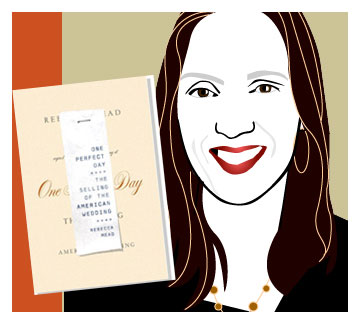
That’s the thorny dilemma reporter Rebecca Mead confronts in her new wedding industry exposé, “One Perfect Day: The Selling of the American Wedding.” Mead’s obsession with the marketing of weddings began three years ago, when she wrote a story for the New Yorker about discount bridal dress chain David’s Bridal. While researching “One Perfect Day,” Mead made her way from Walt Disney World’s Wedding Pavilion (where brides regularly spend $2,500 extra to rent the Cinderella Coach) to the ersatz wedding town of Hebron, Mich., and a crowded bridal dress factory in Xiamen, China. She also attended trade shows, hung out with newly minted bridal consultants and trailed a celebrity wedding planner, a “multifaith” minister and a wedding dress magnate — all to illustrate the ways in which the industry preys upon both a bride’s hopes and her insecurities by aggressively marketing products that promise to make her day “perfect.”
The result is a concise but searing skewering of the marriage marketplace and the “Bridezilla” culture that has sprung up around it, written in the spirit of the great muck-raking journalists. And in the midst of reporting her book, Mead showed her personal rejection of elaborate nuptial extravaganzas by quietly having her own wedding at a New York City courthouse. She and her betrothed dressed in everyday office attire and, a few days later, celebrated with friends and family at their Brooklyn home.
Salon sat down with Mead recently to discuss Cinderella brides, the changing meaning of the honeymoon and whether a feminist wedding planner is an oxymoron.
At the beginning of “One Perfect Day” you point out that marriage used to signal that you were becoming an adult or herald the start of your sex life as well as your departure from the family home. Now that we do all of these things before marriage, do you think it’s the extravagant ceremony itself that has become the rite of passage?
Precisely. It’s amazing the number of people who say, “If we can get through this, we can get through anything,” or “This is the first challenge of our married life together.” And you think, “Jeez, you have no idea what you’ve got coming!” It’s not like it’s a death in the family or anything like that.
This is sort of a psychoanalytic argument, but I think that people need for a wedding to feel traumatic. Because it used to be a traumatic transition. You left your parental home. If you look at documents — diaries or letters from women in 19th century rural America getting married — leaving their mother was a very, very big deal. Wrenching away from your birth family was a very big deal. Now, most of us have done that years earlier. And to some degree, even those people who are living at home are still leading more independent lives.
But I think that people still need to feel that this transition is a viscerally affecting experience. Because being married is very different from not being married. I don’t mean that if you get married tomorrow, suddenly your life is going to be different the next day. But it is a different commitment, as anybody who is going through a divorce will tell you. It’s much harder to break up a marriage than it is to break up a nonmarital partnership. So I think people need the sense of “Wow! Something really big has just happened.”
The purpose of honeymoons has evolved in a similar way, hasn’t it? You point out that they used to be a chance to visit the bride’s relatives and friends, and then they were all about sexual intimacy …
Yeah, and now, if you talk to any couples or look on the Knot.com, you see that people perceive the honeymoon as a time when they can recover from the stress of planning the wedding!
It’s brilliant from a business perspective — it’s as if the wedding industry and the honeymoon industry are in sync — the wedding industry is like, “OK, we’re going to wear them out and then send them to you.”
Right, and you’ll make a fortune off giving them spa treatments!
How did you become interested in writing about the wedding industry?
It wasn’t my own wedding — I got married long after I started the book. It just seemed like a subject that had not been done. I began the book with an article for the New Yorker about David’s Bridal. I loved the story because it was about the way in which small mom and pop stores were being taken over, threatened, by a Goliath; only in this case, Goliath won. And those are always great stories.
Early in the book, you talk about an epiphany you had while attending a Business of Brides conference: that the emergence of extravagant weddings is not a repudiation of feminist principles but, in fact, a direct consequence of them. Can you explain what you mean by that?
It’s interesting. It looks like a contradiction — women in their 30s and younger getting dressed up like princesses to get married. But in a way, it’s not, because it all has to do with the professionalization of weddings. Forty years ago your mother would’ve been planning your wedding, or your aunt would’ve been making you a cake, and your uncle would’ve been taking the photographs. There were big weddings then, but nowhere close to what it is now.
Weddings were traditionally part of the work of women within the household. I don’t know if you’re familiar with the work of Arlie Hochschild, who wrote “The Second Shift.” But you know, women used to make their own dresses, cook, take care of the kids, and now we outsource all of this: childcare, cooking, even getting your eyebrows done or getting your legs waxed. Nobody does their own if they can afford not to — or even if they can’t!
So are you saying that hiring a wedding planner could be construed as a feminist act?
It could certainly be construed as a post-feminist act, though people so shy away from the term now. But certainly, we live in a world that is permeated by and saturated with the achievements of feminism, so we’re all feminists whether we admit it or not.
It’s astounding to see how many wedding “traditions” — everything from the diamond ring to the honeymoon — were invented or co-opted by the wedding industry and neatly repackaged as established conventions.
Oh, definitely. In the book, I mention that in 1939, one survey showed that 16 percent of brides were married in clothes they already owned, a third married without an engagement ring, and roughly a third didn’t go on a honeymoon. Yet, those are all things that we think of as absolutely essential, right? And this was in 1939 — not that long ago. Now the Association of Bridal Consultants says that 43 professionals are needed for the servicing of the average American wedding, and I think that’s not including the bridal consultants themselves. So the idea that the weddings that we have today are traditional is a falsehood. You only have to ask any bride’s grandmother, at a wedding, whether this is in keeping with tradition.
The invention of the engagement ring is a well-known and much-researched story — I didn’t go into great depth because people have written whole books about it. The idea of a diamond wedding ring being a token of enduring love was something that was entirely invented in the 1940s by this woman, Frances Gerety — a very clever copywriter. She came up with “A Diamond Is Forever,” which was called the best advertising slogan of the 20th century.
But some of the inventions that are supposedly traditional are so outrageous. Another very nice so-called tradition is the throwing of the garter. The first company to make bridal garters was in the 1940s, but [brides] weren’t throwing them, and the groom wasn’t removing them with his teeth in those days. But now you’ve got the double garter pack, because you have to have one to throw and one that’s a souvenir. People do that with the flowers, too — you have one bouquet to throw and one to keep.
What do you think will be the next “tradition”?
I was at the Great Bridal Expo the other day — because I just can’t give it up! — which is one of those bridal fairs that go around the country and set up in Marriott ballrooms so brides can go and look at dresses, florists and so on. And there was at least one and maybe more than one tooth-whitening stand. When I was going to these fairs three years ago, I don’t remember tooth whitening. I do remember laser hair removal — but tooth whitening, that’s new.
So you think professional tooth whitening is something that the industry is hoping will become part of the wedding preparations?
Yes, it’s becoming just one of the things that you do, like starting to have facials the minute you’re engaged. The stand was offering a discount if you did it for a party of three. The bride, the groom and the mother of the bride could all get their teeth done — in the same shade, no doubt!
But in terms of actual traditions, I think the garlanded pets seem to be taking off in a very big way. I don’t mean I’ve seen them at lots of weddings, but I can see that they’re being pushed. Garlands or wings — you see a lot of wings for the dogs, too.
You must have become a frequent reader of bridal magazines while working on the book. Which became your favorite?
None of them! They speak not at all to me.
But the most fun to read — if you’re not getting married! — is In Style Weddings. The fascination with celebrity weddings is so huge. And there is something novel and very brilliant, in terms of magazine publishing, about the idea that you could get consensual coverage of weddings and product placement. I have sacks of magazines — anyone who wants to know what sort of dress they should’ve been wearing four years ago should come to my house and take them away!
The magazine I most enjoyed reading was Vows, which is the trade magazine of the wedding dress industry. It’s the other side of the looking glass. There are articles about how to sell wedding dresses — and tiaras, and veils, and all the rest of it. One of my favorite pieces described how to market to the “nontraditional bride” and warned readers that this kind of woman is dangerously apt to “forget the wedding and prepare for marriage.” These articles were often unintentionally hilarious, but also very chilling. People who work in the wedding business often appear to be very warm and sentimental, but they’re salespeople, and the successful ones are completely coldblooded about it.
What do you make of the phenomenon of “Disney brides,” i.e., women who plan Cinderella-themed weddings at Walt Disney World and rent horse-drawn carriages for $2,500?
It’s the infantilization that one sees at Disney that’s interesting to me — the way in which grown women are sold the same princess fantasy that Disney so profitably peddles to little girls, as if one never grows out of wanting to dress up in tulle and wave a magic wand. The whole place treats adults as overgrown children. When you’re in the Magic Kingdom, there are 100 places to buy ice cream, but you can’t get a drink anywhere. And when I was there, that was really what I wanted! There’s this very childish fantasy about what life is like, what married life is like and what the world is like.
The thing about Disney — you can’t believe while you’re there that the people are doing this with straight faces. I don’t mean the consumers, I mean the vendors. They won’t let Mickey Mouse host the weddings because it’s not “traditional,” because it would compromise the dignity of the ceremony. But the company’s idea of tradition, curiously enough, permits couples to hire someone dressed up as Major Domo [Prince Charming’s footman in the Disney version of “Cinderella”] to serve as their ring bearer. Of course the difference has less to do with tradition than it does with marketing: Disney has decided to invest a great deal in marketing Cinderella-themed weddings: They’ll sell you everything from a cake topper in the shape of her castle to a ride in her coach. They’ve even started selling wedding gowns inspired by Cinderella.
The cast of characters that you found for this book — from entrepreneur Beverly Clark and celebrity wedding planner Colin Cowie to multifaith minister Joyce Gioia — are at once both sympathetic and scheming. Did that surprise you?
These people think of themselves as providing a service that is needed — and to some extent, they are. But they’re also creating that need and generating the desire, and they’re certainly aware of it; the best ones are very clever marketers. That doesn’t mean they can’t be pleasant enough to talk to.
This wasn’t a book about finding scoundrels, although there is one or two lurking in there! It’s not a surprise to anybody that weddings can be ridiculous and that people spend too much money and get too carried away. And I wasn’t trying to expose some kind of deep, dark conspiracy. What I was interested in was how the wedding industry feeds into the hopes and wishes and dreams of the women, especially — and what that says about how our culture works in a larger way.
You make the argument that spending lots of money on her wedding offers the bride some sort of insurance against divorce. That seems so irrational — do you really think it’s true?
It is irrational. But I do think it is a phenomenon — not that it provides the insurance, of course, just that there is a belief among couples, and it’s probably not even conscious and perhaps not fully stated, that if we’re going to do this and we really mean it, we’re going to show how much we mean it by going all-out, and having our garlanded pet come down the aisle and all the rest of it. This is the generation who has seen so much divorce in their own families, or friends’ families, and there’s really a desire to not do it like their parents have.
But on the other hand, one always hears these stories of people who, once the wedding is over, the marriage is over too. I mean there are people who need to get married in order to get divorced.
Let’s talk about class. You tell one story — about a Brooklyn wedding planner who re-created Melissa Rivers’ wedding for a friend on a budget of $200 — that I found really quite touching. Isn’t there something positive about places like David’s Bridal making luxury affordable to the masses?
Sure. But it’s also just so … pathetic, and I mean that not in a pejorative way but in the true sense of the word. Two hundred dollars doesn’t sound like a lot of money, but it was all that that particular bride had. At the end of the evening, she had to tear open these gift envelopes of cash so she could pay the DJ. But of course people who don’t have a lot of money want to celebrate. And if having a spectacular, warm, huge celebration means a lot to the likes of Melissa Rivers, it means just as much to that young Brooklyn woman. There’s no reason why she shouldn’t want it.
It’s easy to say, “Why the hell not spend this money” and “Let’s go all-out.” But what’s bad is if the whole culture of extravagant weddings encourages women to think that they have to do it — even though they’re not going to be able to pay the rent the next month, or even pay the DJ.
But that suggests that the bride is completely unwitting. Don’t you think she has some agency — can’t she choose to reject the notion that she needs to buy a $1,025 gown or hire a videographer?
Well, she can say no. But two things happen if she says no. One thing is that she has to figure out what she wants instead. Which can be, as I found for myself, extremely difficult.
And then the other thing she can do is say, “Well, you know, we’re just going to elope.” But then there’s the whole elopement industry. You can’t escape! The so-called destination wedding business has grown out of people’s desire to escape the big hometown wedding.
Or you can buy the elopement package from the vineyard in Sonoma County, Calif., that also includes the balloon ride. Then, there’s the recent development of green weddings and carbon-neutral weddings. It’s very small, but you’ll get people talking about how they want to have a carbon-neutral wedding, so they’ll be making donations to this or that company that will offset their emissions. I heard of one wedding where the favor they gave the guests was a packet of wildflowers to be planted. You know, you could just not have a wedding! That would be the most environmentally conscious thing of all. But the new “green wedding” industry is not going to suggest you do that.
Has a “Bridezilla” wedding culture sprung up in other countries, too?
I’m from England and I haven’t lived there for a long time, but I hear that some of the things that we’re talking about here are beginning to happen in Britain. It used to be that you could get married only in a church or in a registry office, but now the wedding marketplace has been deregulated. So people are having these extravagant country house weddings, as if they’re the landed gentry. And weddings in Britain, like everything in Britain, are more expensive.
In China the wealthier, more sophisticated Chinese brides — instead of, or in addition to, having a traditional Chinese wedding — will have a Western-style ceremony, even though they’re not churchgoers. Because they’ve seen it in the movies! Weddings are part of popular culture and America is the generator of that. The spread is inevitable. That’s one of the things the book is about. American consumerism is a dominant force.
What was the most outlandish product — which brides actually buy — that you encountered while doing your research?
Probably this medallion called the “heirloom ornament.” It’s a pewter disk that’s got a picture of a flower and you give it to the flower girl. The one you give to the ring bearer has got a picture of a cushion on it. The suggestion is that they will keep it forever and they will pass it on to their ring bearer or their flower girl. They’ll use it first as a Christmas ornament and then they’ll pass it on.
But the idea that you can buy an heirloom — that is just priceless. You know, “I’ll go into the bridal store and buy myself half a dozen heirlooms.”
Do you have any tips for brides who would like to have less commercial weddings?
I’m trying not to be prescriptive. I don’t have any answers. If I did, it would be a different book, and I’d be a different person. But you know, if there’s anything I would hope that people who are getting married would take away, it is that they should think twice before feeling that they are culturally obliged to participate in practices and rituals that have no meaning for themselves — and really only mean a paycheck for the people who are selling them stuff. I think a lot of people would be a lot less stressed and happier if they felt they were off the hook.
