

As a first-grader, I remember walking into a supermarket one night with my mother, and seeing my teacher manning the checkout line. I froze, red-faced with embarrassment. My embarrassment didn’t stem from an understanding that Mrs. Briggs was working a second job at the supermarket because Palmer Elementary wasn’t paying her enough to live on. I was way too young to get that. My horror was at the fact that she was my teacher, the official lady who had an official job teaching me how to read and recognize numbers and here she was in the supermarket where real life took place. She was dressed in different clothes and wearing an apron. She was a person! It was embarrassing! People have public lives and private lives. And when the twain meet, it makes you turn red.
That’s probably why, a few years ago, when I read Katha Pollitt’s New Yorker essays about learning to drive and web-stalking her ex-boyfriend in the wake of a brutal breakup, I was so taken aback: humiliated for her, embarrassed to have bumped into her this way, in different clothes and an apron! Pollitt and I are now professional acquaintances, but at the time, I had not met her. I knew her only as a columnist, having long loved her work as a political and feminist critic for the Nation. But I viscerally recoiled at these tales of her abandoning her pride, wallowing miserably and defensively as she compared herself to her ex’s new girlfriend, admitting to her lack of self-sufficiency and confidence. The newspaper where I worked at the time ran pieces mocking both of her stories. I didn’t write them, but I laughed at them.
Of course, I also read the essays with the engagement of a Talmudic scholar — identifying with her in some places, happily and self-congratulatingly distancing myself from her shame in others, and appreciating her perhaps way-too-honest lyricism.
Now those two essays, in which she confessed to debasements like looking the other way after finding another woman’s panties in the laundry, to not giving her boyfriend oral sex in the mornings, to the fact that he intellectually belittled her and that she — the great feminist! — stayed with him for seven years anyway, until he finally left her for someone else, are the centerpieces (and one of them the title) of “Learning to Drive,” a new collection of Pollitt’s writing.
Picking up these pieces again in book form, accompanied by other essays about Pollitt’s daughter, the Marxist reading group she joined in part to impress her scoundrel boyfriend, and friendships with the women with whom her ex cheated on her, I have a much more intricate reaction than when I first read them. Instead of simply rearing back from them, I wonder: Is there ever a point at which it is a good idea for women, especially intellectual, politically engaged women, to strip off their clothes and caper naked as jaybirds in front of a line of would-be assassins?
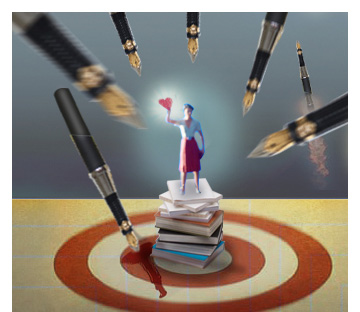
Pollitt is used to her share of ad feminem hit jobs. The publication of a collection of her feminist essays last summer prompted Ana Marie Cox to snigger brattily in the New York Times Book Review about Pollitt’s “preserved-in-amber” version of feminism. “Learning to Drive” has already earned Pollitt two scalding reviews of a different sort, one from the New York Times and one from the Los Angeles Times, and both written by women appalled at the sight of a political thinker they both respect in her public life unmasked as, yuck, a woman, in the privacy of her own confessional essays.
The L.A Times’ Susan Salter Reynolds is unapologetic about the terms of her disgust, admitting that “watching a feminist I’ve admired my entire life dissolve into a whingeing puddle in her late 50s is painful,” and calling the book “self-indulgent.” The New York Times’ Toni Bentley is slinkier in her evaluation of Pollitt’s “brilliant commentary on welfare, abortion, surrogate motherhood, Iraq, gay marriage and health care” next to this collection in which she “gets personal, and shameless.” Bentley, a former ballerina, knows from personal and shameless; her graphic 2004 memoir “The Surrender” explored her devotion to anal sex. In her review, she names other female writers like Laura Kipnis, Daphne Merkin and Maureen Dowd, who have excavated their personal lives (not to say their intestinal tracts) for material, cracking nonsensically that they represent a new breed of “enraged, educated woman (vagina dentata intellectualis),” and wonders whether Pollitt is “giving up her dignity in a generous motion of solidarity toward the rest of us who have already blown our cover?”
First of all, of course “Learning to Drive” is self-indulgent. Memoir is self-indulgent. This hasn’t stopped generations of great, serious writers from mining their private existences for wisdom, beauty or humor. As it happens, a number of Pollitt’s essays are wise and very funny, and if not altogether pretty in content, then at least fine-boned in style. And in addition to being blood-and-guts revelations about her private devastations, they offer a view of the ways in which her political ideologies — the things we respect her for — have been woven throughout her romantic, social and familial life.
In the book’s title essay, Pollitt describes her ineptitude behind the wheel of a car, and the infinite patience of her Filipino driving instructor, who calls her “Kahta” and tells her that observation — of the distance between car and curb, for example — is her weakness. “Observation is my weakness,” she writes. “I did not realize that my mother was a secret drinker. I did not realize that the man I lived with, my soul mate, made for me in Marxist heaven, was a dedicated philanderer … I noticed that our apartment was becoming a grunge palace … I observed — very good, Kahta! — that … I had gained twenty five pounds in our seven years together and could not fit into many of my clothes. I realized it was not likely that the unfamiliar pink-and-black-striped bikini panties in the clean-clothes basket were the result, as he claimed, of a simple laundry room mix-up. But all this awareness was like the impending danger in one of those slow-motion dreams of paralysis, information that could not be processed. It was like seeing the man with the suitcase step off the curb and driving forward anyway.”
Describing the obstetricians who delivered her daughter, Pollitt writes, “[they] were beautiful, slender, delicate dark-eyed women — they looked like they had been antelopes in a previous life. They wore high heels and little black dresses under their white coats … you felt they should be drinking martinis at the Beekman instead of sticking their hands up your vagina.” More painfully, she ponders whether, if she had changed as her ex wanted her to — gotten her license and read Anton Pannekoek’s “Workers’ Councils” — they would still be together. “It’s a lucky thing I didn’t get my license,” she writes. “I would still be living with a womanizer, a liar, a cheat, a manipulator, a maniac, a psychopath. Maybe my incompetence protected me.” Not the kind of thing you necessarily want to hear coming from a writer whose column this week is about the priority of low-income healthcare on the progressive agenda. But the contrast between the two offers a lesson: Big thoughts do not stave off small feelings.
Bentley gets close to the root of the antipathy toward the book: that maybe women who have serious careers writing about serious subjects shouldn’t let their opponents see their soft underbellies, since once they do, their “covers” are blown and they’ll never be taken seriously again.
Questions about the wisdom of personal disclosure get thornier if the writer is a vocal feminist. If a woman is critical of patriarchal practices, a stance that will inevitably lead to being called a man-hater, is there any gain or loss in disclosing that she is happily married to a man? Or that she is a lesbian? Or that she has recently experienced a breakup? What if she thinks that a personal betrayal, or a love affair, or a sexual experience, has shifted her ideology? What if she wants to make some extra money writing freelance essays?
I can testify that in a post-Bridget Jones, post-Candace Bushnell universe, the market for sex-and-love confessional remains hot. If you are a female writer, you’re likely to get asked to do that kind of stuff — along with pieces about motherhood and beauty and plastic surgery and weight loss. These days, those invitations come my way because I’ve done personal writing for Salon. But years ago, when my sole beat was reported stories on the New York film industry, I was puzzled to find that prospects for freelance work relied mostly on my willingness to pen dating diaries or vibrator reviews.
That’s not to say that I was pressured to write on these topics any more than Pollitt was forced to write about her breakup in the New Yorker. It’s also not to say that personal writing precludes more traditionally serious work: Maureen Dowd’s ruminations on her dating life have not kept her off the Op-Ed page, and writing about her wedding menu has not prevented New York Times reporter Jodi Kantor from getting on the presidential campaign trail. The hanging out of Pollitt’s dirty laundry has not slowed the stream of acid political commentary emerging from her Nation column.
But it’s also true that by choosing to write personal pieces that lay bare some aspect of our femininity, journalists probably, at least incrementally, decrease their chances of being sent to, say, Iraq.
So why would someone like Pollitt — so far out of the trenches of confessional journalism — dive in headfirst? Well, perhaps she feels she has a lot to say about the way human beings trust and love and how the smartest among us willingly go deaf and dumb, how the most confident of us go soft, how the savviest get blindsided.
I don’t know if it was a bad idea for her to commit these experiences to paper, but I do know that it makes other smart, confident, savvy women very uncomfortable. It might be easier to kvetch, as Reynolds does, about how Pollitt’s personal admissions hurt the movement she’s spent her life strengthening, making leftist politics look “like a series of silly cocktail parties” and her convictions look “like efforts to impress men.”
Um. Yeah? That the American left has in many instances been principally guided by conversations held at swank cocktail parties should come as a shock to no one. And anyone who thinks it off-base to suggest that the development of political interests can be influenced by connections to the people we love is not being honest themselves. It’s perhaps not attractive for a woman to admit that her politics have been partly shaped by her romances; such an admission reinforces the classical assumption that women have no head for politics and merely absorb the beliefs of their husbands. But how different is it from confessing, as many people do, that their first glimpses of political awareness were passed on by their parents? And if it were a man telling the story — imagine Eric Alterman jocularly revealing that he went to his first Labor Party meeting because a pretty girl was walking through the door and he followed her, only to discover that what was happening inside inflamed more than his nether regions — it would not be so scandalous.
The reaction to Pollitt’s book also stinks of another kind of double-talking hypocrisy — ageism and looksism. The book leaves Pollitt seeming slightly pathetic. But imagine the same book by a lithe twentysomething who writes about getting ditched by some prig, ponders her investment in Marxism, learns to drive as a measure of her independence, discusses how feminism informed and enabled her life as a mother, and ends up remarried, pondering the history of the Communist Party through the stories of her parents. If such a book were as beautifully written as Pollitt’s, I bet it would be received with wild enthusiasm.
That, of course, is because critics don’t expect young, beautiful women to give a damn about Marxism or communism or feminism. They expect them to write about breakups, hopefully in complete sentences. If one of them were to use her personal life as a lens through which to examine sociopolitical movements, I hazard a guess that critics would deem it quite extraordinary.
But the expectation for Pollitt, who is not twentysomething and not lithe, is that she care about Marxism and communism and feminism and not about breakups. It’s surely not a coincidence that the review of her book in the New York Times runs next to a larger than normal photograph of her looking more than a little austere. Ew! Old lady writing about sex!
We frankly don’t want to picture the emotional or romantic or sexual lives of non-dewy, non-leonine women. Even Pollitt herself finds it slightly distasteful, writing in the book that “People who despair after a certain age are just depressing. We don’t have the looks for it, and besides, we make others uncomfortable: what if we’re on to something?”
Perhaps the discomfort it causes is all the more reason “Sex and the Seasoned Woman” author Gail Sheehy and Toni Bentley reflexively crow about the pleasures of aging sexily. It’s never been better! Try it up the butt!
Pollitt also faces something of a gender double standard. Where her bold confessional purportedly leaves her looking foolish, few people got bunched up over the excruciating memoir “American Sucker” by New Yorker film critic David Denby, about losing tons of money and all perspective in the wake of his wife’s leaving their 18-year marriage. A couple of critics griped that he revealed too much personal stuff, but mostly, his self-exposure was welcomed. Publisher’s Weekly printed a review of the book that asserted, “the work is more appealing when Denby focuses on himself … Denby brutally details his decline, from a night of impotence to an affair with a married woman, then a six-month obsession with Internet porn — harrowing stuff for a New Yorker staff writer … More of Denby, and less of the Nasdaq, would have made this good book even better.” Nor did Michael Lewis’ column about being an inconsistent dad on Slate damage the world’s view of him as a journalist who chronicles sports and business. And what about Seth Mnookin, who has written books about the New York Times and the Boston Red Sox, and who wrote extensively (for Salon, in fact) about the depths of his heroin addiction while he was a student at Harvard?
None of these revelations of personal weakness seem to undercut the esteem in which these male critics are held. Nor has there been expressed an air of disappointment that they failed to live up to some bloodless, bileless ideal of who they are. Because stoicism is expected of men, their personal revelations — the more embarrassing the better — register as brave and honest. When women do it, they are merely confirming the worst suspicions about their gender. How, then, is a woman to write honestly of her experiences that do conform to gender expectations? If she is to maintain respect in public realms, must her public evocation of her private life be a lifelong performance? A series of lies, or at least omissions, constructed to leave an impression of unyielding strength and impenetrability?
I understand the impulse to censure a writer like Pollitt for fueling her critics, for revealing so much of herself that she imperils her well-earned reputation. What if the next time I read her on single-issue voting or the death penalty or the Supreme Court, I’m actually thinking about how she never liked to give her ex blow jobs in the morning? What if, even worse, the next time I read her on equality in the workplace, I wonder if she’s so angry about gender injustice because she always resented the fact that her boyfriend asked her for blow jobs in the morning? When people read Daphne Merkin in the New York Times Magazine, do they flicker back momentarily to an image of her being spanked? When Maureen Dowd butterflies Dick Cheney, do her readers recall the Broadway producer she alleges told her she was too smart to date?
Hoary habits die hard, and I suspect it will be a long time before we stop squirming at the meeting of respectability and femininity, the personal and the political. But it’s time we grew up and realized that it is possible to exhibit both intellectual strength and personal weakness simultaneously. And that when a woman chooses to lift her cerebral robes and expose herself in surprising or disconcerting ways, she should be judged on the artfulness and grace with which she does so, not on the body that she reveals.
I wonder how many women have been stopped from literary self-exposure by the fear of incurring a lasting bruise on their previously thick and unblemished skin. Maybe they were right to preserve the illusion of invulnerability, or perhaps in their effort to remain publicly invincible, they have deprived us of what might have been gripping and incisive narrative about their personal travails.
There’s no question that vulnerability makes a tough woman more palatable to the American public. America likes its women with an extra helping of emotional powerlessness — just look at how it worked out for Hillary Clinton, a figure long reviled for her tough exterior. As soon as she got cheated on, she became a less threatening and thus more plausible female politician.
But Pollitt is not running for president. She’s not playing to the masses, but to an audience of women who want her to be what they cannot be, to remain steely while they turn to rubber, to steer with unflinching conviction while they stop to ask for directions.
