
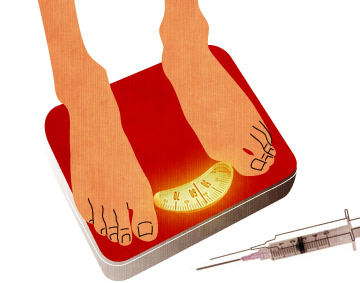

Imagine you have a medical condition that causes you to lose weight. And miraculously, the more you eat, the more you lose. Pastry for breakfast, pasta with clam sauce for lunch, a five-course dinner with crusty bread and any dessert you like, plus snacks in between — the sweeter the better. Follow this diet and you can drop five pounds by tomorrow morning, shrink a dress size for the weekend, show up at your high school reunion enviably trim.
There are a few downsides: Your hair will fall out, you’ll be tired all the time, your mind will be muddled, and your extremities might tingle strangely. Over time, you’ll likely go blind, lose a limb, end up on dialysis, or suffer a sudden heart attack. But in the meantime, you’d be able to eat anything you want and wear a size 2.
Thousands of the approximately 1 million people with Type 1 (or juvenile-onset) diabetes are willing to take the risk. Mostly teenagers and young women, they suffer from a unique eating disorder called diabulimia.
These are girls growing up in the same diet-obsessed America as everyone else. They might begin childhood average size, or even a little fleshy. Then, inexplicably, they begin to lose weight no matter how much they eat. The other symptoms of illness — excessive thirst and fatigue — are far less compelling than the ability to eat an entire bag of chips without getting fat. But eventually, someone else catches on, a parent or a doctor, and they’re diagnosed with diabetes: taught to read food labels as carefully as a scientist; warned to restrict their caloric intake religiously; and put on a medication called insulin that perversely, literally overnight, causes them to plump up like a water-soaked sponge.
Further, they must go through life focused, constantly, on food — but only its chemical elements, never its comfort or taste. And the cure is hardly attractive: They will gain weight, even eating as ascetically as monks. The untreated disease, however, with its wasting syndrome? Now that has its appeal.
Katie, a young woman from suburban Minnesota, was a competitive gymnast on a team that was Olympics-bound several years ago. At 4-foot-10, she weighed about 60 pounds; she collapsed often, but at the end of every practice, her coach would stand her in front of the other girls. This, he told them, was how a gymnast ought to look.
One day, Katie’s mother took her to the team doctor, not because of her low weight or bouts of fainting, but because the team was going to California for a meet and Katie was afraid to fly. They needed sedatives. Katie’s regular physician, a man who’d been ignoring her appearance and (it would later emerge) blood tests, in order to help keep her ultra-slim, happened to be away on an emergency. The doctor who was filling in took one look at the emaciated girl and ordered a series of tests, then ordered an ambulance. Katie’s blood sugar levels were the highest he had ever seen and she was on the brink of ketoacidosis, a combination of high blood sugar and dehydration so severe it causes a toxic buildup, deteriorates fat and muscle tissue, and can cause coma or, if untreated, death.
In the hospital, endocrinologists diagnosed severe diabetes, got Katie’s glucose (blood sugar) levels under control, and taught her how to test her blood and give herself insulin injections. She left mid-summer weighing 40 pounds more than when she’d gone in — a sturdy, round-cheeked girl.
The response was horror: from her coach, who banished her from the team, and from her parents, who had dreamed for years of sending their daughter to the Olympics. Her peers weren’t horrified; they were amused. People whispered when Katie walked down the halls at school and taunted her constantly about how fat she’d become.
At first, Katie didn’t make the connection between insulin and her weight. She tried dieting and wound up going into insulin shock (potentially fatal hypoglycemia, or low blood sugar) twice. But it wasn’t until college — after she’d begun eating pizza and drinking beer and bulked up even more — that Katie realized she was doing things backward. Rather than take her insulin and cut down on her food intake, she had to do just the opposite if she wanted to lose weight.
“I remembered back to the time that I was admitted to the hospital and how skinny I was,” she says. “So I started skipping my shots.” Also, she ate only refined carbs and sugars: bread, brownies, cookies, candy. The opposite of Atkins, this was a diet devoid of protein and most nutrients, but it ensured she would absorb no calories. No matter how many Dove Bars, croissants and bags of M&M’s she consumed, the weight fell off.
The “magic” Katie had discovered actually was the most dangerous component of her disease. Insulin, a hormone produced by the healthy pancreas, breaks down sugars and carbohydrates and helps store their component molecules — and calories — in the body’s cells. With Type 1 diabetes, the pancreas produces little or no insulin, so all the sugars and simple carbs a juvenile diabetic consumes are “wasted,” flushed through the body without being stored. It all gets urinated out.
The stress on the kidneys is magnificent — the equivalent of stuffing an entire Thanksgiving dinner, turkey bones and all, down a garbage disposal, daily — and requires a very high water intake to get the job of flushing everything out done. Thus, the symptoms: chronic thirst, frequent bathroom visits, severe dehydration, an electrolyte imbalance that can lead to heart irregularities (remember Terri Schiavo?) and, ultimately, kidney failure.
Katie experienced all of those but the last. She spent hours in the bathroom and her heart skipped beats. Yet, she kept on, letting her blood sugars creep higher and higher, losing more and more weight. “The other girls on my dorm floor were so envious,” she says. “Every time they saw me I was eating something and I was still about a size 2.”
So imagine your body has this particular glitch. You’ve read this far, you know the dangers. Using a walker for the rest of your life. Waiting for a kidney transplant. Being hooked up to life support in a vegetative state while people picket outside your hospital room, shouting about whether or not your life should end.
But would you do it? Just for this weekend, just for one dance audition, just for your wedding so you can wear that incredibly close-fitting princess waist dress? Would you convince yourself it was only for a couple days? After all, there are a lot of undiagnosed diabetics who walk around with high blood sugars for weeks or months before they’re caught. You don’t have to restrict yourself; you don’t have to vomit. All you have to do is “forget” to take your next shot.
This is the temptation thousands of young people with diabetes face. Diabulimics can eat delicious, fattening foods and remain thin, or they can live by draconian rules and battle to squeeze into their clothes. There are consequences to the first option, but to a teenager they may seem vague and a long way off.
What’s more, their doctors scold them if they gain too much because additional pounds mean more stress on the body and a greater need for insulin. And their blood sugar levels are checked not only four times daily, but also monthly using a test called A1C, which shows average glucose going back several weeks.
It’s the ultimate Big Brother situation: You’re 16 and there’s a bearded man in a white coat who’s telling you exactly how much you should weigh and how he wants your body to behave. You’re supposed to keep tabs on every gram of sugar and record it in a little diary. The other kids you know can eat a Twinkie without having to report back to a committee. It makes you feel — rightly — as if you have no control.
It also makes treating Type 1 diabetes a very tricky balancing act.
The mortality rate from diabetes alone is roughly 2.5 percent annually. For anorexia nervosa, it’s 6.5 percent. But patients with diabulimia — which is referred to in healthcare circles as “dual diagnosis” — have a mortality rate of a whopping 34.8 percent, per year.
“Both diabetes and eating disorders are high-risk conditions,” says Dr. Joel Jahraus, director of the Eating Disorders Institute (EDI) at Park Nicollet Health Services in St. Louis Park, Minn., one of the few centers in the country with a program specifically to treat diabulimics. “But put them together and the risks are just wildly incremental.”
According to anecdotal research done at Park Nicollet, patients with diabulimia routinely suffer from retinopathy, neuropathy, metabolic imbalance, depression and other mood disorders, kidney disease and heart attacks. “High blood glucose triggers a series of mechanisms that injures blood vessels and nerves throughout the body,” says Dr. Richard Bergenstal, director of the International Diabetes Center (IDC). “It affects everything vascular, which means it’s the leading cause of blindness, kidney failure and amputations.”
For females in the general population, the risk of developing an eating disorder during college is between 20 and 40 percent; for those with diabetes, it doubles. In a recent study conducted by the EDI, of 87 patients diagnosed with diabetes in childhood, 36 percent admitted to misusing insulin in order to control their weight — but only when they were asked a decade later.
Whether diabulimia is on the rise or only now being noticed, experts cannot say. What they do know is that more and more patients — mostly young women — come to them every year with the signs of voluntary insulin deprivation. It’s become a standard question for diabetes specialists to ask patients with high A1C results. And it’s now listed in the DSM-IV (Diagnostic and Statistical Manual of Mental Disorders) as a separate illness with criteria specific to insulin-dependent patients.
Some doctors theorize that the Internet is partly to blame: Teens with diabetes are posting information about insulin withholding, they say, much as young women have traded dieting tips and guidelines for traditional purging techniques (vomiting, laxative abuse, excessive exercise) for many years.
But they’re also telling cautionary tales. A young woman identified only as “Goddess G” posted hers on a site called Anorexic Web. Just released from an in-patient dual diagnosis program in California where she was rescued for the umpteenth time, G.’s 2004 post begins:
Just got out of the hospital. I nearly died from insulin manipulation. The docs said if I had come in the next day I would have been dead.
What follows is a cyclic tale of bingeing (consuming, she says, “up to 40,000 calories a day,” including 14 liters of sugary soda) that led to constant acid reflux, hair loss, dehydration, collapse and a heart attack while still in her teens. The piece ends with a description of her most recent round of recovery and relapse. After coming back from an esteem-boosting three and a half month stint in the hospital, she was broken back down by her home environment and a verbally abusive boyfriend:
In about five months, by skipping insulin, I lost my friends, my health, my hair, my happiness, and sense of security in life. But I also went from 126 to 80 pounds…
I still do it, and I can’t stop. Is it worth it? My bones are weak, I have sores on my mouth, my hair is thin, my heart flutters, it is a struggle to walk, and the docs say I will need dialysis and eye surgery by the time I’m twenty.
I am 18, and I live in a 90 year old body. So if you have diabetes, please, don’t start, because once you do, you can’t stop. Diabulimia, how I loathe thee.
Katie, the former gymnast who is now married and a stay-at-home mom, has had a happier outcome — so far. She was admitted to the Eating Disorders Institute in 2003, one of its pilot diabulimia patients. (Note: Park Nicollet was unwilling to allow an interview with any patients receiving ongoing treatment and would provide only an interview with a patient deemed “cured.” So Katie probably is not representative of this patient group at large.)
“They didn’t understand diabetes,” she says. “I was one of the first [diabulimics] to enter their program and I challenged them to recognize what a weird struggle this was for me. For instance, I was told never to look at numbers or labels. But I have to look at the carb number on a food, or I won’t know how much insulin to take. I can’t get around the numbers.”
Ultimately, the therapist working with Katie brought in a dietician to help develop an eating program that took her diabetes into account. And the staff at the EDI learned about the unique ways the diabetic body responds to sudden dietary changes and scheduled insulin injections.
One thing they learned to anticipate: the hysteria of eating disordered patients who take their insulin and awaken the next morning looking pregnant. Because unlike the otherwise healthy patient with an eating disorder — who might put on two to three pounds a week when put on a standard food plan — someone with diabetes can gain 10-20 pounds in a week. Most of this is much-needed water, but it causes the body to swell and the stomach to “pouch.”
After treating Katie and several other early patients, the doctors at Park Nicollet began collaborating in a way that few healthcare organizations can. Bergenstal and Jahraus assembled a team of practitioners from both sides (the IDC and the EDI) to develop a curriculum specifically for the treatment of diabulimia. It includes regular screenings for blood glucose levels and ketoacidosis, food plans that allow for label reading, diabetes education, a private space for patients to give themselves insulin injections, and a separate support group where the problem of having both diseases can be freely discussed.
In November, Park Nicollet will break ground on the Melrose Institute, a new facility for the treatment of eating disorders that will be one of the largest in the country. Bergenstal and Jahraus say they plan to standardize care for diabulima and — once it’s been adequately tested — publish their curriculum so other eating disorder centers can treat the disease.
However, Katie admitted during our interview that even after she left the EDI in 2004, she was inconsistent about taking her insulin. She knew exactly what she was supposed to do. But when she was under stress, or her clothes started to feel tight, she’d go back to eating bags of Doritos and entire cakes and skipping her shots. It was only when she became pregnant for the second time, in 2006, that she started following her eating and insulin plan.
Now, nine months after the birth, Katie swears she’ll never go back to her old ways. But the pressure is there every time she steps on a scale or goes shopping for clothes. All she has to do if she wants to take off that last five pounds of baby weight and slip into a pair of low-rise jeans is omit her insulin for a few days. Can she really be expected to resist the temptation? Could you?
