
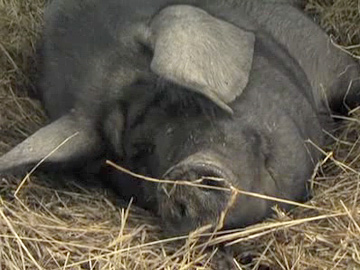

The chefs and pork experts I interviewed for this story have strong feelings about pigs. They have deeply held convictions about breeds and ethical farming. They believe big pork factories are evil and that, if we care about our meat, then we should care enough to find out where it comes from. And, of course, they are happy to hold forth on the deliciousness of pork itself, from that sumptuous, buttery belly to the bladders and the bones (yes, you can use them, too).
Below is a collection of condensed interviews with pork lovers pushing back against the American notion that convenience and cost should trump all else. The future of pork, if these experts had their way, would look a lot like the past: consumers buying from farms and collectives, pigs allowed to forage in the woods and raise their young rather than being bloated with antibiotics and degraded in wall-to-wall pens, and all of us making more, better use of an animal’s body. It’s not cheap; important things rarely are.
By the way, if you don’t live near a farmers market, these experts recommended the following online sources: Caw Caw Creek, Debragga, Bev Eggleston’s Eco-friendly Foods, Flying Pigs Farm, Heritage Foods USA, , Niman Ranch and Vermont Quality Meats.
We wanted to have Pork Week because, yes, we love pork. But we were also fascinated by its increasing role in our lives — whether as a pop-culture fetish, a culinary trend or as a way to find a more meaningful connection to our own food. As we acknowledged at the beginning of this series, pork is a polarizing meat, and it raises complicated issues — not just about religion and carnivore culture, but also about animal treatment. Our first reader e-mail about Pork Week was unambiguous. (“I’m absolutely revolted,” it read.) So was our second. (“Pork week! Good fun!”) And so it went, all week long, but I like to think the passion on both sides is an indication of how much more there is to say, the way the pig touches so many parts of our lives.
A certain “Simpsons” quote feels apropos right about now. Lisa has announced her decision to become a vegetarian, to which Homer scoffs, “Lisa, honey, are you saying you’re never going to eat any animal again? What about bacon? Ham? Pork chops?”
“Dad!” Lisa replies. “Those all come from the same animal!”
“Yeah, right, Lisa,” says Homer, with a chuckle. “A wonderful, magical animal.”
“A nice pink in the center”
Tom Colicchio is best known as the evenhanded mentor and judge on Bravo’s popular cooking reality series “Top Chef.” But as the force behind New York’s Gramercy Tavern and the Craft series of restaurants, he has also been an influential proponent of locavore eating and sustainability farming. Oh, and the man knows his way around a pig. GQ once voted his pork belly its favorite meat dish.
“I like all pork. If I had to choose one cut, I’d say the belly. It has the most amount of flavor. You can roast it or grill it or fry it.
My favorite breed is probably the Ossabaw. It’s more like pig and less like ‘the other white meat.’ It wasn’t raised to taste like nothing. Commercial pork, they bred the taste right out of pigs. The pig was bred to be very lean, because people didn’t want to eat fat. People didn’t want that big white fat on the outside of a pork chop. That was a great ad campaign, ‘the other white meat’ — we all remember it — but it was mass-produced pork. Mass producers like Smithfield? They’re disgusting. There was an article in Rolling Stone about Smithfield. They’re gross.
Everybody thinks pork has to be cooked well-done, because of trichinosis. Listen, we haven’t had a major case of trichinosis in this country in more than 40 years. Don’t overcook pork. It doesn’t have to be rare. For mine, I prefer medium, a nice pink in the center.”
“Big pork companies are no different than big tobacco”
David Chang is the closest thing the pork world has to a rock star. For me, the outrageously delicious dishes at his Momofuku restaurants in Manhattan have done for pork what the Beatles did for pop music. They are as brilliant as they are varied and crowd-pleasing. Chang doesn’t need my praise, or anyone else’s, really; his most recent venture, Momofuku Ko, received a rare four stars in New York magazine. The best pork that Chang’s ever had? “I’d have to say the pork belly at [Wylie Dufresne’s celebrated Manhattan restaurant] WD-50, about two years ago.”
“The only part of the pig that I dislike is the pork chop. Depending on the pig that it’s from, it can still be delicious. But the traditional American way? Dry pork chops with applesauce? That’s pretty gross.
Pig is not supposed to be a white meat. That was the fault of pork producers and it’s the reason pork chops taste like crap, because Big Pork producers bred out all the flavors, in the same way you breed a dog to be tall. The pigs are treated like shit, too. I always say that big pork companies are no different than big tobacco companies. Everyone’s so into the breed of pork, but what’s more important is how it’s raised.
To buy good pork, you should go local if you can. But it’s harder and harder to find local pork. In fact I don’t think you can find good pork in the supermarket at all. I think “certified organic” is a bunch of bullshit. There’s a right way and a wrong way to raise animals, that’s all. If you go two hours upstate, there’s this beautiful farm — I’m not gonna name it, but it’s a place where they raise pigs and ducks and they feed them well — it’s not certified organic but they show a lot of love for the animals. You can buy from Niman Ranch — people give them a lot of shit, because it’s a natural American reaction to start hating on something once it gets big. But someone has to do this kind of traditional hog farming on a larger scale [Niman Ranch is a network of more than 500 family farmers].
Here’s the thing that’s happening. Big pork companies have realized the new thing is heirloom pigs or Berkshire pigs, so they’re also doing that. I won’t name the companies, but they’re using families as fronts, and you gotta be careful.”
“The pig is funny, but the pig is delicious”
John Currence is the co-owner of City Grocery in Oxford, Miss. But when I spoke to him, he had just opened up a breakfast spot based entirely around pork. At one point during the restaurant’s development, he tells me, “We decided we had to build a smokehouse. And I suddenly realized, oh, there was a void in my life. I’m going to have a smokehouse!”
“Being from the South, there’s a tremendous amount about pork that just rings familiar. It’s wonderful because it’s a double-edged thing — the pig is funny, but the pig is delicious. Every facet of my life that has to do with the South can be connected to pork– cooking ribs when I was in college, my father taunting me with pickled pigs’ feet when I was a little boy, so much bacon and sausage. I remember going to a barbecue chain when it first opened, and they had this smoked brisket, and I went, well, why? It’s an interesting idea, but why would you wanna do that when there’s pigs’ meat?
The best pork I ever had would probably be that crazy pig-and-oyster thing that David Chang does [the Bo Ssam]. I remember eating pork at this insanely delicious dim sum place in Chicago called Phoenix. There’s Ben Barker’s crazy pork dish at Magnolia Grill in Durham, N.C. Ricky Parker’s Whole Hog BBQ in Lexington, Tenn. I could go on. But you almost have to break it down to each individual cut.”
“We’re so far distanced from our food sources”
The executive chef at the celebrated Gramercy Tavern, Michael Anthony, spoke to me about pork longer than anyone I interviewed, nearly an hour, and it still seemed like we had more territory to cover.
“If you ask cooks around the country what aspect of contemporary cooking is most interesting to them, you’d hear a vast majority say charcuterie. It’s a fetish. We’re starting to get good at it. We’re getting great flavor from secondary cuts. Terrines and sausages and pâtés — this is slightly unexplored by American chefs. If you look to European chefs, they’ll tell you some nostalgic story about growing up in France, slaughtering a pig and then making blood sausage. That is the way people grew up in Europe and Asia. We’re so far distanced from our food sources, we’re so far from how our food is grown. Most of us didn’t grow up on farms making this stuff. But at least we are catching up.
There is also a deep appreciation for using every last little bit of the animal. It makes good sense — good dollars and cents — to figure out the multiple menu items that a whole animal can drive. What are you gonna do with all the secondary parts? So 85 percent of the animal goes into cured meats and sausages and terrines and homemade bacon and our own pancetta and lardo. It’s not just about having a great rack of pork.
In America, we’ve gone through a long period of fast-paced convenience and privilege. Like, if I can’t cook this meal in 15 minutes, then it’s not worth it. I’ll just have someone else do it. But this era has taken something away from us: the pleasure of preparing the foods that we eat and the knowledge of where it comes from. The bottom line is that everybody is searching for a way to connect to the world around them and part of that is connecting to their food.”
“You can use almost all of the pig”
It would be hard to find an American chef more passionate about using the whole pig than Chris Cosentino, executive chef at the San Francisco restaurant Incanto and evangelist for offal cooking — that is, using the guts, heart, liver and all the nasty bits. Cosentino has a forthcoming cookbook called “Cuts and Guts,” but in the meantime, anyone interested in learning to make more of their animals can also visit his Web site, Offalgood.com.
“After you take the meat from an animal, you dispose of about 45 percent of it. If you’ve ever participated in animal slaughter, that’s a powerful thing. Once you physically do it, you take ownership of what happens to that animal. Harvesting an animal is not a pretty thing. But it’s a necessary thing. When you think about the harvest of an animal, it’s a mix of emotions: There’s fear and joy and disgust. It’s a big ball of everything at once, and it’s not pretty. Something is giving its life for food for people. Now, when you start throwing away 45 percent of it — well, that’s what changed me. You want to do the right thing by the animal.
Offal cookery has been a huge part of Italian food. It’s peasant food — braising and making charcuterie. You can use almost all of the pig. We pull out the brains. We use the tongue. I do an unctuous jelly made with boiled hog skin, which is like using a butter; it gives everything a real richness. In salami production you use intestines, you use chitlins. You use their bladders in cooking vesica. You can use its bones for pork stock. I just recently started messing around wIth pork marrow. Everybody knows about beef bone marrow, but what about lamb or pork? This is the stuff that people think is garbage. It used to be we never threw anything away. Now we’re a throwaway culture.”
“A foodstuff with a story, just as wine has a story”
Peter Kaminsky wrote his 2005 book “Pig Perfect” about his search for the ideal swine. His travels took him to France and Spain and, eventually, to an island off the Georgia coast, where he found a feral population of pigs that have since become a favorite among top-tier chefs. I asked him to tell me the brief history of the Ossabaw.
“I knew the Spaniards brought pigs with them everywhere they went — Pizarro did this and Cortes did this, de Soto did this. I wondered: When the Spaniards came to America, what the hell happened to their pigs? I was looking for pigs with pure Spanish genetics, and I discovered that the Spaniards had left some pigs on Ossabaw Island, off the coast of Georgia. It was a mosquito-infested place, so it was never settled, and the pigs thrived there. There were a lot of acorns, which is the pigs’ favorite food and which accounts for the wonderful taste in Spanish hams and also filled them with mono-unsaturated fats. (In Spain they call the pig the four-footed olive tree.)
It turned out the NIH [National Institutes of Health] was using these pigs for diabetes research in Missouri. I couldn’t get them off the island — they were quarantined — so I bought 23 hogs from the NIH with a professor named Chuck Talbot of North Carolina A&T. We took them back to sustainable farmers, raised them and slaughtered them, and the pork turned out to taste delicious. The fat melts at room temperature. We made copa and lomo and ham from it, and [fabled New York chef] Daniel Boulud bought some as well as a few other big chefs and they became a brandable pig — like wagyu beef, a foodstuff with a story, just as wine has a story.
It was a great conceptual scaffold to build a book around, but in the end I think any rustic hog that can live in the woods, forage for food, take care of their kids, be free range, eat acorns and grasses, and be allowed to get big and fat is going to make good meat.
The factory system of pork farming is inhumane and unconscionable. But if you raise animals the way I’m advocating — if they’re allowed to live free range, able to care for their young, they live three times longer. Listen, if you want better-tasting meat, you don’t stress out the animal. If you object to industrial slaughterhouses, the whole system is horrid. If you object to local avatars, well, I would disagree.”
“This is the way that’s right and responsible”
New York-based Heritage Foods USA was founded by Patrick Martins, the man behind Slow Food USA, to promote “small family farms and a fully traceable food supply,” according to the site. It is one of a handful of companies, like Niman Ranch, that are helping the embattled American pig farmer. Sarah Obraitis, a partner in Heritage Foods, spoke with me about their efforts.
“We connect farmers to the consumer. We promote what’s produced by these small, independent producers and by sharing their stories and making their meats available, it’s quite possible to help keep farming a viable livelihood, even in the forgotten region of the Midwest, where we’ve got a handful of pig farmers because they have the space still, and they have a chance to raise meats in the number that a city like New York needs. The Midwest may seem far away from New York, but it’s local when we compare it to bringing in meats from places like Argentina.
Pigs are all so different. The Duroc has an attitude. The Berkshire is motherly. They all like people. They’re not afraid of the hand of man. If you go to a factory, with 2,000 pigs in one room, they run away. But the pigs I’ve seen on farms, they’re curious. They forage and root. They’re beautiful animals. They’re happy.
In factory slaughterhouses, they’re killing four and five pigs a minute, the production line is speedy and rarely slows down. It’s gross and awful. The corporate meat industry cuts corners, which keeps food prices artificially low and still guarantees hefty profits.
Our slaughterhouses are small and family-run and 100 head a day is a lot. They spend almost 20 minutes processing one pig. It’s peaceful and slow and reverent. The workers respect the amount of time necessary to get the job done right, which ultimately preserves the quality in the meat. If the slaughter is not calm, not done properly, it can undo the work of the farmer. I’ve seen pigs right before slaughter who are sleeping. A dramatically different scene than what’s typical at a big packing house. This is the way it used to be done and this is the way that’s right and responsible. And there are still, albeit few, custom slaughterhouses like this. It gives the future hope.”
