

Monday night, millions gathered around the television to watch an event years in the making. No, I’m not talking about the Olympics. Rather, Monday night was the premiere of “The American Mall,” MTV’s “High School Musical” rip-off in which teenage dramas unfold under the dizzying fluorescents of a food court. It’s a story, so says the promo, about a place we all love, where everything is for sale but love and dreams.
Like “Fast Times at Ridgemont High” or “Mallrats,” “The American Mall” presents the enclosed shopping mall — America’s most iconic, infamous and replicated retail phenomenon — as the ultimate gathering place (which was, in fact, the intention of inventor Victor Gruen, the Holocaust survivor who created the first indoor shopping mall in Edina, Minn., in 1956). Funny thing, though: We all love the mall a little less right now. Retail vacancies have hit 6.3 percent in regional malls, the highest number in six years, and not a single new, enclosed shopping mall was built last year. As we hold tighter to our wallets, what’s going to become of all that empty consumer space?
Michael Townsend and Adriana Yoto have an answer.
The Rhode Island couple awoke one morning in 1998 to find the name of their street changed: Kinsley Avenue was now Providence Place, which happened to be the name of the 1.3 million-square-foot mall rising on 13 prime downtown acres. Townsend and Yoto were among the Providence residents objecting to the mall — the cost to taxpayers, the colonizing presence of the structure that dominated the skyline from the highway. But Yoto, a scholar, and Townsend, a public artist, expressed their outrage in an unusual way: They decided to live with the mall. Literally.
In 2003, inside a 750-foot storage space, abandoned since construction days, they crafted a secret apartment within the mall from which they could study its allure. Why do so many of us flock to the mall’s sanitized hallways? Why do we love the sameness of mall life, identical shops and structures across the country? Why is the mall the site of our grievances, the place where gunmen go to inflict maximum pain? Earlier this year, a man set off an explosion in a mall in Exeter, England. The week before, a woman was shot in one.
Clearly, we have complicated emotional relationships to malls, and Townsend and Yoto figured one way to comprehend all that they critiqued was to embrace it, to live it so they might understand it. The mall adventure was to last a week; it went on for four years. If Townsend hadn’t been nabbed by security and charged with criminal trespassing last October, they’d still be camping out there today.
– – – – – – – – – – – –
The mall as we know it today — an enclosed concrete box of shops, connected by common space — is only 52 years old, created by Gruen, an Austrian Socialist Jew who thought he was inventing a utopian, community-oriented commercial center. The mall was meant to pull people together from disparate regional corners; instead, with the help of the trusty automobile, it drained those corners, dismembering many a downtown.
But Providence Place was Mall 2.0: four floors, 170 shops and eight restaurants and “entertainment venues” (we called those movie theaters when I was a kid), on the former site of the University of Rhode Island School of Continuing Education building, that were expected to draw people back to downtown, instead of pulling them away. This new breed of mall was not a hulking, ugly box of concrete plopped down among former farmland, but a camouflaged structure, clad in brick and placed at the city’s center.
“Almost no developer builds malls anymore,” said Paco Underhill, author of “Call of the Mall.” “They build ‘alls.'” Hotels, offices, libraries and, yes, residences are now folded into mall developments. Only one traditional enclosed shopping mall was built in 2006 and none last year. Many older structures are being “demalled,” in the language of the industry: razed and rebuilt as mixed-use, open-air facilities we call lifestyle centers — they’re not just shopping centers anymore.
For many people, especially outside America, malls represent a sunnier future, despite the lack of weather inside. The opening of a mall in Soweto, South Africa, for instance, prompted a citywide celebration with Nelson Mandela presiding. But because they are repositories of our aspirations — when you’re at the mall, the better you always hovers within reach — they’re also magnets for our frustration. Last November, a gunman killed eight people in an Omaha, Neb., mall, declaring, “Now I’ll be famous,” before killing himself.
The daughter of a Chinese economist and a fashionable Venezuelan beauty queen, Adriana Yoto, 30, grew up in Chappaqua, N.Y., obsessed with mall shopping. Michael Townsend, 37, came from God-fearing Christian parents in a suburb of Worcester, Mass., and played “Commando” at the mall arcade (he claims to have held the national record at one point). “Our mallifications were very different,” he said.
Shopping had been a point of contention in their marriage long before Providence Place became their neighbor. When she chose to marry Townsend, who makes his living crafting (quite beautiful) murals out of tape, Yoto’s folks told her, “Misery can only be your destiny,” because he couldn’t support her Nordstrom habit on an artist’s pay. She eventually recovered from shopoholism but was left with such passion for malls that she went on to study them, earning a master’s in international relations from the New School, where last year she proffered theories on malls as modern-day British colonies.
Four years after the mall opened, Yoto, Townsend and six friends in their art collective, called Trummerkind (“children of the ruins” in German), vowed to spend a full week at the mall that had transformed their city, to use the mall as an actual public space while surviving sans commerce.
“The mall has something really positive to offer, something that has nothing to do with shopping,” Townsend told me.
“What is it?” I asked.
“I don’t know — that’s what I moved there to find out.”
They never intended to undermine the mall or its corporate structure, or to make a spectacle of themselves. Townsend describes himself as “wired for happiness” and Yoto’s idea of a good time is cataloguing all the items in a store and rating their desirability from “gift-worthy” to “if-it-were-the-apocalypse-and-I-was-looting-I-would-take-it.” Which is precisely what they did during their stint living at the mall. Every day.
Each of them voted in one item (a flashlight, space blanket, sketchbook and facecloth) and accepted an allowance of $20. “I had a lot of tea,” said Yoto. They camouflaged themselves, carrying empty Nordstrom bags and wearing mall outfits — nice slacks and button-down shirts (more of a stretch for Townsend, who will happily wear the same pair of sneakers until they’re held together with tape). At night they had to skirt through a 2-foot-wide passage to the dark space Townsend had found, its walls and ceiling coated in what Yoto described as “opaque gray oatmeal mixed with the contents of a lint trap.” They made a bed of cardboard and insulation tiles where they spent cold nights, not risking capture by using the mall off-hours. They washed up — it was dusty — in mall bathrooms, while Yoto arrived at the porcelain sink in the Origins store each morning, sampling its face cleansers. Occasionally, they leafed through books at Borders.
They were, after four days, both completely bored and totally ecstatic. “I felt this vacation-like euphoria that I’ve never felt till then or since then,” Townsend said. “It was better for me than any nature walk I’ve every taken.” Let’s be clear: He’s not being ironic — this is wired-for-happiness talking. They felt they had subverted the mall’s reason for existence by not buying anything, yet they had achieved what it promised: a release from the burdens of everyday life, within walking distance.
“[The mall is] supposed to be an everyday vacation,” Yoto said. “But it only works if you don’t bring any money or your cellphone.”
The mall has always been much more than a place to shop. “For so many people, the mall was the first place they got to see the world,” said Underhill. “The first place they spent their own money, the first place they met somebody who wasn’t in their neighborhood, the first time they saw things from music to fashion that, previous to that, their only connection to it had been on TV.”
Malls became antidotes to the typically isolated and alienating spaces of suburbia: lonely stretches of highway and echoey McMansions. There we congregate and the worries of the world disappear into the thrum of Muzak and met expectations — they are their own gated communities.
“We’re living on a planet that’s going to hell in a handbag,” said architect and architectural critic Michael Sorkin. “At the mall, you enter a condition of perfect climate control, where it’s clean and orderly and you are not forced in any way to confront reality.”
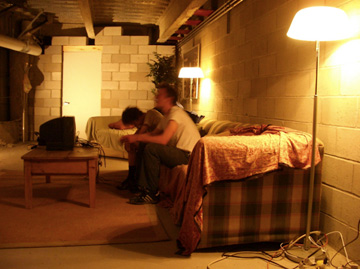
After their experimental week, Yoto and Townsend returned regularly for four years, attempting to transform that storage space into a luxury apartment furnished by the mall. They built a wall with 39-pound cinder blocks that they hauled in themselves — there was plenty of hard physical labor involved in their attempt at the high life. They added sofas, tables, lamps, a TV, a china hutch and a Sony PlayStation (which was stolen while they lived there, which suggests their presence wasn’t entirely secret), and stayed for days at a time. They planned to install pre-laminated wood flooring and a portable toilet.
Yoto says they played house to submit to the “demands to hyper-stylize.” She’s referring to the visions of decorating perfection in the Pottery Barn catalogs or Domino magazine that make their way to our mailboxes, to the pressure some internalize to make our homes match those images, to have them always ready for inspection. “We’re all asked to be performance artists every day,” she says. “We’re all being watched.”
In the mall — perhaps the most heavily surveilled public arena we have, with security cameras and long lists of behavioral rules — she lived a parallel existence in which she realized those hyper-stylizing dreams, performed for that invisible audience by placing tiny jars of sand on a decorative shelf and a cloth runner on the dining room table, flourishes she would excoriate in her real life, in her own loft a mile away.
Yet while Yoto and Townsend critiqued the mall as an agent of surveillance, they worked hard to make sure they were surveilled. They scanned their sketchbooks’ pages onto their blogs. They uploaded handmade maps of the mall’s undefined spaces. They posted video of their mall apartment on their Web site, which began to appear near the top of Google searches for Providence Place. They assume that’s how security knew to search for them, finding Townsend one October afternoon behind the door they built. Townsend yelled “Surprise!” when they turned on the lights. He pleaded no contest, was sentenced to six months probation and was banned from the mall.
Townsend and Yoto maintain that they feel a real sense of loss that the apartment never reached shelter magazine heights — and that it’s gone.
“How long were you expecting it to go on?” I asked.
“Years. Forever,” Yoto said. “We wanted to bring our child to have its birthday there. We wanted to have the baby’s first steps in the mall.”
In some ways, the project didn’t end. After Townsend’s arrest, they experienced a flurry of fame, including a two-minute spot on “The CBS Early Show” and the coveted back page of the National Enquirer. The blogosphere erupted with cheers, and discussions emerged on the nature of public art. One blogger assessed the mall apartment as an adult version of a fort in the woods. The police, according to one newspaper report, were “so intrigued by the apartment that they went to see it themselves.”
Yoto and Townsend have given talks to law school audiences and art students, even re-created the mall apartment at a Providence gallery. (Yoto sent out the announcement with a picture of herself as the mall advertisement, in a slinky maroon dress and a sultry stare into the camera.) A literary agent signed them to work on a mall book. A producer invited them to pitch a reality show about squatting. (The premise they came up with was “Extreme Helping,” in which they would inhabit abandoned buildings and, in Townsend’s words, “just help the fuck out of people.”) Like the Omaha gunman, their actions inside the mall made them famous.
The management of the Providence Place Mall did not share the general public’s enthusiasm. They announced that the mall felt violated — which caused a predictable cackle in the blogosphere — and for months threatened to sue Yoto and Townsend.
Yoto and Townsend’s furnishings were returned — the property is legally theirs, no matter how illegal the act of putting it there — but an intellectual property scuffle continued. General Growth Properties, the mall’s owner, requested the physical possession and copyright of all of Townsend and Yoto’s images of the mall, including their wedding video, shot on the Woonasquatucket River as they paddled past. GGP has since dropped the suit, perhaps deterred by the continuing wave of positive press and the team of lawyers that sprang to the couple’s defense. (GGP declined to comment for this piece).
Yoto and Townsend’s great crime — what made the mall feel violated — was to make the mall an individual experience, to define the space themselves. They wanted to replicate what developers had done around them: declare an abandoned area blighted and then redevelop it, to make a tiny piece of the mall uniquely theirs. It was their own personal eminent domain.
But protest-through-squatting, it turns out, isn’t unique to them. The comedian Mark Malkoff lived inside a New Jersey IKEA for a week in January, citing the extensive selection of IKEA products in his own apartment, the slimming line between his space and theirs. Maybe the Swedes have a better sense of humor than Americans do, since they actually condoned his corporate colonization.
What most people praising Yoto and Townsend’s adventure miss is that living in the mall is not fringe. It’s the new standard. Forty-three miles away, in suburban Boston, a 1994 mall owned by the same company that built Providence Place added condominiums — real live luxury condominiums — inside. People are paying over a million bucks to live within the Natick mall. Maybe this is the answer to the subprime crisis: All those folks with foreclosed homes could move into shut-down Starbucks and Wal-Marts until the economy perks up.
Meanwhile, tourists trek thousands of miles to shop at Abercrombie or dine at the Olive Garden in New York City. Fifth Avenue is lined with the same shops found in Houston’s Galleria, and chain stores choke avenues once lined with local businesses. As our cities become more like suburbs, and vice versa, we’re all pretty much living at the mall, anyway. Funny, but nobody’s dancing in the food court.
