
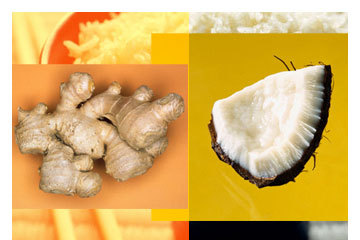

Lemongrass-Scented Coconut Rice
Nasi Uduk
(Java, Indonesia)
Rice that has been cooked in coconut milk and seasoned with aromatics is a velvety-rich, alluring dish. It turns up in countless incarnations all over the Malay Archipelago. This is the Javanese version, which is flavored with lemongrass and daun salam leaves, the woodsy-tasting Indonesian herb. The aromatics are submerged in the rice as it cooks, infusing the cooking liquid — and, in turn, the rice — with their essences. The hint of lemongrass is appealing, while the topping of crisply fried shallots adds smoky succulence. Friends for whom I have cooked this rice tell me it’s the best rice they’ve ever eaten. It pairs well with just about anything that plain rice is served with, including curries and stir-fries, though it’s also wonderful on its own, perhaps with a Malaysian pickle or a salad of baby lettuces. I prefer to eat nasi uduk warm rather than hot, as its flavors are even more delicious.
Don’t try to halve this recipe — that would result in the aromatics sitting on top of the rice, rather than being submerged in it, yielding a poorly flavored dish. It’s also not a good idea to make this dish in a rice cooker, as the fats and proteins in the coconut milk and the cooker’s high, continuous heat can easily lead to the bottom layer of rice sticking and burning.
Makes 4 to 6 servings
2 cups (14 ounces/400 grams) jasmine rice
3 thick stalks fresh lemongrass, tied into a knot
1 1/2 cups (12 fluid ounces/375 milliliters) water
1 cup (8 fluid ounces/250 milliliters) unsweetened coconut milk
1 teaspoon kosher salt
10 whole daun salam leaves
2 tablespoons Crisp-Fried Shallots
1. Place the rice in a 1 1/2- or 2-quart (1.5- or 2-liter) saucepan. Fill the pot halfway with cold water. If any rice hulls or small twigs float to the surface, scoop them aside with your hand and discard them. Gently swirl your fingers through the rice until the water becomes cloudy from the surface starch on the rice grains, about 20 seconds. Be careful not to massage the rice aggressively. You don’t want to crack or break the grains. Allow the rice to settle for a few seconds. Tilt the pot over a sink and drain out all the water, cupping the rice with your hand to prevent it from spilling out of the pot. Repeat this process with 3 more changes of water. The water after the first 2 rinses will be quite cloudy; by the fourth rinse, it will be much less so. The water need not run completely clear by the final rinse. Slightly cloudy water is fine. Leave the rinsed rice in the pot.
2. Add the lemongrass, cooking water, coconut milk, salt, and daun salam leaves (if using) to the rinsed rice. Stir well to combine, making sure that the lemongrass stalks and daun salam leaves are as fully submerged in the rice as possible.
3. Place the pot over high heat and bring the liquid to a boil, stirring with a large spoon to prevent the rice at the bottom of the pot from scorching or burning. Don’t worry if the liquid thickens considerably as it comes to a boil, a result, in part, of the fats in the coconut milk combining with the starch in the rice. Also don’t worry if the lemongrass knots become unraveled from the stirring. The finished rice will still be fine. Allow the rice to boil for 15 seconds, continuing to stir to prevent the rice at the bottom of the pot from scorching or burning. Immediately reduce the heat to the lowest possible setting and cover the pot tightly with the lid. Continue cooking for 15 minutes. Don’t be tempted to lift or remove the lid during this time. You’ll lose essential cooking steam if you do.
4. Meanwhile, if you’ll be using the fried shallots, make them now and set aside.
5. Remove the pot from the heat and allow the rice to continue to steam, covered, away from the heat for an additional 10 minutes.
6. Open the pot and discard the lemongrass and daun salam leaves (if used). Gently fold the rice over with a spoon, evenly distributing the aromatic flavors that may be concentrated in pockets in the rice. Transfer the rice to a deep serving bowl and fluff it well with a fork, lifting it into a peaked mound. Top with fried shallots (if using). Serve hot or warm. (If serving the rice warm, keep it covered with aluminum foil until then.)
Variation: Ginger-Scented Coconut Rice (Nasi Lemak)
To make this gingery Malaysian and Singaporean version of Lemongrass-Scented Coconut Rice, known as nasi lemak (fatty rice), substitute a piece of ginger 2 inches (5 centimeters) long, peeled and bruised until juicy with a heavy, blunt object, for the daun salam leaves. Nasi lemak is traditionally served as a breakfast dish with a halved hard-cooked egg, a wedge of cucumber, a tablespoon or so of fried peanuts, and small portions of a sambal and a pickle, such as Javanese Sambal (page 119) and Sweet-Sour Cucumber and Carrot Pickle with Turmeric (page 130). Do not garnish nasi lemak with fried shallots.
Menu suggestions:
This lush and aromatic dish goes well with nearly every dish I can think of, though it has a particular affinity for Tofu and Summer Vegetables in Coconut Milk and all egg dishes. For a traditional Jakarta-style nasi uduk meal, serve it with Mien’s Garlic Fried Chicken, Garlic-Marinated Tempeh, Javanese Sambal, and lalap, a side dish composed of a few peeled and halved Kirby cucumbers, a few halved Roma tomatoes, and a few sprigs of fresh lemon basil, Thai basil, or Italian basil, all of which guests can nibble between bites of rice.
– – – – – – – – – – – –
Stir-fried Bean Sprouts With Chinese Chives
Tauge Goreng
(Java, Indonesia)
This lively stir-fry of mung bean sprouts with black pepper, garlic, shallots, chiles, and Chinese chives is a specialty of Bogor, in West Java, Indonesia. I learned a valuable lesson the afternoon that I watched Nanik, the wife of my friend Hasan, make it. Not only do bean sprouts cook rapidly, Nanik told me, but they also shed their internal water like tears and continue doing so until they cool down. “Cook them only until they just begin to wilt. Any longer will result in a sad dish,” she said, transferring a wok’s worth of still-crunchy sprouts to a serving plate. Buy the cleanest-smelling, most porcelain white mung bean sprouts you can find. Make sure that they’re 2 to 3 inches (5 to 7.5 centimeters) long, with small, bright yellow seedpods. Don’t mistakenly purchase soybean sprouts, which have larger seedpods and thicker shoots. For the best result, cook the bean sprouts the same day you buy them. Some Javanese cooks replace the Chinese chives with a handful of fresh lemon basil leaves (page 74), which imparts an appealing fruity taste. If you’re using scallions instead of Chinese chives and they’re very thick, slice them in half lengthwise. As with every stir-fry, have all the ingredients prepped and within easy reach before you begin cooking.
Makes 3 or 4 servings
2 tablespoons peanut oil
1 shallot (about 3/4 ounce/20 grams), very thinly sliced lengthwise
1 clove garlic, very thinly sliced lengthwise
1 fresh red Holland chile or other fresh long, red chile such as Fresno or cayenne, stemmed and very thinly sliced on the diagonal (optional, but the chile adds beautiful color and a touch of fire)
1 pound (455 grams) mung bean sprouts
1 tablespoon soy sauce
4 Chinese chives (page 55) or 3 scallions (both white and green parts), tops and roots removed and cut into 2-inch (5-centimeter) lengths
Scant 1/4 teaspoon freshly ground fine black pepper
1/4 teaspoon kosher salt
1. Heat the oil in a wok or 12-inch (30-centimeter) skillet over medium heat. When it’s hot-it should appear slightly shimmery-add the shallot, garlic, and chile and stir-fry vigorously until the shallot and garlic begin to soften and turn translucent, about 1 minute. Don’t allow the shallot and garlic to become golden or golden brown. If you notice that they start to change color, temporarily remove the pan from the heat and allow it to cool for a few moments.
2. Add the bean sprouts and soy sauce and increase the heat to medium-high to high. Stir-fry vigorously until all of the sprouts take in an even amount of heat, about 1 minute. Add the chives, pepper, and salt and continue to stir-fry until the chives wilt and the bean sprouts are just barely cooked through but still crisp, 1 to 2 minutes longer. The sprouts will continue to cook on their own for a few minutes after you remove them from the fire. Taste a sprout for salt, and add a pinch more if needed.
3. Transfer to a large serving dish and eat at once. The bean sprouts will become limp and watery if allowed to sit longer than 10 minutes.
Menu suggestions:
I’m content to eat this dish with nothing more than steaming rice and a just-fried egg — the combination of the crispness of the bean sprouts and the spare luxuriousness of the warm egg is deeply satisfying. But it’s also wonderful paired with Lemongrass-Scented Coconut Rice, Spiced Braised Nyonya Pork, and a coconut milk-based curry, such as Asiah’s Eggplant Curry.
Kevin’s Spiced Roast Chicken with Potatoes, Penang Style
(Penang, Malaysia)
An uncommonly documented offshoot of Malaysian and Singaporean cooking is the cooking of the Eurasians, locals whose ancestry is part British (or, occasionally, Dutch, or both). This is a Eurasian classic: chicken marinated in regular and double-black soy sauce, Worcestershire sauce, bay leaves, and Asian spices and then roasted in a hot oven with butter, potatoes, and small onions. It’s a beautiful fusion of East and West, traditionally served at Christmas banquets, though it’s delicious any time of the year. The recipe comes from Kevin Peterson, who lives in Kuala Lumpur, Malaysia, but learned how to cook the dish when he lived in Georgetown, his hometown.
Makes 4 servings
1 whole free-range chicken, 3 1/2 pounds (1.4 kilograms)
1/3 cup (2 1/2 fluid ounces/75 milliliters) soy sauce
2 tablespoons double-black soy sauce
1 teaspoon Worcestershire sauce
3 bay leaves
2 pieces cinnamon stick, each 4 inches (10 centimeters) long
6 whole cloves
5 small red or yellow onions (about 1 pound/455 grams total), each no more than 2 1/2 inches (6 centimeters) long, halved
1 1/2 teaspoons coarsely crushed black pepper
2 tablespoons unsalted butter, softened
1 1/2 pounds (680 grams) small potatoes such as Yukon Gold, Peruvian blue, or Maine, no more than 1 1/2 inches (4 centimeters) in diameter
1. Remove and discard the fat inside the chicken (reserve the head and feet to use in stock if they were attached). Rinse the chicken and thoroughly pat it dry inside and out with paper towels. Tuck the wingtips behind the shoulders.
2. Place the chicken in a bowl large enough to hold it comfortably. Pour both soy sauces and the Worcestershire sauce over it. Add the bay leaves, cinnamon sticks, cloves, and onions. Using your hands or a large spoon, turn the chicken a few times, making sure that some of the liquid, spices, and a few onion halves are slipped inside the cavity. Rub the inside and outside of the chicken with the pepper. Let the chicken marinate, uncovered, at room temperature for 1 to 2 hours. Turn the bird over every 15 minutes or so to distribute the marinade evenly. Its skin will darken a few shades from the soy sauces.
3. Toward the end of the marinating, preheat the oven to 4500F (2200C).
4. Place the chicken, breast side up, in a shallow roasting pan. Scatter the onions around the chicken, making sure that 1 or 2 halves remain inside the cavity. Rub the chicken inside and out with the softened butter. (I like to rub some underneath the breast skin as well, which helps make the breast meat juicier.) Pour the remaining marinade over the chicken, placing the cinnamon sticks and a few of the cloves inside the cavity. Cover the pan loosely with aluminum foil.
5. Roast the chicken for 20 minutes, then turn it over. Tilt the pan toward you and, using a large spoon or baster, baste the chicken and its cavity with the pan juices. Cover the pan once more with the foil and continue roasting for another 20 minutes.
6. Meanwhile, scrub the potatoes but don’t peel them. Fill a 3-quart saucepan three-fourths full with water and bring to a boil over high heat. Add the potatoes and cook at a rolling boil until they are just tender when pierced with a fork, 5 to 10 minutes. Drain the potatoes well in a colander.
7. Add the cooked potatoes to the roasting pan. Combine them gently with the onions already in the pan and baste them well with the pan juices. Turn the chicken over again (it should be breast side up this time) and baste it once more. Continue roasting the chicken, uncovered now so that it can brown just a bit, until it’s cooked. The total cooking time will range from 1 hour and 10 minutes to 1 1/2 hours. To test for doneness, using a fork, pierce the skin at the thigh joint and press down gently. The juices should have only the faintest tinge of pink. Or, you can insert an instant-read thermometer into the thickest part of the thigh, not touching the bone. The chicken is ready when the thermometer registers 1700F (750C).
8. Place the chicken on a serving platter. Pour half of the pan juices over it and allow the chicken to rest for at least 10 minutes before carving (this allows time for the juices to be absorbed by the flesh). Place the potatoes and onions around the chicken or in a serving bowl. Pour the remaining pan juices over the potatoes and onions. This chicken is best when served slightly warm. The flavors will be more pronounced and the flesh juicier.
Menu suggestions:
Kevin Peterson suggests serving this chicken as you would an English holiday roast, with boiled peas and roasted beets, or serving it Malaysian style, with steamed white rice, a soupy, coconut-milk-based vegetable curry, such as Green Beans with Coconut Milk; Nyonya Sambal; and Sweet-Sour Cucumber and Carrot Pickle with Turmeric. Either way, it’s stunning.
– – – – – – – – – – – –
Nutmeg Tea Cookies
Kue Kering
(Indonesia)
Like Indonesian Spice Cake, these delicious little butter cookies, fragrant with vanilla and a pinch of nutmeg, are a legacy of Dutch rule. This recipe is adapted from one from Mami, my sweets expert in Bandung, Indonesia. Her special touch is the nutmeg, which she adds for its warm aroma. As with the spice cake, have all your ingredients at room temperature to streamline making the cookies. makes about 45 small cookies
8 ounces (1 cup/225 grams) unsalted butter (2 sticks), at room temperature
3/4 cup (5 1/2 ounces/155 grams) sugar
1 teaspoon vanilla extract
1 large egg, at room temperature
2 1/2 cups (12 1/2 ounces/355 grams) all-purpose flour, sifted
Pinch of kosher salt
1/4 teaspoon freshly grated nutmeg
1. In a bowl, using an electric mixer on high speed, beat together the butter and sugar until pale and fluffy, about 3 minutes (or 4 to 6 minutes by hand with a wooden spoon). Beat in the vanilla and egg until they’re well combined.
2. In a large bowl, stir together the flour, salt, and nutmeg with a wooden spoon. Gradually add the flour mixture to the butter-egg mixture and stir by hand just until combined.
3. Divide the dough into 4 equal portions. Place 1 portion on a sheet of plastic wrap on a work surface. Using your hands and the plastic wrap, roll the dough into a log 1 inch (2.5 centimeters) in diameter, making sure that the plastic wrap covers the entire length and diameter of the roll. Gently flatten the ends of the log by gently tapping them on the work surface, and then fold the plastic wrap over the ends. Roll the log a few more times to make it as smooth and evenly cylindrical as possible. The smoother and more even the log, the rounder and more uniform your cookies will be. Wrap the log in an additional sheet of plastic wrap. Repeat with the remaining 3 dough portions. Lay the 4 logs flat in the refrigerator and chill until firm, at least 2 hours or up to overnight.
4. Position a rack in the middle of the oven and preheat the oven to 3500F (1800C). Have ready 2 ungreased baking sheets.
5. Remove 2 logs from the refrigerator and unwrap them. (Keep the remaining 2 logs in the refrigerator until you’re ready to use them.) Using a sharp knife, cut each log into slices 1/4 inch (6 millimeters) thick. Work quickly, as this dough softens rapidly. (Chill the dough in the freezer for about 5 minutes if it becomes so soft and droopy that you can no longer easily manage the cookies.) Place the slices on 1 of the baking sheets, spacing them about 1 inch (2.5 centimeters) apart (they spread as they bake).
6. Place the baking sheet on the middle oven rack and bake the cookies until their edges are golden and their tops are a very pale gold, about 10 minutes. Remove from the oven and let the cookies cool on the baking sheet on a wire rack for 3 minutes. Then, using a spatula, transfer the cookies to 1 or more wire racks to cool completely.
7. Repeat the cutting, baking, and cooling with the remaining 2 logs and the second baking sheet. (If you can’t accommodate all the cookies on the 2 baking sheets and need to reuse 1 sheet to bake the balance of the cookies, be sure to let the sheet cool completely before you put the cookies on it.) The cookies will keep in a tightly covered container in the refrigerator for up to 1 week.
