

You wouldn’t know it from looking at me — perched upon a wooden stool window-side in the Kampuchea Noodle Bar, on a trendy street in Manhattan’s Lower East Side — but I’m eating my way to the past. I’m hunched over a bowl of something named Phnom Penh katiev, and the long white strands of rice noodle are dripping off my chopsticks back into a cloudy broth. Let it splatter. I’m fishing for the shrimp, lapping them up and wondering if the tingling on my tongue is a hint of MSG.
This is New York, food capital of the world, where you should be able to get whatever you want, whenever you want. But I’m just not finding it. Kuy thiew (koy-TEA-oo), not “katiev,” is breakfast in Cambodia. I came here hoping to be transported back to the corner of Street 130 and Preah Ang Eng Boulevard, downstairs from my river-view apartment in Phnom Penh. There, under the rotating fans at Rthy’s sidewalk noodle stand, bright pink plastic chairs are arranged around bright blue plastic tables, each with a can of metal spoons and plastic chopsticks in the center. The clovers of sauces are so dark red and corrosive and oily that not even the 90-degree heat can spoil them.
In New York, transplanted Hong Kong hands have a couple of Chinatowns to choose from. Colombians can head out to Queens for an oblea caramel wafer and yucca bread under the elevated train tracks. Eastern Europeans longing for a borscht can ride the F train to Brighton Beach. West Africans have the Bronx, North Africans have the East Village — and even the Bukharians, the Sephardim of the Silk Road, can find home cooking out in Rego Park. But for Cambodians (and nostalgic travelers like me), a taste of home remains elusive.
Last year, such was my longing, I made the trip to Lowell, Mass., just to order a plate of pliah, marinated beef salad, and sit under posters of pop stars in silk dresses and whiteface. By the odd topology of refugee migration, a quarter of Lowell’s 105,000 citizens are Cambodian. (One grocer told me he stocks his vegetable counter with the help of a Cambodian immigrant in Florida who found the Mekong Delta-like Everglades perfect for growing tropical greens.) “Is this how it’s supposed to be?” my uninitiated companion asked about the pliah, gazing around the Formica-clad dining room with an expression approaching horror. “This is it,” I said, chomping on a dangly piece of cold tripe. The acid from the Asian coriander bit through my teeth. “This is right.”
Over the past three decades, the West has fallen in love with the cuisines of Thailand, southern China, Vietnam and Malaysia, even Burma (for its barbecue), but somehow, Cambodia’s food has slipped through the cracks. It has been nearly 30 years since “before Pol Pot” became “after.” Two million tourists converged on Cambodia last year to see the temples at Angkor and what’s left of Phnom Penh’s French colonial grace. A generation of refugees resettled in America and France and had children of their own. Slowly, Khmer cultural heritage is being restored, protected, re-created. A no-fly zone covers the temples at Angkor, to keep engine blasts from shaking delicate foundations. The nation’s Royal Ballet has trained a new troupe of hyper-flexible ingenues to perform on world tours. And Khmer shadow puppetry, called sbaek thom, or “big skin,” now carries UNESCO’s seal as one of 89 “Masterpieces of the Oral and Intangible Heritage of Humanity.” Why not Khmer food?
– – – – – – – – – – – – – – – – –
It’s 2003: I’m living, teaching and writing in Phnom Penh, and for the first time in my life I’m employing someone to cook for me at home. Bophal Kattya, round-faced and still remarkably smooth-skinned at 62, sits cross-legged on the floor of my apartment, pounding out a kreung herb paste in the stone mortar. Around her, arrayed in a rough semicircle, all within arm’s reach, lie the key ingredients: a bottle of Golden Boy brand fish sauce, limes, lemongrass, peeled shallots and garlic, long red chilies, a jar of sugar and a strainer of bright green herbs scooped by the fistful from a market stall down the street, including sweet basil, saw leaf and rice paddy herb. Bophal’s teaching my girlfriend, a chef from Britain, how to make crispy noodle salad. We’re learning that there is such a thing as Khmer cuisine, and that it is, like much of Cambodian culture, in danger of being lost.
Once — before Cambodia fell apart under the Khmer Rouge — Bophal was sent from the royal court to cook for the Khmer ambassador in France. It was a fitting position for what she called the “bourgeois upbringing” of the daughter of a government official. Bophal passed her time in France cooking potato curries with star anise and cinnamon, and then she returned home, cooking nothing but rice porridge for four years while her family and her country fell apart.
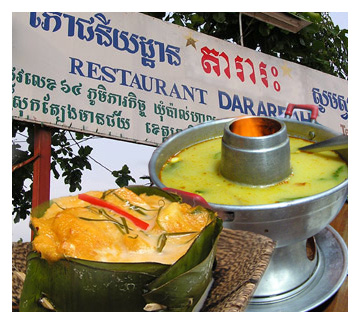
Now, in my apartment, with overhead fans whipping overheated air, Bophal teaches the British chef how to splay a duck, stuff it with ground pork and spices, and sew it back together. She shows us how to dry leftover cooked rice to be deep-fried into cakes, how to use toothpicks to fashion a bowl out of a banana leaf for steaming a fish mousse (called amok), and how a dribble of egg whites on top, just before the sliver of red chilies, helps bring out the green in the herbs. Khmer curries are not like Thai curries, Bophal explains; they’re sweeter, smoother, more Java than India. She says that no one knows how to make the nyoam salad anymore because the matrons who served it in its “right proportions” all died in the war.
In her cooking, Bophal conjures up the Shangri-La of pre-Pol Pot Cambodia. She describes a quiet tropical corner of the world. Shade and space. A rich heritage and a functional religious and social order. Food for everyone. Ceremonial food, like heaping wedding platters of crispy noodle salad, with its colorful vegetable juliennes, both succulent and crunchy under vinegary-sweet dressing. Ingenious snack food, like the pork-stuffed ingots of rice wrapped in banana leaf for easy transport out to the fields. Ritual cakes for the saffron-clad monks. Upper-class foods like spicy fish sausage and peasant baw-baws, rice porridges garnished with zucchini flower and mudfish paste, thought to offer the restorative power of Chinese medicine.
When Bophal teaches us the history of Khmer food, she teaches us the history of Cambodia. The great kingdom of the part of the world we now call Southeast Asia was the seven-century reign of the Khmers at Angkor. Only a sophisticated grasp of rice cultivation, food preservation and irrigation, along with a refined cultural order, could have permitted the grand works of the line of god-kings who, at Angkor’s zenith, presided over a city the size of New York.
The first great unifying Khmer, Jayavarman II, began the Angkorian tradition of the devaraja, or divine ruler, with a self-proclamation in A.D. 802. The devaraja cult, in turn, required formal distinctions between the earthly and the divine. A god-king could not be expected to eat the same glutinous rice ball and pungent soy paste of his subjects. Within a few centuries, the rarefied and genteel Angkorian courts were creating less functional, more formal food, served in ritualistic settings as elaborately refined as their enduring and impressive architecture suggests.
Then, in April 1975, the Khmer Rouge emptied Phnom Penh and began a psychotic social experiment that led to 1.7 million deaths — and a radical rupture with the country’s cultural past. Two scenes in Roland Joffé’s 1984 film “The Killing Fields” illustrate the dearth and desperation Cambodians experienced under the Khmer Rouge: The first shows Dith Pran, the Cambodian protagonist, slicing into a cow’s jugular to suck its blood for sustenance. Pran silences the cowbell with his fingertips to avoid detection. The second shows Pran slumped in the rain-soaked mud of a rice paddy alongside other black-clad forced laborers, horrifyingly joyful to have secretly snagged a tiny salamander to sweeten his tin cup of watery gruel.
But today in Cambodia, the scramble is under way to cash in on the flood of tourists. In Siem Reap, the tourist hub for the Angkor complex, luxury resorts like the Hotel de la Paix serve “haute Khmer” with black-tablecloth elegance, under the motto “Respecting the past, embracing the future.” The French chef there charges $28 for a “traditional Khmer set” that starts with “dried snake and green mango pounded salad” and ends with “assorted Khmer sweets,” and in between somehow manages to make the fermented mudfish sludge known as prahok (ingredients: mudfish, rice, salt; traditionally made by stomping on it in bare feet) into a “Khmer crudité.”
– – – – – – – – – – – – – – – – –
So why can’t I get a good bowl of kuy thiew in New York City? For one, there aren’t many Cambodians here, fewer than 3,000 by last count, and Cambodians generally don’t eat out. But why have just over 4,000 Thai immigrants in New York opened at least 160 restaurants, 47 in Manhattan alone? Something didn’t add up, so I sought out Krishnendu Ray, a professor of food studies at New York University.
Ray writes about the rise and fall of various ethnic cuisines and their relation to immigration and culture. He studies why, for example, Japanese cooking peaked in the 1990s as a high-prestige foreign food, while Chinese food, with a few exceptions, still can’t seem to break some mysterious threshold of elegance and price. In answer to my query, Ray suggested that besides ethnic migrations, world’s fairs, gastronomical proximity, aesthetic cachet and the location of U.S. military bases can play influential roles in shaping American culinary perceptions. The short answer, though, is, “we don’t know why certain cuisines become popular and others don’t,” he said.
Back in the Vietnam War, Ray explained, members of the U.S. military took R&R in Thailand. That fact — and several things that Cambodia seems to lack, such as a middle class, a supportive tourism board and the “entrepreneurial persistence” of the Thais — set it apart from Cambodia. So if the U.S. had openly been in Cambodia during the Vietnam War, we might all be slurping kuy thiew in Little Cambodias? “It can be hypothesized,” Ray says, “but hardly proven.”
More important, though, is the question of whether the Cambodian culinary tradition — the glory and artistry of Khmer food, not $5 noodle shop fare — is something that foreigners are ready to buy. Even before I went to Cambodia, I’d been to the one restaurant in America that had managed to package Khmer food as an exotic, upscale crossover experience: the Elephant Walk, in Boston’s Somerville. Longtiene de Monteiro, and later her daughter Nadsa, won national acclaim in the early ’90s for serving Cambodian (“traditional dishes ranging from everyday street food to aristocratic and royal delicacies”) side by side with French. By 1998, the year Pol Pot died, de Monteiro had published what is still America’s only Cambodian cookbook. It includes this prescient opening: “People in the West simply don’t know very much about the history and culture of Cambodia, so it is no surprise they don’t know anything about the food.”
The de Monteiros understood the power of storytelling in making the jump from ethnic food to foreign cuisine. The Elephant Walk’s menu and staid cloth-napkin décor help sell the narrative of Longtiene’s diplomat husband, their limbo after the fall of Phnom Penh, their shelter in France and the family’s arrival on American shores, where the Cambodian culinary slate was clean. De Monteiro spurns the idea of “fusion,” or what she calls “a forced amalgam of disparate culinary traditions,” and has done more than anyone else to try to establish Cambodian food as a culinary category of its own.
Another place I’d been to eat was Fey Ley’s Cambodian Cuisine — formerly of Fort Greene, Brooklyn. Ley arrived in 1979 as a refugee, after a time in the Thai camps, sponsored by a brother who lived in Lake Placid, N.Y. Ley’s story is atypical of the 206,000 Cambodians who now live in the U.S. in that he chose to move to the city. In his first decade here, Ley learned English at Norman Thomas High in midtown Manhattan, raised three American-born boys, worked in a Japanese restaurant and later for an electric company, began to call himself “Jerry,” drove a taxi and, spurred by praise at family picnics, decided to drop his savings into a restaurant he called “Cambodian Cuisine.”
For a while, it seemed, the novelty was enough to bring in customers. Eric Asimov’s 1997 “$25 and Under” New York Times review begins, “As far as I can tell, Cambodian Cuisine is the only Cambodian restaurant in New York City,” and then spends a lot of time explaining what that means. In response to customer demand, Ley put more Cambodian dishes on the menu. The restaurant found a loyal local following and attracted New Yorkers (like me) who made food a destination.
In the fall of 2006, when I came back to the U.S. from a stint in South America after Phnom Penh, a listing on a New York food Web site said that Cambodian Cuisine was “temporarily closed,” and when I went out to Fort Greene to see for myself, the new owner told me Ley was reopening in Manhattan. A few months later, I tracked down Ley. He took me to the gutted turn-of-the-century storefront on East 93rd Street where he hoped to reopen. His hair was fully gray and his face was wrinkled into a kind of permanently pained look.
He was paying $13,000 a month in rent. There was supposed to be seating for 140. This wasn’t going to be an ethnic dive anymore, but a “real restaurant.” He liked the location because the new place, though still the only Khmer restaurant in New York, was going to sit snugly between an Italian and a Japanese place — in a part of town, he said, where people eat. But then contractors found some defunct piping that would have to be moved and learned that Ley hadn’t negotiated city permits properly.
Ley was soft-spoken, but he couldn’t help ticking his tongue at each described misfortune, as Cambodians do in their everyday speech. “Before, I had a future as a government worker,” he said. Tick. “I was evacuated to the fields from Phnom Penh and made it back to Battambang.” Tick. “When my brother and sister and I made it to the Thai camps, they put us in jail.” Tick. “My family broke apart.” Tick. “I came to America — this restaurant — .” Tick. “My dream, it’s going to be a disaster.”
We hadn’t eaten anything — in fact, we’d retreated to talk in a Starbucks nearby — but when Ley discussed cooking and eating, it was hard not to daydream. I couldn’t help marveling at a man who was in the process of losing everything for the second time, who could talk of being “brokenhearted” and say without irony that he was in “the land of opportunity,” with no desire to return to Cambodia. I wanted it, against the odds, to work out, not just because I felt for him but also because I felt for me. Without Ley, where was I supposed to get my kuy thiew?
– – – – – – – – – – – – – – – – –
A year later, Ley’s has closed (or not reopened) — and in New York, there still has been no Cambodian food craze. Ratha Chau’s Kampuchea Noodle Bar, the Lower East Side spot where I sat slurping noodles and fishing for shrimp, is now the city’s singular outpost for kuy thiew, or at least a version of it.
I meet Chau at his restaurant one stormy afternoon before the evening rush to ask him about Khmer food. Kampuchea has rows of high wooden tables and stools, an open kitchen and a low pass where Chau stands during service, finishing the dishes he has designed.
At 35, Chau is sturdy and tall. His parents are from Phnom Penh, and in 1972, his father, a five-star general, was taken as a Vietnamese POW for 18 years. Chau says they had a “final goodbye” when he was 9, before his mother and her three sons set out as refugees, first to Austria, then to Roxbury, N.Y., then West Hartford, Conn.
Chau says his adolescence in the U.S. wasn’t especially Cambodian, and that his adjustment wasn’t out of the ordinary. His English has the shaped vowels of the Northeast. He speaks Khmer but can’t read or write it, and his memories of a Cambodian cultural upbringing are from birthdays and weddings, not temple visits. After college, Chau and his older brother started a business buying sea urchins from Maine and shipping them to Boston, where they were processed and sent to Japan. When that ended, a friend knew a girl named Nadsa b
Over the next decade, Chau moved up the ranks with the de Monteiros, eventually managing all three Boston branches, then moved to New York, where he worked the managing side of the Blue Water Grill and Asia de Cuba, and later became a managing partner at Fleur de Sel. He married a woman from Shanghai, had a son and set out on his own to try something a little closer to his own sense of self, though he wondered if New Yorkers were ready for it.
“Ready for it?” I said. “This is the food capital of the world!”
“If I said I was opening a southern French restaurant,” Chau said, “people would understand. But if I open a Cambodian place, for some reason, it has to be cheap. It has to have certain classic dishes on the menu, and nobody agrees on what those are. It has to be a hole-in-the-wall. Have you been to Lowell? They’re all dives.”
“I’ve been.”
“Why can’t I move my world in a different direction? I was born in Cambodia, I love my food, I love my country, I eat my food, and I interpret it my way. I grew up here in the United States, and I want to move my flavors along.” He admitted that for personal reasons he has never been back to his native country.
Since our conversation last spring, Chau has changed his establishment’s name to Kampuchea Restaurant — but his menu still calls what he does “a tribute to street food.” Chau says “regular people,” like the neighbors who dropped in specifically to overcome a fear of oxtail soup, don’t want to know if the food is “authentic.” They just want good food. “If Nadsa came in here, she’d say, ‘This is not Cambodian!'” he explains. “She knows a lot more than I do, and she’s probably right.”
Nyoam Mi Sua (Crispy Noodle Salad)
Recipe by Tansy Evans
A standard at wedding feasts in Cambodia, this light, refreshing salad is crunchy and tangy in surprising ways. Though not authentic, roasting the shallots and garlic for the vinaigrette gives a smoother flavor for Western palates. Vegetarians can omit the meats.
Ingredients
1/2 cucumber, peeled, seeded and sliced thinly into half-moons
1 green pepper, seeded and sliced thinly
2 cups red cabbage, shredded very thinly
2 cups white cabbage, shredded very thinly
1 1/2 to 2 carrots, grated
1/4 red onion, peeled and sliced thinly
2 chicken breasts
1/3 pound pork loin
1/3 pound shrimp, peeled and deveined
salt and pepper
4 tbsp fresh mint, whole leaves
4 tbsp fresh Thai basil, whole or half leaves
1/2 cup peanuts, roasted, peeled and crushed
1/2 packet (4 oz.) dry vermicelli rice noodles
vegetable oil for frying
For vinaigrette
2 cloves garlic, peeled; 1 thinly sliced
2 shallots, peeled; 1 thinly sliced
1-2 large dried red chilies
1 tsp salt
5 tbsp sugar
1/4 cup lime juice
2 tbsp fish sauce
3/4 cup hot water or chicken stock
Method
Prepare the vegetables. Take care to make very thin slices of each. In water or vegetable stock, poach the chicken breasts, then the pork loin (10-15 minutes each, depending on the size) and then the shrimp (1-2 minutes).
Shred the chicken and slice the pork into strips. Season the chicken, pork and shrimp with salt and pepper.
To make the vinaigrette, blend the ingredients in a blender or food processor for 3 minutes. Alternatively, with a mortar and pestle, pound the garlic, shallots and chili to a fine purée with the salt, then mix in the other ingredients.
When ready to serve, deep-fry the noodles in hot oil until puffed and crispy, 30 seconds to a minute.
Mix the vegetables and meats with the herbs, peanuts and vinaigrette. Serve over the crispy noodles.
