
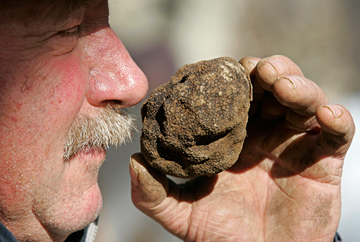

Last spring, I stood in an orchard in eastern Tennessee with a man who cupped in his hands one of the earth’s great treasures. It was black and coarse, about the size of a baby’s fist, and covered in mud. The man, a farmer and scientist named Tom Michaels, lifted it to his nose, closed his eyes and inhaled deeply. He was kneeling before a hazelnut tree, among dozens of rows of hazelnuts and oaks, and his hands were wet from digging. The sun had fallen beyond the mountains and the hillside offered a quintessential Tennessee view — bright red dirt roads, a fine mist in the valley, tobacco barns, blue hills in the distance. When Michaels opened his eyes, he was smiling. “Isn’t it funny?” he said, glancing down at the lump in his grasp. “Everyone’s after this thing and here it is and it looks just like a turd.”
The “thing,” in this case, was a French black truffle, “the black diamond,” a mushroom revered in the circles of high cuisine. Dark and damp and sheathed in what look like tiny warts, it seemed an unlikely object of desire. Yet its scent, among the most powerful of any food, has long inspired a peculiar, almost irrational devotion. It is a paradoxical smell — light and heavy, redolent of both flowers and decay — that contains a hint of something neither nose nor tongue can at first name but which is, in the end, quietly evocative of nothing so much as sex. A sliver of truffle can transform a simple serving of pasta into something mysterious and carnal — a meal for which, as chefs know, you might be willing to empty your wallet. As one woman told me, “If I had a piece of truffle in my mouth, I’d probably say yes to anything.” Or as the Roman scholar Pliny put it nearly 2,000 years ago, “Better to suffer a wheat famine than a shortage of truffles.” Such exuberance accounts for the odd fact that the mushroom in Michaels’ hand — at $800 a pound — was worth more than the watch on his wrist.
Michaels slipped the truffle into a handkerchief in his pocket and together we ambled along between the orchard rows, the remnants of last year’s leaves crunching underfoot. Beneath us, buried in the rich red soil, were untold numbers of black diamonds. Last January, six years after Michaels had planted this orchard, they had begun to appear — a few of them surfacing like gems. Their emergence on this Tennessee hillside was a peculiar thing; until recently such truffles were only to be found in the chalky soils of the Mediterranean. But stranger still, if you consider the history of truffles, is that they could be coaxed into growing at all — that they could, in fact, be farmed. For if the record of our encounters with food is one of ceaseless subjection — we bend to our will the plants we like, we yoke the animals we favor — truffles have long offered a stubborn exception. For most of recorded history, they’ve remained elusive, appearing suddenly in one place one year and then not again the next, a fickleness that led the Greek historian Plutarch to guess that they were the deposits of thunderbolts.
In the red clay of Tom Michaels’ orchard was evidence of the taming of one of the last truly wild foods. And while Michaels is an American pioneer, a Johnny Appleseed of mushrooms, there are others like him — a handful of people who’ve managed, against odds, to produce truffles on American soil. In doing so, they have stolen a cultural cornerstone of Europe — a culinary birthright of the French and Italians, who worship the truffle like no other food. And the ranks of American truffle producers will soon swell. By some estimates there are now several hundred truffle orchards across the States (the numbers multiply yearly), with trees planted, awaiting their virgin crop. If the gods deign it, many of those truffles could begin to appear this winter, in places as far-flung from Europe as King, N.C., and Templeton, Calif., and Eugene, Ore.
– – – – – – – – – – – –
The town of Chuckey sits in the northeast corner of Tennessee, amid the dark valleys of the Smokies, and Tom Michaels lives just outside of the town center, beyond a boarded-up bank and an abandoned hardware store, in a one-story house set on a hill. When I arrived, he greeted me at his doorway, grinning. Nearing 60, with a gray mustache and gray beetling eyebrows, he had the build of a younger man — thick forearms, a broad chest and a wide-set stance. Cats swirled about his legs. “I’m not a dog person,” he said, eyeing them. “In terms of truffles, that might be a strategic blunder.” Dogs, trained to detect the underground scent of ripe truffles, are fixtures on truffle farms (before dogs, trufflers used pigs), and without a beast of one sort or another, locating the mushrooms is maddeningly difficult. When truffles appeared suddenly on Michaels’ property last winter, he paid a man to travel from Oregon with a truffle dog to help him harvest.
Michaels, whose father had been a button mushroom farmer in Illinois, earned a Ph.D. in mycology from Oregon State University, one of the epicenters of mushroom science in the United States. He then went on to run mushroom research and development for Dole Food. Mushrooms have long fascinated him, and truffles have been a decades-long obsession. “I’ve loved fungi all my life,” he told me. “The bug bit me as a kid.”
Truffles, of which there are at least 60 species (and perhaps many more; no one knows for sure), are uniquely priggish — the mushroom equivalent of picky lovers. The black diamond, for instance, will only unite with particular trees (mainly oaks, hazelnuts and filberts) and, like other truffle species, it will only grow under highly specific conditions (extremely alkaline soil, cold winters and warm, wet summers). They refuse planting. You can take an acorn and deposit it in truffle-rich soil and in time, if you’re lucky, the tree that grows there might come to host truffles. But if you take a truffle and bury it along the roots of an oak in virgin soil, in all likelihood nothing will come of your efforts. For most of human history truffles remained a foraged food because, without a means to reliably grow them, and so to alter their genes, we couldn’t improve their predictability. Unlike wheat or maize, they couldn’t be forced into domesticity.
In the early 1970s, the truffle at last relented. Led by mycologist Gerard Chevalier, a team of French scientists discovered a way to inoculate the roots of oak trees with the spores of the black diamond. Their technique, which they kept confidential, was to bathe the roots, under laboratory conditions of sterility, in a fertilized slurry of water and truffle spores. If enough spores took to a seedling’s roots, then the seedling could be planted and in 10 or 15 years, under the right growing conditions, a truffle might fruit. Just as easily, it might not. The process was far from foolproof but it allowed, for the first time, a degree of control over the life of a truffle. Where once truffles were to be found only by hunting in the woods, now they could be farmed.
In time, others learned how to repeat and improve upon the French breakthrough (Tom Michaels has his own secret slurry concoction and inoculates his own trees), and the ripples of that discovery have radiated outward ever since, so that today there are French black truffle orchards not only in France but in Spain, Italy, Hungary, New Zealand, Australia and, finally, the United States. An international industry has developed, with sales in the tens of millions. Truffles are shipped overnight from orchards in Spain and Australia and delivered the next afternoon to the top restaurants in San Francisco, New York, London and Hong Kong. The “wild” black truffle has been relegated to the sidelines as nearly the entire supply of the world’s French black truffles now come from orchards.
But the process of farming truffles nonetheless remains tricky. On account of their economic value, truffles are among the most studied mushrooms on earth and yet scientists still cannot say with any measure of certainty what finally triggers them, after years of dormancy, to fruit, nor precisely when in the year the fruiting process begins, nor why one species of truffle will cling to, say, a hazelnut but not a pine. In part this is a reflection of the truffle’s own peculiar biology and the difficulty with which it offers itself up to study, but it is also a reflection of our state of knowledge about the world of fungi in general. As one mycologist put it to me, “The amount we don’t know is simply vast. It’s much greater than what we do know.”
“Listen,” Michaels said to me, seated at his dining table, “this thing” — by which he meant growing truffles — “is 20 percent science and 80 percent art. Most of the time, we’re shooting in the dark.” As evidence of this, he mentioned, with sorrow and something like bewildered respect, the case of the first attempt to start a large truffle plantation in America: In the early 1990s, a man named Roy Carver planted 45,000 truffle trees in Hext, Texas, at a cost of untold millions, and for his efforts only a few pounds of truffles were ever harvested.
To plant a truffle tree, even today, is still to take one of the larger gambles in farming — and it’s a blind bet. A truffle farmer can help his truffles along — by carefully pruning his trees, liming his soil, watering at the right time — but even so he has little way of telling what’s happening beneath the soil of his orchard, along the roots of his trees. Six or seven or even 10 years might pass before he finds out if truffles will form, years in which he will begin to doubt himself and the wisdom of his pursuit.
I asked Michaels what he thought the chances were that the process could be improved. “We’ll figure it out,” he said, “and there’ll be people who get in big, with big orchards. Heck, if Bill Gates decided he wanted to grow truffles, this industry would change overnight. Ten pounds an acre is laughable! Forty years from now we’ll chuckle that annual world production was once as low as 30 tons. We’ll have 10 times that many truffles! Or more. It’s totally possible to make this a non-elite food. They’ll be able get them down at Safeway.”
It was a bizarre vision, beautiful in its hubris. Michaels, flush with recent success, seemed drunk on that same reckless hope that afflicts gamblers and gold miners — the dream of the big strike. Later, standing with him next to his pickup truck in the soft light of the Tennessee evening, I asked whether he thought he could survive on what he earned from his fledgling truffle farm — not an inconsequential matter now that truffles have become a full-time pursuit for him and he has two children soon to enter college.
His reply came more measured then. “I don’t need to make a killing on this,” he said. “I just want to be able to put a little away, maybe enough, when all the bills are paid, to be able to go on vacation somewhere nice.” He thought for a little while and spoke again in a quiet voice. “I’d like to be able to get a decent piano. I have this fantasy about playing the piano at a little bluesy place.”
As much as he was a hard-nosed scientist, he was also an unreformed romantic, and it made sense that truffles would attract such a man. Only the most hopeful of people could spend years growing a thing that cannot be seen, and that might never consent to appear.
– – – – – – – – – – – –
The godfather of American truffles lives off a dirt road outside of Hillsborough, N.C., in a house he built himself, on land that will someday, if he has anything to say about it, bear him a fortune. In the still small world of American truffle farmers, Franklin Garland has a reputation for being gruff, contentious, proud and undeniably successful. He was the first in the country to produce a truffle, in 1991. As far back as 1978, after he read an article in the Wall Street Journal about the French discovery, he began “fooling around” with truffles. “I like high-tech and agriculture,” he told me, “and truffles are a fusion of the two.”
I had called Garland several weeks before I visited, asking if I might stop by. He was cool on the phone. He wanted to know what publication I worked for. “I don’t trust the New York Times or the L.A. Times,” he said. He wanted to know if I’d talked to “the other guy,” his competitor (upon whom he’d dropped a cease-and-desist letter). He wanted to know what my “angle” was. In Garland, I hoped to take some measure of the future of Americans truffles, to see where all of this was headed. With his wife and two employees, he’s in the business of selling inoculated truffle trees, using his own secret inoculation recipe and producing something on the order of 30,000 seedlings a year (which he sells at $22 a piece). He also consults with prospective farmers, many of them in neighboring towns. The climate of the Carolinas is, Garland says, well suited to truffles; he calls it the Mediterranean of the United States. His method for growing truffles (what sun exposure to look for, how much lime to use, how to prune) is classified, but for a price — and a confidentiality agreement — he’ll share it with anyone. He told me he can “force” truffles to appear in six years. He’s had hundreds of clients — among them, 50 tobacco farmers in North Carolina who are testing the idea of truffles in a time when tobacco is suddenly no longer a sure thing.
Chief among Garland’s concerns was the Chinese truffle, an ignominious cousin to the French black truffle. In almost all respects, it resembles the black diamond — in color, size and, if you slice it up, even in the appearance of its spores. It has a very weak smell, however, and so for culinary purposes it’s practically useless. It sells for $50 a bushel. Yet placed among French truffles for a period of time, a Chinese truffle will come to absorb their scent for a few hours. When it first appeared in Europe in the mid-1990s, all manner of scams were perpetrated, roiling the truffle markets.
Subterfuge has always been part of the truffle story. “Truffles are subterranean in every sense of the word,” says Charles Lefevre, an American truffle authority. “They evoke a criminal mentality.” In Europe, there are tales of truffle poachers with night vision goggles, of dogs being poisoned with strychnine meatballs. There are rumors of mafia connections, of truffle muggings. Americans, in their truffle innocence, seem suitable targets for such chicanery and Garland told me he was worried about the credibility of the industry. “Americans aren’t knowledgeable about mushrooms,” he said. “And most chefs here can’t tell the difference between a real truffle and a fake, which is why I have famous chefs calling me up and asking me to look at their truffles.”
I asked him if the days of $800 truffle prices might be numbered, especially as more and more growers get in on the act. He didn’t pause. “To produce enough volume so that the price comes down,” he said, “it will take 30 to 40 years. And even if the price drops to $350 a pound, it’s still going to be profitable. Truffles are the highest paying legal crop in the world. This industry is in its infancy here. And so is the American appetite for truffles. Until a few years ago, most Americans thought truffles were chocolate. Now I can go into some podunk town in North Carolina and the kid changing tires at the gas station will know what truffles are. So I don’t think we’ll ever be lacking in demand. This is going to grow. By a lot.”
Mushrooms have not always been the fanciful food they are today, nor as rare. At the turn of the 20th century, Europe was procuring somewhere between 1,000 and 2,000 tons of truffles a year. By comparison, the worldwide harvest today hovers between 20 and 40 tons, an amount that could fit into just a few cargo containers. Truffles were so plentiful a century ago that they were eaten in portions that simply stagger the mind: dropped, like matzo balls, into soups; tucked whole into fowl. Whereas today you’ll be lucky to have a few slivers of a truffle sliced onto your plate (at outrageous expense), a recipe for “truffles in cream” in the first edition of “Le Guide Culinaire,” Auguste Escoffier’s 1903 bible of French cuisine, calls for a pound of the mushrooms, raw and peeled — a meal that would cost nearly a thousand dollars today.
The truffle boom of a century ago made the fortunes of hundreds of Frenchmen, and, talking with Garland, I wanted to know if the same riches might be bestowed upon farmers here. I asked how much he thought he could make. In the shroud of secrecy that hovers over the truffle world, people are reluctant to tell you even where their truffle orchards are, let alone how much money they’re pulling from the ground. But Garland smiled knowingly and nodded his head and pointed out the window to an open expanse of meadow beyond his house. “That’s 15 acres,” he said. “Even if the price drops to $500 a pound, if I can manage to get 50 pounds an acre, by the time I retire I’ll be making a quarter of a million dollars a year. That’s pretty good, don’t you think?”
– – – – – – – – – – – –
“How many kings and queens eat truffles three times a day?” Rick Smith asked me. “Well, we’re hoggin’ it in.” With his wife, Jane, we were standing in the kitchen of their home in King, N.C., a suburb of Winston-Salem. The Smiths, both retired, were the latest truffle success story; as with Tom Michaels, truffles had arrived in their orchard last winter. Unlike Michaels, however, they had no mushroom or even farming background: Jane had been a corporate secretary, Rick had worked for an electronics company; their trees came six years ago from Franklin Garland.
“Truffles didn’t do anything for me at first,” Rick told me. He spoke in an unhurried way, in a thick Carolina accent. “Now I love ’em,” he said. “I put truffle butter on spaghetti. On cinnamon toast. On sweet potatoes, popcorn, chocolate chip cookies.” As if to underscore this point, he began handing me Triscuit crackers slathered in his homemade low-fat truffle margarine.
I was with the Smiths in the wake of their brief flirtation with the national spotlight. In January, just a few weeks after they unearthed truffles, Martha Stewart came to visit them, trailed by a phalanx of television cameras. Now, two months later, they still seemed faintly shell-shocked by the experience. Jane was handing me photos that her daughter took of the visit: Martha with a crowd of production assistants, Martha next to her black Hummer. “She was so nice,” Jane said. “It was just like having a friend come to visit.” Across the room, the tape of the Stewart show was playing. There was Martha in a red topcoat, trudging along in the Smith’s muddy backyard orchard. And there were Rick and Jane, standing quietly to one side, slightly awestruck.
In the kitchen, Jane confessed that she didn’t care much for truffles at first. “The smell,” she said, wrinkling her nose and almost shuddering.
The smell of a truffle is a stroke of evolutionary cunning. Mycologists believe that truffles likely evolved from above-ground fungi into below-ground fungi in order to protect themselves from drying out. In their skin-encapsulated sacks, truffles can survive in some of the most arid conditions in the world (among other places, they can be found in the deserts of Mesopotamia). But hiding underground deprived them of the tool by which mushrooms have always dispersed their spores: the wind. So the truffles took a new tack. They developed a smell strong enough to permeate several inches of soil and compelling enough to draw the interest of passing animals. By coaxing us to eat them, and thus scatter their spores, they effectively rendered us agents of their own bidding.
Truffles have perpetrated against us a great scam of natural history. Of little nutritional value themselves, they’ve manipulated us into eating them, providing, in return, a rare sensory treat but little nourishment. And truffles were clever. By appealing to our sense of smell, they slipped through the unguarded back door of our consciousness — for smell, in evolutionary terms, is one of the oldest of the five senses. It has few connections with the “younger” parts of the brain, where language is formed, but it holds many connections with the “older” parts of the brain, where emotions reside. Unlike other senses, smells can bypass our powers of reasoning; they can act on us in surprising ways.
In the kitchen, as Jane and Rick and I shoveled truffle Triscuits down our throats, Rick shared with me the dream that had come to him the previous night. “It’s night,” he said. “I’m coming into the orchard close to the ground, like a mole. And what I see is that the ground is cracked and bursting with truffles. There are truffles everywhere. There are truffles under every tree. The whole orchard is filled with truffles.”
“We should be so lucky,” said Jane.
– – – – – – – – – – – –
Not long ago, I passed an afternoon with a man who’d spent years searching New Jersey for a thing that couldn’t be found: the Italian white truffle. He was a mason, born in Italy, and had come to the States when he was 20. In his 40s he began going out into the woods of southern New Jersey with his dog, searching for truffles. He found some, he told me, but never the white truffle, the truffle of his homeland (it was he who told me, proudly, about the largest truffle ever found: an Italian white, weighing five and a half pounds, delivered as a gift to Harry Truman in 1951). His was a doomed quest, although he couldn’t see this or wouldn’t admit it to himself. While there are edible truffle species native to the U.S — including the Oregon white truffle, which grows along the roots of the Douglas fir in the Pacific Northwest — none of those discovered so far possesses the singular scent and flavor of the Italian white, a truffle that has never been found very far outside the hills of northern Italy. But the man was obstinate, even obsessive, and his search, in time, took him to Pennsylvania, Georgia and the Carolinas. He’s 61 now. If he was younger, he told me, he’d go to California. “That’s where it’ll be,” he said. I asked if he would take me with him on a hunt and show me where he’s found truffles. He looked at me in a pitying way. “I wouldn’t tell my own brother that,” he said.
The world of truffles harbors those at the hopeful fringes — hustlers and gamblers and dreamers of the most determined sort. The dream of the truffle farmer is a dream of control: to bend the truffle to our wishes, to make it grow where it has not yet appeared. In pursuit of this we have poked and prodded it, subjecting an ancient and willful thing to all the tools of our modern minds. And in the end, we may have tamed it, insofar as one can tame a thing that is still only half understood. But it might be fair to say, too, that the truffle has tamed us. For in humans it has found a mammal far superior to pigs in scattering its spores. Through us it has succeeded in delivering its DNA to the far corners of the globe. Perhaps ours is a partnership, as between truffle and tree. We clear a path for the truffle, lifting it from the scrum of life, ensuring its survival among a multitude of competing fungi. And in return, the truffle grants us a taste of haunting pleasure.
Whether that taste will appeal to Americans is another matter. We are not, by inclination, a mushroom people, in the way that Europeans are. We have no history of mushroom picking in this country. In general, we tend not to trust the fungi family — fearing, not unreasonably, for our health. Evidence of this distrust can be found in the market itself: While sales of button mushrooms (white and smooth, the Bambi of the mushroom universe) have climbed slowly but steadily over the past few decades, other mushrooms have fared far less well. Oyster and shiitake mushrooms have managed to seize just 2 percent of the mushroom market, and sales in recent years have slunk. Could truffles — cased in pimply shells, dirt-encrusted, smelling of things scandalous — ever find a foothold in the gleaming white world of American cuisine? And if they manage to, and if they become more popular, will that itself detract from their appeal? For quite apart from the taste of the truffle is its scarcity. We love a thing that resists us, and truffles, like few other foods, have held us at bay.
