Under legislation approved Monday night by Baltimore's city council, crisis pregnancy centers that do not offer referrals for abortion or birth control would be required to post signs saying as much. It seems like such a reasonable plea for transparency! After all, these types of centers are infamous for engaging in religiously- and politically-motivated deception of pregnant women -- and yet, if the city's mayor signs the measure, it will be the very first law of its kind in the U.S.
Time and again, we've written about how crisis pregnancy centers masquerade as legitimate healthcare facilities and target young, poor and minority women by offering free pregnancy tests and counseling. In reality, these centers, which are often staffed by unqualified volunteers, provide medical misinformation as a means of coercing women into going through with a pregnancy and, in some cases, to give the baby up for adoption (to a good Christian family, natch). Some clinics have been found to delay pregnancy test results so they can first subject patients to graphic anti-abortion imagery and propaganda.
This measure is bolstered by more than crisis pregnancy centers' well-established reputation nationwide: Last year, the NARAL Pro-Choice Fund sent staff members into 11 Maryland centers in particular to pose as potential patients and reported that "every CPC visited provided misleading or, in some cases completely false, information" about abortion and birth control." For good measure, the clinics also threw in "emotionally manipulative counseling" (for example, one worker told an investigator, "You need to come meet your baby before deciding what to do"). Worse yet, many clinics "purposefully schedule sonogram appointments two-three weeks after the initial appointment to ensure that there will be a heartbeat and that the pregnancy is larger than a grain of rice." (If you're short on outrage today, I highly recommend reading the report in its entirety.)
What makes these centers so pernicious is that they calculatedly project "an aura of medical authority," as the NARAL report puts it, when in reality they are largely "amateur-run." This measure aims to chip away at that facade. Frankly, the legislation could go much farther and actually require them to cop to the totality of their dishonesty -- these clinics should be happy they're getting off so easy.
What if you threw a protest and nobody came? Operation Rescue founder Randall Terry did just that in Fort Wayne, Indiana, the first stop on a planned 13-city tour in which Terry intends to inform people that the senate healthcare reform bill "will essentially fund abortions." According to the Fort Wayne News-Sentinel, "A few reporters and photographers, Terry and two passersby were the whole rally. Terry's target, U.S. Sen. Evan Bayh and Bayh's entire staff inside the E. Ross Adair Federal Building, were no-shows." "
I'm really not qualified to speculate about what goes on in the minds of anti-choice protesters, but here are a few possible reasons why folks didn't show up for Terry's rally:
1) He's full of crap. As Tracy Clark-Flory wrote in Broadsheet last week, "The key details of the Senate bill are as follows: Both public and private plans are allowed to offer abortion coverage. It empowers consumers to use government subsidies to purchase insurance that covers abortion, but requires that their premiums (and not federal funds) pay for the actual procedures. The Health and Human Services Secretary is charged with evaluating plans to ensure that taxpayers do not pay for abortions."
2) "Taxpayers shouldn't have to fund things they find morally repugnant" is always a weak argument, but it's especially weak right now. I mean, I could give you a list of a dozen things I'm appalled to fund indirectly with my taxes, but these days, do I really need to enumerate any beyond "war" and "other war"? Oh, hell, let's throw in executions, too. Because if you really want anyone to take your "taxes shouldn't fund murder" complaint seriously, we've got a whole lot of dead autonomous human beings to account for at both the federal and state levels before we even begin discussing fetal personhood.
3) Most disturbingly, he's threatening violence, and not even trying to be subtle about it.
"If the U.S. Senate passes this bill and they try and force Americans to pay for child-killing by abortion, they are sowing the seeds of violence in this country," Terry said from the sidewalk in front of the Federal Building.
"We fought a war over slavery, we fought a war over a tea tax. What do people think will happen if they try to force us to pay for murder?"
Um, those most fiercely opposed to murder will start... murdering? Even more than they already have? That sure seems to be what you're saying, there, buddy. And despite a revolting amount of support for the monsters who assassinate abortion providers, most mainstream anti-choicers are not on board with that. At least, not openly.
But please, Randall Terry, do carry on with your campaign to raise awareness about made-up issues. We at Broadsheet wish you every bit as much success as you've already had.
Ah, compromise! There's nothing like an extreme assault on women's reproductive rights to make you truly appreciate moderation. On Wednesday night, Senate Majority Leader Harry Reid introduced the proposed Senate healthcare bill, which trades the House's stringent Stupak-Pitts language in favor of a limited ban on federal funding of abortions. Essentially, the bill applies the restrictions found in the Hyde amendment to the healthcare bill. Stupak supporters may claim their amendment accomplishes the same thing -- but, as we've repeatedly written in Broadsheet, it goes much farther.
The key details of the Senate bill are as follows: Both public and private plans are allowed to offer abortion coverage. It empowers consumers to use government subsidies to purchase insurance that covers abortion, but requires that their premiums (and not federal funds) pay for the actual procedures. The Health and Human Services Secretary is charged with evaluating plans to ensure that taxpayers do not pay for abortions. And, while the bill requires at least one plan in each state to cover abortion, it also includes a conscience clause stating that healthcare providers cannot "be discriminated against because of a willingness or an unwillingness ... to provide, pay for, provide coverage of, or refer for abortions."
It's a true compromise bill. Meaning, it seems, that now both sides have something to be unhappy about. Doug Johnson, the National Right to Life Committee's legislative director, issued the following statement last night: "Reid has sought to please the militant minority that demands funding of abortion through federal programs, even though substantial majorities of Americans believe that abortion should be excluded from government-funded and government-sponsored health programs." Along similar lines, anti-choice Sen. Ben Nelson told The Hill: "I think you need to have it eminently clear that no dollars that are federal tax dollars, directly or indirectly, are used to pay for abortions and it needs to be totally clear." Presumably, "eminently clear" means Stupak-Pitts.
On the other side of the divide, a press release from NARAL Pro-Choice America said President Nancy Keenan is "encouraged that the Senate bill does not include the extreme new anti-choice restrictions adopted by the U.S. House" but notes that "the legislation includes a compromise that continues existing laws that unfairly single out abortion care, including a ban on federal funding." Nancy Northup, president of the Center for Reproductive Rights, was more supportive of the bill: "It is absolutely critical that the compromise language in the Senate bill prevail in any health reform legislation," she said in a statement. Lest you think she's perfectly happy with the new bill, Northup added, "Women have compromised their needs substantially to pass the bill, and Senator Reid's merged bill contains even more stringent segregation of funds and other requirements to ensure that no federal money will pay for abortion services. Enough is enough, and there can be no further weakening of protections for women and their healthcare needs." Now that's a choice -- ehem -- note to end on.
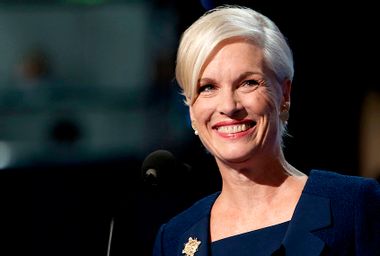
Update: More pro-choice organizations have weighed in on the Senate bill. Consistent with the comments above, Cecile Richards, president of Planned Parenthood, just issued the following statement:
The Senate bill ensures that no federal funds will pay for abortion, which is in keeping with the 33-year consensus based on the passage of the Hyde amendment in 1976. While we don’t agree with Hyde or approve of the fact that the Senate bill singles out abortion from all other medical procedures, we believe that the Senate bill respects the Hyde consensus, while allowing women with private health insurance the choice of plan, coverage, and providers.
Terry O'Neill, president of the National Organization for Women, however, took a more aggressive stance. "The Senate version of the health care bill, released last night, purports to be less harsh, but make no mistake: the anti-abortion provisions of this bill are harmful to women. What's worse, we know there will be an attempt to amend the Senate bill to go all the way with a provision mirroring the House's Stupak-Pitts Amendment," she said in a statement. "Anti-abortion measures have no place in health care reform!"
I started the week biting my nails thinking about how the logic behind Stupak-Pitts could be more broadly applied. A Politico report about how Americans get $250 billion a year in tax breaks to buy employer-based plans, many of which offer abortion coverage, is to blame. I picked up the phone and called some of the amendment's supporting Congress members and anti-choice organizations to ask whether they might target such plans. Of course, my phone calls got me nowhere -- why would they reveal their long-term strategy to me? -- but, no matter. Now I realize my question was naive to begin with, because according to new analysis by George Washington University, it's possible the amendment itself could essentially bring about the same result.
Based on how the insurance industry "adjusts its products over time to conform to the regulatory environment in which it operates," the report concludes that Stupak-Pitts would "have an industry-wide effect." In short, it wouldn't just impact plans purchased through the new health insurance exchange. The most dramatic of those wide-reaching changes is that it will eliminate "coverage of medically indicated abortions over time for all women." That's no typo -- they truly mean all women (in the United States). The analysis explains:
The health benefit services industry, like any large producer of goods and services functioning in a national economy, depends on standardization and norms. If certain types of products are excluded in certain large markets, over time the market as a whole for the product can be expected to shift, as manufacturers move to accommodate their product to reflect the regulated design.
Insurance coverage of contraception offers a choice example of how this works:
Prior to the enactment of state contraception coverage mandates, most health plans did not provide the benefit. As state laws regulating the inclusion of contraceptives have become more prevalent, the broader health benefit services market has been affected. National health benefit services companies report today that they routinely include contraceptive coverage in their plans in all markets, not only those directly affected by state law.
As I mentioned earlier, those of you covered by employer-based plans should also take heed -- we aren't just talking about plans sold in the new exchange: "As the proportion of women of childbearing age covered by an abortion-related treatment exclusion grows, companies offering coverage products in the employer-sponsored market ultimately may elect to simply remove the procedures from their products so that they can be sold in all markets." The report also predicts that "health plan administrators will err on the side of coverage denial" when "interpreting and applying the exclusion." Why? Because of course "the legal risks associated with coverage determination are all on the side of incorrectly awarding coverage, not erroneously denying it." Ah, great.
Finally, there is the issue of those already much-maligned "riders." "It is essential that the supplemental coverage be administered in conjunction with basic coverage," the report says -- but, of course, Stupak-Pitts' requirement of strictly separate cash flow channels prevents this from actually happening. In other words, "the terms and impact of the Amendment will work to defeat the development of a supplemental coverage market for medically indicated abortions."
So goes a week in my post-Stupak life: I start off with one nail-nibbling concern and just a couple of days later I have many, many more.
Rep. Bart Stupak, D-Mich., isn't making many friends with one of his party's key constituencies. The amendment he drafted and got attached to the House's healthcare reform bill, which restricts abortion coverage, has become perhaps the most controversial aspect of the legislation on the left. And now he's taking a tough line on the possibility that the amendment could be changed or stripped altogether.
"They're not going to take it out," Stupak said of Senate Democrats during an appearance on "Fox and Friends" Tuesday morning. "If they do, healthcare will not move forward ... At least 10 to 15 to 20 of us will not vote for it."
Without those votes -- and those numbers about line up with a count that House Majority Whip James Clyburn, D-S.C., has previously offered -- the House can't pass the bill.
(Hat-tip to the Hill's Blog Briefing Room.)
Update: On the other hand, pro-choice Rep. Diana DeGette, D-Colo., said on an ABC News webcast Tuesday, "I think [Stupak] won't have the votes when people explain to those members what exactly the Stupak amendment does."
That's at least worth noting, but probably not much more than that -- DeGette's not talking about an actual whip count, but is hoping for a certain outcome.
Heard the new joke about healthcare reform? It's so funny you might forget to laugh -- and skip straight to crying. That's the aim of the stand-up routine delivered in the Center for Reproductive Rights' new ad against the Stupak-Pitts ban on abortion coverage. Check out the video or skip to my recap below:
The spot opens in a nightclub with a female comedian wielding the mic: "So, this woman goes to her doctor. She says: 'Doc, my back is killing me, does my insurance cover a breast reduction?' And the doctor says, 'Yes it does.'” The audience giggles. She goes on: "A guy goes to his doctor. He says: 'Doc, I can't breathe out of this side of my nose. Does my insurance cover a nose job? And the doctor says: 'Yes, it does.'" Again, laughter. She continues: "Another woman walks into her doctor’s office. She says: 'Doc, I’m 11 weeks pregnant -- my baby has anencephaly, parts of its brain and skull are missing. It’s fatal. Does my insurance cover an abortion?' And the doctor says: 'Oooh, no it does not.'” Cue deafening silence, audience members shifting uncomfortably in their seats.
Not so funny, is it? In a press release, CRR gives a run-down of key facts: 1.) "A majority of private health insurance plans now provide coverage for abortion services," 2.) "One in 3 women will have an abortion within her lifetime," and 3.) "Abortion is one of the most common surgical procedures." Under Stupak-Pitts, however, neither the new private plans nor the more affordable public option would cover abortion. On the ad's accompanying Web site, NoAbortionBan.org, you can tell Congress just how unamused you are. It will take all of 30 seconds -- half the time it took you to watch the video itself.
The abortion doctor
Susan Wicklund has received death threats and worn a bulletproof vest to work. But what really scares her, she writes in "This Common Secret," is the war on reproductive rights.
By Eryn Loeb, Salon
How abortion changed the world
From a sketchy underground doctor to the American fight against communism, a look at the unlikely forces that helped spread global family planning.
By Michelle Goldberg, Salon
What's wrong with the new pro-lifers
The progressive anti-abortion movement still doesn't truly value the life and identity of the mother.
By Frances Kissling, Salon
Is there a next generation of abortion providers?
As if the threat of violence and divisive politics weren't enough, getting trained is almost impossible.
By Kate Harding, Salon
When abortion was a crime
Reagan, an assistant professor of history, medicine and women's studies at the University of Illinois, dedicates her disturbing work on abortion in America before Roe v. Wade to "the lives of... women who died trying to control their reproduction."
The abortion debate
An incredibly interesting debate that looks at both the pros and cons of abortion from a secularist viewpoint.