

President Bush continues to encounter war critics in the unlikeliest of places — the United States military, for example. Last summer, retired Gen. Brent Scowcroft, who served as national security advisor to Bush’s father during the Gulf War, bluntly expressed his doubt about a unilateral war against Iraq. A few weeks later, a trio of four-star generals appeared before Congress to echo that concern.
One of them was Gen. Wesley Clark, a former NATO military commander. “If we go in unilaterally, or without the full weight of international organizations behind us, if we go in with a very sparse number of allies, if we go in without an effective information operation … we’re liable to supercharge recruiting for al-Qaida,” Clark said.
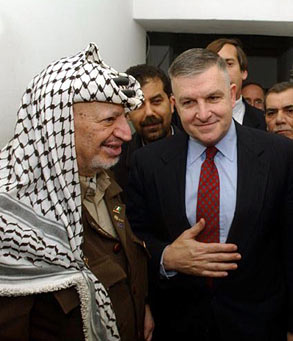
Now comes retired Marine Gen. Anthony Zinni, former head of Central Command for U.S. forces in the Middle East, who has worked recently as the State Department’s envoy to the region with a mission to encourage talks between Palestinians and Israelis. Zinni, a Purple Heart recipient who served in Vietnam and helped command forces in the Gulf War and in Somalia, spoke last Thursday in Washington at the Middle East Institute’s annual conference and laid out his own reservations about a potential war with Iraq.
In a keynote address striking for its critical assessment of the Bush administration, Zinni stressed the need to get the Israeli-Palestinian peace process back on track, build a broad coalition against Iraq, create trust among allies in the region — and put Saddam Hussein’s threat in perspective.
He also took issue with hawks in and around the administration who downplay the importance of Arab sentiment in the region. “I’m not sure which planet they live on,” Zinni said, “because it isn’t the one that I travel.” And he challenged their suggestion that installing a new Iraqi government will not be especially difficult. “God help us,” he said, “if we think this transition will occur easily.”
Following his speech, in an exchange moderated by former U.S. ambassador to Israel Edward Walker, Zinni answered questions from the audience. In that session he was even more pointed as he discussed the possible consequences of an attack on Iraq and why war should always be used only as a last resort.
What level of troops do you think that we’re going to have to invest in order to carry out an operation in Iraq?
I’m a subscriber to Colin Powell’s doctrine: Use overwhelming force. As a military man, I bristle against ideas of small forces and of surrogate forces that we trust that can draw us into things. We then become responsible for their actions and for their welfare; that can suck us into cities and places where units are still fighting that wouldn’t normally fight us if we overwhelmed the situation.
We do not want to get involved in something that is done on the cheap or that is done in a way that maximizes destruction or leaves doubt in the minds that might fight us that they have any other option and don’t have a clear way … to remain intact and have a possible role in [building] a much more viable Iraq.
Do you think the war is unavoidable? Do you think that we are rushing into the war with Iraq without studying the consequences?
I’m not convinced we need to do this now. I am convinced that we need to deal with Saddam down the road, but I think that the time is difficult because of the conditions in the region and all the other events that are going on. I believe that he can be deterred and is containable at this moment. As a matter of fact, I think the containment can be ratcheted up in a way that is acceptable to everybody.
I do think eventually Saddam has to be dealt with. That could happen in many ways. It could happen that he just withers on the vine, he passes on to the afterlife, something happens within Iraq that changes things, he becomes less powerful, or the inspectors that go in actually accomplish something and eliminate potential weapons of mass destruction — but I doubt this — that might be there.
The question becomes how to sort out your priorities and deal with them in a smart way that you get things done that need to be done first before you move on to things that are second and third. If I were to give you my priority of things that can change for the better in this region, it is first and foremost the Middle East peace process and getting it back on track. Second, it is ensuring that Iran’s reformation or moderation continues on track and trying to help and support the people who are trying to make that change in the best way we can. That’s going to take a lot of intelligence and careful work.
The third is to make sure those countries to which we have now committed ourselves to change, like Afghanistan and those in Central Asia, we invest what we need to in the way of resources there to make that change happen. Fourth is to patch up these relationships that have become strained, and fifth is to reconnect to the people. We are talking past each other. The dialogue is heated. We have based this in things that are tough to compromise on, like religion and politics, and we need to reconnect in a different way. I would take those priorities before this one.
My personal view, and this is just personal, is that I think this isn’t No. 1. It’s maybe six or seven, and the affordability line may be drawn around five.
I want your opinion of what the Iraqi people want. Are they going to greet our troops as liberators?
I think that, again depending on how this goes, if it’s short with minimal destruction, there will be the initial euphoria of change. It’s always what comes next that is tough. I went in with the first troops that went into Somalia. We were greeted as heroes on the street. People loved to see us; when the food was handed out, the water was given, the medicines were applied, we were heroes. After we had been there about a month, I had someone come see me who said there was a group of prominent Somalis that wanted to talk to me. I met with them. The first question out of their mouths was that we’d been there a month, hadn’t started a jobs program, and when were we going to fix the economy? Well, I didn’t know it was my Marine unit’s responsibility to do that.
Expectations grow rapidly. The initial euphoria can wear off. People have the idea that Jeffersonian democracy, entrepreneurial economics and all these great things are going to come. If they are not delivered immediately, do not seem to be on the rise, and worse yet, if the situation begins to deteriorate — if there is tribal revenge, factional splitting, still violent elements in the country making statements that make it more difficult, institutions that are difficult to reestablish, infrastructure damage, I think that initial euphoria could wane away. It’s not whether you’re greeted in the streets as a hero; it’s whether you’re still greeted as a hero when you come back a year from now.
Do you believe that Iraq is the endgame or is this only the precursor to engagement in Iran, Syria and Saudi Arabia as some journalists have projected? If there is this widening role for the United States in the region, do we have the necessary military forces and other resources to confront this kind of mega-involvement?
I have a couple of heroes. One is George C. Marshall, a great general that led us through a great war to victory. Look what that general did after the war. He didn’t look to fight more wars; he didn’t look to leave the situation in the condition in a place where those wars would re-breed themselves.
Look at Gen. MacArthur in Japan. He was a man who suffered through Bataan and Corregidor and lost his troops to a horrific enemy. He reached out to the Japanese people and used other means to re-create stability and prosperity. Look at Gens. Grant and Lee, where Grant wanted the mildest of surrenders where dignity was maintained and where friendship and connection could happen, where Robert E. Lee did not want to go into the hills and fight guerrilla wars. He knew it was a time to heal and to do it at the best level.
Like those generals who were far greater than I am, I don’t think that violence and war is the solution. There are times when you reluctantly, as a last resort, have to go to war. I will tell you that in my time, I never saw anything come out of fighting that was worth the fight. I’m sure my brother who served in Korea, my cousins who served in the Pacific and in Europe in World War II, and my father who fought for this country in World War I with the other 12 percent of Italian immigrants who served in the infantry may all have different views of their wars.
My wars that I saw were handled poorly. I carry around with me a quote from Robert McNamara’s book “In Retrospect.” Unfortunately, this was written 30 years after a war that put 58,000 names on that wall, caused 350,000 of us to suffer wounds that crushed many lives. He said: “One reason the Kennedy and Johnson administrations failed to take an orderly, rational approach to the basic question underlying Vietnam was the staggering variety and complexity of other issues we faced. Simply put, we faced a blizzard of problems. There were only 24 hours in a day, and we often did not have time to think straight.”
Well, Mr. McNamara, my 24 hours a day and my troops’ 24 hours a day were in a sweaty hot jungle bleeding for these mistakes. When he resigned in 1968, he didn’t want to do it in a way where he objected openly to the war. There were many more years of that war left, and many more casualties occurred. I wish he had stood up for that principle.
I would just say to you that if we look at this as a beginning of a chain of events, meaning that we intend to solve this through violent action, we’re on the wrong course. First of all, I don’t see that that’s necessary. Second of all, I think that war and violence are a very last resort, and we have to be careful how we apply it, especially now in our position in the world.
Talking about last resorts is a very difficult question and not one that we can answer here; it’s up to another country really. What do you think Israel should do if it is hit with nonconventional weapons?
I think every country has the right to defend itself, and every country has that reserved right to protect its people. I don’t think we could dictate to any nation what its reaction ought to be. That’s a political decision their leadership must make. The prime minister will have to make that decision as to what he feels is in the best interest of his own people and in his own interest. There is no doubt that this will be tested.
General, how do you think the war on Iraq would affect regional allies, particularly Pakistan, Egypt, Jordan and Saudi Arabia?
I think Pakistan will be extremely worried about us getting distracted from the subcontinent, Central Asia and Afghanistan. There is the possibility that it will encourage or incite extremists within that region and within their own country to react. They’re going to look, I think nervously, to see whether we stay committed, that we’re able to handle two fronts or more.
For Jordan and Egypt, if the war is drawn out, the reactions on the street are going to be extremely dangerous for both regimes and may present significant problems in their abilities to support and deal with problems that may emerge from their own street. I think Saudi Arabia will support us. I think they are going to have a lot of difficulty with the decision to go in, unless a clear case is made. It will help in all these countries that there is a clear U.N. resolution that supports this; they can do it in the name of the U.N. I think in all cases the biggest problem is going to be internal. The images that come back and burn across the region are going to decide the greatest problems that each one of those is going to have to deal with.
Could you define success in the context of a military operation and what failure might be?
Well, success in a military operation isn’t only defined in military terms. We tried to do that in Vietnam by body counts and it didn’t work. Success in a military operation has to be measured in success in the political objectives that you’re out to achieve.
I think success will not be measured by what happens in the fight. I would hope in a military context that casualties are minimal all the way around, that destruction is minimized, and that the rapid conclusion of the fighting occurs in a way that we don’t create long-standing hatreds, frictions or security problems in the region. But the military success of this is just the beginning of the beginning. What is going to end up being a deciding factor as to whether this is a success will be what happens to Iraq in the aftermath, whether it stands up as a viable democratic multirepresentational nation with its territory intact, not threatening its neighbors and disavowing weapons of mass destruction. All of those component parts are going to be difficult to pull together. That will be the measure of success.
I don’t believe that we ever lost a battle in Vietnam. I don’t believe we ever lost a battle in Somalia. I don’t believe we ever really lost a battle once we committed ourselves to Korea, but we didn’t resolve the situations politically the way we wanted to in any of those instances. So military success, in and of itself, is never the complete answer. Success will have to be measured not in military terms but in political terms in what is left behind. That will be the mark of what we are — what we leave behind in this.
