

On Feb. 8, 2001, the federally funded International Republican Institute’s (IRI) senior program officer for Haiti, Stanley Lucas, appeared on the Haitian station Radio Tropicale to suggest three strategies for vanquishing Haiti’s president, Jean-Bertrand Aristide. First, Lucas proposed forcing Aristide to accept early elections and be voted out; second, he could be charged with corruption and arrested; and finally, Lucas raised dealing with Aristide the way the Congolese people had dealt with President Laurent Kabila the month before. “You did see what happened to Kabila?” Lucas asked his audience.
Kabila had been assassinated.
IRI’s communications director, Thayer Scott, in an interview with Salon, characterized Lucas’ radio remarks as “a comparative analysis of countries that embrace democracy and those that do not.”
Whatever the case, Lucas and IRI, a nonprofit political group backed by powerful Republicans close to the Bush administration, did more than talk. Throughout the last six years, IRI, whose stated mission is to “promote the practice of democracy” abroad, conducted a $3 million party-building program in Haiti, training Aristide’s political opponents, uniting them into a single bloc and, according to a former U.S. ambassador there, encouraging them to reject internationally sanctioned power-sharing agreements in order to heighten Haiti’s political crisis. Moreover, Lucas’ controversial personal background and his ties to Haitian opposition figures with violent histories — including some who participated in a coup against Aristide in February — raise questions about whether IRI’s Haiti program violated its own guidelines and those of its funders.
The recent political turmoil in Haiti and in Venezuela (where the Bush White House tacitly supported a coup against President Hugo Chavez in 2002, and where IRI also has a murky history of involvement) reflect a troubling pattern in the Bush administration’s prevailing approach to the export of “democracy.” When George W. Bush entered the White House in 2001, he adopted a policy of studied neglect toward Haiti, scaling back President Clinton’s policy of direct engagement while appointing veteran anti-Aristide ideologues to key State Department positions. Meanwhile, the well-connected, smooth-talking Lucas acted as the Haitian version of Ahmed Chalabi, the Iraqi exile who helped neoconservatives in Washington promote the war against Saddam Hussein. Like Chalabi, Lucas ingratiated himself with powerful Republicans sympathetic to the concept of regime change in his native country and lobbied for increased funding to the opposition groups he advised and helped train.
Impeccably dressed and charming, as a young man Lucas gained renown as a Caribbean judo champion and well-connected socialite. He is the scion of a pro-Duvalier Haitian landowning family from the town of Jean Rebel. According to Amnesty International and a longtime Jean Rebel resident now in the U.S. who spoke on condition of anonymity, in 1987 Lucas’ cousins Leonard and Remy organized a machete-wielding mob to hack to death 250 peasants protesting for land redistribution outside their ranch. IRI’s Scott dismisses the massacre as an “urban legend.”
At the time of the massacre, Lucas was active in plans to crush Haiti’s nascent democracy movement. According to Kim Ives, who has known Lucas since 1986 and is editor of the independent Haitian weekly Haiti Progres, during a chance encounter in 1988 in Port-au-Prince, Lucas told him he was training Haitian soldiers in counterinsurgency tactics. “I’d always pictured him as more of a playboy than anything,” Ives recounted. “That was the first time I realized he was a serious player involved with the soldiers preparing to put down the popular uprisings to come.”
According to Bob Maguire, a leading Haiti expert at Trinity College and former State Department official, Lucas’ personal history raises serious questions about IRI’s integrity. “Having this guy as your point person for Haiti, with this kind of background, is just incredibly provocative,” says Maguire. “If your organization wants to have a useful, balanced program, how could you have this guy as your program officer?”
The role of figures like Lucas in the coup suggests a complex web of Republican connections to Aristide’s ouster that may never be known. What is clear, though, is that the destabilization of Aristide’s government was initiated early on by IRI, a group of right-wing congressmen and their staffers by imposing draconian sanctions, training Aristide’s opponents and encouraging them in their intransigence. The Bush administration appears to have gone along, delegating Haiti policy to right-wing underlings like the assistant secretary for the Western Hemisphere, Roger Noriega, a former staffer to Sen. Jesse Helms, R-N.C. Not only did Noriega collaborate with IRI to increase funding to Aristide’s opponents, but as a mediator to Haiti’s political crisis he appears to have routinely acquiesced with the opposition’s divisive tactics.
In February 2004, as insurgents went on the offensive and Haiti began descending into chaos, Defense Secretary Donald Rumsfeld outlined the Bush administration’s view of the situation at a Feb. 10 press briefing: “Everyone’s hopeful that the situation, which tends to ebb and flow down there, will stay below a certain threshold … we have no plans to do anything.” Two weeks later, an international delegation was unable to broker a compromise; Aristide agreed to a power-sharing peace deal, but the rebels declined. With the insurgency sweeping toward the capital on Feb. 28, top Bush officials convened, but rather than send in troops to protect Aristide’s government, they reversed their official position of support, asking Aristide to leave the country immediately under U.S. stewardship. Haiti’s elected leader left on a plane the following day in the company of U.S. diplomats, bound for exile in the Central African Republic.
To be sure, Aristide was a corrupt, problematic leader — but since his ouster, the situation in Haiti appears to have deteriorated to a point lower than at any moment during his tenure. The looting that followed Aristide’s departure has cost Haitian businesses hundreds of millions of dollars; most of the Haitian national police force’s weapons and equipment were stolen and over half of its officers quit; and the price of rice, essential to the diet of Haiti’s poor, has more than doubled in the last four months. Moreover, recent reports describe rampant human rights abuses and extra-judicial killings filling the power void.
For the majority of Haitians who live on one meal and less than a dollar a day, regime change has only brought more violence, chaos and starvation.
The right-wing campaign to oust Aristide has its roots in the GOP’s longstanding support for pro-U.S. dictators in Haiti. In 1971, President Nixon restored U.S. military aid to the brutal regime of dictator Jean-Claude Duvalier, whom he considered an anticommunist counterweight to Cuba. The Duvalier regime eventually crumbled beneath a wave of popular opposition in 1986; a procession of GOP-backed puppets and military dictators followed, until the charismatic Aristide won Haiti’s first democratic election in 1990. But Aristide was overthrown a year later by FRAPH, a CIA-backed junta led by Raoul Cedras, a Haitian army officer trained by the U.S. Army and openly supported by prominent Washington conservatives like Helms.
When Aristide fled Haiti in 1991, he was given sanctuary in Washington by sympathetic liberal politicians and intellectuals, especially members of the Congressional Black Caucus, who were eager to show solidarity with the first democratically elected leader of the world’s oldest black republic. In 1994, under intense pressure from congressional Democrats, President Clinton returned Aristide to power by military force. Though Aristide accepted onerous economic reforms as a condition of his return, his legacy as a liberation-theology preaching slum priest thrust to power by Haiti’s poor masses fueled a perception among conservatives that he was the next Fidel Castro.
The GOP secured a majority in Congress in 1994. Soon afterwards Helms, who chaired the Senate Foreign Relations Committee; his counterpart in the House, Ben Gilman, R-N.Y.; and House Intelligence Committee Chairman Porter Goss, R-Fla. (now considered a potential successor to former CIA Director George Tenet) passed a stream of bills ordering U.S. troops out of Haiti, terminating a host of infrastructure-building initiatives there and imposing an embargo on lethal and nonlethal weapons to the Haitian national police force. Helms even presented a now-discredited CIA document on the Senate floor in 1995 claiming Aristide was “psychotic.”
With conditions deteriorating, Aristide clung to power using a mixture of firebrand rhetoric and repression, surrounding himself with cronies and hiring armed gangs to intimidate his opponents. Meanwhile, confronted with a Clinton White House that preferred to hold its nose to Aristide’s corruption and focus on building Haiti’s fragile democracy, a coalition of Republicans used IRI as a Trojan horse. From the beginning of its Haiti program, in direct contradiction of many of its own guidelines, IRI embraced reactionary political elements far more antidemocratic than Aristide.
IRI was created by Congress in 1983. It has an approximately $20 million annual budget granted by its bureaucratic parent, the National Endowment for Democracy, the U.S. Agency for International Development, and conservative corporate and philanthropic groups. But past IRI activity highlights an agenda for regime change far from democratic in its methods, from organizing groups that participated in a 2002 coup attempt in Venezuela, to hosting delegates from right-wing European parties at a September 2002 conference in Prague to rally support for war on Iraq. Its Haiti program is the brainchild of its vice president, Georges Fauriol, who is a member of the Republican National Committee and the Center for Strategic and International Studies. At CSIS, a conservative Washington think tank, Fauriol worked closely with Otto Reich, a hawkish Iran-Contra figure who served as the Bush administration’s special envoy to the Western Hemisphere until his resignation this June. Fauriol, who rejected an interview request, has worked as a Latin America expert for CSIS since the days when Duvalier ruled Haiti.
By 1992, while the U.S.-friendly Cedras’ FRAPH death squads rampaged through Haiti’s slums and slaughtered Aristide supporters by the thousands, IRI hired Haitian national Stanley Lucas to head its operations there. Though elections had already been nullified by Cedras, IRI spokesman Scott says the group’s work in Haiti at the time consisted of “election monitoring.” Lucas himself rejected an interview request.
For IRI’s Washington backers, Lucas meant unparalleled access to the key anti-Aristide figures on Haiti’s political scene. By 1998, when IRI’s “party-building” program officially began, Lucas spearheaded the training of an array of small parties at IRI meetings in Port-au-Prince. IRI’s Scott characterized the seminars as benign lessons in “Democracy 101.”
Indeed, Lucas and IRI’s involvement with some of Aristide’s most unsavory enemies suggested an altogether different agenda. Among invitees to IRI’s seminars were members of CREDDO, the personal political platform of Gen. Prosper Avril, the former Haitian dictator who ruled with an iron fist from 1988 to 1990, declaring a state of siege and arbitrarily torturing his opponents. Avril wrote about IRI’s meetings in his 1999 memoir, “The Truth About a Singular Lawsuit,” describing a truce he signed “under the auspices of IRI” with his former torture victim Evans Paul. Thanks in part to the rapprochement, Paul became the de facto spokesman for the coalition of parties trained in 1999 by Lucas and IRI: the Democratic Convergence.
Despite IRI’s efforts to create a credible opposition to Aristide, the Convergence proved a lame horse; the party was blown out by Aristide’s popular Lavalas party in the 2000 local and parliamentary elections. Yet questionable vote counting prompted the Clinton administration to block over $400 million in multilateral loans to Haiti. As economic conditions deteriorated there, Convergence changed its tactics. In addition to boycotting the 2000 presidential elections, between 2000 and 2002 Convergence rejected 20 proposed power-sharing compromises designed to ease Haiti’s political crisis. In 2003 the party formed an ersatz transitional government to challenge Aristide’s legitimacy, and its relationship with IRI and Washington Republicans grew even cozier.
According to IRI’s Scott, from 1998 to 2002, IRI bolstered Convergence with “less than $2 million.” In 2000, $34,994 of that money was granted to IRI from NED to junket Convergence leaders to several meetings in Washington designed “to open channels of communication” with “relevant policy makers and analysts.” IRI met Convergence leaders again in February 2002 in the Dominican Republic with a delegation of congressional Republicans including Caleb McCarry, a staunchly anti-Aristide staffer on the House Foreign Relations Committee who, according to a former senior State Department official, “worked hand in glove with Lucas to tie funding to the opposition.”
Secretary of State Colin Powell advised the continuation of Clinton’s Haiti policy — Aristide had eventually “corrected” the election results — calling for increased international aid, but his diplomatic efforts were stymied by Convergence’s rejectionism — and by a White House that seemed determined to move Haiti policy in an opposite direction. By 2002, Bush had eliminated the State Department position of special Haiti coordinator and removed the national security advisor from daily involvement with Haiti. He also appointed Helms’ ideological heir, Noriega, first as the U.S. ambassador to the OAS, and later to assistant secretary of state for the Western Hemisphere, in turn strengthening the influence of IRI.
Meanwhile, IRI’s Lucas began to sabotage the U.S. ambassador, Brian Dean Curran, a career diplomat and Clinton appointee who had evidence that Lucas was undermining diplomatic efforts to resolve Haiti’s political crisis. Seeking to weaken Curran politically, Lucas spread destructive rumors about his personal life, according to a close associate of Curran’s who asked to remain anonymous. A journalist with access to U.S. diplomats in Haiti offered a similar account. Curran’s associate also said that Lucas threatened Curran and another embassy official, claiming they would be fired “as soon as the real U.S. policy is enacted.” IRI refused to discuss Lucas’ interactions with Curran or embassy officials.
In response to Lucas’ freebooting, Curran demanded that USAID block him from participating in IRI’s Haiti program. During a March 10, 2004, Senate hearing on Haiti, Sen. Chris Dodd, D-Conn., pressed Noriega for details of Lucas’ involvement. “The approval of this new grant was conditioned on the IRI [Haiti] director, Stanley Lucas, being barred from participating in this program for a period of time because the U.S. ambassador in Haiti had evidence that he was undermining U.S. efforts to encourage Haitian opposition cooperation with the OAS efforts to broker a compromise. Is that not true as well?” Dodd asked Noriega.
“Yes, sir,” Noriega conceded.
Dodd continued: “Is Stanley Lucas still involved?”
“As far as I know, he is still part of the program,” Noriega said. According to IRI’s Scott, Lucas was barred for only four months by USAID.
Lucas’ continued role frustrated Curran; he resigned in July 2003. In his farewell address in Port-au-Prince, Curran remarked, “There were many in Haiti who preferred not to listen to me, the president’s representative, but to their own friends in Washington, sirens of extremism or revanchism on the one hand or apologists on the other,” Curran said. “They don’t hold official positions. I call then the ‘chimeres’ [a Haitian slang term for “political thugs”] of Washington.”
By the time of Curran’s departure, IRI’s Haiti program was flush with a $1.2 million grant from USAID for 2003 and 2004. According to IRI’s Scott, “roughly $200,000” of that grant was used to junket over 600 Haitian opposition figures to the Dominican Republic and the U.S. to meet with IRI. With IRI’s help, they formed a new coalition called Group of 184 representing the “civil society” wing of the opposition. IRI currently hosts Group of 184’s home page on its Haiti policy Web site, which features photos of anti-Aristide demonstrations in Port-au-Prince last March. And Scott acknowledged that “IRI played an advisory role in Group of 184’s formation.”
Group of 184’s power brokers were divided into two camps: its majority constitutional wing, which emphasized protests and diplomacy as the path to forcing Aristide out, and a hard-line faction quietly determined to oust Aristide by any means necessary. The constitutionalists were represented by Group of 184’s spokesman and most prominent member, Andre Apaid Jr., a Haitian-American of Lebanese descent who controls one of Haiti’s oldest and largest sweatshop empires. The hard-liners were led by Wendell Claude, a politician who was hell-bent on avenging the death of his brother Sylvio, a church minister burned to death by a pro-Aristide mob after the coup in 1991.
While the constitutional wing mounted a series of anti-Aristide street protests through late 2003, provoking increasing unrest, Claude and the hard-liners hatched plans for a coup. They tapped Guy Phillippe, a U.S.-trained former Haitian police chief with a dubious human rights record. He was to lead a band of insurgents consisting almost entirely of exiled members of FRAPH death squads and former soldiers of the Haitian army, which Aristide had disbanded in 1995. For three years, they camped in Perenal, a border town in the Dominican Republic, using it as a staging point for acts of sabotage against Aristide’s government, including a July 2001 hit-and-run attack on the Haitian police academy that killed five and wounded 14.
Lucas appears to have had at least casual contact with the insurgents. In an interview by cellphone from Haiti, Phillippe said he and Lucas grew up together and that Lucas is a longtime family friend. And though Phillippe said he met with Lucas late last year in the Dominican Republic, he maintained the meeting was not political: “He [Lucas] was helping organize a democratic opposition. I really don’t know about his job because I never would talk about politics with him.”
Others describe more formal ties between IRI and the insurgents. Jean Michel Caroit, chief correspondent in the Dominican Republic for the French daily Le Monde, says he saw Phillippe’s political advisor, Paul Arcelin, at an IRI meeting at Hotel Santo Domingo in December 2003. Caroit, who was having drinks in the lobby with several attendees, said the meeting was convened “quite discreetly.” His account dovetailed with that of a Haitian journalist who told Salon on condition of anonymity that Arcelin often attended IRI meetings in Santo Domingo as Convergence’s representative to the Dominican Republic.
IRI’s Scott fervently denies involvement with the insurgents. “IRI has never dealt with Guy Phillippe or the leaders of other violent groups,” he says. During Senate hearings on Haiti this March, Sen. Dodd probed Secretary Noriega about links between Lucas and Phillippe, and he, too, issued a denial: “I have never heard that [Lucas and Phillippe were associated in any way], and to my knowledge, it wouldn’t be the case. It certainly wouldn’t be acceptable.”
Besides violating its own stated guidelines, IRI also may have broken the rules of its chief funder, USAID, which forbids grantees from working with “undemocratic parties” that do not “eschew the use of violence to overthrow democratic institutions” or “have endorsed or sponsored violence in the past.”
In February 2004 the insurgents attacked, crossing into Haiti and laying siege to its second largest city, Cap-Haitien. Rather than send troops to stop them, the Bush administration sent Noriega on Feb. 18 to attempt to stanch the violence with a power-sharing deal between Aristide and the opposition, which was represented by Group of 184’s Apaid. That afternoon, Noriega presented the proposal to Aristide, accompanied by his general counsel, Ira Kurzban. “Within two hours,” Kurzban said, Aristide agreed to the proposal.
But when Noriega sat down with Apaid that evening, he handled him with kid gloves. “Once we explained to Noriega the situation in Haiti, he understood. I cannot say that he pushed us,” said Charles Baker, Apaid’s brother-in-law and a Group of 184 board member who was briefed on the meeting by Apaid.
“This guy’s an American citizen,” Kurzban said of Apaid, who was born in New York. “You don’t think if the U.S. wanted to put pressure on him, they couldn’t put pressure on him? So it’s like, OK, Andy,’ with a wink and a nod, ‘Take another couple of days to decide.'” Needless to say, Apaid rejected the compromise.
The following day, Phillippe and a band of 200 insurgents armed with vintage rifles and M-16’s (some of which, according to Le Monde’s Caroit, were provided by the U.S.-armed Dominican military) captured Cap Haitien and began their advance on Port-au-Prince.
On Feb. 28, Bush’s top foreign policy officials, including Dick Cheney, Donald Rumsfeld, Condoleezza Rice and Colin Powell, held a teleconference meeting and, according to the Washington Post, decided to press for Aristide’s ouster. The next day, with Haiti’s police in full retreat and the insurgents bearing down on Aristide’s residence, U.S. Embassy officials presented Aristide with a stark choice: stay in Haiti without protection or accept a U.S.-chartered plane into exile. He took the plane. The following day, Phillippe marched into the capital, greeted cheering supporters and boasted to foreign reporters that he was “the chief.”
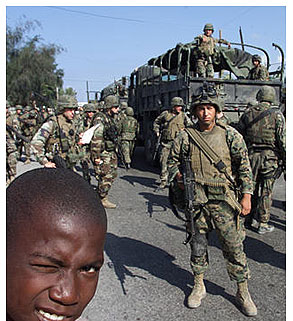
According to the Post, Bush was not involved in the decision to press for Aristide’s ouster nor was the president aware a decision had been made to ferry Aristide into exile. When Aristide was flown out of the country on Feb. 29, Bush had to be awakened from his slumber by a late-night phone call from Rice to inform him. It was only then that he authorized the deployment of U.S. Marines to quell the violence in Haiti.
Aristide’s corruption and authoritarianism may have justified his ouster in the eyes of his opponents, but now that he is gone, is Haiti any better off?
The answer, at present, is that by giving anti-Aristide figures in Washington and Haiti a free hand, the Bush administration has created a situation worse than the one it inherited — and one reminiscent of Iraq after the fall of Saddam. In the wake of Aristide’s departure, widespread looting erupted across Haiti; well-armed thugs terrorized businesses and ravaged the country’s public infrastructure. Virtually every prison in the country was emptied, freeing both common criminals and human rights violators — including Stanley Lucas’ notorious cousin, Remy.
Many Haiti experts, including Trinity College’s Maguire, project the next elections there will be held sometime in the next two years. For now, Haiti’s president is Gerard Latortue, a former World Bank official hailed by Florida Gov. Jeb Bush in a March 23 Washington Post editorial for his “integrity and selfless service.” Yet with no domestic constituency, Latortue has had to kowtow to Phillippe and the insurgents, whom he has publicly called “freedom fighters.” Like another Bush-installed leader — Afghan President Hamid Karzai, whose shaky administration relies on U.N. peacekeeping forces concentrated in his country’s capital — Latortue’s government wields little authority: According to a June 15 press release from the nonpartisan Council on Hemispheric Affairs in Washington, in addition to many hundreds of Aristide supporters murdered inside Port-au-Prince itself, convicted criminals, former paramilitary leaders and other vigilantes retain effective control of most of the Haitian countryside.
And, as it did with European governments on Iraq, the Bush administration’s Haiti policy has provoked a diplomatic crisis in the Caribbean basin: Over four months after Aristide’s departure from Haiti, the 15-nation Caribbean Community still refuses to recognize Latortue’s government, and in June the OAS opened an investigation into Aristide’s ouster. U.S. troops handed over control of the peacekeeping mission in Haiti to the U.N. on June 20.
“One has to be very concerned with the country’s direction,” says Maguire. “An awful lot of people who have been discredited in the past for abusing power and people have been climbing back into government. So far there is no sign that the new government or the U.S. will confront these antidemocratic forces.”
An April press release from the independent Haitian factory workers’ union, Batay Ouvriye, made an urgent plea:
“There is no person legitimately in charge anywhere. A whole series of upstarts have taken advantage of this situation to set themselves up as the authorities, as chiefs, and, in the process, the people are really suffering. THIS SITUATION CANNOT CONTINUE!”
