

Thin bright light stretches taut across the late afternoon sky. At an Arctic biology research site, 135 miles south of the Arctic Ocean, an expanse of golden tundra rolls unhindered toward the craggy mountains of the Brooks Range. Silver rivers and lakes, blueberries and umber hills grace the landscape.
At the moment, University of Alaska Fairbanks ecologist Syndonia “Donie” Bret-Harte is not enjoying the view. As she stares at the tundra carpet with concern, her husband, Peter Ray, a retired Stanford professor of plant physiology, yells from up the hill. “Hey, Donie, you’ve got to come look at this. The eriophorum are efflorescing again.” Translation from science speak: The flowers are blooming.
It’s the second time they’ve blossomed this year. Given an atypically long season of warm weather, the flowers are confused, thinking spring is here again.
“It’s a bad strategy for them because they’ll lose their seeds to the frost,” says Bret-Harte, looking worried behind large gold-rimmed glasses. Flowers only make one set of buds each year so if they spend next year’s buds now, they’ll be out of luck next spring. If the warming trend continues, the flowers may go extinct.
Lean and tall with a long black braid down her back, an intellectual Olive Oyl, Bret-Harte has spent the past 10 summers studying Arctic plants at this research site in Toolik Lake, Alaska. While it’s too soon to prove statistically, she and Ray suspect that these confused flowers are just one more example of the phenomenon threatening the entire planet: global warming.
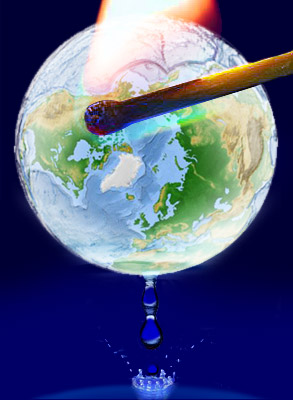
Over the past century, Bret-Harte explains, due to the increase in oil and gas consumption, carbon dioxide and methane emissions have skyrocketed. Such gases hover above the earth, trap the sun’s heat, and cause the planet to warm up. In just the past three decades, this warming has heated the Arctic by nearly 5 degrees Fahrenheit. Since the mid-1950s, Alaska’s glaciers have lost about 3,300 cubic kilometers of melted ice and snow — enough to submerge the entire state of Texas in 15 feet of water. Due in part to this influx of fresh water combined with warmer temperature, computer models predict that the Arctic Ocean’s sea ice could completely disappear within 70 years.
While it’s unlikely the four horsemen of the apocalypse are saddled up and ready to ride, global warming will likely have an enormous and dire impact on human populations in the Arctic and beyond. Already, native communities that dot Alaskan shorelines are seeing villages crumble. Waves, unhindered by large ice chunks, now swell and break against the shore with a ferocity never seen before. Banks are eroding and high water has consumed so many homes and buildings that two villages have been forced to move inland.
Alaska is not alone. In his alarming book “Boiling Point,” Ross Gelbspan writes that global warming is disrupting “the normal flow of deep-water currents that determine climactic conditions in much of the world.” For instance, Gelbspan reports, extreme effects of the weather phenomenon, El Niño, have caused China’s Yangtze River to overflow, killing more than 3,000 people, leaving 230 million people homeless, and generating $30 billion in damages. Worldwide, warmer weather means more extreme floods and drought, which creates breeding grounds for countless disease-carrying insects.
“There’s strong consensus now in the scientific community that global climate change is caused by human activities,” says Bret-Harte in her kind, matter-of-fact manner. “There are always a few folks that disagree. But mostly they work for the oil and gas industry.”
And apparently for the Bush administration. Claiming the jury is still out on what causes global warming, the president has written a climate change policy that is about as aggressive as a tortoise. Loath to enact measures that would reduce our addiction to oil and gas — and income to his friends and campaign supporters — the Bush administration has spent the past several years misrepresenting the science on climate change in order to justify a path of inaction. For the Arctic researchers who are watching a landscape in flux, this is beyond infuriating.
“We see the possible consequences of no action and the consequences are looking graver and graver and more and more imminent,” says John Hobbie, the tough co-founder of the Institute of Arctic Biology Toolik Field Station and director of the Ecosystems Center at the Marine Biological Lab. “We scientists realize that climate change is more than just vague words and models.”
A funky hodgepodge of old military trailers, canvas tents and a helicopter (to transport scientists to remote lakes and streams), the Toolik Field Station looks like some sort of 21st century “MASH” set. Established by the National Science Foundation in 1975 as a long-term ecological research facility, the site, nestled on the edge of Toolik Lake, has since attracted an annual crew of up to 100 scientists, graduate students and technicians from universities and institutions throughout the country. Each year they spend weeks at a stretch analyzing the changing landscape, isolated by the empty terrain from what they fondly call “their real lives.”
Because the Alaskan Arctic is warming faster than any other place in the world, it offers an ideal natural laboratory to study climate change. Unlike the rest of the world, which has warmed about 1 degree over the past century, the Arctic’s unique landscape of mostly ice and snow magnifies temperature changes because as ice and snow melt, the terrain stops reflecting sunshine and starts absorbing heat. With this trend in a dizzying rate of motion, computer models predict that during the next century the Arctic will warm an additional 7 to 12 degrees Fahrenheit. Considering that the last ice age was spurred by a temperature difference of 13 degrees, such climate change means that the flowers aren’t alone in their strange behavior.
The tundra that Bret-Harte and Ray study is a patchwork of ancient grasses, berries, moss and woody shrubs. Due to the intense cold and the limitations of a two-month-long growing season, the plants are miniature — 400-year-old tussocks are no bigger than a pie tin. Yet as the climate has warmed, the woody species like birch, willow and alder shrubs are not quite so shrublike these days. Compared with aerial photographs taken on oil exploration missions in the mid-1950s, the woody plants have taken off like a case of bad acne. In each of the 200 comparison photos, not only did individual shrubs increase in size, but the patches of alder and birch have spread into areas that weren’t shrubby before. This trend is likely to continue, says Bret-Harte.
To further predict the outcome of future warming, in 1988 Bret-Harte’s former postdoctoral advisor, Gaius Shaver, perched greenhouses directly atop the tundra. Inside the enclosed plot, the plastic structure increased the temperature by 3.5 degrees Celsius, the predicted regional warming for the next century. In less than 20 years, the birch has squeezed out the mosses and berries, growing from an average height of 8 inches to almost 4 feet.
“They’re trying to become trees,” says Bret-Harte, balancing on a boardwalk beside the crowded plastic greenhouse. While currently the birch lie down beneath the snow’s weight, if and when the shrubs stay standing throughout the winter, they will trap snow. While it’s hard to think of snow as bikini weather, for the soil in the north, snow actually acts as a thick blanket, creating a layer of insulation from the frigid wind and air. With more snow, soils could warm, releasing more carbon and other nutrients into the atmosphere and, that’s right, contribute to more global warming.
A shrubbier landscape devoid of moss and grass could spell hard times for wildlife such as caribou, which feast on ground willow and cotton grass. Already caribou are feeling the proverbial heat: With warmer springs, plants are blooming earlier and then drying up earlier — by as much as 10 to 20 days. That means less food in the fall, the critical time when caribou fatten up for the winter.
“Without ample forage, caribou aren’t as able to conceive offspring or survive the long, cold winter,” says Brad Griffith, an associate professor of wildlife ecology at the University of Alaska Fairbanks. Griffith suspects this shift in seasons is why the Porcupine caribou herd, the wildlife poster child in the fight over the Arctic National Wildlife Refuge, has dropped from 178,000 to 123,000 in the past decade.
Across the dusty Dalton Highway, in another watershed near Toolik, the landscape offers one more sign that global warming may already be having an impact. A wide hole, large enough to consume a helicopter, gapes from the tundra. Climb down into the pit and an underground world is exposed. A dense layer of rich soil and roots rests atop a slab of what looks like brown concrete. Called permafrost, this soil layer froze thousands of years ago, but as temperatures have warmed, it’s melting. As these ancient slabs of ice dissolve, the spongy tundra tears off in large chunks and sinks a good 10 feet into the crater left by former permafrost. At the hole’s lip, a small stream forms a waterfall, carving a new path, dense with soil and sediment under the landscape above.
“We’ve been walking around out here for 20 years and have never seen one of these things, and all of a sudden we’ve got four in our backyard,” says William “Breck” Bowden, a professor of watershed science and planning at the University of Vermont, who has logged countless hours slogging across the tundra to study Arctic streams. For Bowden, these new formations are the biggest news of the summer — the influx of mud is enough to smother the moss, algae and insects for up to 60 miles of river. While scientists aren’t exactly a rash group, he makes a prediction: “This may be a tangible indication of the warming of the Arctic environment.”
Not all permafrost melting results in such mud pits but, says Jon Benstead, a postdoctoral scientist from the Marine Biological Lab, the thawed soil is dumping additional nutrients into lakes and streams throughout the region. Benstead stands by the Kuparuk River in boots held together with duct tape.
As a heavy rain falls, he explains that to measure the impact of permafrost thaw, Toolik scientists have, for 20 years, been adding phosphorus to this river to mimic the nutrients that melting soil releases into the ecosystem. So far, the results have shown that with additional phosphorus, the river’s algae flourish like an athlete on steroids. More plants translate into insect habitat and more food for fish. In this case, the changes of climate warming are beneficial for the plants and animals in the ecosystem.
Still, there’s not a lot to throw a party over. Benstead adds that they’re also seeing a trend: The Arctic grayling, one of only a handful of fish species sturdy enough to withstand the frigid winters, don’t do well in warmer summers. He and his colleagues predict that if and when streams heat up to a measurable amount, the Arctic grayling may become extinct.
“There is no doubt that climate change is rewriting the rules that have governed these ecosystems for millennia,” says Stan Senner, executive director of Alaska Audubon.
About 150 miles north of Toolik Lake, the impact of oil and gas dependence translates into more than just an abstract notion of global warming: Here lies the unappealing landscape that accompanies energy development. Welcome to Prudhoe Bay, Alaska, home to one of the largest oil and gas reserves in North America.
Clinging to the edge of the Arctic Ocean, the small town of temporary employees is an industrial wasteland of oil wells, semis and high security clearance areas. Every day, nearly 1 million barrels of oil flow out of here; that’s less than 10 percent of U.S. consumption. The Bush administration and the state of Alaska are hoping to significantly increase production within the next 10 years.
“I can’t say specific numbers, but I know we want a whole lot more [oil and gas development],” says Harry Bader, northern regional manager of Alaska’s Department of Natural Resources.
Environmental standards mandate that massive seismic trucks, which search for new oil deposits, can cross the fragile tundra only when there is a thick layer of ice and snow. Over the past 30 years, rising temperatures have cut the frozen season in half, from 208 days down to 98. Now the state is reassessing the standard and hoping it can rewrite it to allow more days on the ice hunting for oil.
In addition, Alaska is pushing for state ownership of federal land that abuts massive swaths of natural gas. If the state of Alaska gets its way, and it’s looking pretty good that it will, such energy development could be headed toward Toolik Lake. With a state dependent on oil and gas for 90 percent of its budget, the state is paving the Dalton Highway, which slices through the 55 million acre North Slope, and roll out a natural gas pipeline. The irony of locating such a massive extraction project in the fastest-warming region of the globe doesn’t faze Bader.
“I don’t think anyone doubts that global warming is happening — at least not up here — but the question is whether it’s anthropogenic or not, and that’s not my job to figure out,” says Bader with a grin. “My job is to maximize the amount of oil and gas drilling on the North Slope while protecting the Arctic tundra.”
Industrial activities here will not only produce more global warming; they also threaten to destroy the very studies of global climate change. New roads and gas wells could scar the currently empty watershed and tundra where the Toolik researchers conduct their research.
“Oh my God, this will have a huge impact,” says Bret-Harte, shaking her head. “I’m hopeful the station will be able to survive, but all the reserves of gas are here in the foothills.” With a wry laugh, she adds: “At least we’ll have the chance to study the impacts of oil and gas development up close.”
