

For those of us who live close to Duke, the recent backlash against the university nicknamed the “Gothic Wonderland” and its students did not come as a surprise.
Tensions in Durham have heated up in the past three weeks after a woman, hired to dance at an off-campus party held by Duke’s lacrosse team, accused players of hurling racial epithets at and sexually assaulting her. The dancer is black and attends nearby North Carolina Central University, a historically black college. All but one of Duke’s male lacrosse players are white.
Fault lines between town and gown, black and white, the privileged and the poor already existed in Durham. But rarely have those lines been so deftly exposed, all at once, as they have by the allegations of what took place at 610 N. Buchanan Blvd. in the early hours of March 14.
This confluence of events, people say, is the perfect storm.
“Here’s a perfect story of what we’ve had to deal with in the past,” explains Terrill Bravender, director of adolescent medicine at Duke University Medical Center, who lives within a block of the infamous lacrosse party house.
“Last year, in middle of the baby-oil-wrestling party that made it to the national news, there were a whole bunch of people in my yard, milling around, out on the sidewalk and in the side yard. I went outside to ask them to leave, and I saw a guy peeing on the side of my house. So I told him to stop.
“The guy turned around and said, ‘What’s the matter?’
“I explained that he was peeing on my house.
“He again asked, ‘What’s the matter?’
“‘That’s it,’ I said. I don’t think he really got it.
“So I had my dog there, and I let him go out and sort of jump on him. Then he started yelling, ‘What’s your problem? I didn’t hurt anything! If I hurt anything, I’ll pay for it.’
“I said, ‘No, you won’t pay for it, your dad will. You don’t have any money.’
“Then I saw a guy leaning over our fence vomiting into the flower bed. I told him to get the guy out of there, it was unacceptable. Then he tried to have a conversation with me about why was I so hostile toward Duke students.
“These kids have never had to own up to anything. It was more sad than anything.”
The antagonistic feelings cut both ways. Students say they’re getting a raw deal. They say that residents of Trinity Park, the historic, bungalow-filled neighborhood adjacent to Duke’s East Campus, are intent on spoiling their fun. After all, they’re simply doing what college kids are supposed to do. When locals call 911 in the wee hours to break up rowdy mixers, Duke students return fire with Op-Ed pieces stating that perhaps the curmudgeons shouldn’t have settled down in a neighborhood that’s right off their campus.
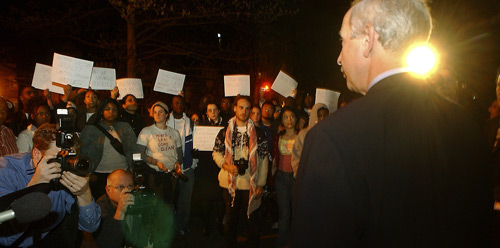
Since the accusations of rape against members of the lacrosse team were made public, though, neighbors and a segment of students have stood together at vigils and protests, as annoyance turned to anger. Together they have found a new target: the most privileged of Duke’s students.
The students in question are “a small number of idiots who are mind-bogglingly arrogant and never have had to take responsibility for anything in their lives,” says Bravender, referring, in part, to the fact that students aren’t often held accountable by the university for disorderly off-campus conduct. “It’s those kids who choose to live off campus, … so that’s what the larger community sees of Duke kids,” he says. (Still, plenty of Duke students, those living both on and off campus, do volunteer work in the community. You can spot them hammering nails for Habitat for Humanity houses, reading to kids in public schools and cleaning up creeks.)
Duke sophomore Fiona O’Sullivan finds that some students behave in a way that reveals a “we can do no wrong” attitude.
She searches for an example. “At tailgates,” she says, “there are people who get ridiculously drunk and feel they can do idiotic things that aren’t acceptable in real life, just because we have this weird sense of superiority, because we’re Duke students and can do what we want.”
When town residents fill neighborhood listservs with gripes about publicly drunk and disorderly students, they’re invariably referring to a subset of Duke students who are considered privileged, and no one seems to represent that stereotypical subset better than the lacrosse team.
“There’s a social hierarchy at Duke, and they’re at the top,” explains O’Sullivan. “They must have such a feeling of power.”
Her friend Katie Brehm, also a sophomore, chimes in, “But we give them that power. Why do we look up to them?”
“Because they’re hot!” says another student, who wishes to remain unidentified. “And they have, like, the best parties.”
The lacrosse team’s reputation for “Animal House”-like parties dates back at least a decade, if not more. Christopher Johnson, Duke Class of ’01, remembers the Duke lacrosse parties as pure debauchery. “Their section would be trashed, there would be girls all around … There was this machismo, masculine energy,” says Johnson, who now works on Capitol Hill for North Carolina’s Rep. Mel Watt.
Johnson, who is black, says that lacrosse players have always been at the top of the university’s social strata because they personify the Duke ideal: rich, white, athletic, good-looking, prep-school-educated guys from the Northeast. Duke is indeed elite: Although Durham itself has almost equal numbers of black and white residents (with 15 percent living below the poverty level), blacks make up only 11 percent of Duke’s undergraduate student body.
Johnson adds: “I was so intrigued by them. They seemed so above it all because of who they are, because of what they were physically.”
They also have a reputation for going unchecked. Duke history professor Peter Wood, who played lacrosse at Harvard and Oxford and coached the women’s lacrosse club at Duke, told a dean two years ago that the men’s lacrosse team was out of control. During a closed-door Academic Council meeting between faculty and Duke president Richard Brodhead last week, another professor supported Wood’s claim, telling the group that several lacrosse players had shown up drunk for her summer classes.
Even in the spotlight, two days after all but the one black member of the team had submitted DNA samples, team members’ behavior reflected a certain haughtiness. One woman watched with disbelief as lacrosse players slammed down shot after shot of alcohol at a local bar, shouting “Duke Lacrosse!” They seemed unaware, she said, of how poorly their indifference reflected on the university. (She was subsequently banned from the bar and its softball team for writing a letter to the local paper about the incident.)
Some students, such as sophomore Katie Brehm, have voiced their disappointment in the way team players have put up a Blue Devil wall of silence, refusing to break rank and come forward with information.
“Before I thought they were really cool,” she says. “Now I think they’re not.”
Another student, who wishes to remain unidentified, isn’t so certain. She feels it would be wrong not to support the woman who says she was raped, but also wrong to “betray” her school by rushing to judgment. Let’s just wait and see, she says.
Meanwhile, inside the faux-Gothic walls of Duke’s campus, some faculty members are growing tired of the lack of action. Houston A. Baker, a professor of English and African-American studies, says that even as Duke’s esteemed professors are seething, “some lacrosse players are still donning jerseys and swaggering about on campus.”
“I have never seen a faculty as angry — I’ve been teaching for 38 years — as angry, as rational and as creative in its suggestions to the administrators.”
At last week’s Academic Council meeting, Baker says, “one of the faculty asked President Brodhead directly, ‘Will you say, I condemn Duke’s culture of alcohol, violence and sexual assault, and make that a top-down statement?’
“He answered, essentially, I will not do that. His rationale? These things exist at tier one institutions. Causality is not certain, but we do know these cultures exist in high school, as well. I’m the leader, and how can I make that sort of focused statement for this entire institution?
“I thought, Wow,” Baker says.
He gives Brodhead some credit for trying to say the right things in response to the crisis, but says it hasn’t been enough. Saying that certain acts and racist language are deplorable may make you sound as though you’re fair-minded, he says, but it should not be confused with bold, outraged, ethical action.
In Baker’s view, the team should be disbanded until “the culture of lacrosse can be held accountable” (Duke’s president has already suspended games pending the resolution of the investigation), and the university should open up more dialogue among students about race.
Johnson says racial tension was always a problem when he was at Duke. For the most part, he says, black students go one way and white students go the other. The racial separation is palpable.
“It’s possible to go through four or five years of Duke without having to interact with someone different from you,” Johnson says. “You’d see black people in class, but your only actual interactions with black people might be with the service people — the little old black ladies cleaning up after you and serving your meals.”
Race, in fact, is the behemoth in the room. That several presumably privileged white lacrosse players hurled racial epithets at a working-class black mother of two is, for the moment, one of the few substantiated facts of the incident.
Racial discomfort could be the reason an overwhelming number of Duke students say they’re afraid for their safety outside Duke’s stone walls. The city of Durham is 44 percent black, with more poverty than the national average. The median income of a Durham household is roughly equal to the annual tuition for a Duke student (about $44,000).
“I don’t think I’d ever live off East [Campus], because it scares me,” says another student, who wishes to remain unidentified. “When I’m on campus, I feel completely safe. That’s my bubble.”
“When you’re inside the stone wall that surrounds East Campus, you think, Wow, I’m so privileged to be at Duke,” says Johnson. “You take that with you for the rest of your life. You’ll always know you’re a member of this club, a part of something exclusive.”
Many in Durham say they hope that this experience brings all sides closer together. At Monday night’s rally on North Carolina Central University’s campus, which drew hundreds of students and Durham residents, people were able to engage in conversation and respond peacefully to a tense situation. With each day, though, another ugly crack threatens to break our fragile optimism.
On March 31, Duke students expressed concerns for their safety after vice president for student affairs Larry Moneta warned them that they could be the target of drive-by shootings by Durham gang members. Then around 3 a.m. April 1, two Duke students were assaulted off campus by a group screaming that the students were on “[NC] Central territory.” According to Duke student newspaper the Chronicle, the two undergrads were told, “Duke kids aren’t welcome here because they’re all rapists.”
And the next night, one Trinity Park resident who has been quoted in the media received a menacing call from an unidentified male: “Can I speak with J___ ‘the C**t’ M____ who’s sticking her nose where it doesn’t belong?”
This week, as Duke students and Durham residents await the results of the lacrosse team’s DNA tests, the low wall that divides town from gown is showing a steely hint of barbed wire.
