
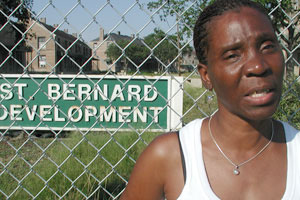

 Sitting under a homemade banner reading “Survivors Village” strung between two light poles, former residents of New Orleans public housing have vowed to stay camped out on a traffic median in front of the abandoned St. Bernard development until officials from the U.S. Department of Housing and Urban Development offer a plan for reopening their apartments. While lawyers representing the displaced tenants plan to file a class action lawsuit against HUD later this month, the protesters, who set up their tent camp under a blazing sun the first weekend of June, say they will tear down a government-erected fence on July 4 and begin repairs themselves unless housing officials respond.
“Nobody wants to disrupt their lives by going to jail or getting hurt, but July 4 is do-or-die for us,” said Endesha Juakali, a housing activist and former St. Bernard resident who ran a community center and day care at the development. “These people have leases and they have been illegally evicted from their homes. We’re going in, we’re prepared for dozens of people to go to jail, and there’s no backing down on this.” Former tenants had threatened to tear down the fence the prior weekend, prompting a public plea from HUD Secretary Alphonso Jackson not to break the law or expose themselves to the dangers of mold and lead in the hurricane-damaged apartments.
The FEMA housing assistance that many hurricane evacuees have relied on to pay rent in other cities will expire on June 30. HUD officials say that former residents of public housing in New Orleans are eligible for the agency’s own disaster housing assistance program to continue receiving aid. “What they don’t seem to understand is that people want to come home to New Orleans,” said Juakali. “They don’t want to sign another lease in Houston or somewhere else.”
Ten months after the Katrina, at least 80 percent of public housing in New Orleans remains closed. Six of ten of the largest public housing developments in the city are shuttered, with the other four in various states of repair. Fewer than 1,000 of the 5,100 families who lived in the older housing developments before the storm have returned, according to the Housing Authority of New Orleans. HANO, as it is popularly know, has been under the direct control of HUD since going into federal receivership in 2002. Jackson announced last month that HUD would invest $154 million in rebuilding public housing in New Orleans, and that he would work with the city to bring displaced residents home. But critics say they see mismanagement and neglect echoing the disastrous government response in the early days of the catastrophe. And some fear that government officials and business leaders are quietly planning to demolish the old projects and privatize public housing.
Former tenants and housing activists say that many apartments that received minor to moderate storm damage could be quickly repaired, such as the second- and third-floor units at the St. Bernard development. With more than 3,000 people living there before the hurricane, St. Bernard was the largest public housing project in the city.
“Alfonso Jackson was not telling the truth when he said there’s lead in these apartments,” said Walter Smith, a 30-year employee of HANO who has been laid off since September. “I was one of the authority’s first lead inspectors and we don’t have lead paint in these buildings. As for mold, that’s what happens if you have a flood and don’t clean out your apartments for nine months. But mold was always a problem in St. Bernard before Katrina. People here learned to live with it.”
Lawyers representing displaced tenants plan to file a class action lawsuit against HUD and the housing authority, claiming that the agencies have failed in their responsibility to relieve the severe housing shortage in the city and help residents return. “Most of the people not being allowed back in had leases, and there are federal laws governing under what circumstance HUD can get people out of their homes and keep them out,” said Bill Quigley, director of the public law clinic at Loyola University and one of the lawyers working on the suit. “While the purpose of HUD is to get people into housing, since Katrina they have acted to keep people out. HANO has laid off a huge portion of their maintenance staff and focused on fencing off properties.”
Plagued for years by drugs and crime, and once the focus of an intense community policing program, public housing in New Orleans was far from an ideal home for the city’s poor. But activists and former tenants view the fences erected around St. Bernard and other developments starting in March as a clear sign that housing officials have no plans to reopen them.
“What we’re seeing is a push to privatize low-income housing in New Orleans, using Katrina as an excuse and River Garden as the model,” said Jay Arena, a housing activist. River Garden, a mixed-income redevelopment begun in the late 1990s, replaced the 1,500 housing units of the St. Thomas projects with more than 1,600 new apartments. In the end, only 120 apartments were designated for public housing at River Garden, with only about 40 occupied by low-income tenants to date. Both Jackson and Mayor Ray Nagin have praised River Garden as a model of how public housing in New Orleans should be rebuilt.
“HANO and HUD are playing a delay game with displaced tenants,” Arena said, “hoping that the longer they take to reopen public housing, the fewer tenants will come back.”
HUD officials contend that health and safety concerns prevent reopening St. Bernard. “Our first concern is always the well-being of our tenants, and our environmental studies have found the presence of mold in 90 percent of damaged public housing units in New Orleans,” said Donna White, a spokesperson with HUD’s public affairs department in Washington. “We also have a problem with the state of the neighborhoods where the developments are located. People have to have stores and schools and public transportation, and a lot of those services are not back yet.”
Housing activists and former HANO workers counter that HUD is overstating safety concerns. Marty Rowland, a civil engineer who volunteers for a local housing advocacy group, said he conducted an informal survey of five buildings at St. Bernard last winter and found that while the first floors had flooded, most second and third floors appeared to have little water damage. “There was flooding but no more so than other areas of Gentilly where buildings have been gutted and are being renovated,” Rowland said. “If you got electricity back, people could move back in on those floors in short order.”
Living in temporary housing in New Orleans or driving in from cities such as Baton Rogue, Houston and Atlanta, former tenants have organized in recent weeks to put pressure on federal and city housing authorities.
“I came back to New Orleans because this is where I want to be, but HANO is not giving us a chance,” said Stephanie Mingo, a former resident of St. Bernard who returned from Houston last week. Mingo lost her mother during Katrina and saved herself, two daughters and a grandchild by floating on a refrigerator to the nearby Interstate 10 overpass. Since last weekend she has been camping on the traffic median in front of the development.
“My kids are stressing and I’m stressing,” Mingo said. “Our young people are getting killed in Houston. Our elderly are getting sick and dying. I left on Thursday and I’m not going back to that place. We’ve offered to go into these apartments and clean up ourselves, but they don’t want to hear what we have to say.” Tens of thousands of evacuees moved into temporary housing in Houston last September. As the months have worn on, many say they now feel less than welcomed, and as outsiders, are facing more problems with crime than they did in New Orleans.
Taking on the feel of a homecoming block party with smoking barbecue grills and music thumping from a portable sound system, the protest at St. Bernard attracted a few dozen former tenants and a hundred supporters, including Rep. William J. Jefferson, whose district includes the 7th Ward. “You all have the right to return,” Jefferson told the crowd, calling on housing officials to reopen apartments that weren’t flooded, as soon as possible. (Jefferson is currently under investigation by federal officials in a bribery case that gained national attention.) “You’re not going to have a tourism industry here without your workers, and the folks that are out of town and want to come home kept this city going for years.”
According to the housing authority, 49,000 people lived in public housing before Katrina, 20,000 in older, large-scale developments such as St. Bernard, and 29,000 in Section 8 rental housing, which was also devastated by the storm. HANO had been dismantling traditional public housing for nearly a decade before the storm through Hope VI, a Clinton-era program that favors vouchers and mixed-income developments. Troubled for years by mismanagement, HANO itself was taken over in 2002 by a HUD reorganization team, which prior to the hurricane got good marks from many observers for reforming a housing authority considered one of the worst in the nation.
But since Katrina, HANO has been sharply criticized for its management and treatment of former residents. Tenants who had been evacuated to temporary housing across the country were notified by the authority last fall that they had until Dec. 31 to remove property from the apartments or their possessions would be thrown out, a deadline that was extended to Jan. 15 and then dropped. While no effort has been made to clean out or gut flooded buildings, the authority has spent hundreds of thousands of dollars erecting fences and installing steel plates on doors to close off the developments — though it only installed the new security months after hundreds of units had been ransacked and looted. Meanwhile, housing advocacy groups have filed a lawsuit against HANO for leasing units at River Garden to 35 of its employees and to 11 New Orleans police officers, despite an extensive waiting list for public housing tenants.
In Katrina’s aftermath, public officials in Louisiana have made some astonishingly frank comments. “We finally cleaned up public housing in New Orleans. We couldn’t do it, but God did,” Rep. Richard H. Baker, a Republican from Baton Rouge, was quoted as saying in the Wall Street Journal last September. Former New Orleans City Council president Peggy Wilson, a candidate in the recent mayoral election, declared that the city should keep out “pimps” and “welfare queens,” while City Council president Oliver Thomas, who is African-American, said that public housing should be for people who work, instead of for “soap opera watchers.”
Thomas, who later apologized for his comment, has proposed screening returning public housing tenants for work history and employability. “We have to build a working-class community that’s able to take care of themselves,” Thomas told New Orleans evacuees in Houston in March. “We’ve had three generations of poverty where people never expected to get better. If we have an opportunity to make it right and make it better, we should.”
Critics across the country as well as in New Orleans have called public housing a failed experiment that foments drug use, crime and poverty. Yet, before Katrina, crime was down at developments in New Orleans compared with previous decades. Data from the 2000 census showed that the majority of public housing residents in New Orleans worked. Employment among St. Bernard residents was 60 percent, while in the city overall 73 percent of residents had a wage-earning job or salary. (Residents of public housing also included many children, and tenants past retirement age.)
“I’m not going to say that public housing is the best thing in the world for people, or that we want it back exactly like it was, but this city is desperate for any kind of housing it can get right now, and we need to get as many viable units back on line as soon as possible,” said Laura Tuggle, a public interest lawyer who works on housing issues for New Orleans Legal Assistance. Tuggle cited a recent call from a personnel manager at Harrah’s Casino. “They had employees who lived in public housing and they want to get them back, but there’s nowhere for them to live now.”
After months in exile many former residents say they are desperate to return and are taking an increasingly confrontational approach with HANO. At a protest at St. Bernard in April, several HANO officials and a dozen police officers stood by as a hundred former residents and supporters forced open a gate on the new security fence and briefly reentered the complex. Gloria Irving, 70, a grandmother living in Houston, led the demonstrators by driving her motorized wheelchair through the line of police and HANO security guards. No arrests were made.
Later that month, HUD Secretary Jackson replaced HANO’s federal receivership team. At the first board meeting in May, Donald Babers, a career HUD official serving as the authority’s recovery adviser, and William Thorson, the new federal receiver, yielded the first hour and a half to public comment after being shouted down by former public housing residents. A similar scene played out at a recent meeting of the City Council’s housing committee, where residents demanded to know when HANO and HUD would present a schedule for reopening housing developments including St. Bernard. Officals for the agencies said they needed another 12 to 18 months to do assessments and develop a plan.
But housing advocates believe HUD already has plans, which the agency is refusing to make public. At the same City Council meeting, housing officials announced they were submitting 11 applications for low-income tax credits to the Louisiana Housing Financing Agency for rebuilding public housing. “If you go to the state agency asking for tax credits worth millions of dollars, you have to already have a plan for what you want to do,” said Tuggle. “As I understand it, Secretary Jackson seems to be making all of the decisions about New Orleans and the public here is not being told much.” Tuggle, who tracks housing issues closely, says she believes that “some pretty big redevelopment” is on the horizon.
While redevelopment could take decades, the old developments — some of which, like St. Bernard, were built as WPA projects in the late 1930s and early 1940s — were the social anchors of their neighborhoods and the only home many New Orleanians had ever known.
“I’m here today because my family lived here. We were born and raised in this place,” said Kenneth Simms, 34, a former St. Bernard resident who drove to New Orleans from Baton Rogue. “My older sister lived right over there, my other sister lived over there, my older brother over there, and my aunties lived in the back. There are hundreds and hundreds of people we know and love from here, and they want to come back and work. So what are we going to do?”
Jualaki, who ran the community center here, said he expects many displaced residents to return to the city this summer. He has joined with local ministers to create temporary housing in gutted-out churches.
“We’re preparing shelters for people. These are people who were in New Orleans doing minimum wage jobs and haven’t been able to come back,” said Juakali, who is living in a FEMA trailer parked in front of his hurricane-damaged house across the street from St. Bernard. “We’re expecting hundreds if not thousands to start coming home. What are we going to do with them? The city doesn’t have a plan. The state doesn’t have a plan. The feds don’t have a plan.”
