
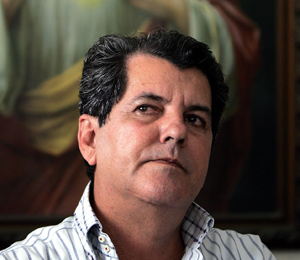

The window blinds of Osvaldo Payá’s front parlor are shut on greater Havana. In this metropolis of shared noise and open-door dinners, depriving pedestrians of a peek inside is not the norm. But Payá has reason to pull back from Calle Peñon, a dingy, potholed street in El Cerro, a close-in suburb southwest of Havana’s center. Payá, Cuba’s leading dissident, has been harassed by neighbors and security police alike, and the word graffitied on his house years ago established Payá’s place in the neighborhood: “Traitor.”
Despite the sealed blinds, the 4 p.m. din of Habaneros in midcommute fills Payá’s parlor. Payá himself has just biked home from work on his Chinese-made one-speed, and his jet-black hair is still slick from the shower. At age 54, he maintains two careers. By day, like any upstanding adherent of the revolution, Payá repairs medical equipment at a nearby hospital. He does his other work here in this cloistered residence, alone. He used to have colleagues in his fight against the Castro regime, but all that remains of his original team of dissidents are the photographs that hang from a white plaster sculpture in a corner of the parlor. All his friends are in prison.
In 2002, Payá and his team delivered 11,000 signatures to the Cuban Parliament in the hopes of getting that body to debate and vote on a human rights referendum called the Varela Project. A year later, the Cuban government arrested 76 “counterrevolutionaries.” Fifty of them were Payá’s co-conspirators in the Varela Project. Payá was spared because he’d become internationally famous. By the time of the arrests, he was a nominee for the Nobel Peace Prize and a winner of the European Union’s Sakharov Prize for promoting human rights.
Ever since, Payá has been involved in a still more ambitious project. For the past three years, he’s been spending his nights on what he calls the National Dialogue, a campaign to bring Cubans together to discuss life after Fidel Castro, and a possible transition to democracy. In secret groups of two to 12, as many as 14,000 Cubans have specified in written surveys how they’d like to see Cuba change, asking for everything from constitutional reform to better healthcare to access to the much-resented tourist-only hotels. Even before the announcement of the ancient leader’s serious illness, Payá had begun an assault on Cuba’s ultimate taboo.
In person, Payá doesn’t have the bravado or charisma one might expect from a totalitarian regime’s most prominent critic. A stocky man with a nasal voice, he makes only sporadic eye contact during conversation. He speaks forcefully, in long barrages of opinion, but swallows every few minutes as if there’s a pill in his throat that he must force down without water.
On the summer afternoon I appeared at his door without warning, Payá forgave my spontaneity, knowing its reason. Since Payá’s phone is tapped, a Cuban nun had told me that the safest and most confidential way to request an interview was to approach Payá’s brother Alejandro in person, at the church where Alejandro works. I contacted Alejandro as instructed — and was interrogated by the Cuban secret police the next day. Deciding to trust no intermediary, I waited a few weeks and then went directly to Payá’s one-story home in El Cerro. His 18-year-old daughter answered the door, handed me a glass of limeade on a saucer and asked me to wait. After 10 minutes, Payá greeted me with a smile, shooed his portly, asthmatic beagle from the room and gestured toward two rocking chairs. “I have a lot of work,” he said, “but I can talk for a few minutes.” He sat down and began to rock and speak without pause for an hour.
The lack of open debate within Cuba about a post-Castro government has long irked Payá. “It’s as if there were a fatalism,” he complained, “in which they say, ‘There’s nothing to do. You have to wait until Fidel Castro dies. And after that, his successors.'” When Payá says “they,” he means, like many Cubans, the voice of the regime’s propaganda machinery. Payá imitated the voice’s newest, doom-laden iteration, as shouted from billboards, about what the U.S. government plans for Cuba should socialism fall: “They’re going to take away your house … You’re not going to have education … You’re not going to have public heath.” Lest Cubans misconstrue this “they” as a domestic villain, each slogan is headed: “El Plan Bush.”
What bothers Payá even more than Cubans assuming the regime is immutable is when non-Cubans pontificate that the island will “fall” in one of three directions. “What are the alternatives that people are discussing,” Payá asked, “a succession? Chaos? An intervention?” Dryly, he dismissed all three. “These aren’t alternatives, though the danger of them exists.” Payá has a fervent conviction that the future of Cuba hinges on citizen involvement. He gazes up the tall parlor wall, looking for an apt metaphor, and settles on one from the New Testament: “In architecture, the cornerstone is the point of equilibrium. If it’s missing, everything falls. This cornerstone is the Cuban people.”
In Cuba, few people even refer to their leader by name, using nicknames like “the Boss” or miming a long beard below their chin. When I asked Payá how he pulled off his post-Castro focus groups in such a climate, he made it sound uncomplicated. “It was easier,” he shrugged, “than getting 40,000 signatures,” which is the current and still growing total for the Varela Project. Payá had asked signers to include their identity card numbers. For the National Dialogue, explained Payá, Cubans “got together in some churches. They got together in some houses, with much privacy.”
Then Payá’s doorbell rang. He stared at the parlor door for an instant before rising to answer the bell. After a quick exchange with an unseen and unnamed woman, Payá resumed our interview. “Many participated under surveillance,” he continued, “with the [secret police] interfering.”
Payá himself has clashed with the Castro regime since puberty. In 1968, at age 17, he was shipped off to a work camp for young people with “ideological problems” on the Isle of Youth, off the southern coast of Cuba, for being a devout Catholic and for speaking publicly in favor of Czechoslovakia’s Prague Spring. Payá labored at the island’s rock quarry, getting special permission from the camp guards to live in an abandoned church. It was in the old nave of Our Lady of Dolores that Payá resolved to take a pacifist approach to challenging the Castro regime — and to do so from within Cuba. Unlike many Cubans who branded themselves dissidents as early and as loudly as Payá, he didn’t flee to Miami. Payá married and had three children in Havana, where his movement, the “Movimiento Cristiano Liberacion,” was also born. By 1996, the group had recruited enough activists to cover the island, and Payá zoned in on what he thought could be the Achilles’ heel of Castro’s totalitarian regime.
There was a clause in the 1976 Cuban Constitution stipulating that 10,000 citizen signatures could bring about a national referendum. Payá started petitioning Cubans to support five reforms: freedom of speech, freedom of the press, free enterprise, amnesty for political prisoners and new electoral laws. He named his campaign after Father Felix Varela, a Cuban priest who had championed Cuban independence from Spain. Asking participants to write down their identity card numbers was an exercise in combating fear.
Once the Varela Project petition had surpassed 11,000 signatures, Payá and his fellow activists lugged the cardboard boxes to the Cuban Parliament. The regime responded with an immediate counterreferendum, which it boasted had a whopping 99 percent approval rating among Cuban voters. To stomp on Payá’s petition with classic Castro flourish, the government used the counterreferendum as an occasion to declare socialism in Cuba “irrevocable.” The following spring, on the eve of the United States’ invasion of Iraq, when few foreign media outlets had an eye on the Caribbean, the police rounded up most of Payá’s colleagues, sentencing them to prison for up to 28 years.
Cuba’s chief activist was marooned. Three years passed, and by Payá’s account, surveillance only worsened. (“Imagine if the parents of your children’s friends were harassed.”) When I sat down with Payá and listened to his assurance that the Castro regime was in its “final stage,” the claim sounded wishful. Payá was the lone change-maker on the anti-change island. The only novelties in the Havana landscape were fallen pillars, collapsed roofs and a few new billboards of doom.
But Payá proceeded with his National Dialogue. In May 2006, Payá announced that he and his “modest network” of activists had compiled the feedback of these meetings and now had a hefty 170-page document that would guide the country through its seminal post-Castro steps in the direction dictated by the Cuban people. “It tells us how there can be a bridge between our current situation and democracy.” Payá leaned forward in his rocking chair. “It’s the fruit of the process of citizens’ participation. And that’s why it weighs so much!”
At that, the fat, wheezing beagle waddled back into the room, and Payá allowed himself another of his infrequent jokes. “Vamos. Ya participaste,” he told the dog. “Let’s go. You have participated.”
Though the “All-Cuban Plan” may have been written by a committee of thousands, the document bears a clear Payá imprint. He’s most known for championing free elections and human rights, but Payá also insists that Cuba’s public healthcare and education not be trampled as democracy rushes in. Payá doesn’t rush, nor does he think Cuba can. “It can’t happen overnight,” he kept repeating, as he flipped through some key components of the massive blueprint: the return of exiles, privatization of the media, economic aperture. “Fine, open the economy,” said Payá, “but not so that those who have money can come and buy Cuba like it’s an estate.”
“The hope is that with this plan, the Cuban people can discover … that change is not a punishment. That it is not a jump to capitalism as savior. Nor is it a piñata of anguish.”
Until last month, the idea of these Cubans — sitting among strangers and deliberating how the Cuban revolution, at 47 years strong, might look with a democratic makeover — was almost laughable. But one month after Payá and I spoke, both his words and campaign gained prescience. Paya had spent years shepherding Cubans into secret rooms, positing that Papa Fidel could someday expire, and coaxing them to opine on a future, anonymously. Then Castro got on the loudspeaker and broke the news himself. Overnight, Cuba’s 11 million people were rushed through step one of Payá’s anti-fatalism campaign: realizing that the status quo could break.
“Yes, there’s a change in the atmosphere here,” Payá said over the phone last week. After days of trying to catch him in the early evening, I had called at 7 a.m. — before he bicycled to work. “For the first time, people think that Cuba will have to change.” Payá is eager to continue holding meetings as part of the ongoing National Dialogue project, though he was reluctant to provide many details over his bugged phone line. He wants to use the “All-Cuban Plan” as a working document that can “say to the world, ‘Look, yes — there is a real alternative … found[ed] on the wisdom and experiences of Cubans.” Some of Payá’s allies in Miami maintain a National Dialogue Web site, where the plan waits in PDF form for anyone who wants to look. “It’s what Cuba needs. It can open a dialogue about the changes that are being proposed, because it’s not a rigid formula. It can evolve.”
Despite the hint of optimism, however, Payá sounded beleaguered. Surveillance has increased since the announcement of Castro’s illness. “There’s a great deal of vigilance,” he said in a tired monotone. “The situation is much, much more closed.” He may believe his 170-page plan is the cornerstone of the future, but Payá now has even less opportunity than before to meet with fellow dissidents. When I asked if other people might have more latitude, he cut the question short. “No one. Everyone’s watched and persecuted. Everything’s closed off. Completely.”
While the security police are intent on keeping Payá inside his shuttered parlor, they pounce on Payá’s foreign media contacts as soon as they leave. Those journalists who make it to El Cerro learn soon thereafter that they’ve broken and entered the island’s highest-security one-man prison.
After leaving Payá’s home, I rejoined the foot traffic of Calle Peñon and went looking for a cab. While waiting to flag one, I spotted a propaganda billboard, took out my notebook and wrote down its unironic slogan: “Determined to Go On Being Free.” About 36 hours later, an agent from contrainteligencia was at my host family’s house, inquiring (among many other things) whether I liked to carry a notebook around Havana.
To gauge how many more run-ins I would have with agents in olive-green fatigues, I consulted a Cuban acquaintance. “Prepare yourself for a hellish airport experience,” he advised. “Everything will be searched.”
By then, I’d lived in Cuba, off and on, for a year. I’d had only a tourist visa, and had done only untouristy things. In three days, I had to expunge all trace of journalism from my luggage. I dressed my notebooks as birthday presents and mailed them via DHL to an address in Toronto. I hand-shredded 60 printouts of a Cuba-centric book draft and dumped the bag of memoir confetti into a dumpster on garbage day. I even cured my laptop’s Cuba infestation by copying its documents onto three CDs: Salsa No. 1, No. 2 and No. 3. Most important, I found a tourist kind and daring enough to smuggle the cassette tape of my interview with Payá out of the country.
When counterintelligence returned to my guest house, this time with a police car, my belongings were clean. I braced myself for the Osvaldo Payá inquisition, and got into the car waiting below my casa balcony.
When my three-on-one interrogation ended with a soft rebuke to get the right visa next time — no mention of my visit to the famous dissident — I thought I’d let my paranoia swell to Cuban size unnecessarily. It seemed safe enough to hide a computer flash-drive in the base of my flashlight for my flight home, remembering that Payá himself had told me, as I set my tape recorder on his parlor table, “You always have to run a risk, or you’ll never accomplish anything in Cuba.”
I arrived at the Jose Marti International Airport at the crack of dawn and, sure enough, I made it past the ticket counter, customs and the carry-on scanner. At my flight’s gate, I sprawled out over three seats to take a nap, noticing the airport employees lollygagging at the breakfast counter. Then two men in tan fatigues approached and told me to come downstairs, to a pitch-black interrogation room, where two of the four interrogators were slumped over desks, asleep.
They combed through every item in my luggage and scanned everything with text, from half-written postcards to a paperback of “Lolita.” If Osvaldo Payá has lived even 10 moments like the moment I spent watching counterintelligence pull a flashlight out of my suitcase sleeve, then it’s no wonder Cuba’s leading dissident braids his activism with religious faith. Counterintelligence did not unscrew the cap of my blue flashlight to find the blue flash-drive. They were more interested in my address book.
The interrogation then became a name game, as the men pressed me to confess the name of every Cuban at whom I’d ever smiled. When the flight crew peered through the room’s glass window, hinting that takeoff was imminent, one interrogator finally snapped, and threw the name “Payá” at me, demanding to know where Osvaldo and I had met. They’d found nothing to confiscate, no proof that I was a spy or even a journalist, and would have to let me board the plane. But first, they did want to make one thing clear. I’d touched an untouchable in Cuba, and the revolution had been watching.
