
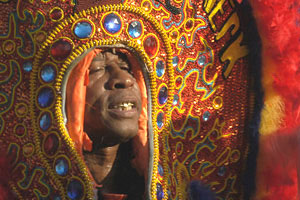

On Sunday afternoon in New Orleans’ Congo Square, Kevin Goodman, Big Chief of the Flaming Arrows, performed with fellow Mardi Gras Indians and musician Cyril Neville in a drum circle, part of a series of performances to bring healing to the city. The event was a memorial to the thousands who lost their lives in Hurricane Katrina or have died in the year since from illnesses and stresses associated with the disaster. Held on the spot where slaves once drummed and the Storyville neighborhood, leveled long ago, gave birth to jazz, the performers were joined by hundreds of the city’s residents in the grand New Orleans tradition of celebrating life while grieving loss.
Goodman’s Flaming Arrows, a tribe founded by his father, Therdot, marched the streets of New Orleans’ 7th Ward for more than 40 years. A lifelong resident of the city who worked as a house painter before the hurricane, Goodman has served as Big Chief for 16 years and had never missed a Mardi Gras. But a year after the storm breached the levees and flooded his neighborhood with 6 feet of water, Goodman, 46, is still living in Austin, Texas, where he was evacuated with literally nothing but the clothes on his back after surviving for days in harrowing conditions.
With people like Goodman gone, New Orleans’ unique culture remains at risk. Many of the neighborhoods that nurtured its wild creativity lie in ruin, their artists and musicians flung apart by the disaster. Goodman’s story also reflects the personal devastation and displacement experienced by so many following a natural disaster and a government failure of historic proportions.
“It still makes me angry when I think of the way we suffered,” Goodman says, his usually infectious smile falling away as he recalls the desperation of the many people who waited days to be rescued.
Everyone important in his life has been scattered across a thousand miles of the South, from San Antonio to Atlanta. Like so many other New Orleanians who loved their city but lived by modest means, he finds that Katrina continues to take a toll. In recent months, two members of Goodman’s family have died and another remains in critical condition in a Dallas hospital, all from illnesses that took a turn for the worse after exposure to toxic floodwaters and the stresses of dislocation.
The New Orleans that Goodman lost was 10 or so blocks of the 7th Ward, where he grew up, centered on the corner of Frenchmen and North Rocheblave streets. Places like the 7th Ward were the soul of a city defined by its patchwork of neighborhoods. Schools and churches, corner stores and bars, and extended families that went back for generations wove a network of support and survival, and were a source of the city’s culture and creativity.
“Even though New Orleans was ragged, it was beautiful to me,” Goodman said recently over a soul food dinner of country-style steak with gravy and butter beans, in his new south Austin apartment. “I know New Orleans like the back of my hand, every Indian and every Indian suit. I loved sewing, I loved masking, I loved singing and dancing — anything that went on with a tambourine and a drumbeat, I was there.”
Goodman believes that the New Orleans he knew will never recover and that, despite their deep ties, many survivors like him will not return. “The city was always about the rich getting richer and the poor getting poorer,” he says. “They didn’t care about us. I don’t want to live in a place where if a hurricane blows through again, then the ones with the money make it out and the ones who don’t get left to drown.”
While long in coming, signs of recovery are beginning to appear in the city’s devastated neighborhoods. New Orleans has reached nearly half its pre-Katrina population, and funds from huge federal block grants are finally arriving to help with the rebuilding. Among hurricane evacuees, Goodman is fortunate to have settled well into life in a new city, finding a warm welcome in Austin and new opportunities in his career as artist and musician. He says he will always be an Indian, and he has performed more in the past year than any other. But the scars of what he has lost may never heal.
After the levees were breached last August, Goodman and his family waded through the floodwaters and used a wood door to float the small children to a nearby church. Huddled with dozens of other survivors with little food or water, they were picked up the next day by some men from the neighborhood with a boat and taken to an I-10 overpass. By then the Superdome had been closed to additional evacuees. They hiked the elevated highway in hundred-degree heat, past unforgettable scenes of suffering. When they reached the drier ground of the Morial Convention Center, more disaster awaited them. They spent four days in the heat with little food and water, no toilets and no electricity. Around them, diabetics went into insulin shock, elderly people died in their wheelchairs, and bodies lay under sheets on the sidewalk.
“I couldn’t even take the smell on me, and everything around smelled worse than I did,” Goodman recalls. “I couldn’t eat — my stomach just shut down. I felt like I was losing my mind, but I knew I wasn’t. What was going on wasn’t supposed to be.” His brother Brian’s two grandchildren, 3-month-old twin girls, nearly died in Goodman’s arms from dehydration. Several times he had to wrap the twins in his body to keep them from being crushed by the crowds, which rushed the curbs expecting rescue buses every time headlights were seen coming down the street. On Saturday, a man was shot dead by police in front of Goodman and a crowd of hundreds. (Amid the wider chaos, the circumstances of the shooting of Danny Brumfield, 45, were disputed. Witnesses claimed he obstructed a police car in the street to plea for help. A statement released by the New Orleans Police Department last October said the shooting was in self-defense.)
“The cops just kept driving like nothing had happened — that was cold-blooded,” Goodman recalls. “What scared me the most was the way they shot like that toward the crowd, with thousands of people for blocks around. That was the straw that broke it for me. I was done. I didn’t care where I was going, as long as it was out of that place.”
Goodman has been back to visit his neighborhood several times in the last year. He found mostly empty streets, gutted houses and a few FEMA trailers.
“Before the hurricane, I could walk three blocks and see most of my family — grandmother, uncles, nieces, nephews, cousins, grandbabies, all of them being raised right there,” Goodman remembers. “I could go out my front door and see my people, the people who loved me — that’s what kept us together. Without the people like that, why should I be there?”
Family, and the art and music that became so important in his life, were woven tightly together. Goodman, an accomplished vocalist, percussionist and visual artist, learned the art of Mardi Gras Indian costuming and masking from his father, who founded the Flaming Arrows in 1963 and reigned for 20 years as “Big Chief Merk.” The fabulous hand-sewn “suits” of feathers, rhinestones and beads can cost $10,000 to make, weigh more than a hundred pounds, and take up to a year to create. Traditionally, a costume can be worn only once, and making a new suit every season is an extended community effort involving family, friends and neighborhood supporters.
During Mardi Gras, tribes take to the street with drumming, singing and dancing, and they stage elaborately choreographed standoffs with other Indian gangs. “We knew that on Carnival morning everybody in the neighborhood was going to be in front of our door, because they knew we were going to have the most beautiful costumes in the world,” says Goodman. “Our grandmothers and old people in the neighborhood looked forward to seeing us on Mardi Gras day. That’s what we did it for, but none of them are there anymore.”
Separated from his family when rescue finally came, Goodman’s art and music would become his lifeline in a new city. On the morning of Sept. 3, buses finally rolled into the convention center and helicopters began airlifting evacuees. The twins were rushed to a triage unit at the New Orleans airport and treated for dehydration. Goodman’s brother and his brother’s immediate family were flown to Dallas. After being airlifted by helicopter to the airport himself, Goodman boarded a plane before being told that he was going to Austin, a city he knew nothing about. A few hours later he was at Austin’s downtown convention center. The mayor shook the evacuees’ hands as they got off the bus. Strangers hugged them. “We had all the food we could eat and could take a shower anytime we wanted,” Goodman remembers.
Camped out at the convention center while the city made housing arrangements, Goodman and other evacuees started playing music on donated instruments. Among them was Kevin Bush, an old friend from the 7th Ward. Wheelchair bound after being paralyzed 10 years ago by a stray bullet, Bush had spent days after Katrina lashed to a rafter in his attic before being rescued. Cyril Neville had relocated to Austin and came by the convention center to join some jam sessions. During the second week, Goodman organized a second-line parade and made Bush his Second Chief for the Austin incarnation of the Flaming Arrows. Later that month, he joined Neville’s new Austin-based band, Tribe 13, for a performance at Antone’s, the famous downtown blues club.
“On a scale of 1 to 10, I’d say the reception we got here was a 10-plus — that’s kinda made me want to stay,” Goodman says. “The people here really enjoy our work and our costumes and our performances. They showed me the music scene here. In a lot of ways it’s like New Orleans.”
Goodman had lost everything in his New Orleans apartment, including sewing material worth thousands of dollars and two Indian suits considered priceless, but was able to send for two other suits that survived the flood at the Backstreet Cultural Museum in New Orleans’ Treme neighborhood. He’s had a full schedule since. In December, he joined several other Mardi Gras Indians for a tour sponsored by Jazz at Lincoln Center that went to India, Sri Lanka and the United Arab Emirates. He marched as Big Chief for Austin’s New Year and Mardi Gras celebrations and appeared at the annual South by Southwest music festival. “I never missed a Mardi Gras in 45 years and I didn’t miss it this year — I just did it here in Austin,” Goodman says. “I still have the Indian spirit that carries me everywhere I go. That gets me through whatever situation I’m in. Right now my focus is on making a new life in Austin.”
Two brothers in San Antonio are his closest family. His mother, sisters and two nieces are in Atlanta and are fine. But his brother Brian, who suffered a severe cut on his leg wading through hurricane debris, contracted meningitis, apparently from exposure to the flood waters. Goodman’s 16-year-old niece, Precious, who suffers from lupus and had undergone a kidney transplant less than a year before Katrina, lost all of her medications in the flood. A few days after their evacuation, she was hospitalized with kidney problems and lapsed into a coma after having surgery to remove her transplant. Under the stress of their displacement and their daughter’s deepening illness, Brian and his wife, Tina, began having more serious health problems of their own. Tina, 54, was hospitalized in the spring for congestive heart failure and died at a nursing home outside Dallas in May. Brian had a relapse of meningitis soon afterward and died following surgery, at the age of 50, in June. Precious remains on life support at the same Dallas hospital.
“She’s more like my daughter than my niece,” says Goodman, who is seeing a counselor in Austin to deal with his losses of the past year. “Precious and I were real close. When she was a girl she masked Indian with me as my queen. She was a happy person who loved to sing and dance. She had a hard time when she got sick and was missing so much school, being away from her friends. Then the hurricane happened.”
Goodman’s 6-year-old daughter, Kavonne, lives in New Orleans’ Gentilly neighborhood with her mother and stepfather, which keeps drawing Goodman back to the city for visits. In April he performed in a Mardi Gras Indian celebration at Jazz Fest, and returned again for the Congo Square appearance. Goodman hopes that he can continue the Indian tradition in Austin — but of course, he says, it’s not the same.
Many in New Orleans have vowed not to give up its ghost. On a recent Sunday night at Les Bon Temps Roule, an uptown club on Magazine Street, the Wild Tchopitoulous and Golden Comanche Indian gangs held a benefit to raise money for making new costumes for Mardi Gras 2007. “A lot of people lost their houses and aren’t back, but they’ll come back — eventually everyone will be back,” said Roderick Childers, Big Chief of the Wild Tchopitoulous, adding that Goodman would still have his place in the Indian pantheon if he returns. “I know Kevin, and he’s my man, and a man can do what he want to do, but the tradition and culture is here. You can go anywhere and costume and play, but it’s not going to be the same.”
Like everything else in New Orleans’ recovery, fortune has lain with higher ground. Most of the uptown tribes lived in neighborhoods that had much less flooding than downtown areas like Goodman’s in the 7th Ward.
“They say you can’t be an Indian anywhere else, but for a lot of us New Orleans isn’t the same place now either,” Goodman says. “We’re all scarred from Katrina. Some people want to come back, but there’s no affordable rental property, and everything is still so tore up. So a lot of people don’t have anything to come back to but bad memories.”
He wonders what life in New Orleans would be like without the neighbors he grew up with at Frenchmen and North Rocheblave.
“I keep thinking about Mrs. Marker,” says Goodman, recalling an elderly neighbor who helped raise him. “She wasn’t my blood relation, but she was like my grandmother to me. She told me, ‘Son, don’t hang out on that street corner. Son, don’t pick up no gun.’ All those elderly ladies out there at the Convention Center were Mrs. Marker to me. We were all brought up to respect these people, and that’s who raised us and taught us right from wrong. So where are we going to be now without them?”
